
SAVE America Act: Is it now federal law after six votes? SAVE stands for the Safeguarding American Voter Eligibility Act.
In summary
The SAVE America Act, the federal bill that would require proof of citizenship through documentation to register to vote, was introduced in the Senate on April 9, 2025, as a veterans’ bill, and the House passed it as an election bill on February 11, 2026, by a vote of 218 to 213.
As of October 22, 2026, it is still not law: the White House stated that if that bill were to reach the president as is, his advisors would recommend that he sign it; the Senate held six votes in March, none of which were on the full text; the House reintroduced the same text in July as part of the defense authorization bill; and the Senate is in recess until November 9.
Voting as a foreign national in a federal election has been a crime for decades, with two narrow exceptions defined by the law itself. This is relevant for anyone following the federal legislative process on electoral integrity and for anyone who wants to distinguish between what is already law and what is still a bill. Florida’s law on the same subject, HB 991—which has already been signed into law and is currently the subject of a lawsuit—is covered in a separate article by this publication.
Simply put: The SAVE America Act requires voters to present a document proving citizenship in order to register to vote. Its sponsors present it as a measure to protect the integrity of federal elections by preventing non-citizens from being registered on the voter rolls.

The bill that would require voters to prove their citizenship with a document in order to register to vote has been before Congress for eighteen months—first as a veterans’ bill and, for the past eight months, as an electoral bill. It passed the House by a margin of five votes; the White House stated in writing that its advisors would recommend signing it if it were submitted; and as of October 20, 2026, according to its official record of actions, it remains a bill rather than a law. Meanwhile, Florida already has its own: HB 991, signed on April 1, 2026, with three consolidated federal lawsuits and a fourth filed. That state law is the subject of this publication’s companion article, and is only mentioned here.
Before continuing, here is a fact that is already law and does not depend on this bill: voting in a federal election—for president, vice president, presidential elector, senator, representative, D.C. delegate, or resident commissioner—as a foreign national has been a federal crime for decades, with two narrow exceptions: elections that also serve another purpose, where non-citizen voting is authorized and the vote is cast separately; and anyone who meets all three conditions established by law for those who believed themselves to be citizens.
It is not enough to believe that you are a citizen; you must prove it: that your parents, or your adoptive parents, were or had been citizens; that you resided permanently in the United States before turning 16; and that, when you voted, you reasonably believed you were a citizen. Verbatim text of the law: “each natural parent of the alien… is or was a citizen…; the alien permanently resided in the United States prior to attaining the age of 16; and the alien reasonably believed at the time of voting… that he or she was a citizen of the United States.”
Purely local elections—in which some cities allow non-citizen residents to vote, such as Takoma Park, Maryland, and the San Francisco School Board, as documented in this publication’s companion article on the Florida law—are not governed by that statute or this bill. This publication reviewed the current text, 18 U.S.C. § 611, on GovInfo.gov.
See the official version at govinfo.gov
18 U.S.C. § 611, Voting by Foreign Nationals, 2024 bound edition of the U.S. Code, with the three cumulative conditions of the exception in subsection (c). Source 3.
On February 11, 2026, the House of Representatives passed, by a vote of 218 to 213, an amendment that completely replaced the text of a bill introduced by Senator Rick Scott of Florida. Where it previously read “veterans advisory committee,” it now read “SAVE America Act”— the law that would require every person to provide documentary proof of citizenship to register to vote in federal elections. That same day, the White House Office of Management and Budget wrote that, if the bill reached the president’s desk as is, his advisors would recommend that he sign it.
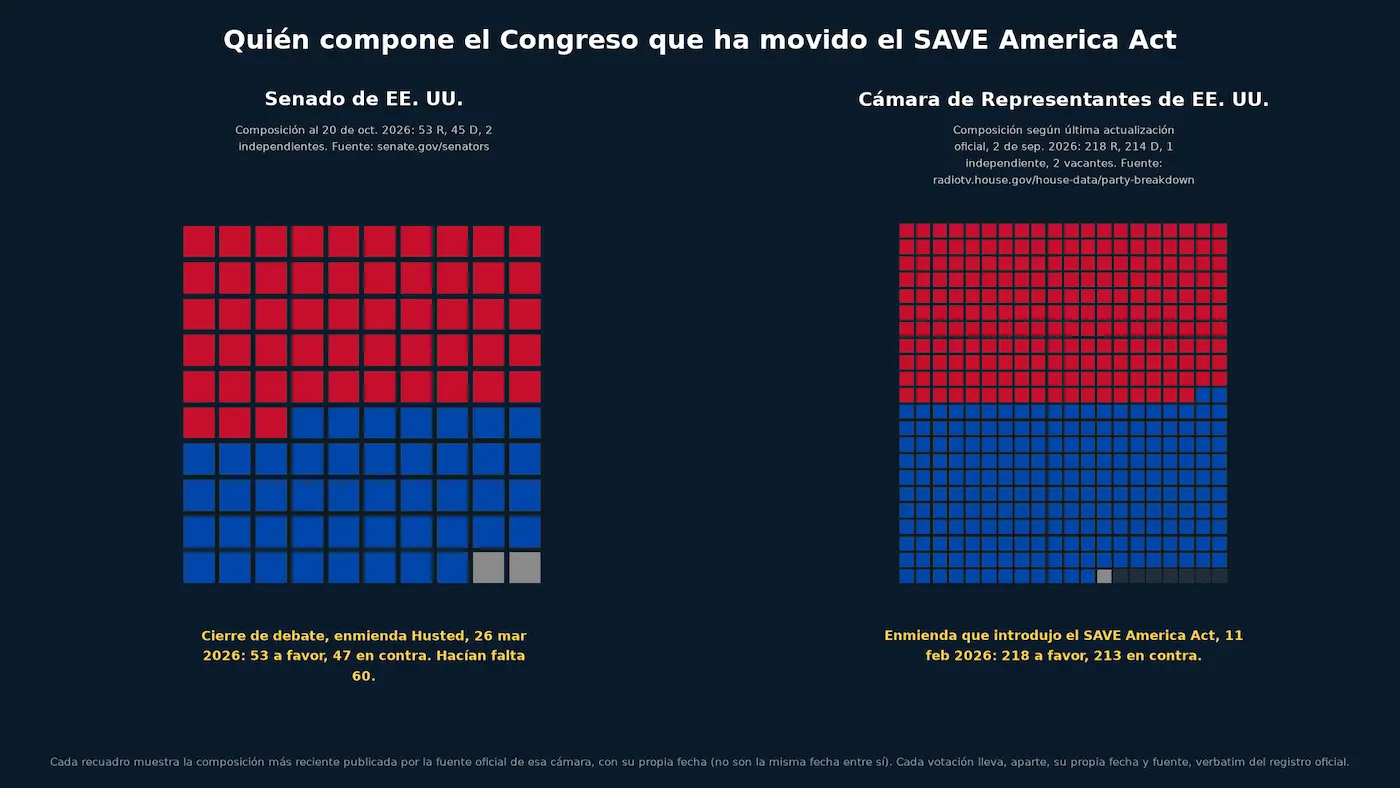
Chart created by News Miami Dade. The boxes show the most recent composition published by the official source for each chamber: the Senate’s, as of October 20, 2026 (senate.gov/senators); that of the House of Representatives, according to its latest official update, dated September 2, 2026 (radiotv.house.gov/house-data/party-breakdown, which had not been updated again as of that date). Neither of these necessarily reflects the composition on the day of each vote: the House vote on February 11, 2026 (218 in favor, 213 against) and the Senate vote on March 26 (53 in favor, 47 against) have been verified separately against the official record of each chamber, as cited earlier in this article.
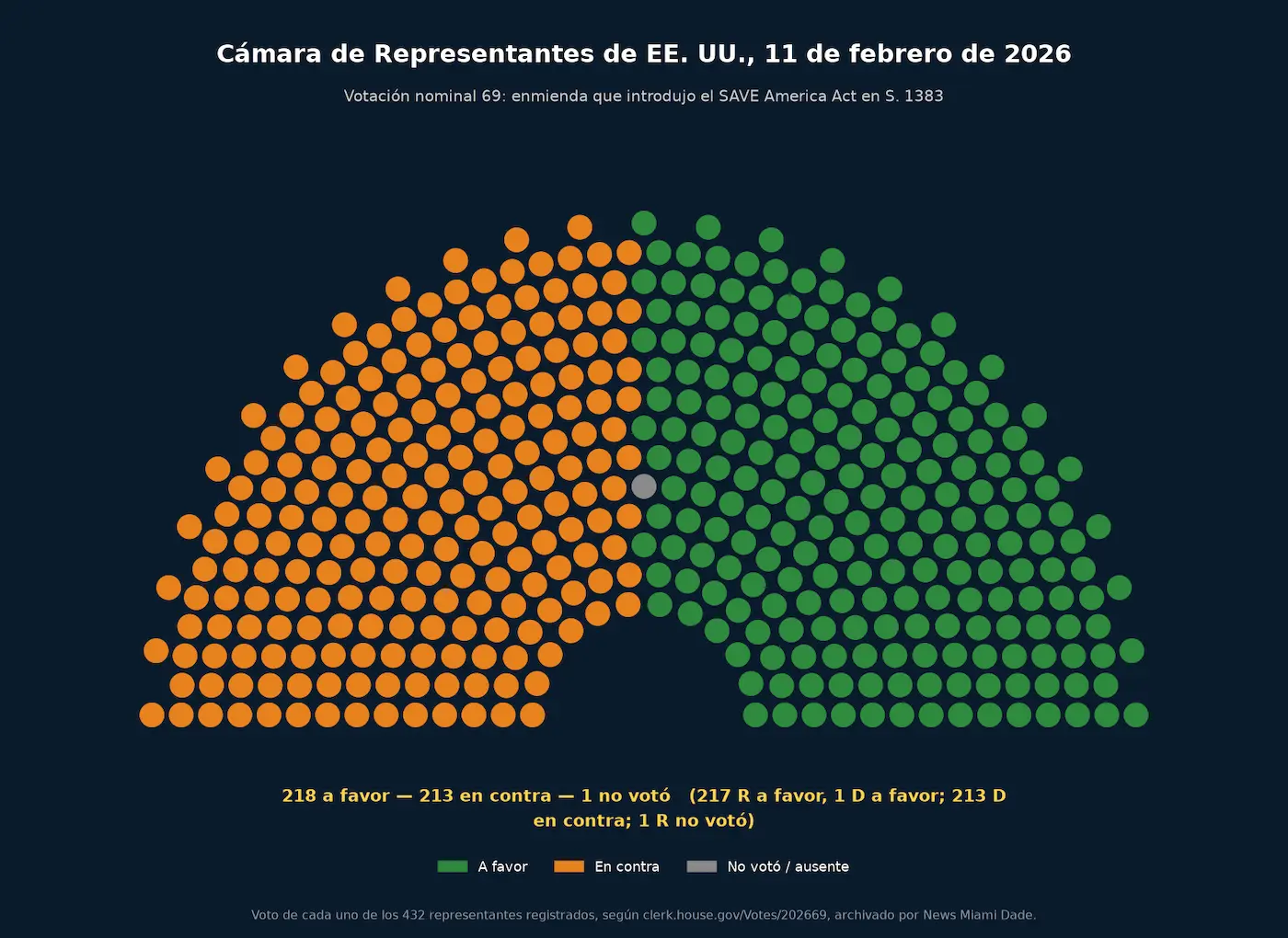
The chamber of the U.S. House of Representatives, showing the vote of each of the 432 representatives recorded in roll call vote No. 69: votes in favor are shown in green; votes against are shown in orange.
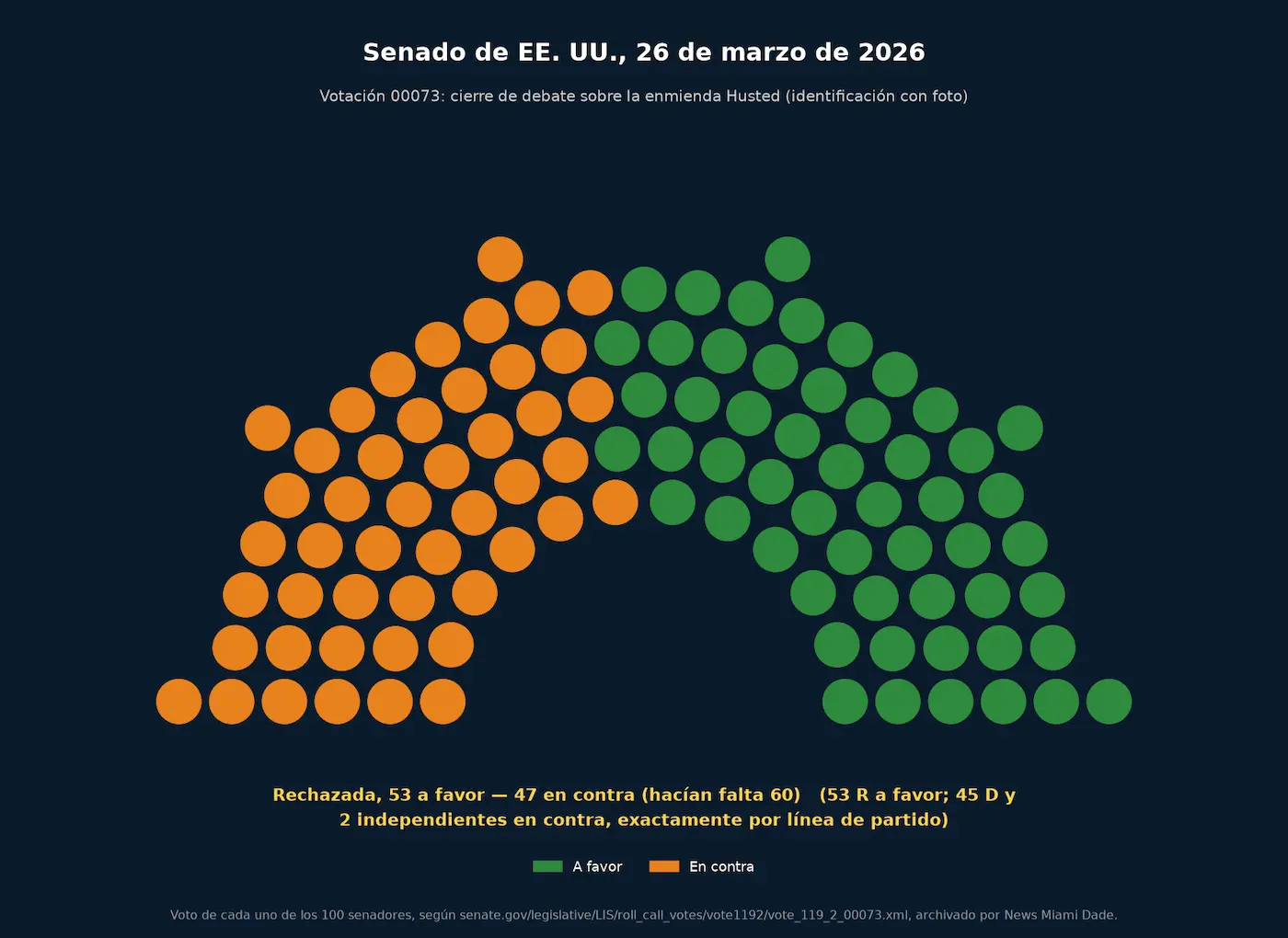
Chart created by News Miami-Dade, showing the vote of each of the 432 registered representatives in roll call vote No. 69, one by one, according to the official record of the Office of the House Secretary (clerk.house.gov/Votes/202669), filed on September 27, 2026. Green: in favor. Orange: against. Gray: did not vote. The block on the left represents the Democrats, and the one on the right represents the Republicans; the two colored dots, one on each side, mark the boundary between the two blocks.
Eight months later, on October 20, 2026, it has not reached the president’s desk as S. 1383. In the Senate, where 60 votes are needed to close debate, the bill went through six votes in March—all on procedural motions and specific amendments, and none on the full text; the highest vote to close debate was 53. That did not conclude the process: in July, the House reintroduced the same text through another channel, which is described below.
What happened?
Senator Rick Scott introduced S. 1383 on April 9, 2025. Its title at that time was the Veterans Accessibility Advisory Committee Act of 2025, and its stated purpose, according to the official text, was “to establish the Veterans Accessibility Advisory Committee.” The Committee on Veterans’ Affairs recommended its passage, with a substitute text, on July 30, 2025, and the Senate approved it by unanimous consent on December 18, 2025, still as a veterans’ bill.
What happened next is common practice in Congress and has a name: a legislative vehicle. A bill that has already passed one stage of the legislative process is emptied and refilled with a different text, to skip the process from the beginning. On February 11, 2026, the House approved an amendment in the form of a substitute bill— roll call vote No. 69—and with it, the SAVE America Act was incorporated into S. 1383. The Senate’s own summary, in the daily report of March 26, 2026, refers to S. 1383 as “the legislative vehicle for the SAVE Act”: this is not my interpretation; it is how the Senate describes it.
On February 11, the Office of Management and Budget issued its Administration Policy Statement. It reads, verbatim: “The Administration strongly supports passage of the House Amendment to S. 1383, the Safeguard American Voter Eligibility (SAVE America) Act.” And it concludes with a sentence that should be read slowly, because it is conditional: “If the House Amendment to S. 1383 were presented to the President in its current form, his advisors would recommend that he sign it into law.” If it were presented to him . It had not been.
View the original at whitehouse.gov
Administration Policy Statement on the House Amendment to S. 1383, Office of Management and Budget, February 11, 2026. Source 1.
On March 17, 2026 , Senate Majority Leader John Thune introduced a motion to concur with the House amendment, along with his own amendment—a substitute amendment, No. 4420. The Journal of Proceedings for that day—viewed online on September 23 and 26, 2026, and reviewed page by page in its official PDF on the latter date—records the proceedings and the debate.
Thune opened the proceedings and introduced the motions and his amendments (pages S1066 and S1067). Among those who spoke in favor of the bill were Senators Marshall, Blackburn, Cruz, Scott, Daines, and Schmitt; among those who spoke against it were Minority Leader Charles Schumer (page S1066) and Senators Murray, Klobuchar, Kim, Warner, Padilla, Welch, Blumenthal, and Merkley. The debate from that day is recorded on pages S1066 through S1088.
That same afternoon, March 17, 2026, the Senate voted on the motion to proceed: vote 00057; the exact wording from the official record was “Motion to Proceed Agreed to (51-48).”
U.S. Senate — Vote No. 57, March 17, 2026.
Subject: Motion to proceed to consideration of the House message on S. 1383. This was a procedural vote, not the final passage of the SAVE America Act.
According to the XML file you shared, the motion was approved: 51 in favor, 48 against, and one abstention.
R: Republican · D: Democrat · I: Independent. The other two letters identify the state.
| In favor — 51 | Against — 48 |
|---|---|
| Jim Banks (R–IN) | Angela Alsobrooks (D–MD) |
| John Barrasso (R–WY) | Tammy Baldwin (D–WI) |
| Marsha Blackburn (R–TN) | Michael Bennet (D–CO) |
| John Boozman (R–AR) | Richard Blumenthal (D–CT) |
| Katie Britt (R–AL) | Lisa Blunt Rochester (D–DE) |
| Ted Budd (R–NC) | Cory Booker (D–NJ) |
| Shelley Capito (R–WV) | Maria Cantwell (D–WA) |
| Bill Cassidy (R–LA) | Christopher Coons (D–DE) |
| Susan Collins (R–ME) | Catherine Cortez Masto (D–NV) |
| John Cornyn (R–TX) | Tammy Duckworth (D–IL) |
| Tom Cotton (R–AR) | Richard Durbin (D–IL) |
| Kevin Cramer (R–ND) | John Fetterman (D–PA) |
| Mike Crapo (R–ID) | Ruben Gallego (D–AZ) |
| Ted Cruz (R–TX) | Kirsten Gillibrand (D–NY) |
| John Curtis (R–UT) | Maggie Hassan (D–NH) |
| Steve Daines (R–MT) | Martin Heinrich (D–NM) |
| Joni Ernst (R–IA) | John Hickenlooper (D–CO) |
| Deb Fischer (R–NE) | Mazie Hirono (D–HI) |
| Lindsey Graham (R–SC) | Timothy Kaine (D–VA) |
| Chuck Grassley (R–IA) | Mark Kelly (D–AZ) |
| Bill Hagerty (R–TN) | Andy Kim (D–NJ) |
| Josh Hawley (R–MO) | Angus King (I–ME) |
| John Hoeven (R–ND) | Amy Klobuchar (D–MN) |
| Jon Husted (R–OH) | Ben Lujan (D–NM) |
| Cindy Hyde-Smith (R–MS) | Edward Markey (D–MA) |
| Ron Johnson (R–WI) | Jeff Merkley (D–OR) |
| James Justice (R–WV) | Lisa Murkowski (R–AK) |
| John Kennedy (R–LA) | Christopher Murphy (D–CT) |
| James Lankford (R–OK) | Patty Murray (D–WA) |
| Mike Lee (R–UT) | Jon Ossoff (D–GA) |
| Cynthia Lummis (R–WY) | Alex Padilla (D–CA) |
| Roger Marshall (R–KS) | Gary Peters (D–MI) |
| Mitch McConnell (R–KY) | John Reed (D–RI) |
| David McCormick (R–PA) | Jacky Rosen (D–NV) |
| Ashley Moody (R–FL) | Bernie Sanders (I–VT) |
| Jerry Moran (R–KS) | Brian Schatz (D–HI) |
| Bernie Moreno (R–OH) | Adam Schiff (D–CA) |
| Markwayne Mullin (R–OK) | Charles Schumer (D–NY) |
| Rand Paul (R–KY) | Jeanne Shaheen (D–NH) |
| Pete Ricketts (R–NE) | Elissa Slotkin (D–MI) |
| James Risch (R–ID) | Tina Smith (D–MN) |
| Mike Rounds (R–SD) | Chris Van Hollen (D–MD) |
| Eric Schmitt (R–MO) | Mark Warner (D–VA) |
| Rick Scott (R–FL) | Raphael Warnock (D–GA) |
| Tim Scott (R–SC) | Elizabeth Warren (D–MA) |
| Tim Sheehy (R–MT) | Peter Welch (D–VT) |
| Dan Sullivan (R–AK) | Sheldon Whitehouse (D–RI) |
| John Thune (R–SD) | Ron Wyden (D–OR) |
| Tommy Tuberville (R–AL) | — |
| Roger Wicker (R–MS) | — |
| Todd Young (R–IN) | — |
Did not vote: Thomas Tillis, a Republican from North Carolina.
| Match | In favor | Against | Without voting |
|---|---|---|---|
| Republican | 51 | 1 | 1 |
| Democrat | 0 | 45 | 0 |
| Independent | 0 | 2 | 0 |
| Total | 51 | 48 | 1 |
Florida: Ashley Moody and Rick Scott voted in favor. Lisa Murkowski was the only Republican to vote against it.
The five votes that followed, taken verbatim from the Senate’s official record and the daily report. The bill did not come to a standstill after March 17: it returned to the floor five more times over the course of nine days. Two votes to close debate on Republican amendments, which the Republican side lost (00060 and 00073), and three votes regarding the House message, which the Republican majority won (00061, 00067, and 00068). Vote 00061 was also a motion to close debate, on a motion by Schumer related, according to the record itself, to funding the TSA; votes 00067 and 00068 were motions to table.
Saturday, March 21, 2026, Vote 00060: Closure of debate on Amendment 4421, introduced by Senators Tuberville and Blackburn, regarding the participation of women and girls in sports, submitted as part of the proceedings on S. 1383. Verbatim result: “Cloture Motion Rejected (49-41, 3/5 majority required).”
The Senate’s daily report for that day records it as follows: “By a party-line vote of 49-41, the Senate did not agree to the motion to invoke cloture on the Tuberville-Blackburn amendment No. 4421 regarding the House Message accompanying S. 1383, the SAVE America Act.” Along party lines.
U.S. Senate — Vote No. 60, March 21, 2026, at 1:03 p.m.
Subject: Closure of the debate on Tuberville Amendment 4421, regarding women and girls in sports, as part of the consideration of S. 1383. This was not the final vote on the SAVE America Act.
Result: 49 in favor, 41 against, and 10 abstentions. The motion to close the debate was rejected because it required 60 votes.
R: Republican · D: Democrat · I: Independent. The other two letters identify the state.
| In favor — 49 | Against — 41 |
|---|---|
| Jim Banks (R–IN) | Angela Alsobrooks (D–MD) |
| John Barrasso (R–WY) | Tammy Baldwin (D–WI) |
| Marsha Blackburn (R–TN) | Michael Bennet (D–CO) |
| John Boozman (R–AR) | Richard Blumenthal (D–CT) |
| Katie Britt (R–AL) | Lisa Blunt Rochester (D–DE) |
| Ted Budd (R–NC) | Cory Booker (D–NJ) |
| Shelley Capito (R–WV) | Maria Cantwell (D–WA) |
| Bill Cassidy (R–LA) | Catherine Cortez Masto (D–NV) |
| Susan Collins (R–ME) | Tammy Duckworth (D–IL) |
| John Cornyn (R–TX) | Ruben Gallego (D–AZ) |
| Tom Cotton (R–AR) | Kirsten Gillibrand (D–NY) |
| Kevin Cramer (R–ND) | Maggie Hassan (D–NH) |
| Mike Crapo (R–ID) | Martin Heinrich (D–NM) |
| Ted Cruz (R–TX) | John Hickenlooper (D–CO) |
| Joni Ernst (R–IA) | Mazie Hirono (D–HI) |
| Deb Fischer (R–NE) | Andy Kim (D–NJ) |
| Lindsey Graham (R–SC) | Angus King (I–ME) |
| Chuck Grassley (R–IA) | Amy Klobuchar (D–MN) |
| Bill Hagerty (R–TN) | Ben Lujan (D–NM) |
| Josh Hawley (R–MO) | Edward Markey (D–MA) |
| John Hoeven (R–ND) | Jeff Merkley (D–OR) |
| Jon Husted (R–OH) | Christopher Murphy (D–CT) |
| Cindy Hyde-Smith (R–MS) | Patty Murray (D–WA) |
| Ron Johnson (R–WI) | Jon Ossoff (D–GA) |
| James Justice (R–WV) | Alex Padilla (D–CA) |
| John Kennedy (R–LA) | Gary Peters (D–MI) |
| James Lankford (R–OK) | John Reed (D–RI) |
| Mike Lee (R–UT) | Jacky Rosen (D–NV) |
| Cynthia Lummis (R–WY) | Bernie Sanders (I–VT) |
| Roger Marshall (R–KS) | Brian Schatz (D–HI) |
| Mitch McConnell (R–KY) | Adam Schiff (D–CA) |
| David McCormick (R–PA) | Charles Schumer (D–NY) |
| Ashley Moody (R–FL) | Elissa Slotkin (D–MI) |
| Jerry Moran (R–KS) | Tina Smith (D–MN) |
| Bernie Moreno (R–OH) | Chris Van Hollen (D–MD) |
| Markwayne Mullin (R–OK) | Mark Warner (D–VA) |
| Lisa Murkowski (R–AK) | Raphael Warnock (D–GA) |
| Pete Ricketts (R–NE) | Elizabeth Warren (D–MA) |
| James Risch (R–ID) | Peter Welch (D–VT) |
| Mike Rounds (R–SD) | Sheldon Whitehouse (D–RI) |
| Eric Schmitt (R–MO) | Ron Wyden (D–OR) |
| Rick Scott (R–FL) | — |
| Tim Scott (R–SC) | — |
| Dan Sullivan (R–AK) | — |
| John Thune (R–SD) | — |
| Thomas Tillis (R–NC) | — |
| Tommy Tuberville (R–AL) | — |
| Roger Wicker (R–MS) | — |
| Todd Young (R–IN) | — |
Did not vote:
| Senator | Match | Status |
|---|---|---|
| Christopher Coons | Democrat | Delaware |
| John Curtis | Republican | Utah |
| Steve Daines | Republican | Montana |
| Richard Durbin | Democrat | Illinois |
| John Fetterman | Democrat | Pennsylvania |
| Timothy Kaine | Democrat | Virginia |
| Mark Kelly | Democrat | Arizona |
| Rand Paul | Republican | Kentucky |
| Jeanne Shaheen | Democrat | New Hampshire |
| Tim Sheehy | Republican | Montana |
| Match | In favor | Against | Without voting |
|---|---|---|---|
| Republican | 49 | 0 | 4 |
| Democrat | 0 | 39 | 6 |
| Independent | 0 | 2 | 0 |
| Total | 49 | 41 | 10 |
Florida: Ashley Moody and Rick Scott voted in favor of closing the debate.
Source: XML
That same Saturday, at 2:01 p.m., Vote No. 00061: cloture on a motion by Minority Leader Charles Schumer to suspend a Senate rule and allow the Committee on Rules and Administration to consider a proposal regarding the House message to fund the TSA. Verbatim title from the record: “Motion to Invoke Cloture: Schumer Motion to Suspend the Rules re: TSA Funding.” Verbatim result: “Cloture Motion Rejected (41-49, 3/5 majority required).” The daily record for that day states: “By a party-line vote of 41–49, the Senate did not invoke cloture on the motion to suspend, ” and notes that ten senators did not vote.
U.S. Senate — Vote No. 61, March 21, 2026, at 2:01 p.m.
Subject: Closure of the debate on Schumer’s motion to suspend the rules regarding TSA funding. This was not a final vote on the SAVE America Act.
Result: 41 in favor, 49 against, and 10 abstentions. The motion to close the debate was rejected because it required 60 votes.
R: Republican · D: Democrat · I: Independent. The other two letters identify the state.
| In favor — 41 | Against — 49 |
|---|---|
| Angela Alsobrooks (D–MD) | Jim Banks (R–IN) |
| Tammy Baldwin (D–WI) | John Barrasso (R–WY) |
| Michael Bennet (D–CO) | Marsha Blackburn (R–TN) |
| Richard Blumenthal (D–CT) | John Boozman (R–AR) |
| Lisa Blunt Rochester (D–DE) | Katie Britt (R–AL) |
| Cory Booker (D–NJ) | Ted Budd (R–NC) |
| Maria Cantwell (D–WA) | Shelley Capito (R–WV) |
| Catherine Cortez Masto (D–NV) | Bill Cassidy (R–LA) |
| Tammy Duckworth (D–IL) | Susan Collins (R–ME) |
| Ruben Gallego (D–AZ) | John Cornyn (R–TX) |
| Kirsten Gillibrand (D–NY) | Tom Cotton (R–AR) |
| Maggie Hassan (D–NH) | Kevin Cramer (R–ND) |
| Martin Heinrich (D–NM) | Mike Crapo (R–ID) |
| John Hickenlooper (D–CO) | Ted Cruz (R–TX) |
| Mazie Hirono (D–HI) | Joni Ernst (R–IA) |
| Andy Kim (D–NJ) | Deb Fischer (R–NE) |
| Angus King (I–ME) | Lindsey Graham (R–SC) |
| Amy Klobuchar (D–MN) | Chuck Grassley (R–IA) |
| Ben Lujan (D–NM) | Bill Hagerty (R–TN) |
| Edward Markey (D–MA) | Josh Hawley (R–MO) |
| Jeff Merkley (D–OR) | John Hoeven (R–ND) |
| Christopher Murphy (D–CT) | Jon Husted (R–OH) |
| Patty Murray (D–WA) | Cindy Hyde-Smith (R–MS) |
| Jon Ossoff (D–GA) | Ron Johnson (R–WI) |
| Alex Padilla (D–CA) | James Justice (R–WV) |
| Gary Peters (D–MI) | John Kennedy (R–LA) |
| John Reed (D–RI) | James Lankford (R–OK) |
| Jacky Rosen (D–NV) | Mike Lee (R–UT) |
| Bernie Sanders (I–VT) | Cynthia Lummis (R–WY) |
| Brian Schatz (D–HI) | Roger Marshall (R–KS) |
| Adam Schiff (D–CA) | Mitch McConnell (R–KY) |
| Charles Schumer (D–NY) | David McCormick (R–PA) |
| Elissa Slotkin (D–MI) | Ashley Moody (R–FL) |
| Tina Smith (D–MN) | Jerry Moran (R–KS) |
| Chris Van Hollen (D–MD) | Bernie Moreno (R–OH) |
| Mark Warner (D–VA) | Markwayne Mullin (R–OK) |
| Raphael Warnock (D–GA) | Lisa Murkowski (R–AK) |
| Elizabeth Warren (D–MA) | Pete Ricketts (R–NE) |
| Peter Welch (D–VT) | James Risch (R–ID) |
| Sheldon Whitehouse (D–RI) | Mike Rounds (R–SD) |
| Ron Wyden (D–OR) | Eric Schmitt (R–MO) |
| — | Rick Scott (R–FL) |
| — | Tim Scott (R–SC) |
| — | Dan Sullivan (R–AK) |
| — | John Thune (R–SD) |
| — | Thomas Tillis (R–NC) |
| — | Tommy Tuberville (R–AL) |
| — | Roger Wicker (R–MS) |
| — | Todd Young (R–IN) |
Did not vote:
| Senator | Match | Status |
|---|---|---|
| Christopher Coons | Democrat | Delaware |
| John Curtis | Republican | Utah |
| Steve Daines | Republican | Montana |
| Richard Durbin | Democrat | Illinois |
| John Fetterman | Democrat | Pennsylvania |
| Timothy Kaine | Democrat | Virginia |
| Mark Kelly | Democrat | Arizona |
| Rand Paul | Republican | Kentucky |
| Jeanne Shaheen | Democrat | New Hampshire |
| Tim Sheehy | Republican | Montana |
| Match | In favor | Against | Without voting |
|---|---|---|---|
| Republican | 0 | 49 | 4 |
| Democrat | 39 | 0 | 6 |
| Independent | 2 | 0 | 0 |
| Total | 41 | 49 | 10 |
Florida: Ashley Moody and Rick Scott voted against this motion to close the debate.
Source: XML
Tuesday, March 24, 2026, at 4:19 p.m., Vote No. 00067: Motion to table—to dismiss without further action—against another motion by Schumer to suspend Rule XXV. Verbatim title: “Motion to table Schumer’s motion to suspend Rule XXV.” Verbatim result: “Motion to Table Agreed to (53-47).”
U.S. Senate — Vote No. 67, March 24, 2026, at 4:19 p.m.
Subject: Motion to dismiss Schumer’s proposal to suspend Rule XXV. Voting in favor meant supporting the dismissal of that proposal; it was not the final approval of the SAVE America Act.
Result: Passed by a vote of 53 in favor and 47 against. All senators voted.
R: Republican · D: Democrat · I: Independent. The other two letters identify the state.
| In favor — 53 | Against — 47 |
|---|---|
| Alan Armstrong (R–OK) | Angela Alsobrooks (D–MD) |
| Jim Banks (R–IN) | Tammy Baldwin (D–WI) |
| John Barrasso (R–WY) | Michael Bennet (D–CO) |
| Marsha Blackburn (R–TN) | Richard Blumenthal (D–CT) |
| John Boozman (R–AR) | Lisa Blunt Rochester (D–DE) |
| Katie Britt (R–AL) | Cory Booker (D–NJ) |
| Ted Budd (R–NC) | Maria Cantwell (D–WA) |
| Shelley Capito (R–WV) | Christopher Coons (D–DE) |
| Bill Cassidy (R–LA) | Catherine Cortez Masto (D–NV) |
| Susan Collins (R–ME) | Tammy Duckworth (D–IL) |
| John Cornyn (R–TX) | Richard Durbin (D–IL) |
| Tom Cotton (R–AR) | John Fetterman (D–PA) |
| Kevin Cramer (R–ND) | Ruben Gallego (D–AZ) |
| Mike Crapo (R–ID) | Kirsten Gillibrand (D–NY) |
| Ted Cruz (R–TX) | Maggie Hassan (D–NH) |
| John Curtis (R–UT) | Martin Heinrich (D–NM) |
| Steve Daines (R–MT) | John Hickenlooper (D–CO) |
| Joni Ernst (R–IA) | Mazie Hirono (D–HI) |
| Deb Fischer (R–NE) | Timothy Kaine (D–VA) |
| Lindsey Graham (R–SC) | Mark Kelly (D–AZ) |
| Chuck Grassley (R–IA) | Andy Kim (D–NJ) |
| Bill Hagerty (R–TN) | Angus King (I–ME) |
| Josh Hawley (R–MO) | Amy Klobuchar (D–MN) |
| John Hoeven (R–ND) | Ben Lujan (D–NM) |
| Jon Husted (R–OH) | Edward Markey (D–MA) |
| Cindy Hyde-Smith (R–MS) | Jeff Merkley (D–OR) |
| Ron Johnson (R–WI) | Christopher Murphy (D–CT) |
| James Justice (R–WV) | Patty Murray (D–WA) |
| John Kennedy (R–LA) | Jon Ossoff (D–GA) |
| James Lankford (R–OK) | Alex Padilla (D–CA) |
| Mike Lee (R–UT) | Gary Peters (D–MI) |
| Cynthia Lummis (R–WY) | John Reed (D–RI) |
| Roger Marshall (R–KS) | Jacky Rosen (D–NV) |
| Mitch McConnell (R–KY) | Bernie Sanders (I–VT) |
| David McCormick (R–PA) | Brian Schatz (D–HI) |
| Ashley Moody (R–FL) | Adam Schiff (D–CA) |
| Jerry Moran (R–KS) | Charles Schumer (D–NY) |
| Bernie Moreno (R–OH) | Jeanne Shaheen (D–NH) |
| Lisa Murkowski (R–AK) | Elissa Slotkin (D–MI) |
| Rand Paul (R–KY) | Tina Smith (D–MN) |
| Pete Ricketts (R–NE) | Chris Van Hollen (D–MD) |
| James Risch (R–ID) | Mark Warner (D–VA) |
| Mike Rounds (R–SD) | Raphael Warnock (D–GA) |
| Eric Schmitt (R–MO) | Elizabeth Warren (D–MA) |
| Rick Scott (R–FL) | Peter Welch (D–VT) |
| Tim Scott (R–SC) | Sheldon Whitehouse (D–RI) |
| Tim Sheehy (R–MT) | Ron Wyden (D–OR) |
| Dan Sullivan (R–AK) | — |
| John Thune (R–SD) | — |
| Thomas Tillis (R–NC) | — |
| Tommy Tuberville (R–AL) | — |
| Roger Wicker (R–MS) | — |
| Todd Young (R–IN) | — |
| Match | In favor | Against | Without voting |
|---|---|---|---|
| Republican | 53 | 0 | 0 |
| Democrat | 0 | 45 | 0 |
| Independent | 0 | 2 | 0 |
| Total | 53 | 47 | 0 |
Florida: Ashley Moody and Rick Scott voted to reject Schumer’s proposal.
That same Tuesday , March 24, 2026, at 5:00 p.m., vote 00068: another motion to table, this time against the proposal to refer the House message to the Committee on Rules and Administration with instructions. Exact title of the archived record: “Motion to table the motion to refer the House message accompanying S. 1383 to the Committee on Rules and Administration with instructions.” Exact result: “Motion to Table Agreed to (53-47).” The record does not indicate who introduced the motion to refer; the only motion of that nature recorded in the archived section of the Journal of Proceedings for March 17 (pages S1066 through S1088) was introduced by Thune (page S1067).
U.S. Senate — Vote No. 68, March 24, 2026, at 5:00 p.m.
Purpose: To reject the motion to refer the House’s message on S. 1383 to the Committee on Rules and Administration, with instructions. Voting in favor meant supporting the rejection of that referral; it did not constitute final approval of the SAVE America Act.
Result: Approved by a vote of 53 in favor and 47 against, with no absences.
| Match | In favor | Against | Without voting |
|---|---|---|---|
| Republican | 53 | 0 | 0 |
| Democrat | 0 | 45 | 0 |
| Independent | 0 | 2 | 0 |
| Total | 53 | 47 | 0 |
All 100 senators voted exactly the same way as in vote 67 in the table above. None of the column names have changed.
Florida: Ashley Moody and Rick Scott voted in favor of rejecting the referral to committee.
Source: The XML file you shared.
Thursday, March 26, 2026, Vote 00073: Closure of debate on Amendment 4732, introduced by Senator Husted, which would require voters to present photo identification. The archived record describes it as follows: “On the Cloture Motion S.Amdt. 4732 to S.Amdt. 4420 to S. 1383…”. Verbatim result: “Cloture Motion Rejected (53-47, 3/5 majority required).” The Senate’s daily report from that same day states: “By a vote of 53-47, the Senate did not agree to the motion to invoke cloture on the Husted amendment #4732 in relation to the House message accompanying S. 1383, the SAVE America Act.”
The 53 votes were to close debate on an amendment, not on the bill itself. In vote 00073, 53 senators voted in favor of closing debate on the Husted amendment—the photo ID amendment—and 47 voted against it: 53 Republicans in favor; 45 Democrats and 2 independents against, exactly along party lines. That is a majority, and yet it was not enough, because ending debate requires a three-fifths majority—60 votes out of 100. The photo ID amendment fell seven votes short.
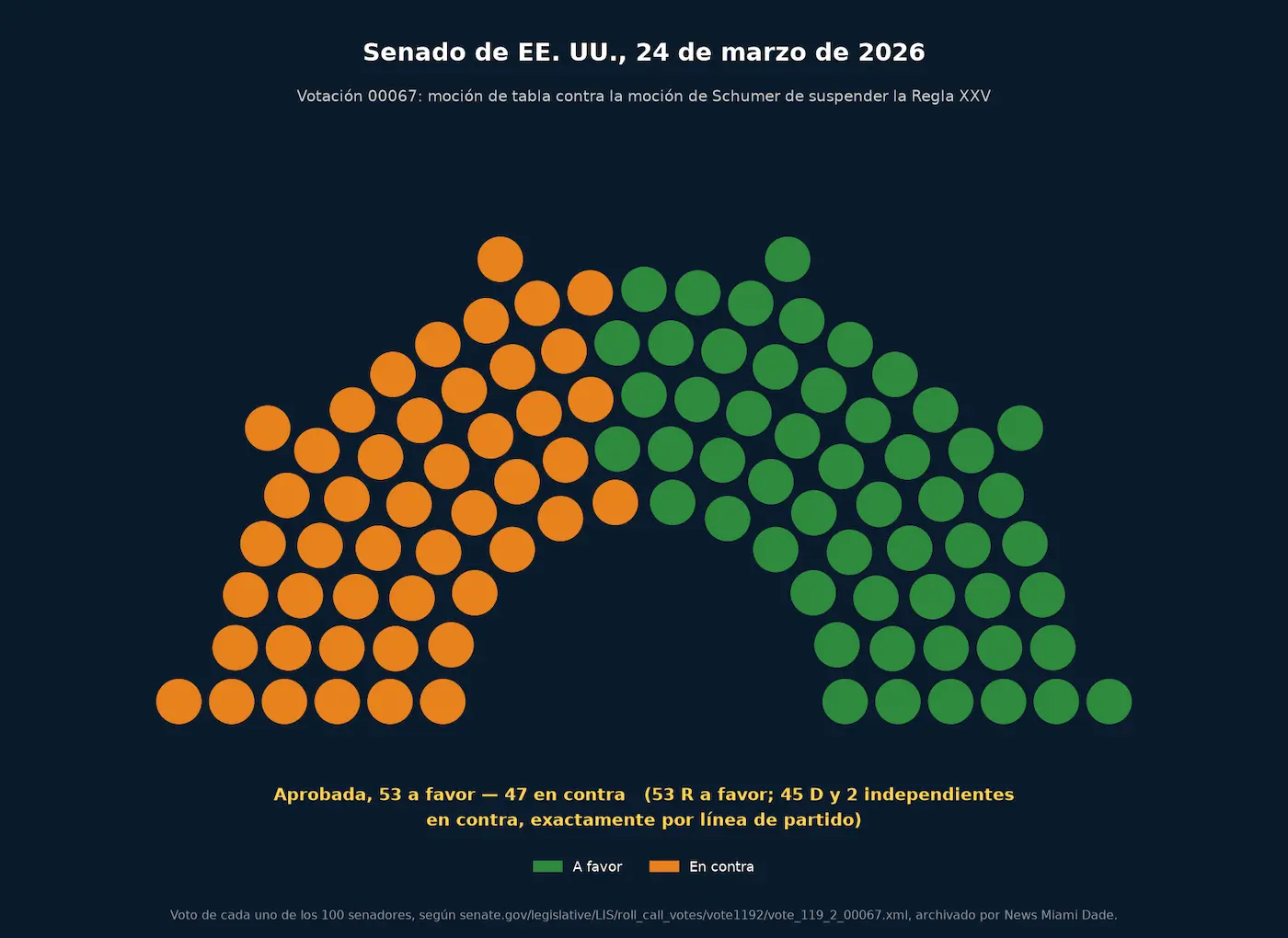
Chart created by News Miami Dade, showing the vote of each of the 100 senators, one by one, according to the official voting record 00073 (senate.gov/legislative/LIS/roll_call_votes/vote1192/vote_119_2_00073.xml), on file with this publication. Green: in favor of closing debate. Orange: against. No cross-markings: the 53 Republicans voted in favor, and the 45 Democrats plus the 2 independents voted against, strictly along party lines.
Of the six votes on S. 1383 that this publication tracked, none was a motion to end debate on the motion to concur with the full text of the SAVE America Act: Of the three votes to end debate, two were on Republican amendments and the third on a Democratic motion, while the other three were procedural motions.
To say that “the Senate rejected” the SAVE America Act is just as inaccurate as saying that “the Senate passed it”: neither statement describes what actually happened, which is that the Senate never actually voted to end debate on the full text, and that in the highest-level vote to end debate—on an amendment—a majority of 53 was not enough.
What happened next, in roll-call votes. The Senate’s official roll-call vote record for this session, filed by this publication on September 26, 2026, and again on October 20, when it reached vote No. 00256 on September 30, does not record any vote on S. 1383 after vote No. 00073 on March 26. Anything not put to a roll call vote does not appear in that index.
That information is in the project’s own official log of actions, which this media outlet archived on September 28, 2026, and downloaded again on October 20—identical byte for byte; Congress.gov returned a 403 error on September 23 and 26, and again on October 20. Its last action is dated March 26, 2026, verbatim: “Considered by the Senate (Message from the House considered). (consideration: CR S1647).” It does not record any subsequent actions or any public law numbers in its last update, dated August 20, 2026.
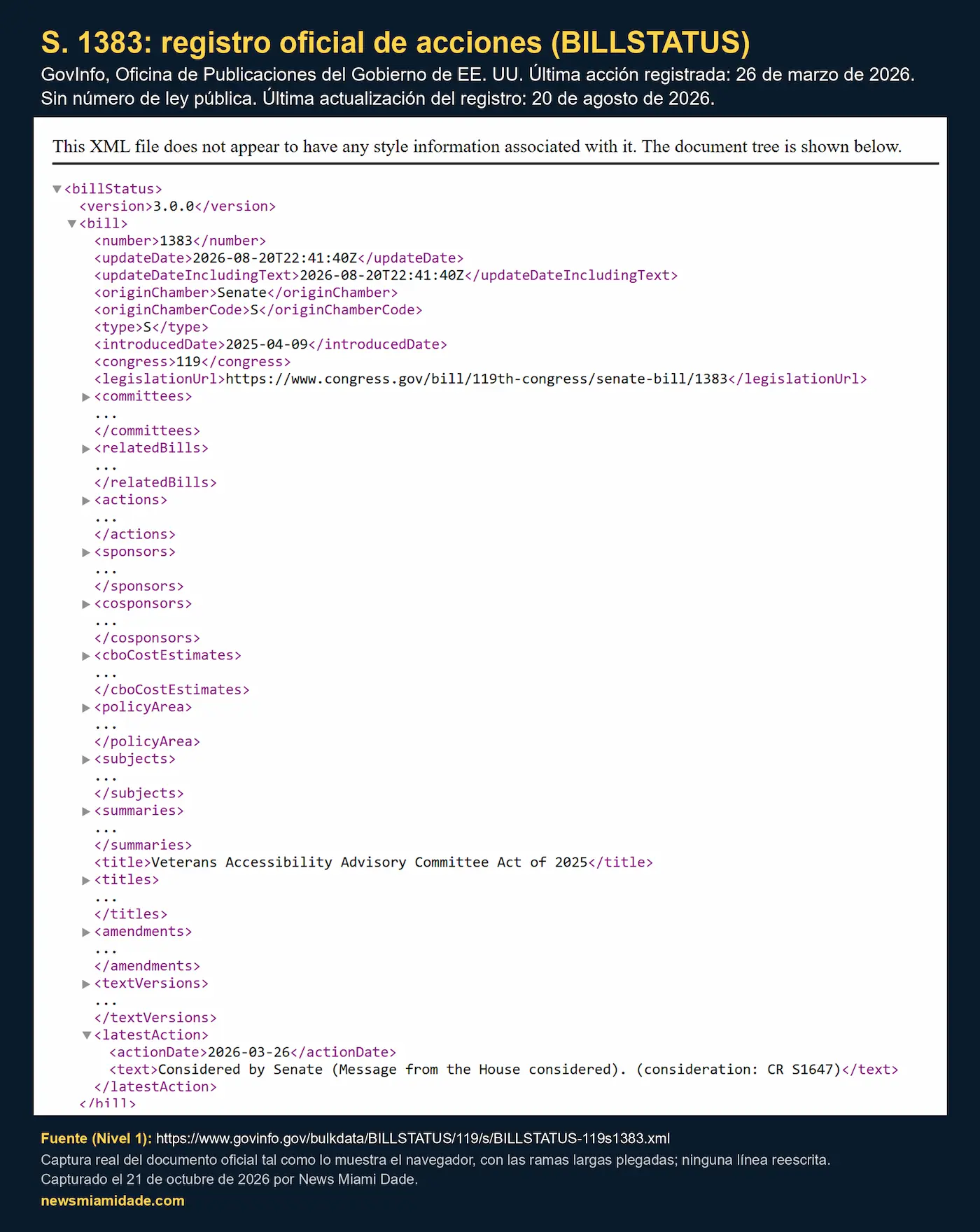
View the original at govinfo.gov
The official stock record for S. 1383 as displayed by the browser on October 21, 2026, with the long branches collapsed: number 1383, last updated on August 20, 2026, and, as the most recent action, the one dated March 26, 2026. No public law items appear. Source 7.
The same index lists, in addition to S. 1383, four other rejected attempts whose official titles pertain to identification requirements for registration or voting. The first, on April 23, was the vote to waive budgetary discipline on an amendment by Senator Kennedy to budget resolution S. Con. Res. 33 (48-50), regarding reserve funds tied to “identification requirements for registration to vote in elections for federal office” and photo identification for voting.
This was followed by two similar votes—to waive budgetary discipline, not on the text of the amendment itself—on two amendments to the budget reconciliation bill S. 2, introduced by Senators Graham (June 4, 48–50) and Lee (June 5, 50–49), “To ensure only citizens are registered to vote in elections for federal office, and to require voters to provide photo identification, ” and to end debate and take up S. 5271, a photo ID bill (August 8, 52–46). This publication has not read the text of those amendments or that bill and does not claim that they are consistent with the SAVE America Act.
The same text, by a different route. There is a second attempt, through a different channel than S. 1383, which this news outlet independently verified against the official text based on an external analysis received by the editorial staff. On July 21, 2026, the House approved the measure by a vote of 214 to 211,
U.S. House of Representatives — Roll Call Vote 254
Date: July 21, 2026 · Resolution: H. Res. 1438
Result: Passed, 214 votes in favor and 211 against.
The resolution established the rules for considering bills H.R. 8800, H.R. 8884, H.R. 7008, H.R. 6955, and H.R. 9770, as well as concurrent resolution H. Con. Res. 113. This vote pertains to the rules of debate, not to the final approval of those bills.
| Match | In favor | Against | Present but did not vote yes or no | They did not vote |
|---|---|---|---|---|
| Republican | 213 | 1 | 0 | 4 |
| Democrat | 0 | 210 | 0 | 2 |
| Independent | 1 | 0 | 0 | 0 |
| Total | 214 | 211 | 0 | 6 |
Representatives from Florida
| Representative | Match | In favor | Against | Did not vote |
|---|---|---|---|---|
| Aaron Bean | Republican | ✓ | ||
| Gus Bilirakis | Republican | ✓ | ||
| Vern Buchanan | Republican | ✓ | ||
| Kat Cammack | Republican | ✓ | ||
| Kathy Castor | Democrat | ✓ | ||
| Mario Díaz-Balart | Republican | ✓ | ||
| Byron Donalds | Republican | ✓ | ||
| Neal Dunn | Republican | ✓ | ||
| Randy Fine | Republican | ✓ | ||
| Lois Frankel | Democrat | ✓ | ||
| Scott Franklin | Republican | ✓ | ||
| Maxwell Frost | Democrat | ✓ | ||
| Carlos Giménez | Republican | ✓ | ||
| Mike Haridopolos | Republican | ✓ | ||
| Laurel Lee | Republican | ✓ | ||
| Anna Paulina Luna | Republican | ✓ | ||
| Brian Mast | Republican | ✓ | ||
| Cory Mills | Republican | ✓ | ||
| Jared Moskowitz | Democrat | ✓ | ||
| Jimmy Patronis | Republican | ✓ | ||
| John Rutherford | Republican | ✓ | ||
| María Elvira Salazar | Republican | ✓ | ||
| Darren Soto | Democrat | ✓ | ||
| Greg Steube | Republican | ✓ | ||
| Debbie Wasserman Schultz | Democrat | ✓ | ||
| Daniel Webster | Republican | ✓ | ||
| Frederica Wilson | Democrat | ✓ | ||
| Total Florida | 19 | 7 | 2 |
Votes That Stand Out in the National Results
| Representative | Status | Match | Vote |
|---|---|---|---|
| Massie | Kentucky | Republican | Against: the only Republican who voted “no” |
| Kiley | California | Independent | In favor |
| Biggs | Arizona | Republican | Did not vote |
| Clyde | Georgia | Republican | Did not vote |
| Fine | Florida | Republican | Did not vote |
| Gosar | Arizona | Republican | Did not vote |
| Moulton | Massachusetts | Democrat | Did not vote |
| Wilson | Florida | Democrat | Did not vote |
H.Res. 1438, the procedural resolution to consider various bills, including H.R. 8800, the National Defense Authorization Act for fiscal year 2027.
It wasn’t the first attempt. Three weeks earlier, on June 30, 2026, the House had rejected the measure by a vote of 198 to 224,
U.S. House of Representatives — Roll Call Vote 231
Date: June 30, 2026 · Resolution: H. Res. 1398
Result: Rejected, with 198 votes in favor and 224 against.
The resolution established the rules for considering H.R. 8800, H.R. 8595, H.R. 8884, and H. Res. 1383. This vote concerned the rules of debate, not the final passage of those bills.
| Match | In favor | Against | Present but did not vote yes or no | They did not vote |
|---|---|---|---|---|
| Republican | 197 | 14 | 0 | 7 |
| Democrat | 0 | 210 | 0 | 2 |
| Independent | 1 | 0 | 0 | 0 |
| Total | 198 | 224 | 0 | 9 |
Representatives from Florida
| Representative | Match | In favor | Against | Did not vote |
|---|---|---|---|---|
| Aaron Bean | Republican | ✓ | ||
| Gus Bilirakis | Republican | ✓ | ||
| Vern Buchanan | Republican | ✓ | ||
| Kat Cammack | Republican | ✓ | ||
| Kathy Castor | Democrat | ✓ | ||
| Mario Díaz-Balart | Republican | ✓ | ||
| Byron Donalds | Republican | ✓ | ||
| Neal Dunn | Republican | ✓ | ||
| Randy Fine | Republican | ✓ | ||
| Lois Frankel | Democrat | ✓ | ||
| Scott Franklin | Republican | ✓ | ||
| Maxwell Frost | Democrat | ✓ | ||
| Carlos Giménez | Republican | ✓ | ||
| Mike Haridopolos | Republican | ✓ | ||
| Laurel Lee | Republican | ✓ | ||
| Anna Paulina Luna | Republican | ✓ | ||
| Brian Mast | Republican | ✓ | ||
| Cory Mills | Republican | ✓ | ||
| Jared Moskowitz | Democrat | ✓ | ||
| Jimmy Patronis | Republican | ✓ | ||
| John Rutherford | Republican | ✓ | ||
| María Elvira Salazar | Republican | ✓ | ||
| Darren Soto | Democrat | ✓ | ||
| Greg Steube | Republican | ✓ | ||
| Debbie Wasserman Schultz | Democrat | ✓ | ||
| Daniel Webster | Republican | ✓ | ||
| Frederica Wilson | Democrat | ✓ | ||
| Total Florida | 16 | 10 | 2 |
The 14 Republicans who voted against it
| Representative | Status | Vote |
|---|---|---|
| Boebert | Colorado | Against |
| Burchett | Tennessee | Against |
| Burlison | Missouri | Against |
| Crane | Arizona | Against |
| Fine | Florida | Against |
| Harris | Maryland | Against |
| Moon | Florida | Against |
| Massie | Kentucky | Against |
| Miller | Ohio | Against |
| Roy | Texas | Against |
| Scalise | Louisiana | Against |
| Self | Texas | Against |
| Spartz | Indiana | Against |
| Turner | Ohio | Against |
Representatives who did not vote
| Representative | Match | Status |
|---|---|---|
| DeGette | Democrat | Colorado |
| Dunn | Republican | Florida |
| Emmer | Republican | Minnesota |
| Fitzpatrick | Republican | Pennsylvania |
| Hayes | Democrat | Connecticut |
| Lucas | Republican | Oklahoma |
| Mills | Republican | Florida |
| Rose | Republican | Tennessee |
| Tenney | Republican | New York |
Kiley, an independent from California, voted in favor. Source:
H.Res. 1398, an earlier resolution regarding the same H.R. 8800, contained—word for word in its Section 14—the same directive to add the text of S. 1383 to the end of the defense authorization. The official record of the Secretary of the House does not state why it was rejected—among other things, it bundled several different bills into a single vote—and this publication does not claim otherwise.
View the original at govinfo.gov
H.Res. 1398, the resolution that the House rejected 198–224 on June 30, 2026, with its Section 14 already identical in substance to the one that would later appear in H.Res. 1438. Source 9.
Section 11 of H.Res. 1438 directs the Clerk of the House, verbatim: “In the engrossment of H.R. 8800, the Clerk shall— (a) add the text of S. 1383, as passed by the House, as new matter at the end of H.R. 8800”— when preparing the final copy (engrossment) of H.R. 8800, the Clerk shall add the text of S. 1383, as approved by the House, as new matter at the end of H.R. 8800. This is an instruction for that procedure, not a description of what had already occurred during the previous day’s vote.
The following day, July 22, 2026, the House passed H.R. 8800 by a vote of 216 to 212, as recorded in Roll Call No. 278 of the official record of the Secretary of the House; Pursuant to that resolution, the text of S. 1383 is added to the final copy that the House transmits to the Senate.
U.S. House of Representatives — Roll Call Vote 278
Date: July 22, 2026 · Bill: H.R. 8800
Subject: National Defense Authorization Act for Fiscal Year 2027.
Result: Passed by the House, 216 votes in favor and 212 against.
This vote concerns the approval of the bill in the House, unlike the previous votes, which dealt with rules of debate. On its own, it does not mean that the bill has become law.
| Match | In favor | Against | Present but did not vote yes or no | They did not vote |
|---|---|---|---|---|
| Republican | 209 | 7 | 0 | 2 |
| Democrat | 6 | 205 | 0 | 1 |
| Independent | 1 | 0 | 0 | 0 |
| Total | 216 | 212 | 0 | 3 |
Representatives from Florida
| Representative | Match | In favor | Against | Did not vote |
|---|---|---|---|---|
| Aaron Bean | Republican | ✓ | ||
| Gus Bilirakis | Republican | ✓ | ||
| Vern Buchanan | Republican | ✓ | ||
| Kat Cammack | Republican | ✓ | ||
| Kathy Castor | Democrat | ✓ | ||
| Mario Díaz-Balart | Republican | ✓ | ||
| Byron Donalds | Republican | ✓ | ||
| Neal Dunn | Republican | ✓ | ||
| Randy Fine | Republican | ✓ | ||
| Lois Frankel | Democrat | ✓ | ||
| Scott Franklin | Republican | ✓ | ||
| Maxwell Frost | Democrat | ✓ | ||
| Carlos Giménez | Republican | ✓ | ||
| Mike Haridopolos | Republican | ✓ | ||
| Laurel Lee | Republican | ✓ | ||
| Anna Paulina Luna | Republican | ✓ | ||
| Brian Mast | Republican | ✓ | ||
| Cory Mills | Republican | ✓ | ||
| Jared Moskowitz | Democrat | ✓ | ||
| Jimmy Patronis | Republican | ✓ | ||
| John Rutherford | Republican | ✓ | ||
| María Elvira Salazar | Republican | ✓ | ||
| Darren Soto | Democrat | ✓ | ||
| Greg Steube | Republican | ✓ | ||
| Debbie Wasserman Schultz | Democrat | ✓ | ||
| Daniel Webster | Republican | ✓ | ||
| Frederica Wilson | Democrat | ✓ | ||
| Total Florida | 19 | 8 | 1 |
The seven Republicans who voted against it
| Representative | Status | Vote |
|---|---|---|
| Brecheen | Oklahoma | Against |
| Burchett | Tennessee | Against |
| Crane | Arizona | Against |
| Hageman | Wyoming | Against |
| Moon | Florida | Against |
| Massie | Kentucky | Against |
| Roy | Texas | Against |
The six Democrats who voted in favor
| Representative | Status | Vote |
|---|---|---|
| Cuellar | Texas | In favor |
| Davis | North Carolina | In favor |
| Golden | Maine | In favor |
| Gonzalez, V. | Texas | In favor |
| Gray | California | In favor |
| Perez | Washington | In favor |
Representatives who did not vote
| Representative | Match | Status |
|---|---|---|
| Biggs | Republican | Arizona |
| Boebert | Republican | Colorado |
| Wilson | Democrat | Florida |
Kiley, an independent from California, voted in favor. Source:
This publication opened and read that final copy: it does, in fact, contain SECTION E–SAVE AMERICA ACT, with its three sections: 4801 (short title), 4802 (citizenship on the registry), and 4803 (photo identification), the text of which is substantially the same as that of S. 1383.
Where is it, by page number, in the official 2,586-page PDF that this media outlet archived? Section 2(a) of the act itself, on page 2, lists “(5) Division E—SAVE America Act” among its divisions; the table of contents lists it with its three sections; and the text of the division spans pages 2,555 through 2,585, beginning with the heading “DIVISION E—SAVE AMERICA ACT” and Section 4,801, verbatim, “This division may be cited as the ‘Safeguard American Voter Eligibility Act’ or the ‘SAVE America Act’, ” through the closing of the act on page 2585: “Passed the House of Representatives July 22, 2026. Attest: Clerk.”
Sections 1, 2, and 3 of S. 1383 appear there as 4801, 4802, and 4803: the renumbering mandated by section 11(b) of H.Res. 1438 instructs the Secretary to “assign appropriate designations.” This publication compared the two versions section by section and by specific phrases—the “KIC” card, the date “October 1, 2025” in Section 303A, “subtitle A of title III”—not word for word. The official record of proceedings for H.R. 8800 does not describe Division E in any entry, because it records procedural steps rather than content, but it does list S. 1383 as a related bill; proof of incorporation is the text of the final version itself.
Section 4802 states, verbatim: “Each State shall submit the complete, official list of individuals registered as eligible voters for federal office in the State to [the Department of Homeland Security] for comparison through [SAVE]… for the purpose of identifying individuals who are not citizens of the United States and taking the necessary steps to remove such individuals… after notice is given to such individuals and they are given the opportunity to provide documentary proof of U.S. citizenship. “
The cross-check against SAVE applies to the entire existing voter registry, not just to those who are registering for the first time. A separate subsection, (k), also requires each state to remove, at any time and without conducting a full voter roll comparison, anyone found not to be a citizen: “A State shall remove an individual who is not a citizen of the United States from the official list… at any time upon receipt of documentation or verified information that a registrant is not a United States citizen.”
Section 4803 does not require photo identification only from those who vote in person: it also provides a mechanism for those who vote by other means. It inserts a new Section 303A into the Help America Vote Act (HAVA) which, in subsection (a)(2), “Individuals voting other than in person,” mandates that no state or local election official accept a ballot from a voter casting a non-in-person vote unless the person submits, along with the ballot, a copy of a valid photo ID, or the last four digits of their Social Security number along with a sworn statement, provided by the state itself, that they were unable to obtain that copy despite making reasonable efforts to do so.
Verbatim: “(i) a copy of a valid photo ID; or (ii) the last four digits of the individual’s Social Security number and an affidavit prepared and provided to the individual by the State attesting that the individual is unable to obtain a copy of a valid photo ID after making reasonable efforts to do so.”
The same section exempts two specific groups—and not just any overseas voter—from this requirement: members of the uniformed services or the merchant marine on active duty who are absent from their electoral residence due to that service, and their spouses or dependents in the same situation, as defined in Section 107(1) of the Uniformed Services and Overseas Citizens Voting Act (UOCAVA); and to individuals eligible to vote by mail under the Voting Accessibility Act for the Elderly and People with Disabilities.
However, it does not exempt civilian residents living abroad who have no such military affiliation, nor does it require that the exempted military member be outside the country: it is sufficient that he or she be absent from the place where he or she is eligible to vote.
It is not a second bill: it is the same substantive text, advanced through a different legislative vehicle—the defense authorization bill, a bill that is generally considered mandatory—rather than S. 1383 alone. For it to become law, the Senate must pass the same text and the president must sign it. The Senate officially acknowledged receipt of H.R. 8800 on September 14, 2026, nearly two months after the House passed it: these are two separate acts, from two separate chambers, and should not be confused.
H.R. 8800 — National Defense Authorization Act for Fiscal Year 2027
The file contains the legislative process and the votes on amendments. It does not include a breakdown of individual votes by representative or party.
| Date | Stage | In favor | Against | Result |
|---|---|---|---|---|
| June 4, 2026 | Armed Services Committee: Direct that the bill be reported with amendments | 44 | 12 | Approved |
| July 22, 2026 | House of Representatives: Passage of H.R. 8800, vote of 278 | 216 | 212 | Passed by the House |
| September 14, 2026 | Reception at the Senate | — | — | Last action recorded in the file |
Amendments put to a roll-call vote
| Date | Voting | Proposer | Subject of the amendment | In favor | Against | Result |
|---|---|---|---|---|---|---|
| July 21 | 255 | Boebert | Maintain the current deadline for the Commission’s final report on the War in Afghanistan | 65 | 361 | Rejected |
| July 21 | 256 | Boebert | Prohibit Foreigners from Attending U.S. Military Academies | 61 | 360 | Rejected |
| July 21 | 257 | Boebert | Maintain the limit on the number of cadets who may perform alternative service in order to pursue a career in professional sports | 65 | 359 | Rejected |
| July 21 | 258 | Boebert | Eliminate the pilot program that uses voice-based risk assessment to select service members for drug testing | 265 | 161 | Approved; 1 “present” vote |
| July 21 | 259 | Hunt | Prevent court orders that would hinder military preparedness, fuel supply, or defense logistics | 208 | 219 | Rejected |
| July 21 | 260 | Hunt | Ensure the continuity of the Santa Ynez pipeline system, which is linked to the defense fuel supply | 215 | 214 | Approved |
| July 21 | 261 | Gallagher | Examine federal mechanisms in response to state measures that affect the refining capacity necessary for national defense | 212 | 216 | Rejected |
| July 21 | 262 | Carter, Georgia | Give priority to federal standards over certain state and local requirements regarding the recycling and disposal of defense-related materials | 201 | 224 | Rejected |
| July 21 | 263 | Crane | Prohibit the funding of foreign military participation in joint exercises, unless an exception is granted for national security reasons | 61 | 365 | Rejected |
| July 21 | 264 | Crane | Prohibit funding for security assistance to Ukraine, except to protect the U.S. embassy | 76 | 350 | Rejected |
| July 21 | 265 | Crank | Establish a presumption of authorization to carry personal firearms on military installations for eligible personnel | 215 | 214 | Approved |
| July 21 | 266 | Boebert | Enact Executive Order 14183 on military service and biological sex into law | 212 | 217 | Rejected |
| July 21 | 267 | Mace | Prohibit certain care and coverage for gender transition procedures under TRICARE | 219 | 208 | Approved |
| July 21 | 268 | Mace | Prohibit male participation in women’s sports at Department of Defense schools | 221 | 203 | Approved |
| July 21 | 269 | McDowell | Authorize a pilot program for school choice for members of the Armed Forces | 214 | 216 | Rejected |
| July 22 | 273 | Self | Incorporate protections and responsibilities for chaplains under the Uniform Code of Military Justice | 221 | 210 | Approved |
| July 22 | 274 | Issa | Expand participation by investors and licensed professionals in a defense-related investment program | 207 | 224 | Rejected |
| July 22 | 275 | Harrigan | Ban automatic speed cameras at military facilities | 232 | 199 | Approved |
| July 22 | 276 | Grothman | Call for a report on options to reduce the number of civilian employees at the Department of Defense by 200,000 | 175 | 254 | Rejected |
Amendments approved by a voice vote
| Date | Proposer | Amendment | Subject | Result |
|---|---|---|---|---|
| July 21 | Rogers, Alabama | House Amendment 246 | Block Amendment Package No. 1 | Approved |
| July 22 | Hinson | House Amendment 260 | Restrict access by certain foreign nationals from countries of concern to non-public areas of national laboratories, with exceptions | Approved |
| July 22 | Rogers, Alabama | House Amendment 262 | Block Amendment Package No. 2 | Approved |
| July 22 | Rogers, Alabama | House Amendment 263 | Block Amendment Package No. 3 | Approved |
| July 22 | Rogers, Alabama | House Amendment 264 | Block Amendment Package No. 4 | Approved |
| July 22 | Rogers, Alabama | House Amendment 265 | Block Amendment Package No. 5 | Approved |
Voice votes do not provide an individual numerical count. Source: shared file, updated on October 20, 2026.
View the complete final version at govinfo.gov
Division E—SAVE America Act, pages 2555 through 2585 of the final version of H.R. 8800, which the House passed on July 22, 2026, plus the back cover of the act, which is page 2586 (an unaltered excerpt from the official 2,586-page PDF, which is also archived in its entirety). Source 10.
The Senate has its own defense authorization bill, S. 4784, and has not passed the text that came out of the House. On July 14, 2026, before the House vote on H.R. 8800, the full Senate voted 50 to 46 against closing debate on the motion to proceed to consideration of S. 4784 —10 votes short of the 60 required by the rules.
U.S. Senate — Roll Call Vote 195
Date: July 14, 2026 · Bill: S. 4784
Subject: Closure of debate on the motion to proceed to consideration of the National Defense Authorization Act for fiscal year 2027.
Result: rejected. It received 50 votes in favor; it needed 60. This was a procedural vote, not a vote on the final approval of the bill.
| Match | In favor | Against | They did not vote | Total |
|---|---|---|---|---|
| Republican | 50 | 1 | 2 | 53 |
| Democrat | 0 | 43 | 2 | 45 |
| Independent | 0 | 2 | 0 | 2 |
| Total | 50 | 46 | 4 | 100 |
Florida Senators
| Senator | Match | In favor | Against | Did not vote |
|---|---|---|---|---|
| Ashley Moody | Republican | ✓ | ||
| Rick Scott | Republican | ✓ | ||
| Total Florida | 2 | 0 | 0 |
Breakdown of the votes
| Match | In favor | Against | They did not vote |
|---|---|---|---|
| Republican | Armstrong, Banks, Barrasso, Blackburn, Boozman, Britt, Budd, Capito, Cassidy, Collins, Cornyn, Cotton, Cramer, Crapo, Cruz, Curtis, Daines, Ernst, Fischer, Graham, Grassley, Hagerty, Hawley, Hoeven, Husted, Hyde-Smith, Johnson, Kennedy, Lankford, Lee, Lummis, Marshall, McCormick, Moody, Moran, Moreno, Murkowski, Paul, Ricketts, Risch, Rounds, Schmitt, Scott (Florida), Scott (South Carolina), Sheehy, Sullivan, Tillis, Tuberville, Wicker, and Young | Thune | Justice and McConnell |
| Democrat | None | Alsobrooks, Baldwin, Bennet, Blumenthal, Blunt Rochester, Booker, Cantwell, Coons, Cortez Masto, Duckworth, Durbin, Gallego, Gillibrand, Hassan, Heinrich, Hickenlooper, Hirono, Kaine, Kelly, Kim, Klobuchar, Lujan, Markey, Merkley, Murphy, Murray, Ossoff, Peters, Reed, Rosen, Schatz, Schiff, Schumer, Shaheen, Slotkin, Smith, Van Hollen, Warner, Warnock, Warren, Welch, Whitehouse, and Wyden | Fetterman and Padilla |
| Independent | None | King and Sanders | None |
The process did not end there: according to the bill’s own official record of proceedings, new motions to proceed were filed in the Senate on July 20, July 23 (filed and withdrawn that same day), and July 27. The official record of proceedings does not name anyone in the motions from July 20 and 23, so this publication does not attribute their authorship to Thune or any other senator.
S. 4784 — National Defense Authorization Act for Fiscal Year 2027
| Date | Legislative Action | In favor | Against | Result |
|---|---|---|---|---|
| June 15, 2026 | The Armed Services Committee introduced the bill through Senator Roger Wicker, with Report No. 119-127 | — | — | Bill Submitted to the Senate |
| June 15, 2026 | Inclusion on the Senate’s legislative calendar, No. 436 | — | — | Added to the calendar |
| June 24, 2026 | Presentation of the motion to proceed with consideration of the bill and the request to close the debate | — | — | Process Initiated |
| July 14, 2026 | Vote 195: Closing of the debate on the motion to proceed | 50 | 46 | Rejected: It needed 60 votes |
| July 14, 2026 | Thune filed a motion to reconsider vote 195 | — | — | Motion for reconsideration filed |
| July 14, 2026 | New motion to proceed with consideration of the bill | — | — | Presented |
| July 20, 2026 | Motion to proceed with consideration of the bill | — | — | Presented |
| July 23, 2026 | Presentation and Subsequent Withdrawal of a Motion to Proceed | — | — | Motion Withdrawn |
| July 27, 2026 | Motion to proceed with consideration of the bill | — | — | Last recorded action |
Breakdown of Vote 195, based on the roll call record you shared earlier:
| Match | In favor | Against | They did not vote |
|---|---|---|---|
| Republican | 50 | 1 | 2 |
| Democrat | 0 | 43 | 2 |
| Independent | 0 | 2 | 0 |
| Total | 50 | 46 | 4 |
The record lists 884 amendments, but does not include votes on whether they were approved or rejected. Submitting an amendment does not mean it has been approved.
The closure of the rejected debate was a procedural decision, not a final vote on S. 4784. Source:
Thune did introduce the one from the 27th: the Journal of Proceedings for that day, now also archived, reads, verbatim: “Mr. THUNE. Mr. President, I move to proceed to Calendar No. 436, S. 4784, ” and the Senior Deputy Secretary read it as follows: “Motion to proceed to Calendar No. 436, S. 4784, a bill to authorize appropriations…, ” page S4276.
According to that same official record of actions related to the project itself, filed by this outlet on September 27 and again on October 20, 2026 (last update from its source: October 15), following that motion of July 27, only amendments submitted (“Senate amendment submitted”) are listed, the last one on September 29: the motion is not listed as having been voted on, withdrawn, or otherwise resolved.
Regarding H.R. 8800, the last recorded action—according to its own official record cited above, which was also shelved again on October 20 with an update to its source dated October 15—is the formal receipt on September 14, 2026. Beyond that procedural step, this publication has not found any record of a vote, referral to committee, or other substantive action by the Senate regarding the bill as it came from the House in either of the two official records.
And the Senate is no longer in session. The Senate’s daily report for September 30, 2026, on file with this publication, records, verbatim, “11:24 p.m. The Senate adjourned.”; the front page of that same official publication, archived on October 20, states that the Senate “adjourned until 3:00 p.m. on Monday, November 9, ” with pro forma sessions with no business in between;
Tentative Legislative Calendar of the U.S. Senate — 2026
119th Congress, Second Session
The following are the scheduled periods during which there will be no regular legislative activity in the plenary session. “Work in the states” refers to the work senators do in their respective states.
| Dates in 2026 | Recommended activity | Holiday or note |
|---|---|---|
| January 1–2 | No activity specified | New Year’s Day: January 1 |
| January 19–23 | Work in the states | — |
| February 16–20 | No activity specified | Presidents’ Day: February 16 |
| March 30–April 10 | Work in the states | — |
| May 4–8 | Work in the states | — |
| May 25–29 | Work in the states | Memorial Day: May 25 |
| June 19 | Work in the states | Juneteenth: June 19 |
| June 29–July 10 | Work in the states | Independence Day: July 4 |
| August 10–September 11 | Work in the states | Labor Day: September 7 |
| September 21 | No activity specified | — |
| October 5–November 6 | Work in the states | Columbus Day: October 12 |
| November 11–13 | No activity specified | Veterans Day: November 11 |
| November 23–27 | Work in the states | Thanksgiving: November 26 |
| December 21–31 | Work in the states | Christmas: December 25 |
This is a tentative schedule, subject to change; these periods do not necessarily correspond to vacation time.
Source: the Senate calendar you shared, updated on November 21, 2025.
and the Senate’s tentative 2026 calendar designates October 5 through November 6 as the “State Work Period. “
The Capitol press (The Hill, October 1, 2026) reports that the defense authorization bill is among the priorities that remain, verbatim, “in limbo until after the Nov. 3 election.” Whether or not the text of the SAVE America Act will be voted on during the post-election session is something that no official record anticipates, and this publication does not assert.
What is confirmed, however, is this: As of October 20, 2026, S. 1383 has not been enacted into law. Its official record of actions, filed on September 28 and re-uploaded without changes on October 20—with the latest update to its source dated August 20, 2026—does not record any action regarding submission to the president or signature: it is this record—and not merely the absence of a number—that allows us to conclude that it is not law.
The two failed attempts to conclude the debate in March, as described above, do not tell the whole story of why, eight months later, there is still no law: On July 22, the House passed H.R. 8800 with instructions to add the same language, this time within the defense authorization bill (see above). As of the deadline for this article, that text has not yet passed the Senate either; furthermore, on July 14, the Senate rejected a motion to end debate on its own defense authorization bill, S. 4784 (50–46), and is in recess until November 9. The specific obstacles, with their dates and purposes, are described above; there is no single cause.
Who voted how—and in what terms—is covered in another article. Each of these votes is recorded by roll call, with the vote of every senator and every representative, including Florida’s two senators and 28 representatives, and the Journal of Sessions records what those who opposed and those who supported the measure said on the floor. That breakdown—senator by senator and in their own words—is the focus of this publication’s comparative analysis of the SAVE Act and state citizenship and voting laws, which is currently in preparation and will be published separately by this publication; it is not repeated here.
The detail that makes the law seem nonexistent
The tracking record for S. 1383, which this publication filed on September 23, 2026, lists the bill’s title as the “Veterans Accessibility Advisory Committee Act of 2025” at the time of its introduction, reporting, and passage in the Senate, and lists only “Safeguard American Voter Eligibility Act” and “SAVE America Act” as subsequent short titles. This is neither an error nor a hidden maneuver: it is the title under which the bill was originally introduced and which persists in part of the system, even though its current text is different.
Anyone searching for the law by name may conclude that it does not exist. This publication was unable to access the Congress.gov page (error 403 on September 23 and 26) and does not state what title appears on that page today.
There is a second catch in that same record. Its automatic status label reads “Passed House & Senate (President next),” because both chambers passed S. 1383. But they passed different bills: the Senate passed the veterans’ bill; the House passed the SAVE America Act. The Senate itself, in its March daily journals, continued to refer to it as “House message to accompany S. 1383”—that is, a message from the House pending the Senate’s concurrence. Anyone reading only the label might believe that the bill is on the President’s desk. It is not: the record itself does not include a public law number.
Who is listed in the document, along with their position, party, and vote
The names of those involved in this process are listed here along with their position, party, state, and vote in two of the six roll calls, as recorded in the official record of each Senate roll call archived by this publication, which identifies each senator by their party and state. This is not a vote-by-vote breakdown of the six votes or of the House, which is covered elsewhere; it is the bare minimum information needed to know who is who. Each senator’s role is as recorded in the Journal of Sessions dated March 17, 2026, and in the records already cited in “What Happened.”
| Name | Position | Party and state | Role in this process | Vote 00067 (March 24, table on Schumer’s motion) | Vote 00073 (March 26, conclusion of debate on the Husted amendment) | Verification (record of each vote, linked in the column header) |
|---|---|---|---|---|---|---|
| Rick Scott | U.S. Senator | Republican, Florida | He introduced S. 1383 on April 9, 2025, at that time as a veterans’ bill; he spoke in favor of it during the debate on March 17, 2026 | in favor of | in favor of | Verified: official record, “Scott (R-FL)” |
| John Thune | U.S. Senator; Majority Leader | Republican, South Dakota | He introduced the motion of March 17, 2026, to concur with the House amendment and the motion to proceed with S. 4784 of July 27 | in favor of | in favor of | Verified: official record, “Thune (R-SD)” |
| Marsha Blackburn | U.S. Senator | Republican, Tennessee | She spoke in favor of the measure on March 17 (page S1069); she co-sponsored, with Tuberville, Amendment 4421 (vote 00060) | in favor of | in favor of | Verified: official record, “Blackburn (R-TN)” |
| Tommy Tuberville | U.S. Senator | Republican, Alabama | Co-author, with Blackburn, of Amendment 4421, for which a motion to close debate was rejected 49-41 on March 21 | in favor of | in favor of | Verified: official record, “Tuberville (R-AL)” |
| Jon Husted | U.S. Senator | Republican, Ohio | Author of Amendment 4732, regarding photo ID, for which a motion to close debate was rejected 53-47 on March 26 (vote 00073). The official record identifies him as Jon Husted | in favor of | in favor of | Verified: official record, “Husted (R-OH)” |
| Roger Marshall | U.S. Senator | Republican, Kansas | He spoke in favor of it on March 17 | in favor of | in favor of | Verified: official record, “Marshall (R-KS)” |
| Ted Cruz | U.S. Senator | Republicano, Texas | He spoke in favor of it on March 17 | in favor of | in favor of | Verified: official record, “Cruz (R-TX)” |
| Steve Daines | U.S. Senator | Republican, Montana | He spoke in favor of it on March 17 | in favor of | in favor of | Verified: official record, “Daines (R-MT)” |
| Eric Schmitt | U.S. Senator | Republican, Missouri | He spoke in favor of it on March 17 | in favor of | in favor of | Verified: official record, “Schmitt (R-MO)” |
| Charles Schumer | U.S. Senator; Minority Leader | Democrat, New York | He spoke against the motion on March 17 (page S1066); he was the author of the motions to suspend the rules, which the plenary session rejected or shelved (votes 00061 and 00067) | against | against | Verified: official record, “Schumer (D-NY)” |
| Patty Murray | U.S. Senator | Democrat, Washington | He spoke out against it on March 17 | against | against | Verified: official record, “Murray (D-WA)” |
| Amy Klobuchar | U.S. Senator | Democrat, Minnesota | He spoke out against it on March 17 | against | against | Verified: official record, “Klobuchar (D-MN)” |
| Andy Kim | U.S. Senator | Democrat, New Jersey | He spoke out against it on March 17 | against | against | Verified: official record, “Kim (D-NJ)” |
| Mark Warner | U.S. Senator | Democrat, Virginia | He spoke out against it on March 17 | against | against | Verified: official record, “Warner (D-VA)” |
| Alex Padilla | U.S. Senator | Democrat, California | He spoke out against it on March 17 | against | against | Verified: official record, “Padilla (D-CA)” |
| Peter Welch | U.S. Senator | Democrat, Vermont | He spoke out against it on March 17 | against | against | Verified: official record, “Welch (D-VT)” |
| Richard Blumenthal | U.S. Senator | Democrat, Connecticut | He spoke out against it on March 17 | against | against | Verified: official record, “Blumenthal (D-CT)” |
| Jeff Merkley | U.S. Senator | Democrat, Oregon | He spoke out against it on March 17 | against | against | Verified: official record, “Merkley (D-OR)” |
The two votes listed in the table followed strict party lines, with all 100 senators voting: 53 Republicans in favor, 45 Democrats, and 2 independents against, according to official records 00067 and 00073 on file. That is why every Republican listed in the table appears in favor and every Democrat against; the table does not draw any conclusions—it simply copies the vote recorded next to each name in the official record.
In the House, Vote No. 69 of February 11, 2026, according to the official record of the Secretary of the House filed by this publication, breaks down as follows: 217 Republicans in favor and one abstention; 213 Democrats against and one in favor; no independents. Total: 218 in favor and 213 against. All 213 votes against were cast by Democrats. Who was the sole Democrat in favor, and how each of the 28 Florida representatives voted, is the subject of this publication’s comparative analysis and is not repeated here.
Why It Matters
It matters in Miami-Dade for an arithmetic reason backed by data. Florida ranks second in the country in naturalizations: 93,240 Florida residents became U.S. citizens in fiscal year 2024, accounting for 11 percent of the national total, second only to California (149,800), according to the annual report *U.S. Naturalizations: 2024* from the DHS Office of Homeland Security Statistics, which this media outlet obtained and filed on October 20, 2026. The number of those individuals living in Miami-Dade is not recorded in any document filed in this case, nor is it stated.
They are citizens with the right to register and vote. How many of them are registered and how many vote is also not recorded in any document on file in this case: the DHS figure counts naturalizations, not registrations or votes, and by itself does not indicate whether the new requirement would change their participation or not. The federal bill does not strip them of their citizenship; what would change is what they would have to prove—and when—in order to register or for their vote to count.
What I would ask of you is contained in the text approved by the House—32 pages that this publication read in their entirety and that are on file in the case record. Section 2(b) rewrites Section 4 of the NVRA as follows (page 4):
“Under any method of voter registration in a state, the state shall not accept or process an application to register to vote in an election for federal office unless the applicant submits documentary proof of United States citizenship with the application.”
View the original at govinfo.gov
S. 1383, Engrossed Amendment of the House (EAH), the text of the SAVE America Act as passed by the House on February 11, 2026, 32 pages. Source 17.
And the effective date provision, Section 2(r) (page 25), states that the requirement applies to “applications for voter registration that are submitted on or after” the date of enactment: to anyone who registers or reapplies for registration on or after that date, not to anyone who is already registered simply by virtue of being registered.
Section 2(a), pages 1 through 4, specifies which documents are acceptable:
- an identification document in accordance with the REAL ID Act that indicates that the holder is a citizen;
- a valid U.S. passport;
- a military ID along with a service record showing birth in the United States;
- an official photo ID showing that the person was born in the United States;
- or any other official photo ID, but only when accompanied by one of the following: a certified birth certificate, an extract from the hospital birth registry, a final adoption decree, a consular report of birth abroad, “a Naturalization Certificate or Certificate of Citizenship” or another federal citizenship document issued under the Immigration and Nationality Act (letter E, page 4), or an American Indian card with KIC classification.
In other words: for a naturalized citizen, the naturalization certificate is not valid on its own; it must be presented along with an official photo ID; a passport, however, is valid on its own.
The text approved by the House does provide a pathway for those who changed their last name—specifically, married women who changed their last names, one of the burdens cited in the lawsuits against the Florida law, as detailed in this publication’s companion article— in the same Section 2(f) (pages 11 and 12, the subsection that adds the new subsection (j) to Section 8 of the NVRA).
That provision requires states to accept the registration if the applicant submits, along with proof of citizenship under a different name, additional documentation substantiating the name change or, alternatively, “an affidavit signed by the applicant attesting that the name on the documentation is a previous name of the applicant” —a simple sworn statement, with no other paperwork—all through a process that each state must establish (subject to any guidance from the Electoral Assistance Commission).
And for anyone who does not have any of the documents required by Section 2(a)—such as a naturalized citizen who has lost their certificate—Section 2(f) itself (pages 12–14) requires each state to establish a process whereby the applicant, under penalty of perjury, submit “such other evidence” to a state or local official, who must determine whether it is sufficient to establish citizenship and sign their own affidavit explaining why they registered that person.
Neither option waives the requirement: in the first, the applicant must still submit a document from the list under their previous name; in the second, the document is replaced by another form of proof, under penalty of perjury, which an official must evaluate and, if accepted, justify in writing.
And for those who are already registered, there is another option: Section 2(f), pages 15 and 16: Each state would send its complete list of voters to the Department of Homeland Security to cross-check it with the SAVE system, and would remove anyone found to be a non-citizen “after notice is given to such individuals and such individuals are given the opportunity to provide documentary proof of United States citizenship.” The text also includes, in Section 3 (pages 25–31), a separate requirement: photo identification is required to vote in person using a provisional ballot, and voters have three days to submit it.
Here is the specific question that this article cannot yet answer: How many registered voters in Miami-Dade were born outside the United States, and how many of them have those documents on hand? A lost naturalization certificate can be replaced using USCIS Form N-565, for which the fee, according to the official G-1055 fee schedule (October 16, 2026 edition, page 31), is $555 for paper applications and $505 for online applications. It’s not impossible. It costs money and takes time, and those are quantifiable; how long it takes USCIS to issue a replacement is a fact that this publication was unable to verify independently, because its processing times page could not be accessed on October 20, 2026.
And anyone who says that the Senate has closed the door on the SAVE America Act for good isn’t telling the whole truth either: what we have is a bill that was never actually put to a vote to end debate, and an amendment that fell seven votes short of the required 60—not a definitive rejection.
Timeline
| Date | Who | Fact | Verification document or status |
|---|---|---|---|
| April 9, 2025 (verified) | Sen. Rick Scott (R-FL) | Introduces S. 1383 as the Veterans Accessibility Advisory Committee Act of 2025 | Verified, tracking record on file |
| July 30, 2025 (verified) | Senate Committee on Veterans’ Affairs | Orders that S. 1383 be reported with substitute text | Verified, tracking record on file |
| Dec. 18, 2025 (verified) | United States Senate | Approves S. 1383 with an amendment, by unanimous consent | Verified, tracking record on file |
| Feb. 11, 2026 (verified) | House of Representatives | The amendment introducing the SAVE America Act is approved by a vote of 218 to 213 (roll call vote: 69) | verified, tracking record, and official voting record on file; the breakdown by representative is included in the comparative document |
| Feb. 11, 2026 (verified) | Office of Management and Budget, White House | Administration Policy Statement: Express Support and Conditional Recommendation to Sign | verified, PDF on file |
| March 17, 2026 (verified) | Sen. John Thune, Senate Majority Leader | Motion to concur in the House amendment, with Amendment 4420; debate with Minority Leader Charles Schumer and other senators (pages S1066 through S1088); vote 00057, motion to proceed approved 51-48 | Verified; image of the Session Log (S1066, S1067, and S1074 through S1078) and voting record on file |
| March 21, 2026 (verified) | United States Senate | Vote 00060: Motion to close debate on the Tuberville-Blackburn Amendment 4421 defeated 49-41, along party lines | Verified, daily log, and voting record on file |
| March 21, 2026 (verified) | United States Senate | Vote 00061: Motion to close debate on Schumer’s motion to suspend the rules (TSA funding) defeated 41-49 | Verified; voting record on file; daily report on file, lines 95, 96, and 110 |
| March 24, 2026 (verified) | United States Senate | Vote 00067: Table motion against Schumer’s motion to suspend Rule XXV, passed 53-47 | verified, voting record on file |
| March 24, 2026 (verified) | United States Senate | Vote 00068: Motion to adjourn the debate on the motion to refer the message to the Rules Committee with instructions, approved 53-47 | verified, voting record on file |
| March 26, 2026 (verified) | United States Senate | Vote 00073: Motion to close debate on Husted Amendment 4732 rejected 53-47; 60 votes were needed | Verified, daily log, and voting record on file |
| March 27 to September 30, 2026 (open) | Author unknown | No roll call vote on S. 1383 in the Senate | Verified; official index vote_menu_119_2 on file, downloaded on September 26 (through vote 00244 on September 24) and again on October 20, 2026 (through vote 00256 on September 30); the official record of actions (BILLSTATUS) for S. 1383, archived here on September 28, 2026, and downloaded again without changes on October 20, does not list any action after March 26 in its latest update, dated August 20, 2026. |
| June 30, 2026 (verified) | House of Representatives | H.Res. 1398, a previous resolution for H.R. 8800 and other bills—whose Section 14 already mandated, word for word, the incorporation of the text of S. 1383 at the end of the defense authorization—was rejected by a vote of 198 to 224; first failed attempt, three weeks before H.Res. 1438 | Verified; official text from GovInfo and roll call vote No. 231 by the Secretary of the House on file |
| July 14, 2026 (verified) | United States Senate | Vote 00195: Motion to close debate on the motion to proceed to consideration of S. 4784 (Senate Self-Defense Authorization)—rejected 50-46 | verified, official Senate voting record on file |
| July 21, 2026 (verified) | House of Representatives | Approves H.Res. 1438 by a vote of 214 to 211, the procedural resolution for H.R. 8800 and other bills; Section 11 thereof directs that the text of S. 1383, as approved by the House, be incorporated at the end of H.R. 8800 | Verified; official text from GovInfo and roll call vote No. 254 by the Secretary of the House on file |
| July 22, 2026 (verified) | House of Representatives | H.R. 8800, the defense authorization bill for fiscal year 2027, is approved by a vote of 216 to 212, with Division E—the SAVE America Act—already incorporated into its final version pursuant to H.Res. 1438; It is not yet law; it still requires Senate action and the president’s signature. | After verifying the vote (vote 278), the order (H.Res. 1438, section 11) and the final version of H.R. 8800, with its Division E on pages 2555 through 2585 of the official PDF (section 2(a)(5) on page 2), read and filed |
| July 27, 2026 (verified) | U.S. Senate, Senator Thune | A new motion is introduced to proceed with consideration of S. 4784, following the rejection of the motion to close debate on July 14 and two previous motions to proceed with no author listed in the record (July 20 and 23); thereafter, the official record of actions on the bill, updated on October 15, 2026, and filed on the 20th, lists only amendments introduced—the last one on September 29—with no vote or withdrawal of the motion | Verified, Session Journal (page S4276, archived) and official action log (BILLSTATUS) for the archived bill. |
| September 14, 2026 (verified) | United States Senate | Records the official receipt of H.R. 8800, which was passed by the House nearly two months earlier | Verified, official record of actions (BILLSTATUS) for H.R. 8800 on file |
| September 30, 2026 (verified) | United States Senate | It is adjourned until November 9, 2026 (election recess; October 5 through November 6, “State Work Period” on its tentative calendar) | Verified: Senate daily report for September 30 (“11:24 p.m. The Senate adjourned.”), the front page of the same service (“adjourned until 3:00 p.m. on Monday, November 9”), and the tentative 2026 calendar, archived on October 20, 2026. |
| Oct. 20, 2026 (verified) | Author unknown | S. 1383, with no public law number and no record of submission to the president or signature in the official record of actions | Verified in the GovTrack tracking record filed on September 23 (unofficial source) and in the official action record (BILLSTATUS) for S. 1383, filed here on September 28, 2026, and re-downloaded unchanged on October 20, with no public law provisions or submission to the president in its August 20, 2026, update; Congress.gov returned a 403 error on September 23 and 26 and October 20. |
| Open slot: date to be determined | Author unknown | A resident speaks at what appears to be a public hearing in Massachusetts on the SAVE America Act, which is at the heart of this case | It was not possible to verify the organization, the date, or the name of the speaker; the video is not archived and has no recorded address, and no source is cited |
The conversation below
This article is based on a video posted on a Facebook page, featuring a local resident speaking at what appears to be a public hearing in Massachusetts regarding this project. The video is not on file with its URL in the case record; the governing body, date, and official recording could not be located; and, in accordance with this publication’s policy of not citing material that cannot be accessed, neither his words nor the content of the video are reproduced here.
What this article does deliberately distinguish—because they are often conflated in public debate—are two things: a verifiable statement and accusations against individuals and their motives. The verifiable fact is that the decennial census determines the allocation of seats in the House of Representatives among the states. The Constitution, Article I, Section 2, states this verbatim: “Representatives and direct taxes shall be apportioned among the several States which may be included within this Union, according to their respective numbers.”
This is reiterated in the Fourteenth Amendment, Section 2: “Representatives shall be apportioned among the several States according to their respective numbers, counting the whole number of persons in each State, excluding Indians not taxed. “ And it is implemented by the Census Act, 13 U.S.C. § 141, whose subsection (b) provides, verbatim, “The tabulation of total population by States… as required for the apportionment of Representatives in Congress among the several States.” The allegations, however, would require documentary evidence that this article neither has nor presents. Mixing them in the same paragraph would be a mistake that this publication does not make.
The question this article leaves open
How many registered voters in Miami-Dade would have to provide proof of citizenship—a passport or a naturalization certificate along with a photo ID—if the SAVE America Act were to become law and they had to reapply to register, and how much would it cost them, in terms of both money and time, to obtain that document if they don’t have one?
Frequently Asked Questions
Is the SAVE America Act already law?
No. The House of Representatives passed the bill on February 11, 2026, and that same day the White House stated that, if the bill reached the president as is, his advisors would recommend that he sign it: a conditional recommendation, not a promise to sign. For it to become law, both chambers must pass the same bill and the president must sign it, and the Senate has not done so. As of October 20, 2026, according to its official record of actions (last updated August 20, 2026; re-downloaded that day with no changes), it remains a bill, and the Senate is in recess until November 9.
Why does the official record say “Passed House & Senate”?
Because both chambers passed the same bill number, S. 1383, but not the same text: on December 18, 2025, the Senate passed a bill regarding a veterans advisory committee; the House, on February 11, 2026, struck it out and replaced it with the SAVE America Act. The automatic label in the tracking registry refers to the number, not the content. The Senate itself, in its March daily journals, still referred to it as “House message to accompany S. 1383”: a message pending the Senate’s concurrence. The record does not have a public law number.
Is it legal for a non-citizen to vote in a federal election?
No. Voting as a foreign national in a federal election has been a crime for decades, with two narrow exceptions defined by the law itself: mixed elections, in which non-citizens are authorized to vote and cast their ballots separately, and cases in which a person meets the three conditions set forth in the law for someone who reasonably believed they were a citizen.
What documents would the SAVE America Act require for registration?
According to the text approved by the House, Section 2(a): identification in accordance with the REAL ID Act that indicates citizenship; a valid U.S. passport; military identification with a service record showing birth in the United States; an official photo ID showing that birth; or any other official photo ID accompanied by a birth certificate, a consular report of birth abroad, or a certificate of naturalization or citizenship, among others. For a naturalized person, the certificate is not valid on its own: it must be accompanied by a photo ID; a passport is valid on its own. There is an affidavit option for those who have changed their last name and another, under penalty of perjury, for those who do not have documentation.
What happens if the Senate never passes the SAVE America Act?
It does not become law: the same text must be approved by both chambers and signed by the president. Without that, voter registration for federal elections remains unchanged nationwide—with no new documentation requirements. What individual states do on their own is another matter: Florida already has its own law, HB 991, with its own deadlines and requirements, which this publication covers in a separate article.
What is the difference between this federal bill and a state law like Florida’s?
A federal bill such as the SAVE America Act, if passed, would apply nationwide for federal elections, but until it completes the legislative process in Congress and is signed into law by the president, it has no legal force in any state. A state law applies only within that state and takes effect on the dates it specifies: Florida’s law took effect on April 1, 2026, and its provisions regarding voter registration will take effect on January 1, 2027. Neither depends on the other.
Sources consulted
Level 1, officers
- Office of Management and Budget, White House. Statement of Administration Policy: House Amendment to S. 1383 – SAVE America Act. February 11, 2026. PDF archived on News Miami Dade. Download PDF
- U.S. House of Representatives, Office of the Law Revision Counsel. 18 U.S.C. § 611, Voting by Aliens, current preliminary edition (“Text contains those laws in effect on September 26, 2026,” according to the HTML itself), full text read. HTML archived on September 27, 2026. See text
- Office of the Law Revision Counsel of the U.S. House of Representatives, official bound edition. United States Code, 2024 Edition, Title 18, pages 150 and 151, containing the full text of Section 611 and its three cumulative conditions for the exception in subsection (c), verbatim. Official GovInfo PDF, 2 pages, both pages read, archived on September 27, 2026. Download PDF
- U. S. Senate, U.S. Senate Daily Press. Saturday, March 21, 2026, and Thursday, March 26, 2026. Archived HTML and text extractions.
- United States Congress. Congressional Record, Volume 172, Number 48, March 17, 2026, pages S1066–S1088. Accessed online on September 23 and 26, 2026; pages S1066, S1067, and S1074–S1078 viewed as images in the official GovInfo PDF on September 26; filed in the case record. Access the Journal of Proceedings. ( Official PDF). Congressional Record, Volume 172, Number 122, July 27, 2026, page S4276, containing Thune’s motion to proceed on S. 4784, filed on September 28, 2026. Access the Journal of Proceedings
- U.S. Senate. Official Record of Roll Call Votes, 119th Congress, 2nd Session: Vote 00057 (March 17, 2026), Vote 00060 (March 21), Vote 00061 (March 21), Vote 00067 (March 24), Vote 00068 (March 24), and Vote 00073 (March 26), XML files archived on News Miami Dade. Official Index of Roll Call Votes of the Senate, 119th Congress, 2nd Session, vote_menu_119_2.xml, archived on September 26, 2026, through vote 00244 on September 24, 2026; and again on October 20, 2026, through vote 00256. See index
- U.S. Congress, Government Publishing Office / Congress.gov. Official Record of Action (BILLSTATUS) for S. 1383, 119th Congress: last action on March 26, 2026, “Considered by the Senate (Message from the House considered). (consideration: CR S1647),” no public law number; record last updated August 20, 2026. XML file filed in the case record on September 28, 2026, and re-downloaded on October 20, 2026, with an identical fingerprint. See S. 1383
- U.S. House of Representatives. H.Res. 1438 (EH), 8 pages, read on the 8th; Section 11 thereof directs that the text of S. 1383 be incorporated into H.R. 8800. Official PDF from GovInfo, archived on September 27, 2026. Download PDF. Office of the Clerk of the House, record of roll call votes 254 (H.Res. 1438, July 21, 2026, 214–211) and 278 (H.R. 8800, July 22, 2026, 216–212, On Passage), archived on September 27, 2026.
- U.S. House of Representatives. H.Res. 1398 (RH), 9 pages, read on the 9th; Section 14 of the resolution mandated, verbatim and word for word in subsection (a), the same provision that Section 11 of H.Res. 1438 would mandate three weeks later: to add the text of S. 1383 to the end of H.R. 8800 in its consolidated version. Rejected by the House, 198 to 224, on June 30, 2026. Official PDF from GovInfo, archived on September 27, 2026. Download PDF. Office of the Clerk of the House, Record of Roll Call Vote No. 231 (June 30, 2026), archived on September 27, 2026.
- 119th Congress. H.R. 8800 (EH), National Defense Authorization Act for Fiscal Year 2027, final version as adopted by the House on July 22, 2026, containing Division E—SAVE America Act (sections 4801 through 4803) already incorporated by order of H.Res. 1438: section 2(a)(5) lists it on page 2, and the division occupies pages 2555 through 2585 of the 2-page PDF.586-page PDF, with the closing note “Passed the House of Representatives July 22, 2026” on page 2585; full text read, with special attention to Division E, as shown in the image. Official PDF and HTML from GovInfo, archived on September 27, 2026. Download PDF, View text
- U.S. House of Representatives, Office of the Law Revision Counsel. 52 U.S.C. § 20310, Definitions (Uniformed and Overseas Citizens Absentee Voting Act), current preliminary edition, paragraphs (1) “absent uniformed services voter” and (5) “overseas voter.” HTML archived on September 28, 2026. See text
- U.S. Congress, Government Publishing Office / Congress.gov. Official records of action (BILLSTATUS) for H.R. 8800 (“Received in the Senate,” September 14, 2026, no further action; lists S. 1383 as a related bill and does not describe Division E) and S. 4784 (motion to proceed on July 27, 2026, followed only by amendments introduced, the last on September 29). XML files archived on September 27 and October 20, 2026 (source updates as of October 15). See H.R. 8800. See S. 4784
- U.S. Senate. Official Record of Roll Call Vote No. 00195 (July 14, 2026): Motion to close debate on S. 4784, the Senate’s Self-Defense Authorization Act, defeated 50-46. Archived on September 27, 2026.
- U.S. Senate. Tentative 2026 Legislative Schedule (senate.gov, updated November 21, 2025): “Oct. 5–Nov. 6, State Work Period.” See calendar. U.S. Senate Daily Press, entry for “Wednesday, September 30, 2026” (“11:24 p.m. The Senate adjourned.”) and front page archived on October 20, 2026 (“adjourned until 3:00 p.m. on Monday, November 9”). See daily report
- U.S. House of Representatives, Office of the Secretary. Roll Call Vote No. 69, February 11, 2026, On Passage, S. 1383, 218–213, with the vote of each representative. Filed in the case record. See vote
- Department of Homeland Security, Office of Homeland Security Statistics. U.S. Naturalizations: 2024, annual report in HTML, “Last updated: June 4, 2026”: “Florida (93,240),” “Florida is home to 11% (93,240),” second only to California (149,800). Archived on October 20, 2026, along with the annual report index. See report
- 119th Congress. S. 1383, Engrossed Amendment House (EAH), text of the SAVE America Act passed by the House on February 11, 2026, 32 pages, all 32 read (re-read in their entirety on September 27, 2026, to verify alternative documentation sources); page 4 viewed as an image; filed in the case record. Government Publications Office. Download PDF
- U.S. Citizenship and Immigration Services. Form G-1055, Fee Schedule, October 16, 2026 edition, 60 pages; page 31, N-565: “Paper Filing: $555 | Online Filing: $505”. Official PDF archived on October 20, 2026, along with the official page for Form N-565. The USCIS processing times page could not be accessed on that day. Download PDF
- National Archives and Records Administration. Official transcripts of the United States Constitution (Article I, Section 2) and Amendments 11 through 27 (Amendment XIV, Section 2), filed on October 20, 2026; and Government Publishing Office, The Constitution of the United States, House Document 110-50, official PDF archived as a backup print copy. See text, see amendments
- Government Publications Office. United States Code, 2024 Edition: Title 13, Section 141, Population and Other Census Information (6 pages; subsections (a) and (b) read), and Title 2, Section 2a, Reapportionment of Representatives (2 pages, subsection (a) read). Official PDFs archived on October 20, 2026; uscode.house.gov did not serve the section on that day. Download 13 U.S.C. § 141, download 2 U.S.C. § 2a
Level 2, media and unofficial sources
- GovTrack (unofficial registry, built using data from Congress.gov). Legislative tracking for S. 1383, 119th Congress: titles, sponsor, key actions, and lack of a public law number. JSON archived on September 23, 2026. Access the record
- Level 2. The Hill. “Senate adjourns until November with Republicans fearful of losing their majority.” October 1, 2026. Archived on October 20, 2026; used solely to provide context that the defense authorization bill remained pending, not to confirm the recess itself, which is confirmed by official sources from the 14th and official records of actions from the 12th. Read article
Disclaimer
News Miami Dade’s reporting is based on primary sources: broadcasts of public hearings, Legistar records, memos from the County Attorney’s Office, recommendations from staff at the Department of Regulatory and Economic Resources, Granicus archives, and records from the Florida Division of Elections and the Miami-Dade Commission on Ethics. Every factual claim is anchored to its identifiable primary source; statements are cited verbatim with the source whenever available.
In this article, those primary sources are the official texts and records of actions and votes on S. 1383, H.R. 8800, H.Res. 1398, H.Res. 1438, and S. 4784, the Senate Journal, the Administration’s Policy Statement, the Senate’s daily reports and official calendar, the official edition of the U.S. Code, the Constitution as transcribed by the National Archives, the USCIS fee schedule, and the DHS annual naturalization report.
This article does not take sides in the parliamentary debate described here, and any information that could not be verified against an official document is stated as such and is not presented as a settled fact. It does not predict whether or not the Senate will vote on the text when it reconvenes.
The individuals named are listed in their official or public capacity, with the position, political party, and vote as recorded in the official records cited.
Stay up to date with the latest news!
Would you like to receive more information like this directly on your screen?
A bill that both chambers passed with the same number but different texts, six votes without a single closure of debate on the full text, and a Senate in recess until November 9. At News Miami Dade, we follow every step of the process with the official record at hand. Don’t miss a single detail.
#MiamiDade #News #Florida #SAVEAct #Congress