
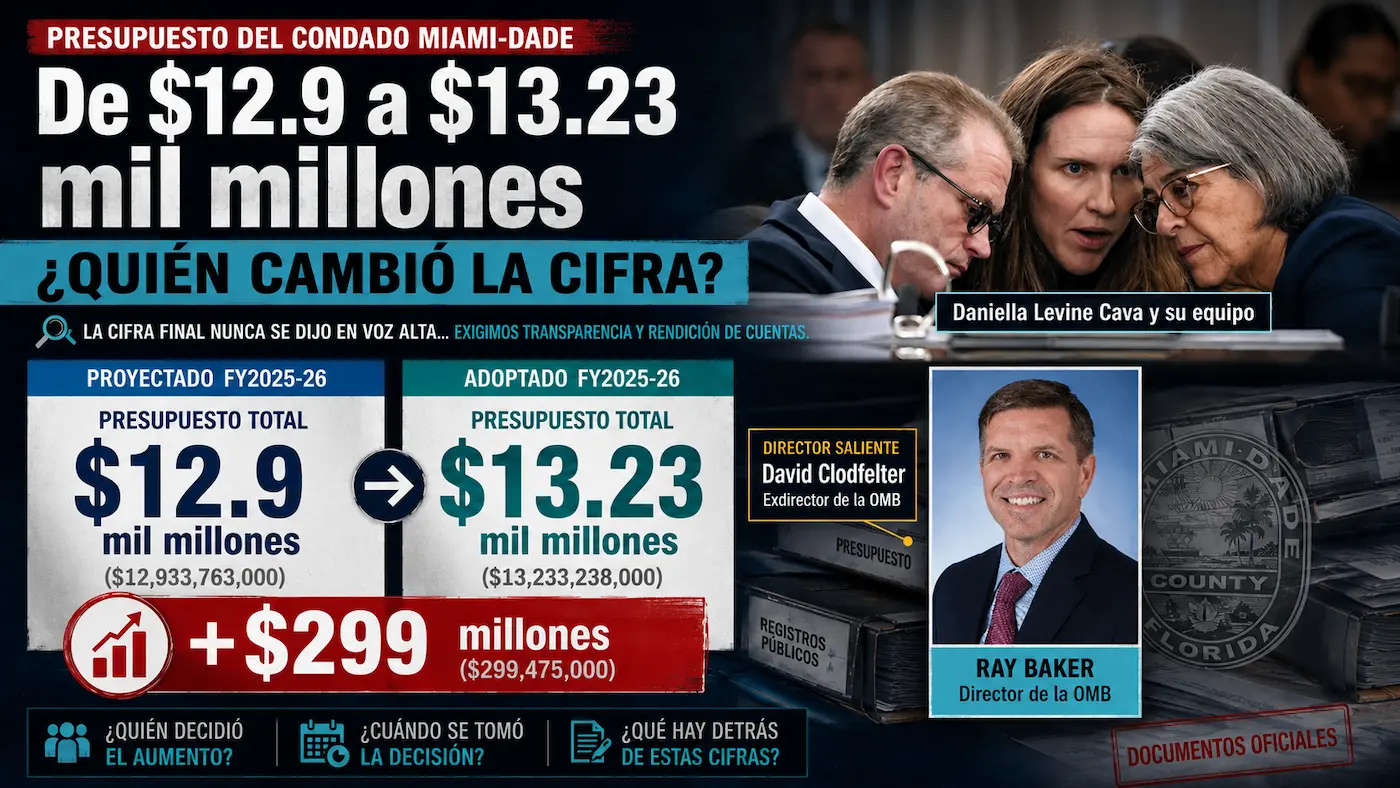
Miami-Dade FY2025-26 Budget: From $12.93 to $13.23 billion—a figure that was never made public. When did the number go up, who changed it, and were the people told?
During the 2025 budget process, the figure that dominated public discourse was $12.9 billion. The official final report lists a different figure: $13,233,238,000. Between those two figures lie $299 million, two budget directors, and a question that, on July 8, 2026, in a public meeting room in Miami Gardens, received an official response of “I don’t know”:
Why did the county approve $299 million more than what was proposed without announcing the new consolidated total at the hearing, and when will it explain this to the public?
FY 2025-26? Adopted in December?
ProposedFY 2025-26: Entire 2025 Budget Period
This is the story of the two officials who headed the budget office of South Florida’s largest county—the one who left and the one who took over—and of a handover that took place right between the night the budget increased by $299 million and the day they were called to account for that difference.
What changed: How did the total go from $12.9 to $13.23 billion?
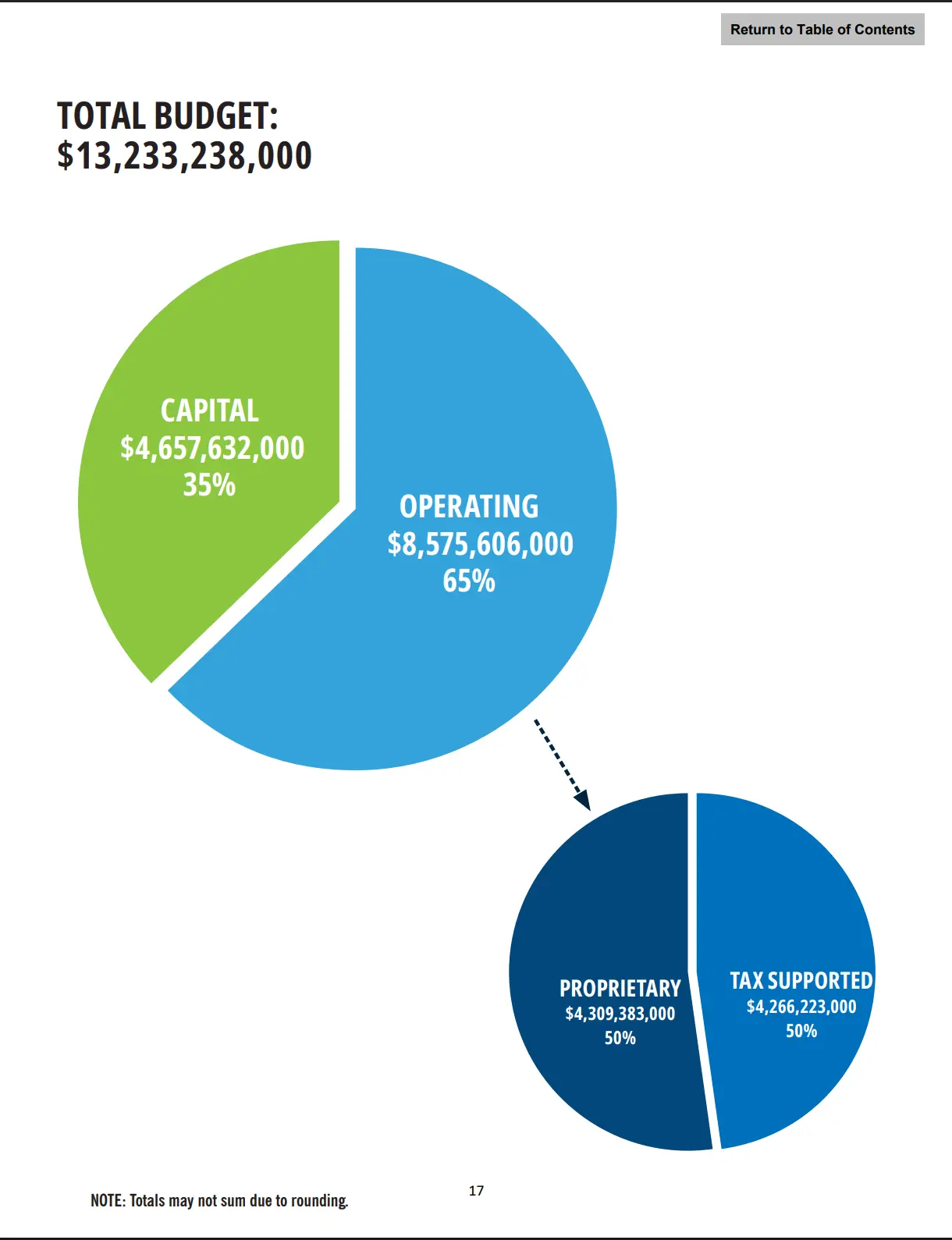
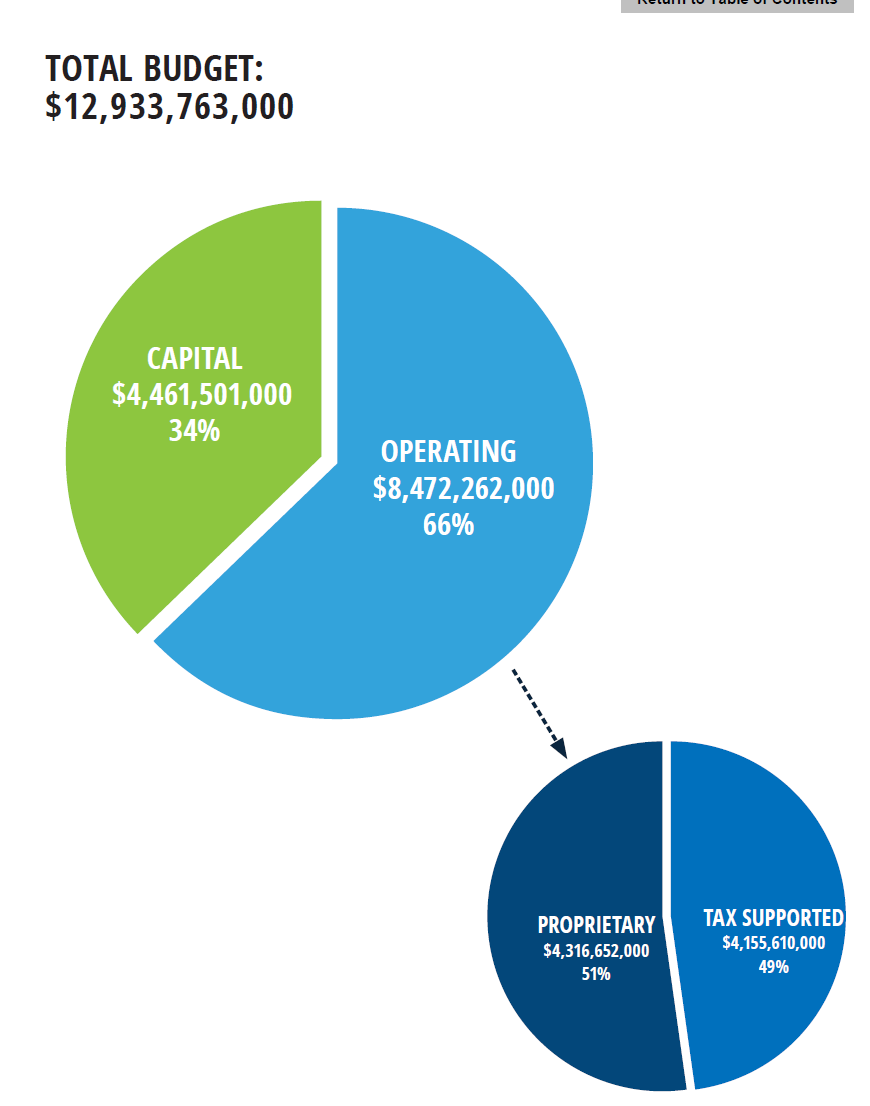
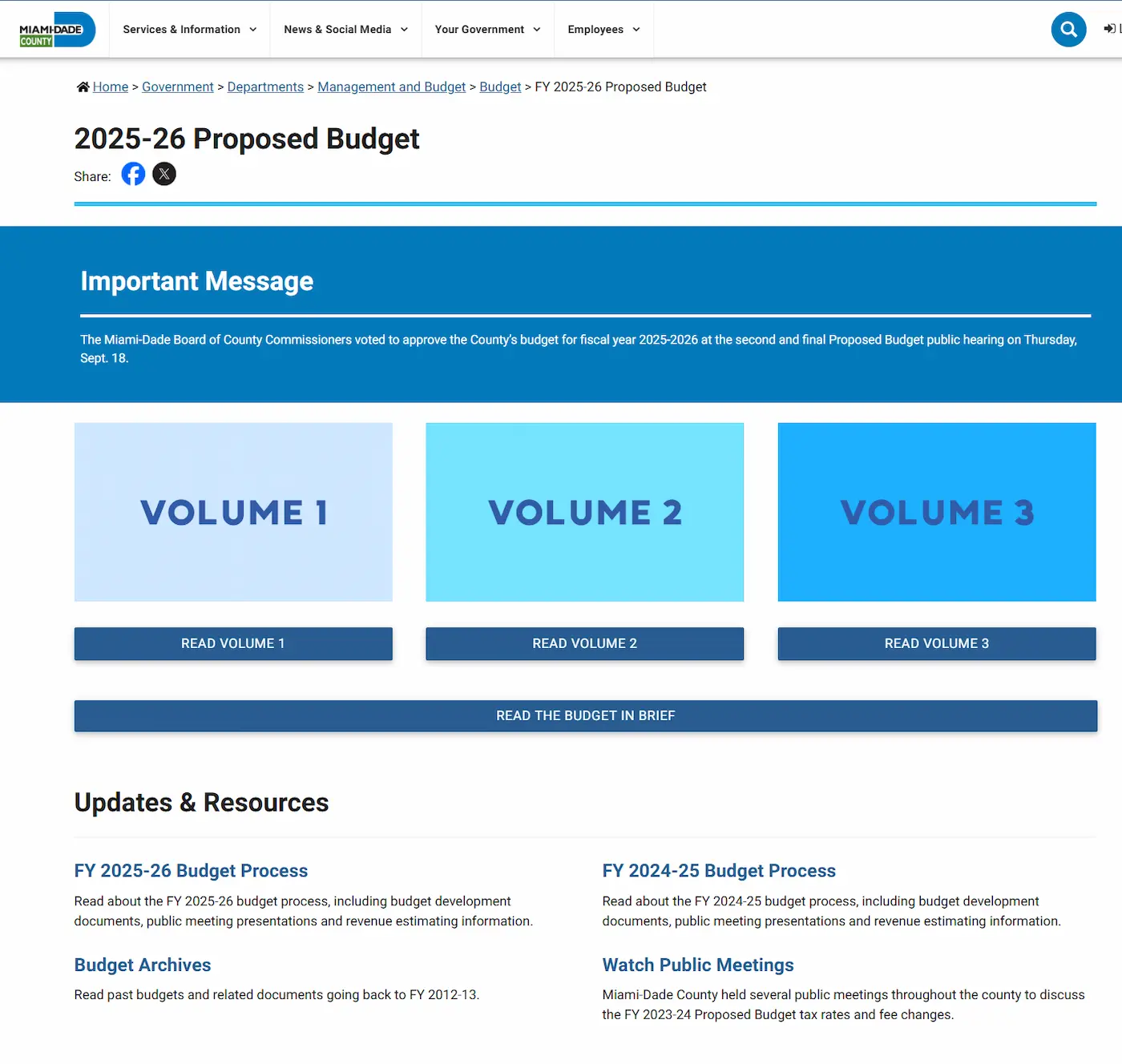
The figure that dominated public discourse throughout the entire process was $12.9 billion: the one featured in media headlines in September 2025, the one repeated at the hearings. The document proposed in July 2025 records it precisely on page 17: $12,933,763,000. But the adopted budget book—which became available after December 2025—lists the figure as $13,233,238,000 on that same page 17.
| Date | Moment | Public figure |
|---|---|---|
| July 2025 | Proposed Budget (page 17) | $12,933,763,000 |
| September 18, 2025 | Adoption by vote; the total is not announced aloud or presented as a consolidated figure at the hearing or in the ordinances | No total was given; the only downloadable grand total found by News Miami-Dade remained at $12.93 billion |
| December 16, 2025 | The Commission approved Resolution R-1226-25, proposed by Commissioner René García (filed on Nov. 21), by a vote of 13-0: it sets out in writing the deadlines for the adopted budget to be made available to each commissioner and the public | Deadline: 60 days for the public / 90 days for a printed copy. The resolution requires that a printed copy of the adopted book be provided to each commissioner within a specified time frame |
| December 22, 2025 | The adopted budget book, with the consolidated total on page 17, is posted for download on the county’s website on December 22, 2025 (Source 3); its PDF has an internal modification date of December 17 | $13,233,238,000 — more than three months after the vote |
| July 8, 2026 | The figure is announced aloud during a public session as the moderator reads the question from News Miami-Dade | “$13 billion” |
The difference between the proposed and the adopted budgets is $299,475,000 (operating budget: +$103.3 million; capital budget: +$196.1 million).
That night, the Commission voted on the ordinances in the package, which adopt the budget “as amended” by reference to two memos detailing budget changes, a supplemental memo submitted with an exemption from the Commission’s rules, and the amendments read into the record, including the $200 million in capital funding for the Seaport. But the consolidated breakdown showing that difference—exactly how much went to operating expenses and how much to capital expenditures—was not available that night.
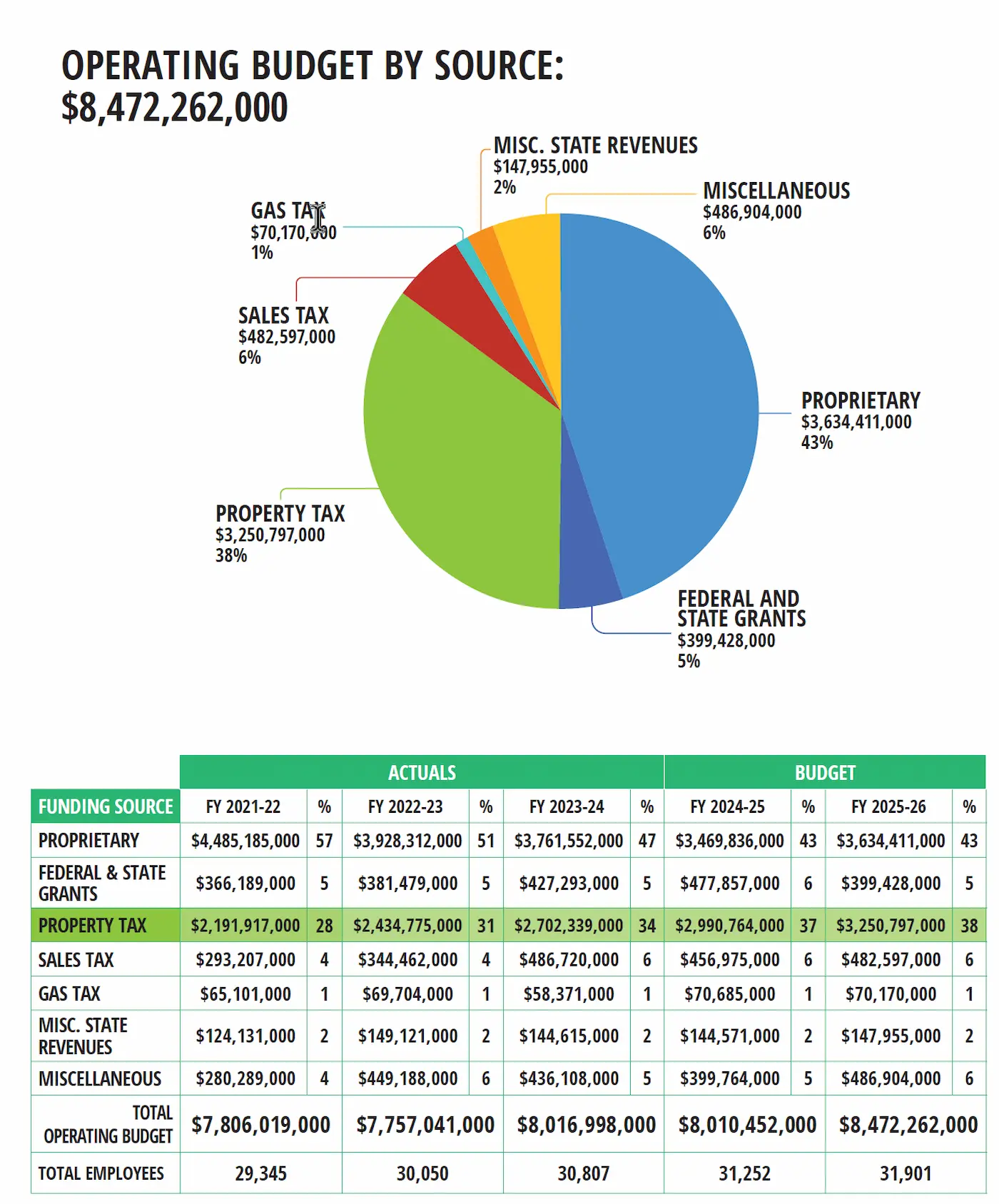
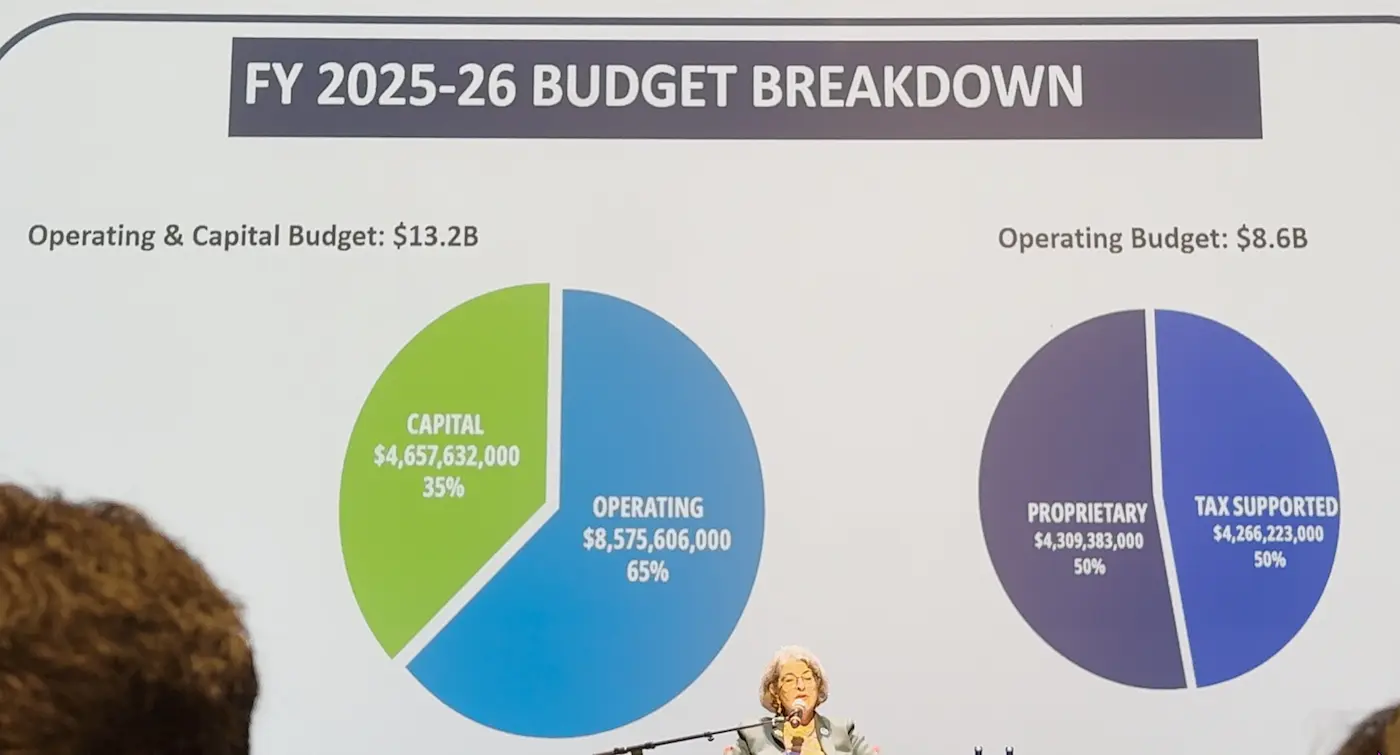
The July proposal, totaling $12,933,763,000, included its own breakdown: $8,472,262,000 for operating expenses and $4,461,501,000 for capital expenditures. The figures for the adopted budget—$8,575,606,000 for operating expenses and $4,657,632,000 for capital expenditures, totaling $13,233,238,000— appear only in the book published on the county’s website on December 22, 2025. What did not happen that night was for anyone to state aloud that the total had increased from $12,933,763,000 to $13,233,238,000.
And did everything go up by the same amount?
No. The increase is concentrated, not spread out. Of the $299,475,000, about $196.1 million is capital and $103.3 million is operating. That same night , September 18, the budget office recorded $200 million in capital funding for the acquisition of the Seaport fuel facility (fund C999); the net capital increase, $196.1 million, is about $3.9 million below that $200 million—other capital line items decreased in net terms—so News Miami-Dade does not equate the port purchase with the total increase; it merely notes that it was the most prominent line item read that night.
The operating component, on the other hand, is more difficult to trace: News Miami-Dade was unable to reconcile, line by line, with the published documents, how the operating budget went from $8,472,262,000 to $8,575,606,000. The aggregate totals match to the dollar on page 17 of the adopted budget; the line-by-line breakdown has not been published.
That capital expenditure illustrates why this point matters. When it was included in the budget adopted on September 18, 2025, the acquisition of the fueling facility had, according to the administration itself, “a structure that would allow the acquisition to pay for itself over time without spending taxpayer dollars.”
But on June 5, 2026, the mayor announced that the negotiations had failed—”the price was simply too high”—and that the county would proceed with eminent domain.
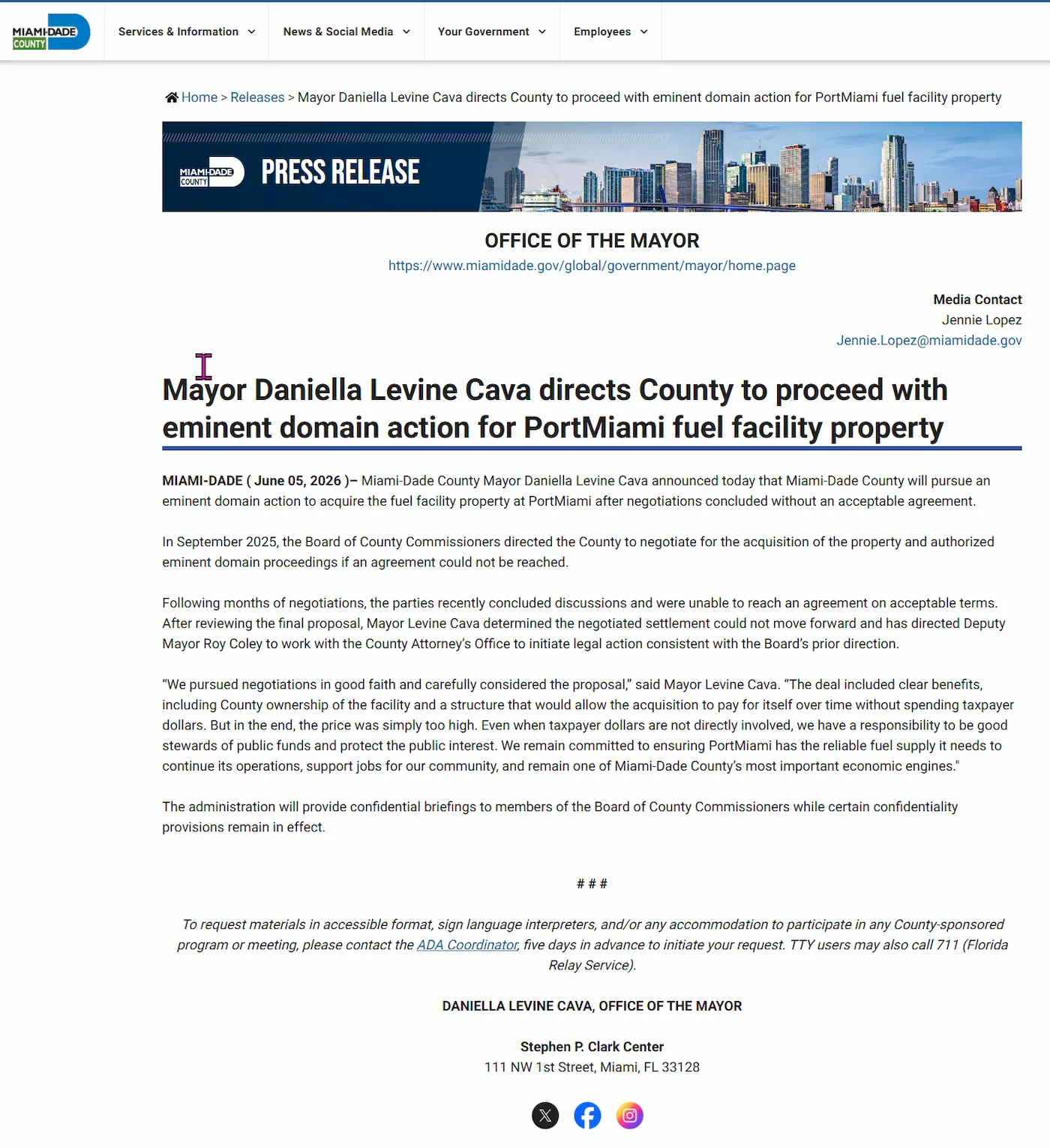
The final settlement is not determined by that budget authorization: it may result from an agreement between the parties or, if the matter goes to trial, be determined by a jury. That port settlement is the subject of a separate investigation by News Miami-Dade.
When did this come to light, and when were the people told?
According to official documents, the timeline is as follows.
On July 15, 2025, the administration—with David Clodfelter heading the OMB—presented the proposed budget: $12,933,763,000 on page 17.
On August 28 , 2025, a memo to the Commission identified $101,478 million in additional revenue and described the proposal as “a snapshot of a moment.”
The first public hearing was held on September 4, 2025.
On September 12, 2025, a second memo arrived with an additional $16,098 million, and a supplemental memo for $3,531 million was submitted so late that it required a waiver of the Commission’s rules in order to be considered.
On September 18, at the second and final hearing, the Commission adopted the ordinances in the package as amended by reference to those memos; it did not vote on a consolidated document showing the total. That document did not yet exist: it would not be submitted until December, when the Commission itself, by its resolution of December 16, had to order that it be submitted. The fact that the administration and its website refer to it as “approved” does not mean that the commissioners had before them, that night, the figure they were approving.
Was the public told? Yes and no.
The hearings on September 4 and 18 were public, and the memos were attached to the ordinances as part of the public record. But the total was never stated aloud. A review of the complete transcripts of the two hearings—the first, on September 4, consisting of 1,693 lines, and the adoption hearing on September 18, which is 3,821 lines long, confirms that the total budget figure was not stated in either: neither the $12,933,763,000 of the proposed budget nor the $13,233,238,000 of the adopted budget. What was explicitly read into the record, however, was the $200 million change in capital funding for the Seaport fuel facility.
The only reference to the overall size of the budget found by News Miami-Dade came from Commissioner René García. In criticizing the cumulative growth of the county government, García said that “the total budget has increased by $3.8 billion, which is 42%”—a historical, multi-year comparison, not an announcement by the administration regarding the current total. In that same speech, he summarized his view: “We keep on growing the size of government… It’s not a revenue problem, it’s an expenditure problem.”
García wasn’t the only one to question the figures: there were motions to cut specific line items, such as a $3,585,000 reduction in the Parks budget proposed by Commissioner Roberto González, and not all of the session’s votes were unanimous.
The consolidated total did not appear in a document available for public download until December 22, 2025, when the county posted it on its website. On September 18, the Commission adopted the amendments by reference, but no total was announced that night, and the downloadable document still showed $12.9 billion. County leadership stated it aloud for the first time, before a live audience at a meeting, on July 8, 2026—nearly ten months later.
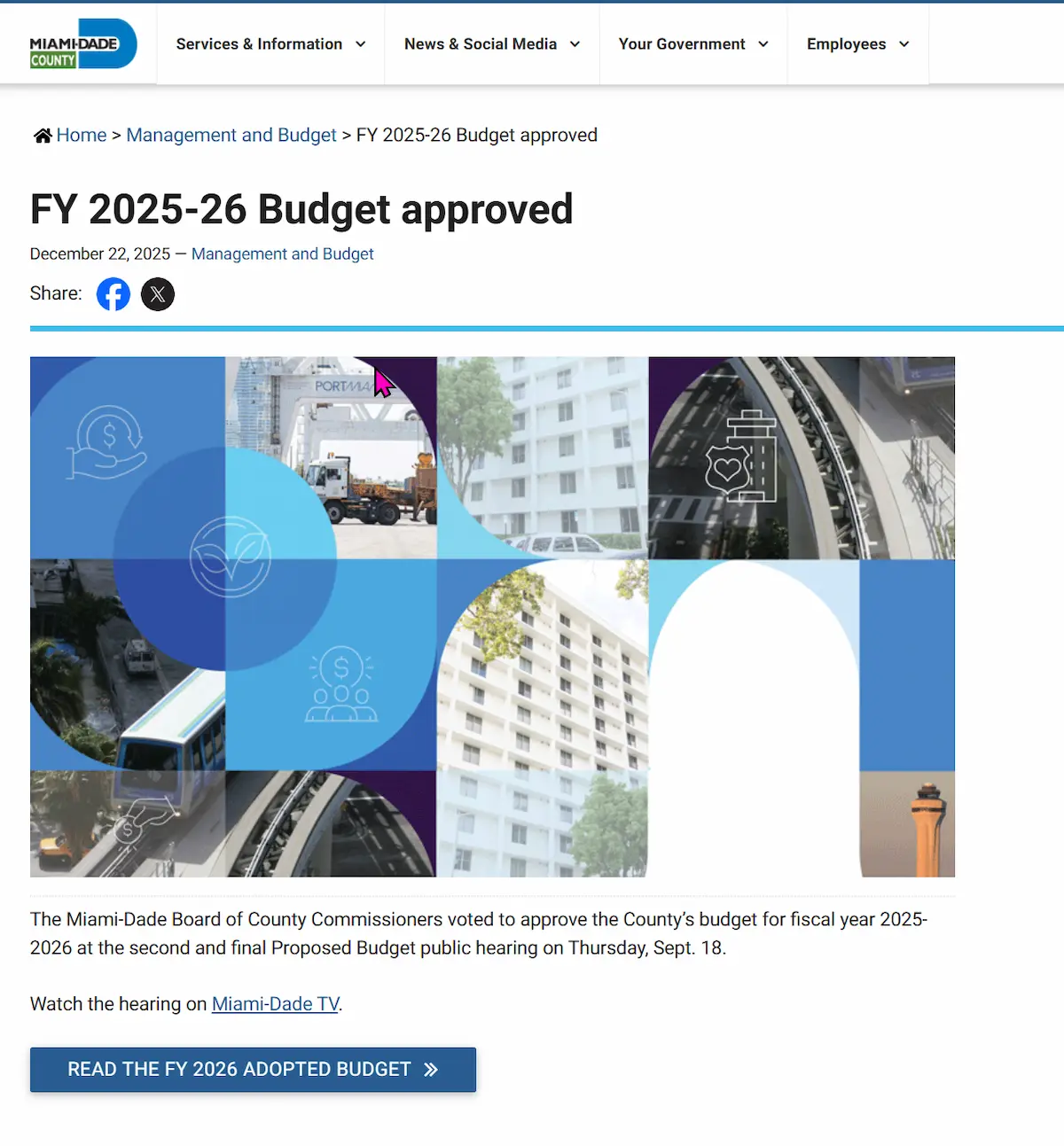
Furthermore, none of the ordinances contains a single grand total: the figure summarizing the budget was never stated in the chamber where the vote took place, and this is not a phenomenon limited to a single year—the budgets for the last three fiscal years ($11,764 million in FY2023-24, $12,760 million in FY2024-25, $13,233 million in FY2025-26)—follow the same pattern, with the grand total appearing in the budget document but not in the ordinance that the Commission actually votes on.
Didn’t anyone try to bring it down? Yes, and those cuts fell away while the total went up
On the night of the vote, there was no shortage of commissioners—among those who do vote on the budget—calling for spending cuts. The one who made this the focus of his remarks was René García, a former Florida state senator.
He put it in numbers: “The total budget has increased by $3.8 billion. That’s 42%… the number of employees has increased by 3,274… We keep expanding the size of government… it’s not a revenue problem, it’s a spending problem” (“the total budget has grown by $3.8 billion, that’s 42%… the number of employees has increased by 3,274… we keep expanding the size of government… it’s not a revenue problem, it’s a spending problem”). And he called for “putting guardrails” on the budget.

It didn’t stop at words. That night, Commissioner González introduced two motions to cut budget items and return the money by lowering the tax rate: one to cut $3,585,000 from the Parks budget—the “special community projects” line item—and another to cut $1,441,000 from the Department of Communications and Technology by eliminating vacant positions. Both were put to a straw vote and both failed: “All opposed, nay. The nays have it.”

And that set the tone for the session: a series of split votes—9-3, 10-2, 9-2, 8-2, 11-1—rather than consensus. Chairman Anthony Rodriguez had already withdrawn the transit fare increases, and the mayor had eliminated the gas tax hike. Even so, with cuts rejected and fees withdrawn, the total did not go down: it rose by $299 million, from $12.9 to $13.23 billion. This is exactly what García warned about: even if specific line items are cut, the overall budget continues to grow. The complete recording of the September 18 hearing documents each of those votes.
García’s oversight is not limited to rhetoric either. On November 18, 2025, with García as the sponsor, the Commission unanimously adopted Resolution R-1123-25 (file 252021, item 8(G)(1), prepared by the OMB), which allocates up to $35.3 million in state funds—with county matching funds of another $35.9 million—to projects related to firefighting, drainage, the environment, and housing. But it adds an unusual condition: it requires the Mayor to submit quarterly reports indicating whether those funds were spent and whether they were spent “in a manner consistent with the original funding request submitted to the State.” This same theme runs throughout this entire story: demanding accountability for public funds.
What does the law say, and was it followed?
Florida law requires that certain figures be read aloud at the hearing, not just published. The Truth in Millage Act, Florida Statute 200.065, requires that, before adopting the tax rate, the county publicly announce the millage rate and the percentage increase in the tax over the rolled-back rate. The law requires them to state the tax figure aloud. There is, however, no equivalent requirement to state aloud the total amount the county spends; that is why the total of $13,233,238,000 could be adopted without being announced.
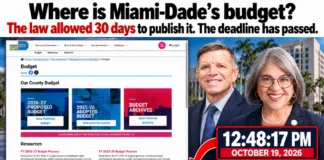
As for the document itself, Florida Statute 129.03 contains two distinct requirements: Section 129.03(3)(b) requires that the published summary of the tentative budgets show the total of all budgets; and Section 129.03(3)(c) requires the final budget to be published on the county’s official website within 30 days of its adoption. The vote took place on September 18, 2025.
The legislative record shows that the Commission itself established in writing the availability of the book. On November 21, 2025, more than 60 days after adoption, Commissioner René García filed a resolution (Matter 252354) requiring the reporting of the exact dates on which the adopted budget was published and on which printed copies were distributed.
On December 16, the Commission approved the amended version, Resolution R-1226-25, by a unanimous vote of 13 to 0, drafted by García himself: it establishes as county policy that the final budget must be made available to each commissioner and the public no later than 60 days after adoption, directs the mayor to submit a written report if this requirement is not met, and requires a printed copy within 90 days. Its recitals cite Florida Statute 129.03 itself and acknowledge that it requires the final budget to be published within 30 days: the resolution neither replaces nor extends that state deadline.
When you look at the dates, the requirements are clear—all counted from the second hearing on September 18, 2025: state law required the final report to be posted online within 30 days, by around October 18; García’s resolution added, as county policy, 60 days for public availability, through November 17, and 90 days for the printed copy to be provided to each commissioner, through December 17.
And that begs the question: Why did a commissioner have to issue a regulation regarding the delivery of a book that the law already required to be published? Because when García pushed for the resolution, the state deadline of October 18 had already passed, and the resolution itself was created to compel the authorities to provide, in writing, the exact dates of publication and delivery: if the final book had been available on time, there would have been no need to legislate its delivery. That resolution is, in and of itself, institutional evidence that the document’s availability was not considered a settled matter.
And it wasn’t just one commissioner: García sponsored it, Commissioner Vicki López proposed it, and Commissioner Danielle Cohen Higgins seconded it, and all thirteen commissioners approved it unanimously. What’s more, the resolution was approved on December 16, even though its own 60-day deadline—November 17—had already expired. The Commission ultimately ordered, unanimously, the submission of a report that the law had mandated be published nearly two months earlier.
Were the deadlines missed? News Miami Dade does not make that determination—that is up to an auditor or the county itself— but the facts point in one direction: the state’s 30-day deadline expired around October 18, 2025; News Miami Dade could not locate any document published within that timeframe; and in December, the thirteen commissioners unanimously had to order the release of the budget book. The best evidence that the book was not submitted on time does not come from News Miami Dade—it comes from the commissioners themselves. If Miami-Dade published the final budget on time, it is up to them to produce the document showing its publication date.
What about the deficit? Where did the money come from to cover it?
There is a figure related to the FY2025-26 budget process that should not be confused with the $299 million increase in the grand total. The earliest fiscal snapshot of the year, as of May 1, 2025, already quantified the general fund shortfall: a chart from the Office of the Mayor titled “Projected Budget Gap” shows revenues and carryover totaling $3,246,194,000 compared to expenditures of $3,633,306,000—that is, a projected deficit of $387,112,000.
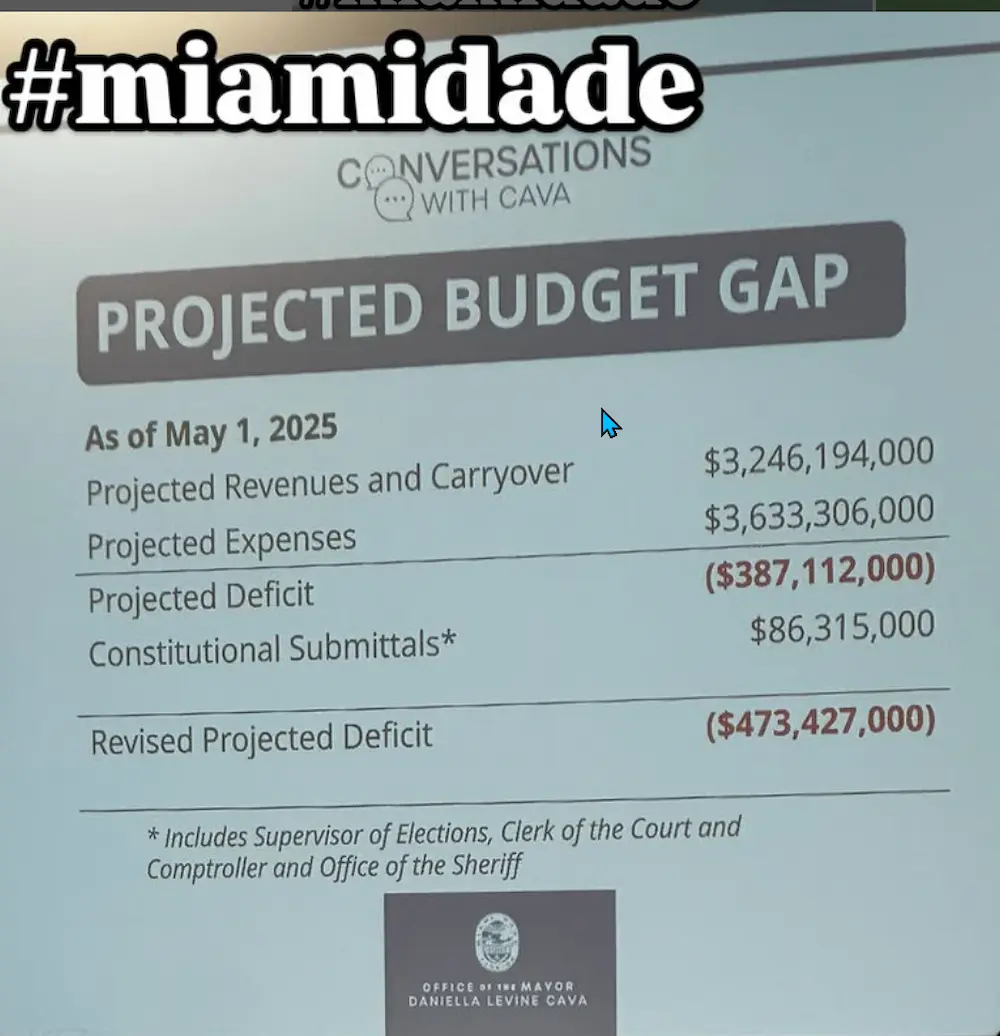
When the requests from the constitutional offices—the Sheriff, the Clerk, and the Supervisor of Elections—totaling $86,315,000 were added, the revised deficit reached $473,427,000. News Miami Dade obtained this slide by photographing it during the public session “Conversations with Cava” on May 1, 2025, when it was shown to the public: the data makes it clear that the budget year began with a deficit that had already been quantified and made public.
From there, the figure went down. In its memo for the first hearing (August 28, 2025), the OMB cited a general fund shortfall of about $402 million—a snapshot of the same problem on a different date, not the same reconciled figure.
That deficit did not make it into the adopted budget, because the law requires the adoption of a balanced budget: it was closed out with spending measures (mergers, hiring freezes, and cuts) already reflected in the July proposal, plus additional revenue sources and carryovers identified in the memos—about $101,478 million on August 28, $16,098 million on September 12, a supplemental appropriation of $3,531 million, and carryovers from departments such as Fire Rescue. This is a legal and standard procedure.
It’s important to distinguish this from the change in the total: the shortfall in the general fund was covered by identified revenues and cuts; the $299 million increase in the grand total is a different story, driven primarily by the capital side. These are two separate issues that should not be confused: one is how the operating deficit was closed; the other is why the total increased.
How much does the county spend? The auditor and the administration don’t agree on the figure
There is one factor that reinforces all of the above from within the county itself. On April 15, 2026, before the Intergovernmental & Economic Impact Committee, the Office of the Commission Auditor—the audit body that reports to the commissioners, not to the administration—presented a new budget dashboard, as mandated by Resolution R-1087-25, and reported that it was still reconciling the figures: “we are seeing some discrepancies” between what the Commission approved and what was entered into INFORMS, the county’s accounting system.
That dashboard wasn’t created as a matter of routine. The resolution that mandated it, R-1087-25, set forth the reason in writing: the administration had been submitting quarterly financial reports late—those for the first and second quarters of fiscal year 2024–25 arrived on August 15, 2025, “well past the required deadline” —a delay that, in the resolution’s own words, “hinders and impairs the Board’s ability to exercise its oversight.” For this reason, the Commission had to order the Mayor to provide real-time access to the county’s financial data, with a dashboard that was to be operational by February 28, 2026. The first version was not presented until April 15.
Then came the revealing exchange. Commissioner Danielle Cohen Higgins asked the Commission Auditor, Yinka Majekodunmi, simply what the county’s budget is. The answer: her office’s estimate of actual total spending is around seventeen billion. “We passed a budget of $13.23 billion just a few months ago… and now it’s $17 billion?” she replied. A gap of nearly four billion between the figure the Board voted on and the one calculated by its own auditor.
The auditor framed it as a matter of presentation, not of lost funds: the total of 13 billion uses a different calculation than simply adding up each department’s expenditures, which would yield a higher figure due to double-counting across funds. His example was the Department of Technology, which appears as about twenty-six million in the family figure but is “closer to 300 million than the 26 million” when all the transactions paid to it by other departments are counted.
The administration presented its version of events during the same session. Chief Administrative Officer Carladenise Edwards maintained that the difference is fully accounted for in the approved budget: the 13.2 billion represents annual operating expenses by department—excluding inter-agency revenues to avoid double-counting— and the remainder consists of non-operating expenses, debt service, distributions to trust funds, intra-agency transfers, reserves for bond covenants, and capital transfers. When asked the same question, she replied 13.2 billion. Neither the auditor nor the administration alleges embezzlement: both describe it as a matter of methodology.
But one gap remained unaddressed. The Comptroller’s office, through Barbara Galvez, noted that the data on the dashboard had not been validated against the county’s financial systems. And the committee chair, Natalie Milian Orbis, concluded by saying that the presentation had left “more questions than answers.” The takeaway for residents is the same as throughout this entire story: when asked the most basic question—how much does the county spend?—three officials gave different figures on the very same day. News Miami-Dade is preparing a separate piece on this dashboard and the $4 billion discrepancy.
Who approved it, and who is responsible?
The adopted FY2025-26 budget was approved by the Board of County Commissioners (BCC) at the second hearing on the evening of September 18, 2025, through the package of ordinances, including Ordinance 25-93 (countywide general fund), 25-95 (UMSA), and 25-98 (the 970-page fund-by-fund appropriation schedules). The mayor’s administration, through the OMB under Clodfelter, prepared and recommended the budget; the Commission reviewed, amended, and adopted it by vote. The mayor recommends the budget and may veto legislation, but she is not the Commission’s fourteenth vote.
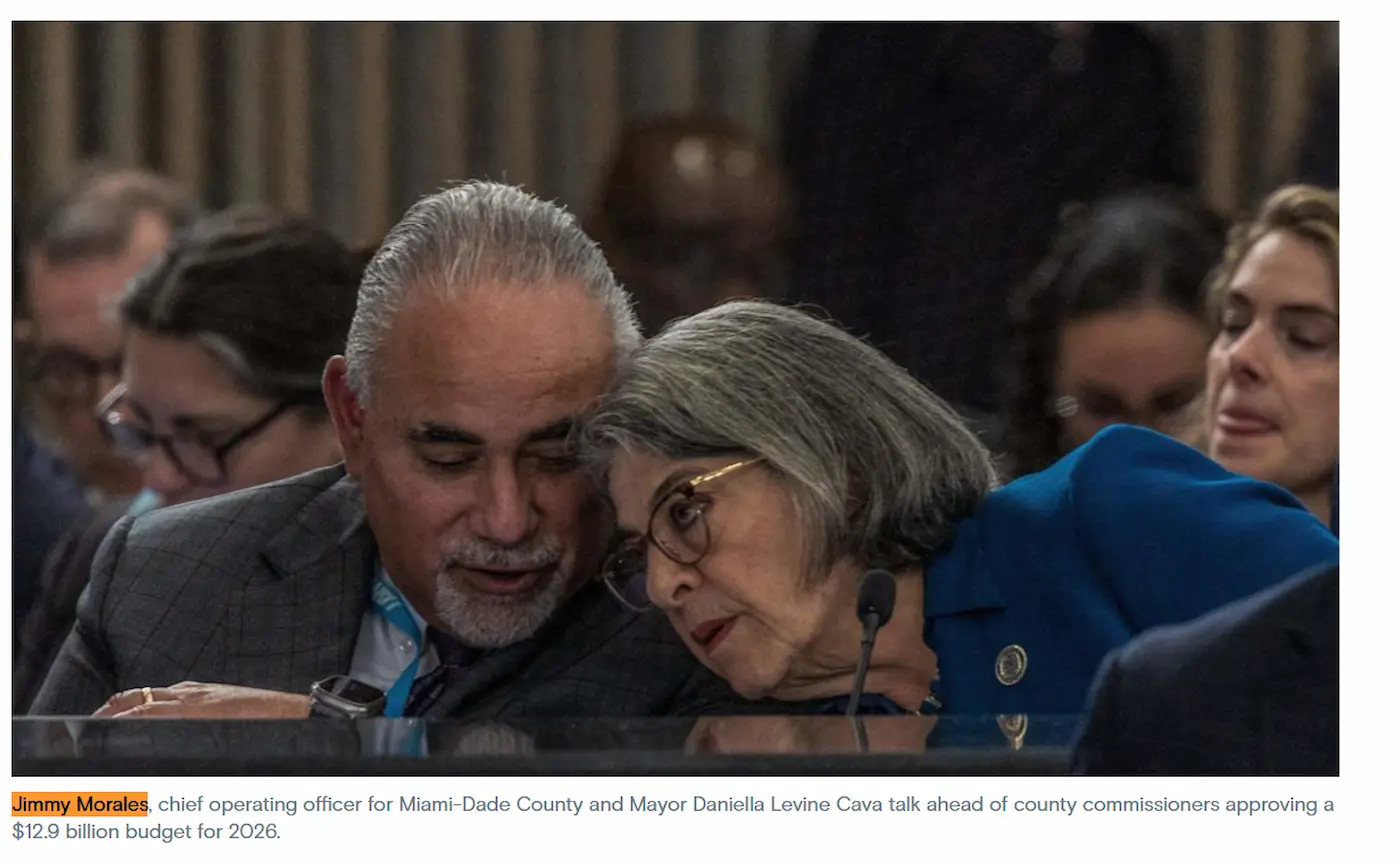
News Miami-Dade reviewed the eight ordinances in the package: the figure of $13,233,238,000 does not appear in any of them, nor does the proposed amount of $12,933,763,000.

The five millage ordinances merely set rates; the three appropriation ordinances adopt the budget “as amended” by reference and allocate appropriations fund by fund.
Nor can they be added together: the schedules include transfers between funds; for example, the Sheriff’s Office receives $377.7 million from the general fund and $545.1 million from the UMSA, which results in double counting. The total appears consolidated only on page 17 of the adopted book. If the county maintains that it previously published another document containing the final total, it must identify that document by its date and publication record.
David Clodfelter: Who He Is and What He Did with This Budget

Administrative responsibility is identified in the budget book itself. News Miami-Dade downloaded the adopted FY2025-26 budget book, Volume 1, from the county’s website. The cover lists Mayor Daniella Levine Cava as the responsible official and David L. Clodfelter as director of the Office of Management and Budget, with Jorge M. Fernández as deputy director and Carlos Maxwell as assistant. In other words, the budget official listed as responsible for the adopted budget is Clodfelter—the same person who put it together—weeks before he leaves office in January 2026. Page 17 of that book, verified directly by News Miami Dade, lists the total as $13,233,238,000.
David Clodfelter served as Chief Budget Officer and director of the Miami-Dade OMB until January 2026; the OMB director’s memo from December 2021 (Source 7) confirms that he was already in that position at the time, and local coverage of his departure (Source 13) details a career spanning more than three decades in county government. It was his office that, on the night of September 18, entered the $200 million in capital for the Seaport into the official record.
Four months later, in January 2026, Clodfelter was reassigned to the position of Senior Strategic Advisor; the website Political Cortadito described his departure as that of an official who had “become a scapegoat.”
Ray Baker: Who He Is and What He Has to Say Today

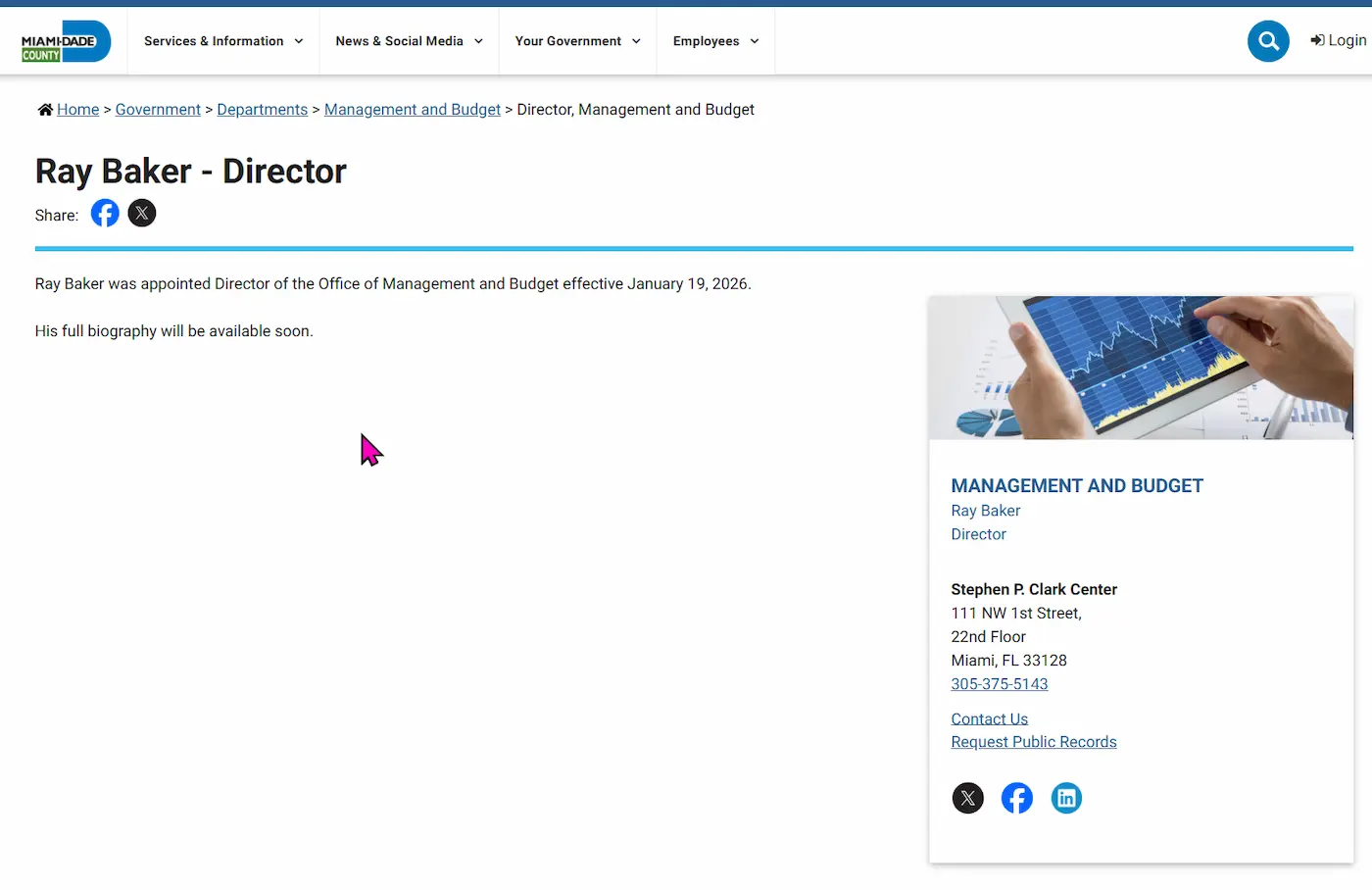
On January 19, 2026, Ray Baker took office as director of the OMB. The FY2026-27 budget, which the mayor is presenting this month, marks his first full budget cycle at the helm of the office. According to local media reports, Baker had been directing the county library system since 2017; the same report notes that he previously worked in the budget office.
Almost six months after his appointment, his official profile still states that “his full biography will be available soon.” That library system operates as a district with its own tax levy and about 50 branches; the comparison does not call his credentials into question, but simply highlights the difference in scale compared to the $13.2 billion county budget he currently manages.
On July 8, 2026, during the second public session of the “Conversations with Cava” series at the North Dade Regional Library in Miami Gardens, the moderator read aloud—via Zoom—the question from News Miami-Dade: Last year, the July proposal was for $12.93 billion; the adopted budget states $13.23 billion—$299 million more—and no ordinance specifies the final total. When will residents hear the final figure announced aloud before the vote? The mayor thanked “this very attentive reader of our budget” and turned the floor over to Ray Baker.
The budget director’s response, word for word, was: “I don’t know that we were aware of any discrepancy in the overall budget numbers that were adopted.” Baker added that the July budget “does vary a little bit” from the one adopted in September, and said: “I would be more than happy to talk to her about where she’s seeing that discrepancy.”
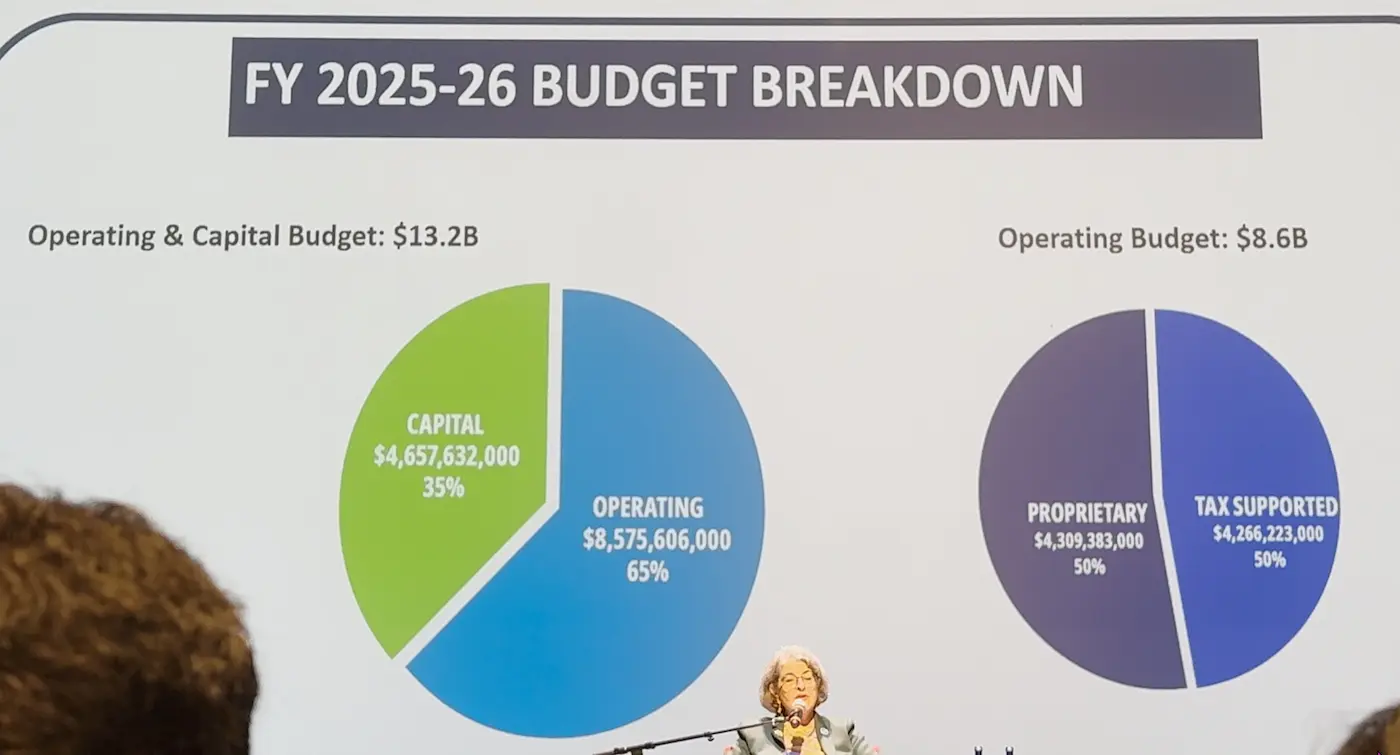
Two facts provide context for that response. Baker was not in office when the number changed: she inherited it as it was printed, and she took office on January 19, 2026—four months after it was adopted. And there is a date in the public record: two days earlier, at the first “Conversations with Cava” session on July 6, the mayor’s office itself had projected a slide breaking down the adopted budget into $13.2 billion ($8,575,606,000 in operating funds and $4,657,632,000 in capital funds)—the same figures as on page 17 of the budget book. In other words, the administration had already publicly presented that breakdown two days before its director responded that he was unaware of any discrepancy.
News Miami-Dade received that offer in writing. On July 9, 2026, the editorial staff mailed Director Baker—with a copy to the mayor—a formal request for the reconciliation table between the proposed and adopted totals and for a line-by-line breakdown of the $103.3 million operating increase. As of the publication of this article on July 16, 2026, the OMB had not provided the table that its own director had publicly offered, and the mayor’s office had sent only an automated response.
Why does it matter: What changes for residents?
Because this month the administration is presenting a new budget, and it is Baker who will present and defend it. Last year’s pattern serves as a warning: between the figure proposed in July and the printed budget, there were two memos—a supplemental memo with a waiver and $200 million—that were read aloud on the night of the vote. Residents who speak at the September hearings will be commenting on a figure that, like last year, could legally increase that very night by reference, without anyone stating the total. Knowing who puts those figures together, where they come from, and what they said when asked about the discrepancy is part of holding them accountable.
Who cares if the figure is a few hundred million more or less, and who does it hurt? The residents. The grand total is a measure of how much the county spends in public funds, and a difference of this magnitude funds actual services. When a neighbor speaks at the September hearing, they’re commenting on a number that could still change that very same night; when the new total is announced verbally at a public meeting nearly ten months later, there’s no longer a budget hearing where they can object to it.
And since the county does not publish a line-by-line reconciliation, the public cannot independently verify how each adjustment resulted in the $103.3 million operating increase and the $196.1 million capital increase. This lack of transparency does not cost those who prepare the accounts—it costs those who pay for them.
Open-ended questions
1. Will the OMB, under the direction of Ray Baker, publish a reconciliation table showing how the proposed budget of $12,933,763,000 became the adopted budget of $13,233,238,000?
2. What is the line-by-line breakdown of the $103.3 million increase in operating expenses between the proposal and the adopted budget, which is not disclosed in any document?
3. What public review took place prior to the $200 million purchase of the Seaport fuel facility—the most visible capital expenditure in the budget increase—before it was read into the record on the night of the vote?
4. Will the FY2026–27 process include, at any public hearing prior to the vote on adoption, a presentation of the final total budget as amended?
5. The state’s 30-day deadline for publishing the final budget expired around October 18, 2025. What document containing the consolidated total did Miami-Dade publish within that deadline, or was the deadline missed, given that in December the thirteen commissioners still had to unanimously order the submission of the budget book?
6. Ray Baker headed the county library system (a district with its own millage) and, according to his profile, previously worked in the budget office; his first full term as head of the OMB is the proposed budget for FY2026-27, which the administration is presenting this month. What position did Baker previously hold within the OMB, for how many years, and with what responsibilities, and what steps has he taken to ensure a public reconciliation between the proposed and adopted budgets?
7 . Will the OMB publish a complete reconciliation that shows, fund by fund and line item by line item, how the proposed budget of $12,933,763,000 was arrived at to reach the official total of $13,233,238,000?
Sources consulted
Level 1: Official Sources
1. Miami-Dade County, Office of Management and Budget. Official profile of Ray Baker, director of the OMB; appointment effective January 19, 2026. Details: Director of the library system since 2017; Master’s degree in Library and Information Science (University of South Florida) and MBA (University of Miami); “his full biography will be available soon.”
2. Miami-Dade County, BCC. Legistar Case No. 260038, appointment of Ray Baker as director of the OMB (memo to Chairman Anthony Rodríguez, January 6, 2026).
3. Miami-Dade County. Proposed Budget FY2025-26, Volume 1, page 17: “TOTAL BUDGET: $12,933,763,000” (retrieved from the Internet Archive, snapshot from August 1, 2025; the PDF is no longer available on the county’s live website; the original URL returns a 404 error). Adopted Budget FY2025-26, Volume 1, page 17: “TOTAL BUDGET: $13,233,238,000,” verified directly by News Miami Dade against the PDF downloaded from the county’s live website; its cover page lists Mayor Daniella Levine Cava and OMB Director David L. Clodfelter (Deputy Director Jorge M. Fernández, Assistant Carlos Maxwell). Totals from previous years verified against the text in the volumes: FY2023-24 “$11,764,183,000” and FY2024-25 “$12,759,799,000.”
4. Miami-Dade County, BCC. FY2025-26 budget package ordinances adopted on September 18, 2025, with attached amendment memos: 252317 (Ordinance 25-93 + memo dated August 28), 252318 (Ordinance 25-95), 252319 (Ordinance 25-98). News Miami Dade reviewed the eight ordinances in the package: the total of $13,233,238,000 does not appear in any of them, and the fund-by-fund appropriations include inter-fund transfers that prevent them from being added to the total.
5. Official record of the BCC’s two budget hearings for FY2025-26: the first hearing on September 4, 2025 (BCC First Budget Hearing) and the second hearing, at which the budget was adopted, on September 18, 2025 (recording on Granicus/Legistar; copies in the News Miami Dade archive), with their transcripts fully transcribed by News Miami Dade (1,693 and 3,821 lines, respectively). Verified finding: The total budget figure was not stated at either hearing; the $200 million amendment for the Seaport fuel facility was read into the record (fund C999, timestamp 13m42s–14m06s). The only reference to the total amount was made by a commissioner (timestamp 4h25m08s), not by the administration.
6. Full recording of the second public session of the “Conversations with Cava” series for the FY2026-27 cycle (Miami Gardens, July 8, 2026, ~1 hour 55 minutes), produced by News Miami Dade; copy on file with News Miami Dade. Verified transcript with timestamps: The moderator read aloud the question submitted by News Miami Dade on behalf of its editor, Isel Rodríguez [52m00s–52m35s]; Ray Baker responded, “I don’t know that we were aware of any discrepancy in the overall budget figures that were adopted,” noting that the July budget “does vary a little bit,” and “I would be more than happy to talk to her about where she’s seeing that discrepancy” [52m50s–53m11s].
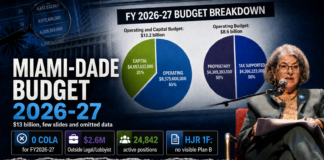
The deficit figures ($387,112,000 projected deficit, $86,315,000 in constitutional submittals, $473,427,000 revised deficit) come from the slide titled “Projected Budget Gap” that the Office of the Mayor presented to the public at the first “Conversations with Cava” session on May 1, 2025, photographed there by the editor of News Miami-Dade; the data is current “as of May 1, 2025.” During those same sessions in July 2026, the Office of the Mayor presented a slide titled “FY 2025-26 Budget Breakdown” showing an operating budget of $8,575,606,000 (65%) and a capital budget of $4,657,632,000 (35%).
7. Miami-Dade County, OMB. Director’s memorandum on the FY2022-23 budget process, signed by David L. Clodfelter as director of the OMB (December 2021), primary source regarding his position and career history.
8. News Miami-Dade. Written request to OMB Director Ray Baker, with a copy to Mayor Daniella Levine Cava, sent on July 9, 2026, as a follow-up to the offer Baker made at the public meeting on July 8: requests a reconciliation table between the proposed and adopted totals and a line-item breakdown of the $103.3 million operating increase. No substantive response as of July 16, 2026; only an automated reply from the mayor’s office. A copy of the email is on file with News Miami-Dade.
9. State of Florida, Legislature. Florida Statute 200.065 (Truth in Millage). Florida Statute 129.03, verified against the official text: Section 129.03(3)(b) requires that the published summary show the total of all budgets; Section 129.03(3)(c) requires the final budget to be posted on the county’s website within 30 days after its adoption (“within 30 days after adoption”).
10. Miami-Dade County, BCC. Resolution R-1226-25 (Matter 252508, Agenda Item 11(A)(5)), adopted by a unanimous vote of 13 to 0 on December 16, 2025; Prime Sponsor Commissioner René García, introduced by Commissioner Vicki López and seconded by Commissioner Danielle Cohen Higgins. It establishes 60 days for public availability and 90 days for the printed copy; its recitals cite Florida Statutes 129.03(3)(c) and 218.35(4). The original version (matter 252354) set a period of 30 days. The video recording of the December 16, 2025, session confirms the amendment to Item 11(A)(5) and its approval; transcript read by News Miami-Dade.
11. Miami-Dade County, Office of the Mayor. Official press release dated June 5, 2026, “Mayor Daniella Levine Cava Directs County to Proceed with Eminent Domain Action for PortMiami Fuel Facility Property.” It confirms verbatim the mayor’s statements (“the price was simply too high”) and the structure that “would allow the acquisition to pay for itself over time without spending taxpayer dollars.”
12. Miami-Dade County, BCC. Intergovernmental & Economic Impact Committee, meeting of April 15, 2026 (official agenda, Meeting Key 5497; item 1E1, Legistar file 260659, “Presentation by the BCC Commission Auditor on the County Budget Dashboard Directive,” sponsored by Commissioner Danielle Cohen Higgins). Official Granicus recording (on-screen date identifier 04/15/26); full 1-hour, 41-minute recording in the News Miami-Dade archive, with transcript. Committee roster verified against the agenda: Natalie Milian Orbis (chair), Vicki López (vice chair), Danielle Cohen Higgins, René García, and Roberto González.
Primary sources for this section: the official Legistar report 260659 (meeting minutes) and the verbatim transcript of the Granicus recording, 100% transcribed by News Miami Dade, which includes the verbatim quotes “we are seeing some discrepancies” (the auditor) and “more questions than answers” (committee chair Natalie Milian Orbis).
Verified verbatim quotes with timestamps: Commission Auditor Yinka Majekodunmi put the actual total expenditure at close to $17 billion compared to the approved $13.23 billion, and illustrated this with the Department of Technology (“closer to 300 million than the 26 million”). Chief Administrative Officer Carladenise Edwards attributed the difference to non-operating expenses, debt service, trust funds, intra-agency transfers, reserves, and capital, and put the approved total at $13.2 billion. Barbara Galvez (Comptroller, COCC) noted that the dashboard data had not been validated against the county’s financial systems. The dashboard was created by Resolution R-1087-25. Neither the auditor nor the administration alleges embezzlement; both describe it as a matter of methodology.
13. Miami-Dade County, BCC. Legistar Matter 252021, adopted as Resolution R-1123-25 (Agenda Item 8(G)(1)) on November 18, 2025, by a unanimous vote of 12 to 0 (District 5 vacant); offered by Commissioner Oliver G. Gilbert III and seconded by Vice Chair Kionne L. McGhee, on behalf of the Prime Sponsor, Commissioner and former State Senator René García; prepared by the Office of Management and Budget.
Authorizes state funds from the 2025 legislative session (up to $35,293,244, with county matching funds of up to $35,874,244) for the projects listed in Exhibit A, and Section 5 directs the County Mayor to submit quarterly reports to the BCC indicating whether those funds were spent and, if so, whether they were spent “in a manner consistent with the original funding request submitted to the State.” Verified by News Miami-Dade against the official minutes (252021min) downloaded from the Legistar website.
14. Miami-Dade County, BCC. Legistar Matter 251954, adopted as Resolution R-1087-25 (Agenda Item 11(A)(2)) on November 4, 2025, Prime Sponsor Commissioner Danielle Cohen Higgins. Amends Resolution R-73-07 (2007) and directs the County Mayor to provide the Commission Auditor with real-time access to the systems the county uses to monitor operating revenues and expenditures, carryovers, authorized positions and vacancies, and actual financial data for each department; and directs the development of an operational Budget Dashboard no later than February 28, 2026.
Its recitals state that the administration submitted quarterly financial reports late (those for the first and second quarters of FY2024-25 were submitted on August 15, 2025, “well past the required deadline”), which “hinders and impairs the Board’s ability to exercise its oversight responsibilities.” This is the resolution that led to the dashboard presented on April 15, 2026 (Source 12). Read by News Miami-Dade from the PDF downloaded from the Legistar portal.
Level 2: Verified Sources
15. Political Cortadito, January 7, 2026: coverage of David Clodfelter’s departure from the OMB and Ray Baker’s arrival from the library system.
16. Miami Today, July 1, 2026: “Ray Baker: Leading the County’s Budget Operations in a Difficult Financial Era,” a profile of Baker.
17. Miami Herald, Editorial Board, January 16, 2026: “Miami-Dade Kicked the Can Down the Road. A New Budget Chief Won’t Change That” (syndicated on MSN).
Disclaimer
News Miami Dade provides the original sources for public hearings, Legistar documents, memos from the County Attorney’s Office, recommendations from staff at the Department of Regulatory and Economic Resources, Granicus files, and records from the Florida Division of Elections and the Miami-Dade Commission on Ethics. Each factual claim is grounded in its identifiable primary source; positions are cited with the source and verbatim when available.
This article is based on Miami-Dade County’s proposed and adopted budget documents, the OMB’s official profile, the adopted ordinances along with their attached memos, Commission resolutions, and the full recording of the public session held on July 8, 2026, produced by News Miami-Dade. Each factual claim is anchored to its source with a page number, section, or timestamp. The article describes the public careers of two officials in the exercise of their public duties and documents a budget process; it does not allege any illegality, and the amendment mechanisms described are those established by the ordinances themselves and by Florida law.
Stay up to date with the latest news!
Would you like to get more information like this right on your screen? Visit our homepage and find out everything that’s happening in South Florida: local news, events, and much more. 👉 Click here! Don’t miss a thing. #MiamiDade #News #Florida