
Miami-Dade County Budget for 2026–27: +$13 billion, few slides, and omitted data. What numbers did the mayor present?
At the first “Conversations with Cava” session on July 6 in Cutler Bay, Mayor Daniella Levine Cava presented a handful of slides to discuss a budget of more than $13 billion that did not yet exist as a public document. She was corrected twice by her own staff and acknowledged that her notes did not match the numbers on screen.
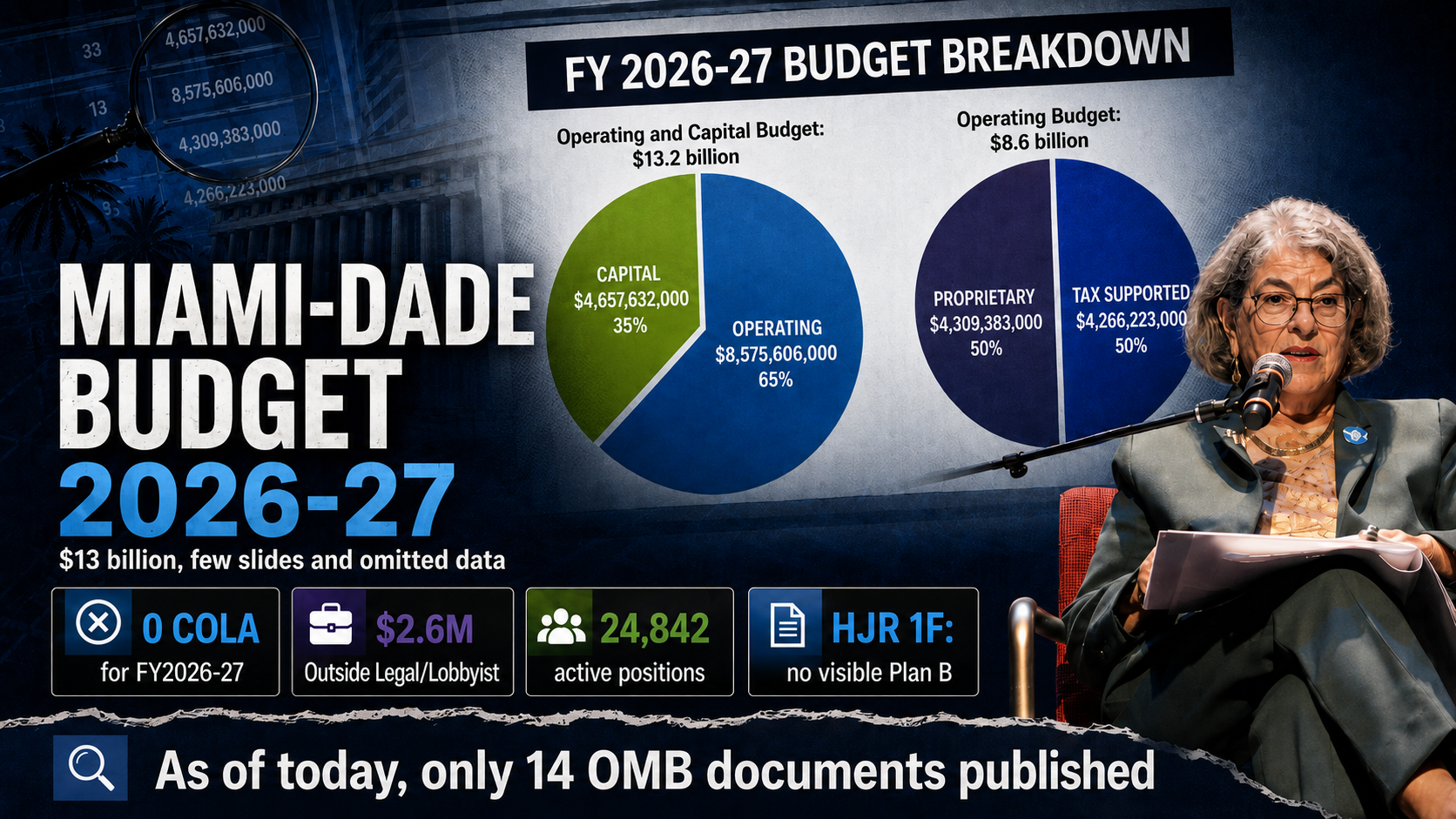
The 14 technical OMB documents analyzed by News Miami Dade before the event reveal zero COLA — no general cost-of-living adjustment — for the 24,842 active employees on the county payroll, $2.6 million under the “Outside Legal/Lobbyist” line with no recipients identified, and not a single mention, in any of the 14 documents, of HJR 1F — the proposal that in November could eliminate the property tax that funds this budget.
News Miami Dade attended the July 6 session and transcribed the full video of the mayor’s remarks. Before the event, this publication analyzed 14 technical OMB documents published as part of the FY2026-27 budget process — 103 pages of instructions, rates, guidelines and templates.

What happened in Cutler Bay?
According to the official release from the Mayor’s Office dated July 2, 2026, the “Conversations with Cava: FY2026-27” event was convened to “invite residents to share their priorities” as the county prepares its fiscal budget. The mayor herself explained that holding these meetings before the budget is published is not standard procedure: “We’re only doing two [sessions] in advance of releasing the budget. So that’s not something we always do.” [timestamp approx. 3-5m] The full budget, she confirmed, would be released on July 15.
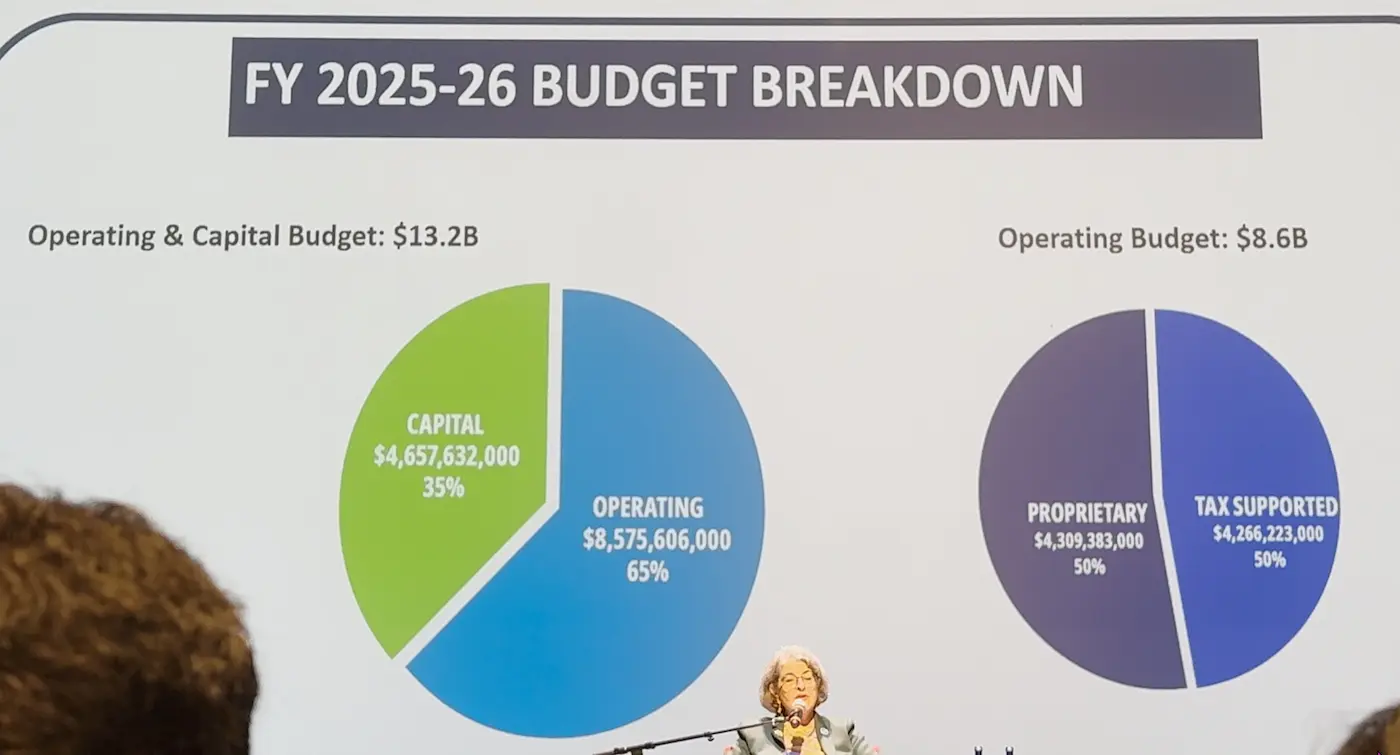
During the presentation, the mayor showed a handful of slides summarizing the budget process, the projected impacts of the property tax reform, and the distribution of county spending. With no department-level breakdown, no verifiable performance targets, and no advance access to the full document, residents had no basis to ask concrete questions about how their taxes are spent.
At the most revealing point of the session, upon reaching the slide with the projected property tax impacts, the mayor looked at her briefing folder and declared out loud to the audience: “This is different than what I have in my high point, ladies and gentlemen. Let me just look behind me.” [timestamp 10m04s] It was not the only discrepancy: the mayor stated that capital represented “about 37%” — her staff corrected her: 35%, exactly what her own slide was projecting on screen: Capital $4,657,632,000, 35% of the total. Later she said “roughly 77%” for another proportion — the correction was 72%.
The numbers the mayor carried in her notes did not match what her own presentation displayed — she acknowledged it herself before the audience. That is why this article distinguishes two layers: it cites the figures from the slides, photographed in the room, as what the county showed; and the mayor’s words, per the verbatim transcript, as what the mayor said.
The county’s own budget books suggest the origin of the confusion. The figures the mayor stated — “about 37%… $4.6 billion” — match page 17 of the prior year’s adopted volume, FY2024-25: Capital $4,687,756,000, 37% of the total. The slide on screen showed the current FY2025-26 breakdown: Capital $4,657,632,000, 35%. Two different fiscal years, both with roughly $4.6 billion in capital — and different percentages.View key transcript excerpts — July 6 session, Cutler Bay (658 Whisper segments)
- Discrepancy between notes and slides [timestamp 10m04s]
- “This is different than what I have in my high point, ladies and gentlemen. Let me just look behind me.”
- Correction 1: capital 37% → 35% [approx. 7-8m]
- [Mayor:] “…about 37% — or $4.6 billion of the general fund — is capital…” — [Staff correction:] “35.”
- Correction 2: operating share 77% → 72%
- [Mayor:] “…roughly 77%…” — [Staff correction:] “Usually 72.”
- On the unusual nature of the event [approx. 3-5m]
- “We’re only doing two [sessions] in advance of releasing the budget. So that’s not something we always do.”
- Full transcript: 658 Whisper segments, 33-minute 19-second video. On file with News Miami Dade.
What numbers did the mayor present?
Despite the format’s limitations, the session established the financial framework with exact figures on screen. The “FY 2025-26 Budget Breakdown” slide — photographed in the room by this newsroom — showed the $13.2 billion total budget broken down to the dollar: Capital $4,657,632,000 (35%) and Operating $8,575,606,000 (65%); and the $8.6 billion operating budget split in half: Proprietary funds $4,309,383,000 (50%) and Tax Supported funds $4,266,223,000 (50%). The figures match the FY2025-26 adopted volume and the OMB’s administrative rates document exactly.
One detail of the slide deserves note: it was labeled “FY 2025-26” — the budget currently in force, not the FY2026-27 budget the session was meant to discuss. It was inevitable: the new budget does not yet exist as a public document. Residents heard the current year’s breakdown at the session convened to weigh in on the next one.
Verbally, the mayor added the rest of the framework: the general fund — funded primarily by the property tax — totals approximately $3 billion. Departments were instructed to cap their increases at 3% over the prior year, even though the actual cost of delivering those services rose 8%. The mayor proposes keeping the millage rate flat: no increase, no decrease this year. A flat millage rate does not mean a flat bill: when assessed values rise, taxpayers pay more even if the rate does not change.
On the property tax reform headed to the November ballot, the mayor presented concrete impacts: a $385 million loss for the county in year 1 of implementation — more than 10% of the general fund. In year 2, that figure would double to more than 20%. Projected consequences for year 1: Animal Services would lose $33 million; Fire Rescue, $83 million (rising to $146 million in year 2); Libraries, approximately $134 million.
How did the budget grow year after year? The official books, side by side
The county’s total budget grew $1.47 billion in two years: from $11.76 billion in FY2023-24 to $12.76 billion in FY2024-25 and $13.23 billion in FY2025-26 — a cumulative increase of 12.5%. Over the same period, the property tax climbed year after year as a funding source of the county’s operating budget: $2,702,339,000 in FY2023-24, $2,990,764,000 in FY2024-25, and $3,250,797,000 in FY2025-26 — a $548 million increase (+20.3%) in two years, according to the “Operating Budget by Source” table on page 18 of the FY2025-26 adopted volume.
(Context note: the period compared includes the separation of the five constitutional offices, effective January 2025, which reorganized how those funds are presented within the county budget; the totals cited are those officially published by the county for each cycle.)
Page 17 of each adopted volume — the same official chart, three years in a row — tells the full story without interpretation. These are the original pages from the county’s three books:
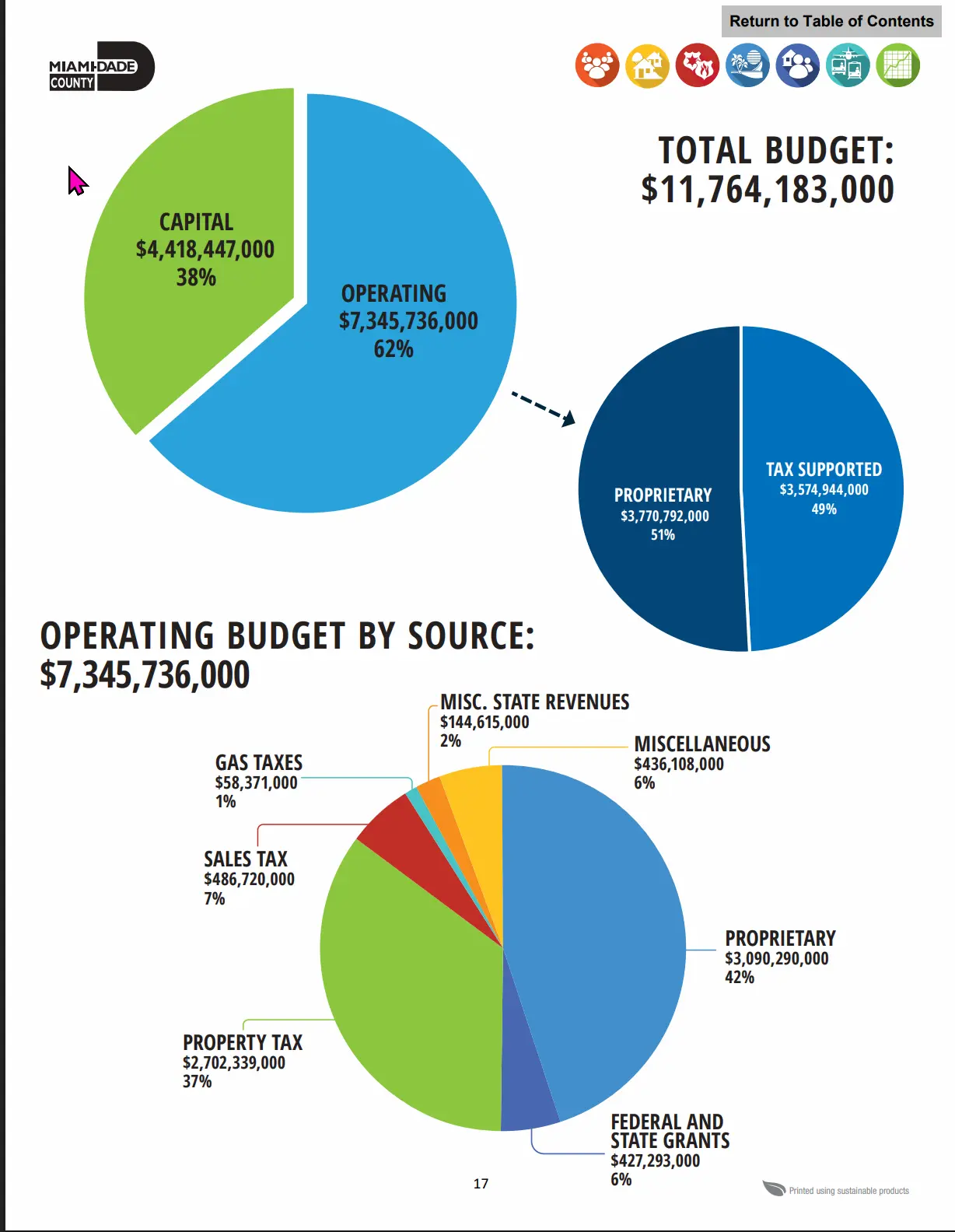
FY2023-24 — Total: $11,764,183,000. Capital $4,418,447,000 (38%); Operating $7,345,736,000 (62%); Property Tax $2,702,339,000 (37% of operating). Source: Miami-Dade County, Adopted Budget FY2023-24, Volume 1, page 17. Captured by NMD on July 8, 2026. Unmodified.
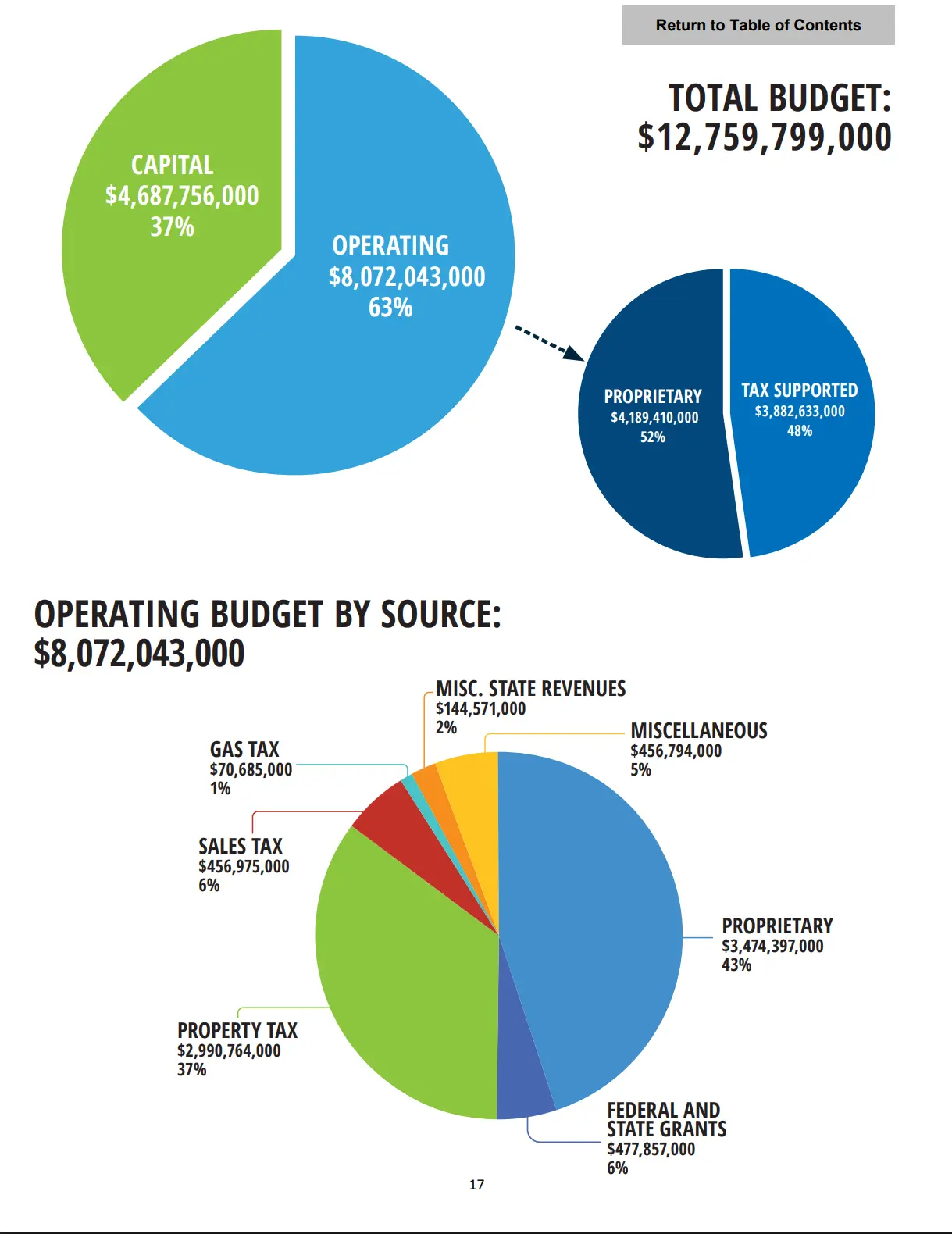
FY2024-25 — Total: $12,759,799,000. Capital $4,687,756,000 (37%); Operating $8,072,043,000 (63%); Property Tax $2,990,764,000 (37% of operating). Source: Miami-Dade County, Adopted Budget FY2024-25, Volume 1, page 17. Captured by NMD on July 8, 2026. Unmodified.
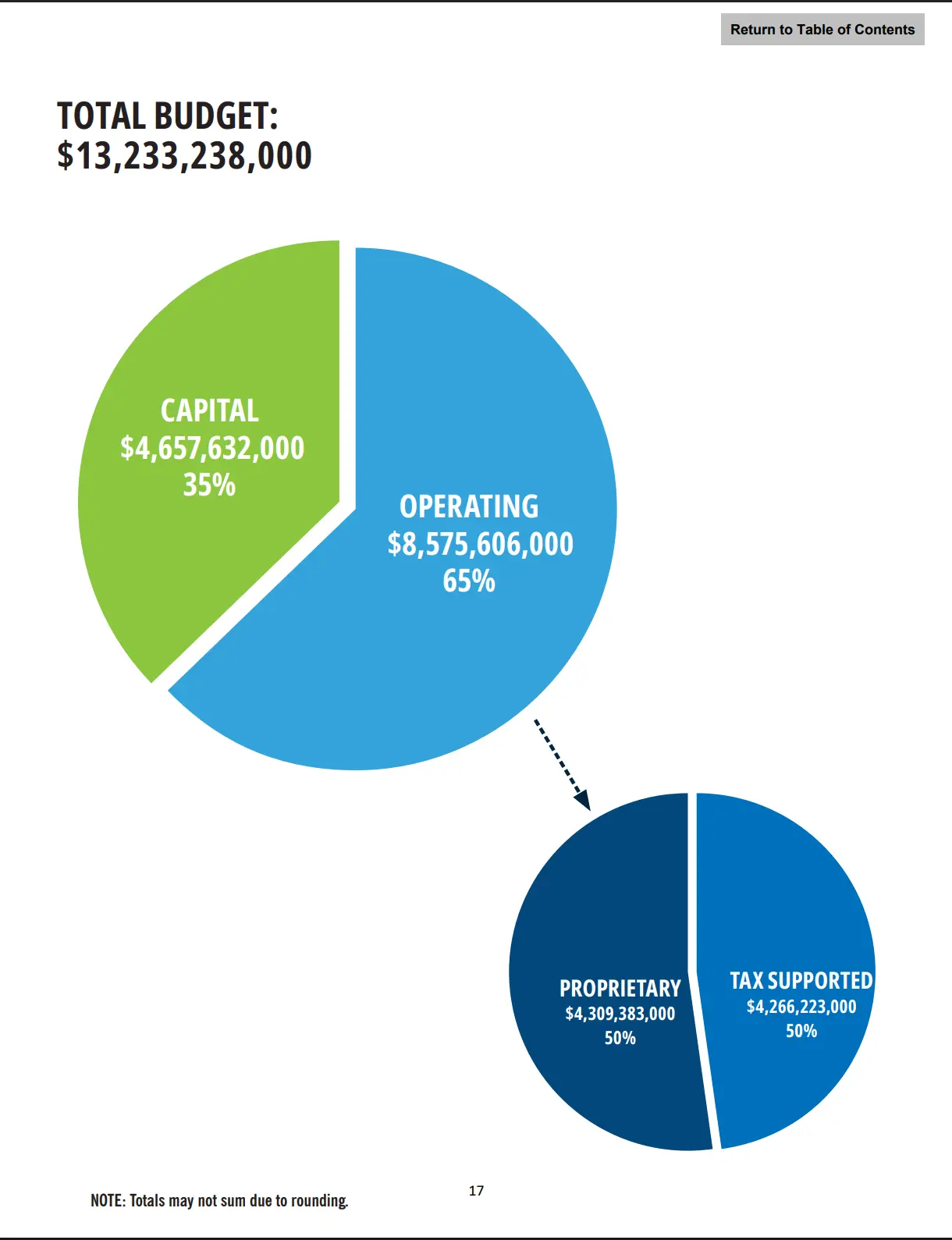
FY2025-26 — Total: $13,233,238,000. Capital $4,657,632,000 (35%); Operating $8,575,606,000 (65%). Source: Miami-Dade County, Adopted Budget FY2025-26, Volume 1, page 17. Captured by NMD on July 8, 2026. Unmodified.
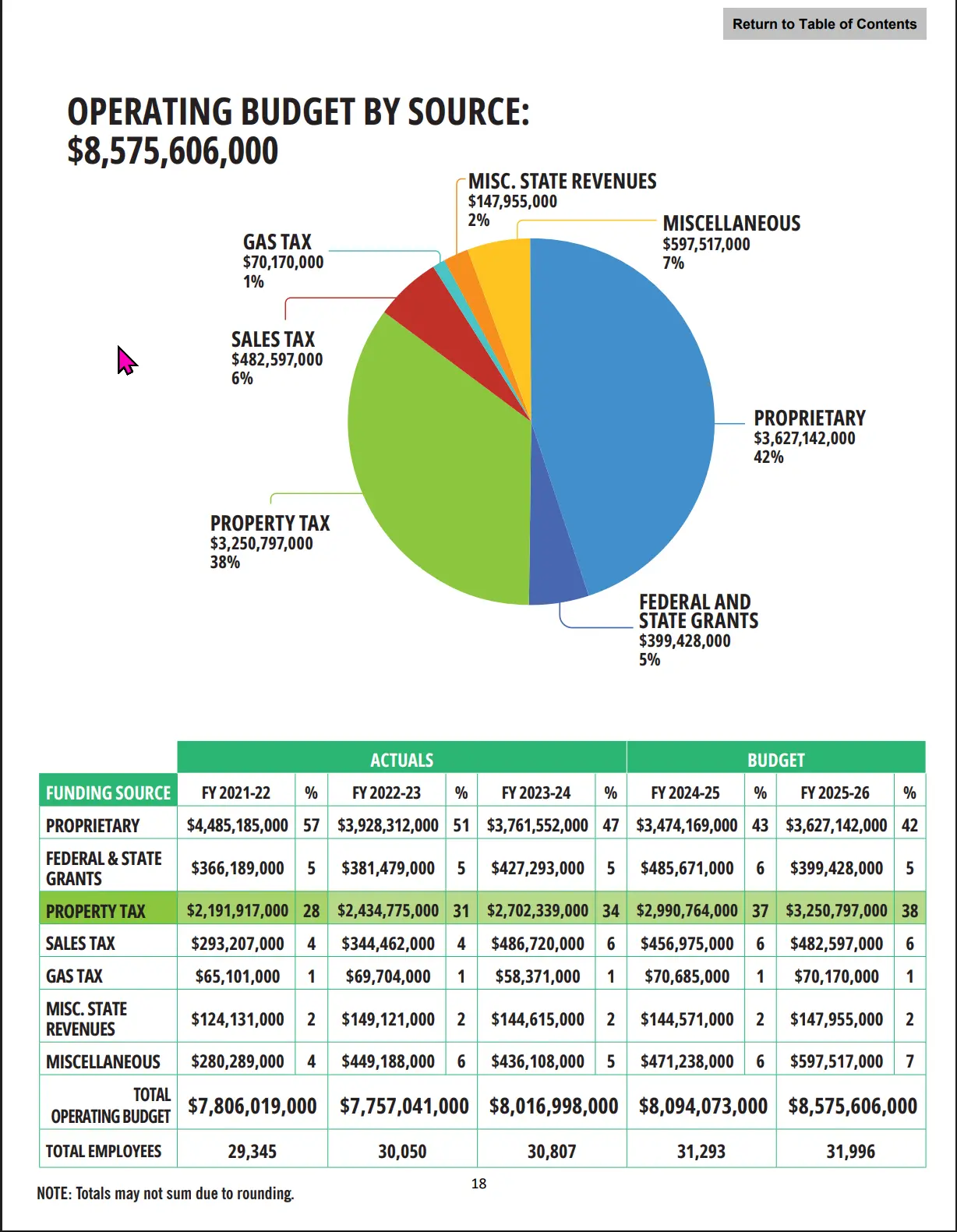
FY2025-26 — Operating budget by source, with the property tax historical series: from $2,191,917,000 (28%) in FY2021-22 to $3,250,797,000 (38%) in FY2025-26. Source: Miami-Dade County, Adopted Budget FY2025-26, Volume 1, page 18. Captured by NMD on July 8, 2026.
The sequence shows three simultaneous trends. The total grew 12.5% in two years. The capital share shrank: 38%, 37%, 35% — a smaller slice for infrastructure each year and a larger one for operations. And the property tax rose in both weight and amount: from 28% of the operating budget in FY2021-22 to 38% in FY2025-26 — nearly $1.06 billion more in four years. It is exactly the revenue source the November ballot puts at stake.
What do the 14 OMB documents reveal?
The 14 technical OMB documents analyzed by News Miami Dade — available at miamidade.gov/budget — reveal a picture that those few July 6 slides did not begin to show. None of this data was presented at the Cutler Bay session.
The OMB’s Personnel Assumptions and Rates FY2026-27 document states unambiguously on its first page: “For FY 2026-27, there is no COLA” — zero general cost-of-living adjustment for the county payroll. This comes as projected inflation for FY2026-27 stands at 2.4%, per the Florida Economic Estimating Conference cited in the Planning Department (RER) rates document. The same table records the recent inflation peaks the payroll already absorbed: 7.2% in 2021-22 and 6.3% in 2022-23. The payroll does not adjust even as prices rise.
The same document lists the employer contribution rates to the Florida Retirement System. Under the heading “FY 25-26” — NMD found no confirmation of an update for FY2026-27 — the document records: regular employees, 15.08%; elected officials, 56.59%. It also includes the C1 executive benefits package designated for BCC commissioners, whose full breakdown follows.
The $70,000 401A contribution the OMB documents for each commissioner is what brings the real-salary question into focus. The county’s public payroll data shows all 13 BCC commissioners listed with an AnnualSalary of $6,000 — the nominal salary set by ordinance. The same records show a GrossPayLastPaycheck of $3,158.14 for 12 of the 13 commissioners; Commissioner René García appears with slightly different figures: $3,153.14 per paycheck and $40,990.82 in accumulated GrossYTD. The GrossYTD for the other 12 stands at $41,055.82 as of the most recent data reviewed.
The official $6,000 salary works as a nominal figure; the public payroll shows a different financial reality. The OMB documents detail the C1 executive benefits package for BCC commissioners component by component: executive allowance $19,186.20; car allowance $11,191.95; expense allowance $43,000; 401A contribution to the individual retirement plan $70,000. Total C1 package: $143,378.15 per commissioner per year — verified verbatim on page 1 of the OMB’s Personnel Assumptions and Rates FY2026-27.
On top of that C1 package comes the county’s employer contribution to the Florida Retirement System under the elected officials category: 56.59% — the highest rate in the state retirement system, versus 15.08% for regular county employees. (The elected officials rate came down from 64.13% in the FY2023-24 cycle — “FRS Classes FY 23-24” table, page 4 of the Personnel Assumptions and Rates FY2023-24 — but remains the highest of all FRS classes.) Miami-Dade cannot present the nominal $6,000 salary as if it represented the real cost of a commissioner. The full analysis requires adding the public payroll, the four C1 components, and the FRS employer contribution.
The comparison with the FY2023-24 cycle — the equivalent budget process documents from three years ago, read in full by this newsroom — shows the C1 package grew 8.2% in three years: from $132,500 (“Annual Amount” table of the Executive Benefits Program, page 1 of the Personnel Assumptions and Rates FY2023-24) to $143,378.15 (the same table, page 1 of the FY2026-27 document). The 401A contribution went from $61,000 to $70,000 over that period.
The mechanism was written down between one cycle and the next: the C1 footnote in the FY2023-24 document (page 2) only provided for reducing the contribution “if required by law”; the FY2026-27 version adds that the allocation is adjusted by CPI — the inflation index.
Over those same three years, the cost-of-living adjustment for employees is zero — “there is no COLA,” page 1 of both documents — and the dental benefit per employee was cut from $500 (page 4, FY2023-24) to $400 (FY2026-27): 20% less. The contrast is literal: the commissioners’ benefits package is indexed to inflation; the general payroll’s salaries are not.
The Administrative Reimbursement Rates FY2026-27 includes a $2,600,000 line under the “Outside Legal/Lobbyist” category as a Non-Departmental General Fund cost. The document does not identify the recipients anywhere in its four pages.
The Budget Submission Manual FY2026-27 reveals, on its page 5, a rarely discussed power: “OMB may need to act independently to ensure a timely submission of the proposed budget by statutory and code deadlines. Any revisions done independently by OMB will be discussed with departments when permitted.” The administration can alter any department’s budget without prior approval; notification comes afterward, and only “when permitted.”
The same manual instructs departments with no identified funding source for a project: “use ‘Future Financing’ as the funding source.” It immediately adds: “Future Financing… does not mean it is automatically approved to move forward.” The result: the public budget can list projects as scheduled when they have no real funding. Residents and commissioners see them as active; the manual describes them as placeholders.
Three critical budget lines lack final rates at the time departments submit their budgets: the CITD’s IT Funding Model, the Communications Funding Model, and the internal Rent Roll for county buildings. The one-page CITD Budget Manual states that information technology rates are “under development” and will be published as an addendum. The PIOD Internal Services Rates declares the Rent Roll “will be provided by OMB once the schedule has been approved.” Every department submitted its FY2026-27 budget without knowing its IT or rent costs.
It was not always this way. In the FY2023-24 cycle, the county published all three models with full figures, each in a one-page table: “FY 2023-24 Proposed IT Funding Model Charges,” total $105,127,000; “FY 2023-24 Proposed Communications Model Charges,” total $25,151,000; and “ISD Rent Schedule: Proposed FY 2023-24,” grand total $95,402,336. In the FY2026-27 package, all three appear “under development,” and the promised addendum is nowhere among the published documents. The information is neither new nor impossible to produce — it simply stopped being published.
An additional detail illustrates the same pattern: the CITD Business Case Narrative form, though it belongs to the FY2026-27 cycle, shows the prior year “FY2025-26” in its header — a documentation error left uncorrected in the published package.
Ordinance 12-25 requires 11 county departments to spend fixed amounts on the Community Periodical Program (CPP) for FY2026-27, coordinated by the CITD. The listed departments total $315,000 — led by Transportation and Public Works and the CITT at $45,000 each. The CITD rates document does not identify which newspapers receive that money, the eligibility criteria, or the selection process. The spending is mandatory by ordinance; the recipients are invisible in the public document.
The program also shrank: in the FY2023-24 cycle the CPP mandate totaled $375,000 across 14 departments — “DEPARTMENT / FY 2023-24” table, page 2 of the CCED Rates FY2023-24 — and included Elections ($30,000), Finance (Tax Collector) ($15,000) and the Miami-Dade Police Department ($15,000). All three left the list in FY2026-27 — their functions now belong to separated constitutional offices or the new elected Sheriff — and the total dropped to $315,000 across 11 departments.
The People and Internal Operations Department (PIOD) rates document lists three sign language interpretation contracts — a service required by the Americans with Disabilities Act — with expiration dates in May 2025, August 2025 and January 2026. All of those dates precede July 7, 2026. The budget documents reviewed show no evidence of renewal; the public question is whether those contracts were renewed through another administrative channel. If the county is providing ADA interpretation services without valid contracts, it would face federal compliance risk.
On the $402 million deficit the county faced in FY2025-26, the administration attributed it in part to the independence of five constitutional offices — the result of Amendment 10 to the Florida Constitution, approved by voters in 2018 and effective for Miami-Dade on January 7, 2025, per the county’s official constitutional offices page. News Miami Dade did not find, in the budget documents reviewed, a comprehensive public transition plan proportional to the projected impact of that reform during the 2018-2025 period.
What else do the county’s budget files show?
Beyond the FY2026-27 cycle, the budget process documents expose long-term commitments that also never appeared on the July 6 slides. The Budget Submission Manual keeps active the fund codes of the Building Better Communities General Obligation Bond (BBC-GOB) — the $2.9 billion bond approved by voters in November 2004 for more than 300 projects across eight categories. Twenty-two years later, the program still has projects underway in the FY2026-27 cycle. The documents do not say how many projects remain pending or how far they have drifted from their original timelines.
The official Business Plan instructions use as their example of a priority initiative the PortMiami capital plan, which per the document itself requires “approximately $2.4 billion in future funding” for new cruise terminals. It is the same “Future Financing” label the manual defines as a placeholder with no approved funding — applied to one of the county’s largest infrastructure projects, while the general fund closed FY2025-26 in deficit.
The rates documents also make it possible to size the real cost of personnel beyond salaries. The FRS employer rate for the Special Risk category — police, firefighters, corrections — is 37.83%, and workers’ compensation insurance by department includes: Sheriff, $21.5 million; Fire Rescue, $17.2 million; Corrections, $10.7 million; Transit, $10.5 million. Group health insurance costs $21,700 per employee per year — $24,750 for members of the IAFF firefighters union, a $3,050-per-employee differential set by collective bargaining.
In fleet, the county’s actual FY2024-25 spending was $87.8 million — and a single department, Solid Waste Management, consumed $39.7 million: 45% of the countywide total. Fuel for FY2026-27 is budgeted at $2.62 per gallon for gasoline and $2.91 for diesel; if actual prices exceed those estimates, the departments with the most vehicles would face mid-year overruns.
A final data point connects back to the CPP: under a directive in force since August 1, 2014, every advertising purchase by any county department — except employment ads — must be approved and placed by the CITD. A single office centralizes the media buys of the entire county government, and it is the same office that coordinates the $315,000 community newspaper program whose recipients are not published.
Who runs the office that prepares the budget?
The FY2026-27 process is the first under a new OMB director. Through a January 6, 2026 memo to the Board of County Commissioners, the mayor appointed Raymond W. Baker director of the Office of Management and Budget, effective January 19, 2026, under Section 2.02(C) of the Home Rule Charter. Baker had led the Miami-Dade Public Library System since 2017 — a system with a $113 million budget, 50 branches and more than 800 employees — and was a Senior Budget Analyst at the OMB itself between 1999 and 2002, per the résumé attached to the memo.
The same memo reassigned David Clodfelter, until then the budget director, to the role of Strategic Advisor reporting to the Chief Administrative Officer. The mayor justified the changes anticipating a year “both critical and challenging from a fiscal and operational standpoint.”
As of July 7, 2026 — nearly six months after the appointment and eight days before the Proposed Budget presentation — the county’s official biographies page shows a single line for the OMB director: “His full biography will be available soon.” The official who manages the $13 billion fiscal plan has no full biography published on the county portal.
How does this process compare with last year’s?
The official FY2025-26 budget process page — the prior cycle — published six public budget meetings between July 31 and August 7, 2025, each with a date, time and venue: Main Library, North Dade Regional Library, Westchester Regional Library, Arcola Lakes Senior Center, Oak Grove Park and the Dennis C. Moss Center in Cutler Bay — the same venue as this year’s July 6 session. The page offered optional registration and a webcast, and stated the purpose: to discuss “the FY 2025-26 Proposed Budget tax rates and fee changes.”
The fundamental difference is the order of the process. The prior cycle’s six meetings took place after the July 15 Proposed Budget presentation: residents discussed the rates and fees of a document already published. This cycle’s two “Conversations with Cava” sessions take place before the budget exists as a public document — the format the mayor herself described as unusual. And as of July 7, the FY2026-27 portal states: “Public budget meetings for FY 2026-27 have not yet been scheduled.”
At the same point in the calendar when the last cycle already had six meetings published with venues and a webcast, the current cycle has none scheduled — and the sessions that did take place happened with no public document to discuss.
What happens to the $13 billion if November eliminates the property tax?
The county’s budget process follows a precise calendar: departments submit their plans in February, the OMB consolidates through the first half of the year, the Mayor presents the Proposed Budget on July 15, and the BCC adopts the formal budget in September with hearings on the 3rd and the 17th. All of this work rests on a premise that none of the 14 technical documents questions: the property tax remains in place.
None of the 14 technical OMB documents analyzed by NMD mentions, in any of their 103 pages, constitutional proposal HJR 1F — the reform approved by the Florida Legislature on June 2, 2026 that, if voters approve it in November with the required 60%, would begin the elimination of the property tax. The Budget Submission Manual states that budget balance depends on “proposed property tax rates” — with no contingency section for a millage reduction.
The gap is quantifiable. Property tax provides $3,250,797,000 to the FY2025-26 operating budget — 38% of the county’s entire operating budget, according to page 18 of the adopted volume. The mayor herself projected in Cutler Bay that HJR 1F would cost $385 million in year 1 and more than double that in year 2. If it passes in November, the $13 billion budget adopted in September 2026 would lose its main funding source barely two months after the BCC approves it.
News Miami Dade found no budget contingency plan for HJR 1F in the 14 documents reviewed: no phased-reduction scenario, no alternative revenue sources, no mechanism to adjust targets. The Business Plan Instructions establishes that departmental performance targets are “locked” in the system through FY2026-27. If a contingency plan exists, it does not appear in the 14 technical documents published for the FY2026-27 process.
Why it matters for residents
Miami-Dade County’s budget is the document that determines how many police officers patrol the neighborhoods, how many buses run, how many hours libraries stay open, and how the services 2.8 million residents use every day are managed. Holding public participation sessions about a budget that is not published inverts the basic order of transparency: first the numbers are published, then the public is invited to debate them.
A handful of slides cannot explain more than $13 billion in public spending. They do not include the 24,842 active payroll employees as of June 1, 2026, the technology rates departments did not know when they submitted their budgets, the projects with no real funding listed as scheduled, or the planning vacuum around the most consequential question Miami-Dade faces in 2026: what happens to the budget if the property tax disappears in November.
Open questions
1. Why was the full FY2026-27 budget not published before the first community session on July 6?
2. Who are the recipients of the $2.6 million under “Outside Legal/Lobbyist” in the Administrative Reimbursement Rates FY2026-27?
3. Which community newspapers receive the $315,000 of the mandatory Community Periodical Program under Ordinance 12-25, and what are the eligibility criteria?
4. How many funded positions does the county have in FY2026-27, and how did the payroll change after the separation of the five constitutional offices?
5. Which departments are increasing beyond the 3% cap, and under what justification?
6. What is the county’s budget contingency plan if HJR 1F passes in November? Is there a scenario A, B or C?
7. Have the three ADA sign language interpretation contracts that the PIOD document shows expired in 2025 and January 2026 been renewed?
8. Which county projects are listed in the budget under the “Future Financing” label with no real identified funding source, and what is their total amount?
9. Under what criteria has the OMB exercised its power to modify departmental budgets “independently” in prior cycles, and which departments were affected?
10. What measurable targets will the administration use to justify $13 billion in spending in FY2026-27?
11. When will the county publish the dates of the FY2026-27 public budget meetings, which in the prior cycle were already scheduled with venues, registration and a webcast at this point in the calendar?
12. Why does the county’s official biographies page not publish the full biography of the OMB director nearly six months after his appointment?
Opinion column — Isel Rodríguez, editor of News Miami Dade

The following words express the editorial opinion of Isel Rodríguez as editor of News Miami Dade and citizen of Miami-Dade County.
Mayor Daniella Levine Cava held her first public appearance for “Conversations with Cava” on Miami-Dade’s 2026-2027 fiscal budget.
According to the official release from the Mayor’s Office, these gatherings were presented as an opportunity for residents to share their priorities and take part in the county’s budget process.
But the question remains the same: how could residents participate seriously if the full budget was not available with enough time to review it?
At the July 6 session, Rodríguez addressed the audience as a citizen and taxpayer (NMD translation; remarks delivered in Spanish):
“In November, we the voters have a key opportunity: to use the midterm elections to demand real change and support the elimination of the property taxes that today squeeze families and force a hard look at public spending priorities.
Because Miami-Dade cannot keep up the same budget theater as always: meetings, speeches and pretty presentations, but no clear numbers, no serious strategy and no real vision of the future.
We are talking about billions of taxpayer dollars, and we still do not know clearly how many employees we pay, what concrete goals exist, what results are measured, and where the money is actually being spent.
When there is no planning, extreme and desperate measures follow, as we have seen with the Port of Miami: late actions that look like crisis reactions, not responsible leadership.
This year we will see what the administration’s new excuse will be to talk to us about a deficit while it keeps spending without an optimal strategy. Miami-Dade does not need more budget theater. It needs clear priorities, less waste and real accounting.”
A multibillion-dollar budget cannot be explained with general phrases or summary presentations. Taxpayers need clear numbers, real priorities, full access to the documents, and time to study before any public conversation.
Transparency does not begin when the administration takes the microphone. It begins when the government publishes the complete information so the community can review, compare and ask informed questions.
Without a previously published budget, citizen participation is limited. Miami-Dade does not need more budget theater. It needs clear accounting.
What can residents do in September and November?
The millage rates are adopted in September. The First Public Budget Hearing is September 3 at 5:00 p.m. and the Second Public Hearing is September 17 at 5:00 p.m. — at both, any resident can speak directly before the BCC.
In November, Florida voters will decide on constitutional proposal HJR 1F, approved by the Florida Legislature on June 2, 2026 by 75-26 in the House and 30-9 in the Senate — the reform needs 60% of the vote to become law.
The second “Conversations with Cava” session will be held Wednesday, July 8 at 6 p.m. It will also be available via Zoom. News Miami Dade will be there.
Sources consulted
Level 1 — Official sources:
1. Official release — Office of Mayor Daniella Levine Cava: “Mayor Daniella Levine Cava to Host Budget Conversations with Cava in North and South Miami-Dade,” July 2, 2026. Available at miamidade.gov — Office of the Mayor.
2. Video recording of the “Conversations with Cava: FY2026-27” session — Dennis C. Moss Cultural Arts Center, Cutler Bay, July 6, 2026. Length: 33 minutes 19 seconds. Available on YouTube. Full transcript produced by News Miami Dade with Whisper (OpenAI), 658 segments. On file with this publication. Verified quotes: “high point” discrepancy [timestamp 10m04s], corrections 37%→35% and 77%→72%, statement on pre-release sessions.
3. Direct observation by News Miami Dade — “Conversations with Cava: FY2026-27” session, Dennis C. Moss Cultural Arts Center, Cutler Bay, July 6, 2026. Includes photographs of the projected slides taken in the room, among them “FY 2025-26 Budget Breakdown”: Operating & Capital Budget $13.2B — Capital $4,657,632,000 (35%), Operating $8,575,606,000 (65%); Operating Budget $8.6B — Proprietary $4,309,383,000 (50%), Tax Supported $4,266,223,000 (50%). Cross-check: 4,657,632,000 + 8,575,606,000 = 13,233,238,000 — matches the Adopted Budget FY2025-26 total to the dollar (source 18); the operating subtotal matches the base of the OMB’s Administrative Reimbursement Rates (source 5). Video coverage by @miamidadetoday:
See Instagram coverage @miamidadetoday — Conversations with Cava: FY2026-27 (Jul 6, 2026)
4. Miami-Dade County OMB. Personnel Assumptions and Rates FY2026-27. 4 pages. Available at miamidade.gov/budget. Verified quotes: (a) Zero COLA — Page 1, “Salary-Related Rates” section, verbatim sub-bullet: “For FY 2026-27, there is no COLA.” (b) C1 benefits — Page 1, “Executive Benefits Program” table, C1 column: 401A $70,000, Total $143,378.15. (c) FRS — Page 3, “FY 25-26” column: Regular 15.08%, Special Risk 37.83%, Elected Officials 56.59% [note: labeled FY25-26, subject to FY2026-27 confirmation]. (d) Group health insurance: $21,700/person/year; IAFF $24,750/person/year.
5. Miami-Dade County OMB. Administrative Reimbursement Rates FY2026-27. 4 pages. Available at miamidade.gov/budget. Verified quote: Page 3, table “ADMINISTRATIVE REIMBURSEMENT CALCULATION FOR FY 2026-27 Using FY 2025-26 Budget,” “General Government Non-Departmental” section, line “Outside Legal/Lobbyist: $2,600” (in thousands = $2,600,000). Rate 2.61%. The document does not identify recipients anywhere in its 4 pages.
6. Miami-Dade County. Miami_Dade_County_Employee_Pay_Information — public payroll dataset. Two snapshots on file with NMD: (a) June 1, 2026: 24,842 active records (header excluded); (b) most recent snapshot reviewed: 13 BCC commissioners — AnnualSalary $6,000 nominal each; GrossPayLastPaycheck $3,158.14 (12 commissioners) and $3,153.14 (García, René); GrossYTD $41,055.82 (12 commissioners) and $40,990.82 (García, René). The nominal $6,000 salary does not reflect accumulated gross pay or the C1 executive benefits package documented by the OMB.
7. Miami-Dade County OMB. Budget Submission Manual FY2026-27. 53 pages. Available at miamidade.gov/budget.
Verified quotes: (a) OMB discretionary power — Page 5, verbatim: “OMB may need to act independently to ensure a timely submission of the proposed budget by statutory and code deadlines. Any revisions done independently by OMB will be discussed with departments when permitted.” (b) Future Financing — capital instructions page: “If there is no funding source identified for a program/project, use ‘Future Financing’ as the funding source.” (c) Property-tax-based budget — Page 7: explicit dependence of balance on “proposed property tax rates.” (d) HJR 1F — 0 mentions in 53 pages. (e) BBC-GOB: $2.9 billion bond approved by voters in November 2004 for more than 300 projects; fund codes active in the FY2026-27 cycle (CBX13/CBX00).
8. Miami-Dade County OMB. Business Plan Instructions FY2026-27. 12 pages. Available at miamidade.gov/budget. Verified quotes: performance targets “locked in SMS through FY 2026-27.” Mayor’s Key Deliverables: 5 categories including “FRE: Fiscal Responsibility and Efficiency.” HJR 1F — 0 mentions in 12 pages. Priority Initiative example cited in the document: PortMiami CIP with “approximately $2.4 billion in future funding” for cruise terminals.
9. Miami-Dade County OMB — People and Internal Operations Department. PIOD Internal Services Rates FY2026-27. 22 pages. Available at miamidade.gov/budget. Verified quotes: (a) Total internal insurance $110,500,000. (b) Fleet FY2024-25: $87,761,235 countywide; Solid Waste Management $39,698,864 (45%). (c) Rent Roll: “will be provided by OMB once the schedule has been approved.” (d) ADA sign language interpretation contracts with expiration dates in May 2025, August 2025 and January 2026 — no renewal documented in the materials reviewed. (e) Workers’ compensation by department: Sheriff $21,468,578; Fire Rescue $17,178,744; Corrections $10,735,526; DTPW Transit $10,547,515. (f) Fuel FY2026-27: gasoline E10 $2.62/gallon; diesel B5 $2.91/gallon.
10. Miami-Dade County OMB — Communications, Information and Technology Department. CITD Rates FY2026-27. 3 pages. Available at miamidade.gov/budget. Verified quotes: (a) Community Periodical Program (Ordinance 12-25, Sections 2-2011 through 2-2023 of the County Code): 11 departments required; total $315,000 — verified against the table on pages 1-2 of the PDF on July 7, 2026 (DTPW $45,000; CITT $45,000; Animal Services, Aviation, Parks, RER, Seaport and Water and Sewer $30,000 each; Cultural Affairs, PIOD and Solid Waste $15,000 each). Recipient newspapers not identified. (b) Communications Funding Model: “currently under development and will be provided to departments by OMB as an addendum.” (c) Directive of August 1, 2014: all departmental media buys, except employment ads, must be approved and placed by the CITD.
11. Miami-Dade County OMB — Department of Regulatory and Economic Resources. RER Planning Assumptions FY2026-27. 2 pages. Available at miamidade.gov/budget. Quotes verified against the original PDF on July 7, 2026 — full CPI table, page 1: 2026-27* = 2.4% (forecast); 2021-22 = 7.2%; 2022-23 = 6.3%. Source declared in the document: Florida Economic Estimating Conference, National Economy, July 11, 2025.
12. Miami-Dade County OMB. General Guidelines for Bondable Capital Improvements FY2026-27. 6 pages. Available at miamidade.gov/budget. Verified quote: bondable eligibility “at the discretion of the Office of Management and Budget and Tax Counsel.” HJR 1F — 0 mentions.
13. Miami-Dade County OMB — CITD. CITD Budget Manual FY2026-27. 1 page. Available at miamidade.gov/budget. Verified quote: IT Funding Model “currently under development and will be provided to departments by OMB via addendum.”
14. Miami-Dade County OMB — CITD. CITD Business Case Narrative FY2026-27. 3 pages. Available at miamidade.gov/budget. Note: the form’s header reads “FY2025-26” — the prior fiscal year. Form with zeros in all cost fields.
15. Miami-Dade County. FY 2026-27 Budget Process portal. Available at miamidade.gov/budget. Verified as of Jul 7, 2026: “Public budget meetings for FY 2026-27 have not yet been scheduled.”
16. Miami-Dade County. Adopted Budget and Multi-Year Capital Plan FY2023-24, Volume 1. Total $11,764,183,000. Direct official PDF: miamidade.gov — Adopted Budget FY2023-24, Volume 1. Page 17, verbatim label “TOTAL BUDGET: $11,764,183,000” — verified against the PDF on July 8, 2026.
17. Miami-Dade County. Adopted Budget and Multi-Year Capital Plan FY2024-25, Volume 1. Total $12,759,799,000. Direct official PDF: miamidade.gov — Adopted Budget FY2024-25, Volume 1. Page 17, verbatim label “TOTAL BUDGET: $12,759,799,000” — verified against the PDF on July 8, 2026. Same page: Capital $4,687,756,000 (37%); Operating $8,072,043,000 (63%); Property Tax $2,990,764,000 (37% of operating).
18. Miami-Dade County. Adopted Budget and Multi-Year Capital Plan FY2025-26, Volume 1. Total $13,233,238,000. Direct official PDF: miamidade.gov — Adopted Budget FY2025-26, Volume 1. Page 17, verbatim label “TOTAL BUDGET: $13,233,238,000” — verified against the PDF on July 8, 2026; matches to the dollar the slide photographed at the July 6 session (source 3). Page 18, “Operating Budget by Source” table: Property Tax $2,702,339,000 (FY2023-24, actual); $2,990,764,000 (FY2024-25); $3,250,797,000 (FY2025-26, budget) — 38% of the operating budget. NMD calculations: total growth ($13,233,238 – $11,764,183) / $11,764,183 = 12.49% ≈ 12.5%; two-year property tax ($3,250,797 – $2,702,339) / $2,702,339 = 20.29% ≈ 20.3%. (Note: the ~$12.9 billion figure that circulated at the September 2025 hearings corresponds to an earlier stage of the process, not to the final adopted book total.)
19. Florida Senate. Press Release: Senate Passes Historic Property Tax Cut for Florida Homeowners, June 2, 2026. flsenate.gov. Verified data: HJR 1F approval, 75-26 House, 30-9 Senate.
20. Miami-Dade County. FY 2025-26 Budget Process portal. Available at miamidade.gov — FY 2025-26 Budget Process. Verified as of Jul 7, 2026: six public budget meetings listed (Jul 31, Aug 2, 4, 5, 6 and 7, 2025) with venues, optional registration and webcast; stated purpose: “to discuss the FY 2025-26 Proposed Budget tax rates and fee changes”; second and final public hearing: September 18, 2025.
21. Miami-Dade County — Office of the Mayor. Memorandum “Mayoral Appointments — Director of the Office of Management and Budget and Interim Director of Libraries,” January 6, 2026, to Chairman Anthony Rodriguez and BCC members. Legistar matter 260038, Agenda Item 2(B)(1) of January 21, 2026. Official PDF at miamidade.gov/govaction. Verified data: appointment of Raymond W. Baker effective January 19, 2026 under Section 2.02(C) of the Home Rule Charter; Baker MDPLS director since 2017 ($113M, 50 branches, 800+ employees); Senior Budget Analyst at OMB 1999-2002 (attached résumé); David Clodfelter reassigned to Strategic Advisor.
22. Miami-Dade County. Official biographies page — Management and Budget: Ray Baker, Director. miamidade.gov — biographies. Verified as of Jul 7, 2026: “Ray Baker was appointed Director of the Office of Management and Budget effective January 19, 2026. His full biography will be available soon.”
23. Miami-Dade County. Constitutional Offices. miamidade.gov — Constitutional Offices. Verified data: Amendment 10 (2018) and the reestablishment of the five elected constitutional offices effective January 2025.
24. Miami-Dade County OMB. Official FY2023-24 budget process documents (comparative baseline, on file with News Miami Dade; historical archive at miamidade.gov — Budget Archive). Quotes verified page by page: (a) Personnel Assumptions and Rates FY2023-24, 5 pages — Page 1: “For FY 2023-24, there is no COLA” and “Annual Amount” table of the Executive Benefits Program, C1 column: Executive Benefit Allowance $18,000, Car Allowance $10,500, 401A Contribution $61,000, Expense Allowance $43,000, Total $132,500; Page 2: verbatim **C1 footnote: “401A contribution amount shall be reduced if required by law” (no CPI adjustment clause, which first appears in the FY2026-27 version); Page 4: “FRS Classes FY 23-24” table — Elected Officials 64.13%, Regular 13.40%, Special Risk 30.61%; Group Health Insurance $15,000/person/year; Dental $500/person/year. (b) IT Funding Model FY2023-24, 1 page — “FY 2023-24 Proposed IT Funding Model Charges” table: Total $105,127,000 (account 5261410000). (c) Communications Funding Model FY2023-24, 1 page — Total $25,151,000 (account 5262600000). (d) ISD Rent Roll FY2023-24, 1 page — “ISD Rent Schedule: Proposed FY 2023-24”: Grand Total $95,402,336. (e) CCED Rates FY2023-24, 3 pages — Page 2: CPP table with 14 departments, total $375,000, including Elections $30,000, Finance (Tax Collector) $15,000 and Miami-Dade Police Department $15,000 (account 5314120000). Full document comparison: 231 pages read at 100%, July 7, 2026.
Level 2 — Verified media:
25. Florida Policy Institute. “Florida Property Tax Amendment: Ballot Language Summary.” Context: cites the Florida Revenue Estimating Conference for the estimated statewide cost of $12 billion per year if HJR 1F passes.
26. CBS Miami. “What Miami-Dade residents need to know as county faces $402 million deficit.” Context for the $402M FY2025-26 deficit.
27. Miami Today. “Ray Baker: Leading county budget operation in difficult financial era,” July 1, 2026. Context: profile of the new OMB director and his three-decade county career.
Disclaimer
News Miami Dade shows the original sources of the Miami-Dade County OMB technical documents for the FY2026-27 cycle, the adopted budget volumes, the county’s public payroll dataset, the official memoranda archived in Legistar, and the July 6, 2026 public session “Conversations with Cava: FY2026-27,” broadcast on video and transcribed in full by this publication. This piece references government material published by the corresponding jurisdiction. Every factual claim is anchored to an identifiable primary source with page and section cited in the “Sources consulted” block. Attributions of positions are cited with source and verbatim text when available. The “Opinion column” section is clearly labeled and signed; it is not part of the verified news body.
Stay informed with the latest news!
Would you like to receive more information like this directly on your screen? Visit our main page and find out everything happening in South Florida: local news, public accountability, budget coverage and the decisions that affect Miami-Dade residents. 👉 Click here! Don’t miss a single detail. #MiamiDade #News #Florida #Budget #PropertyTax #ConversationsWithCava