
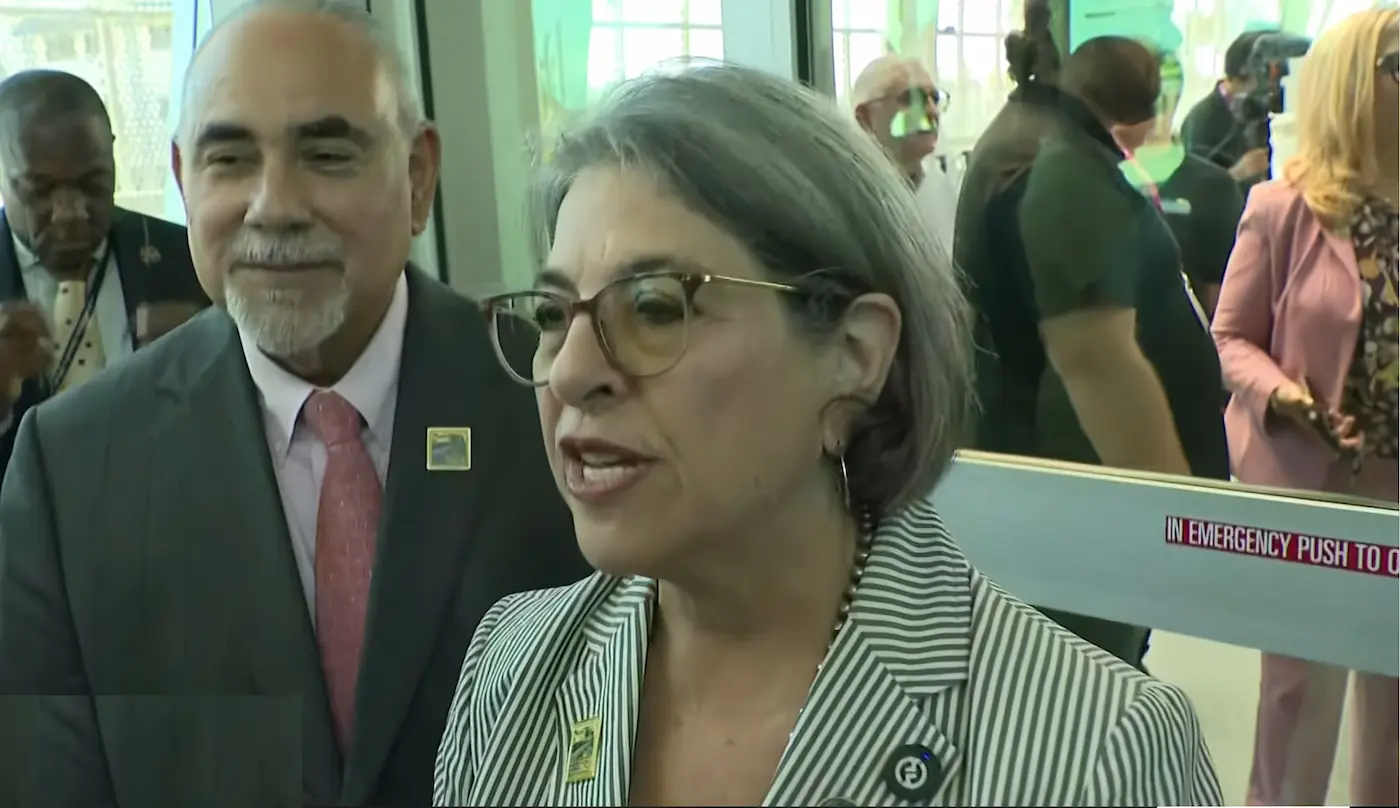
Miami-Dade and the Green Disaster: (and why the Unacceptable Pattern Repeats in 2025). How the purchase of electric buses ended up in an equipment graveyard.
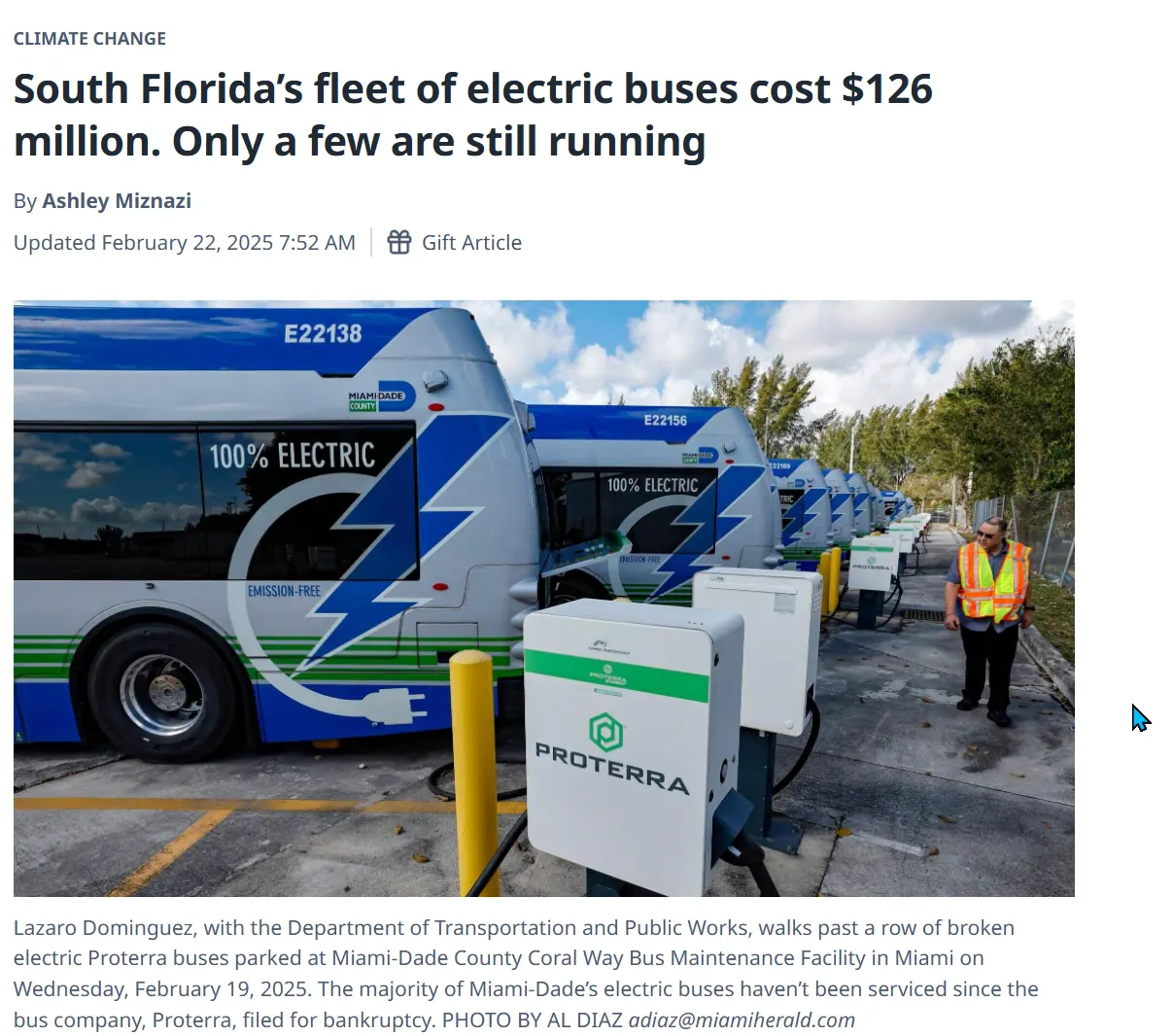
Miami-Dade sold the transition to electric buses as “green” modernization. In practice, the county ended up with an expensive, fragile and difficult-to-repair fleet: in February 2025, reports indicated that only 5 to 7 of the county’s 75 electric buses were operating “depending on the day,” while most remained parked due to failures and lack of parts following the manufacturer’s bankruptcy. GovTech
And in October 2025, 66 buses were reported to be out of service. Miami Today
This is not “bad luck”: public documents and audit reports show signs of weak contractual oversight, poorly tied procurement decisions and a political-contractual ecosystem that rewards announcements and not results.
Key documentary evidence (what is written, not what is “said”)
Inspector General (OIG) finding: payments for noncompliant services and weak oversight
The county’s Office of Inspector General (OIG) issued a contract oversight report on contract RFP-00456 (electric buses and charging system). It documents that the county paid $5.15 million to a contractor (PPI) for services that were not performed, and that the payment was approved despite non-compliance. miamidadeig.org
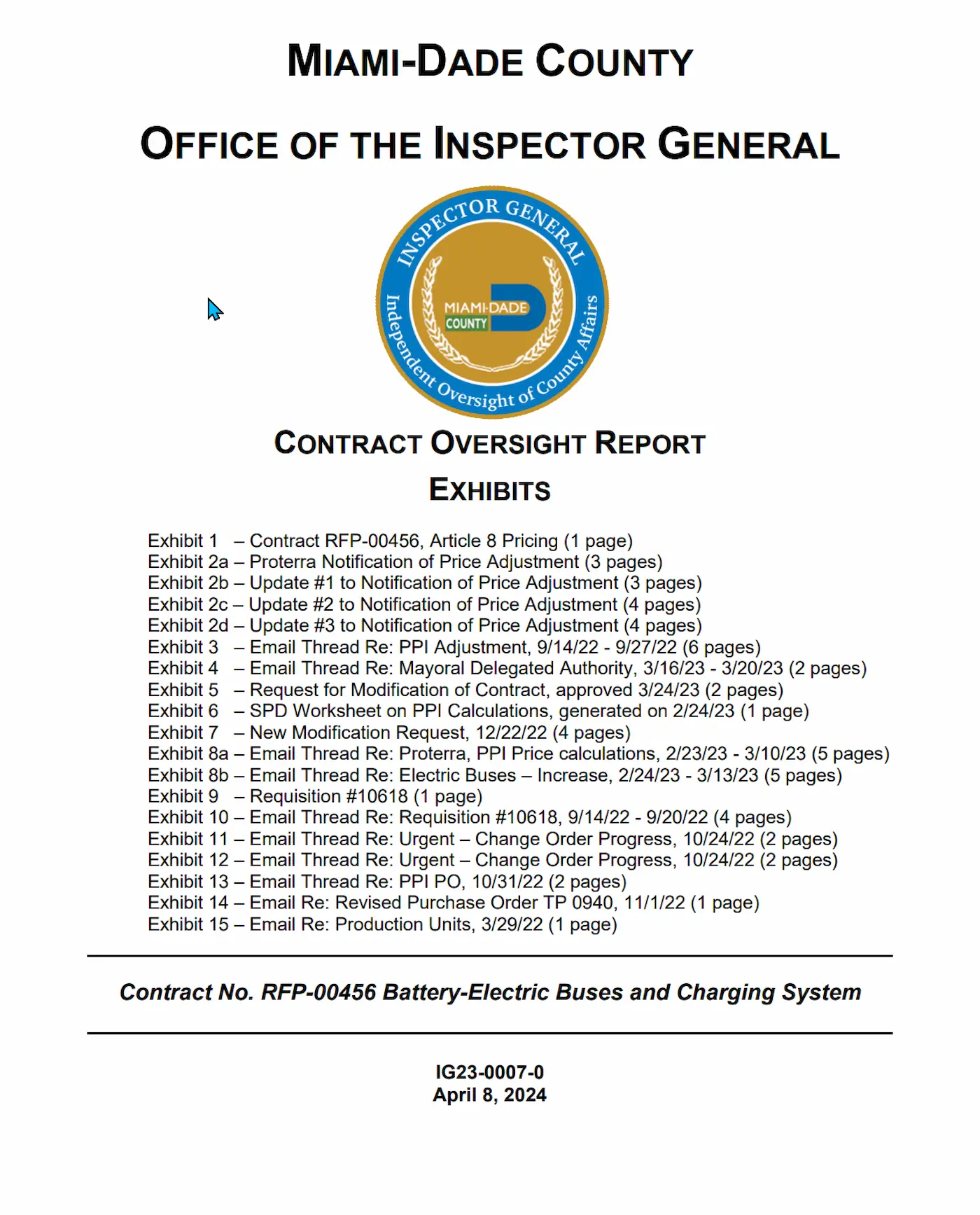
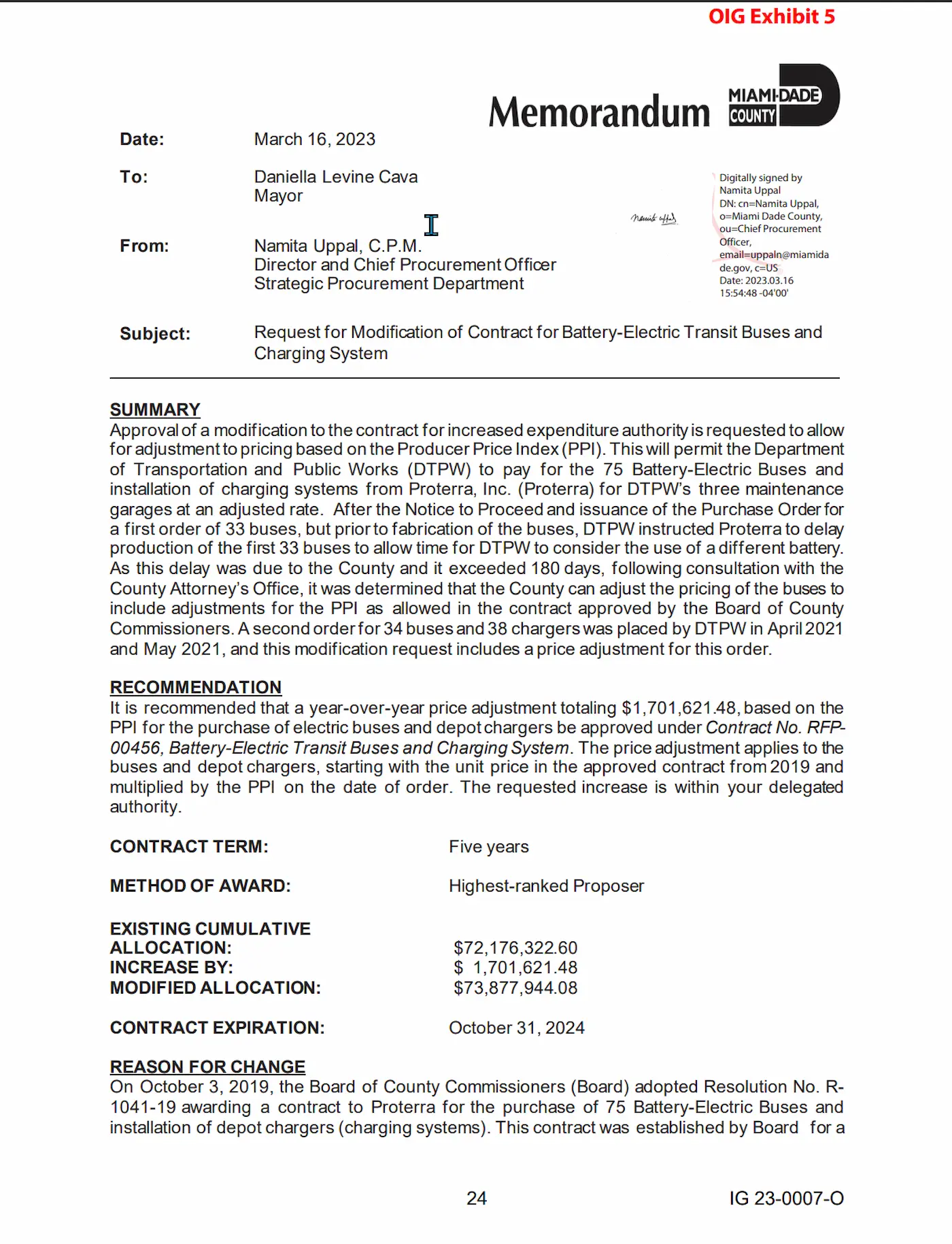
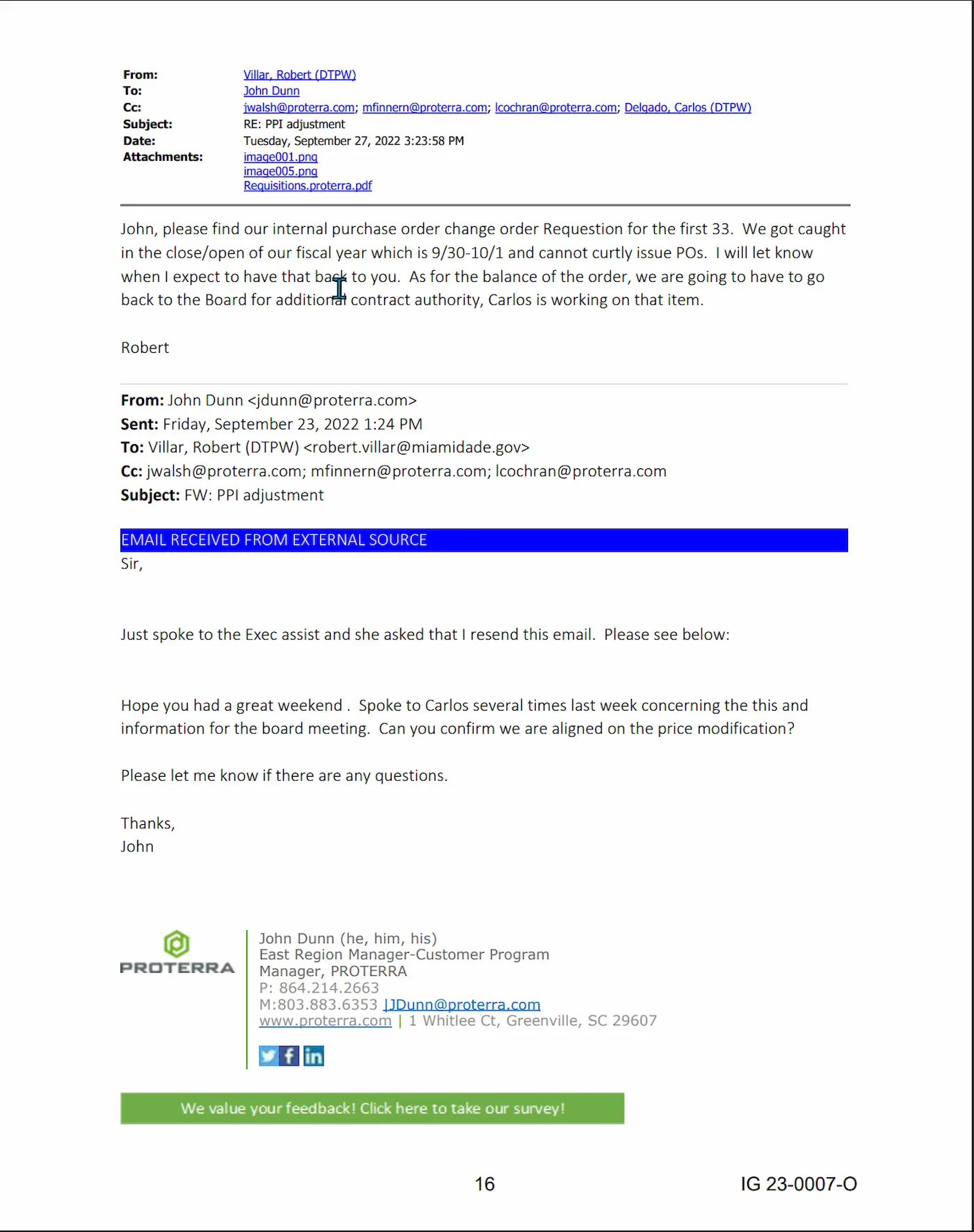
The same report includes findings that point to internal control problems and management decisions that are difficult to justify, including allegations of inflated billing and questionable handling of the approval/payment process. miamidadeig.org
Practical translation: if the county pays millions “up front” or “no hard check,” the result is obvious: the provider gets paid, the public loses.
“Few on the street”: buses failing, parts missing, and bankruptcy as the final blow.
One report (reprinted by GovTech) describes the operational collapse: most buses failed early, were taken out of service and, when Proterra went bankrupt, the problem was compounded by shortages of parts and support, with proprietary technology not repaired by “just any mechanic.” GovTech
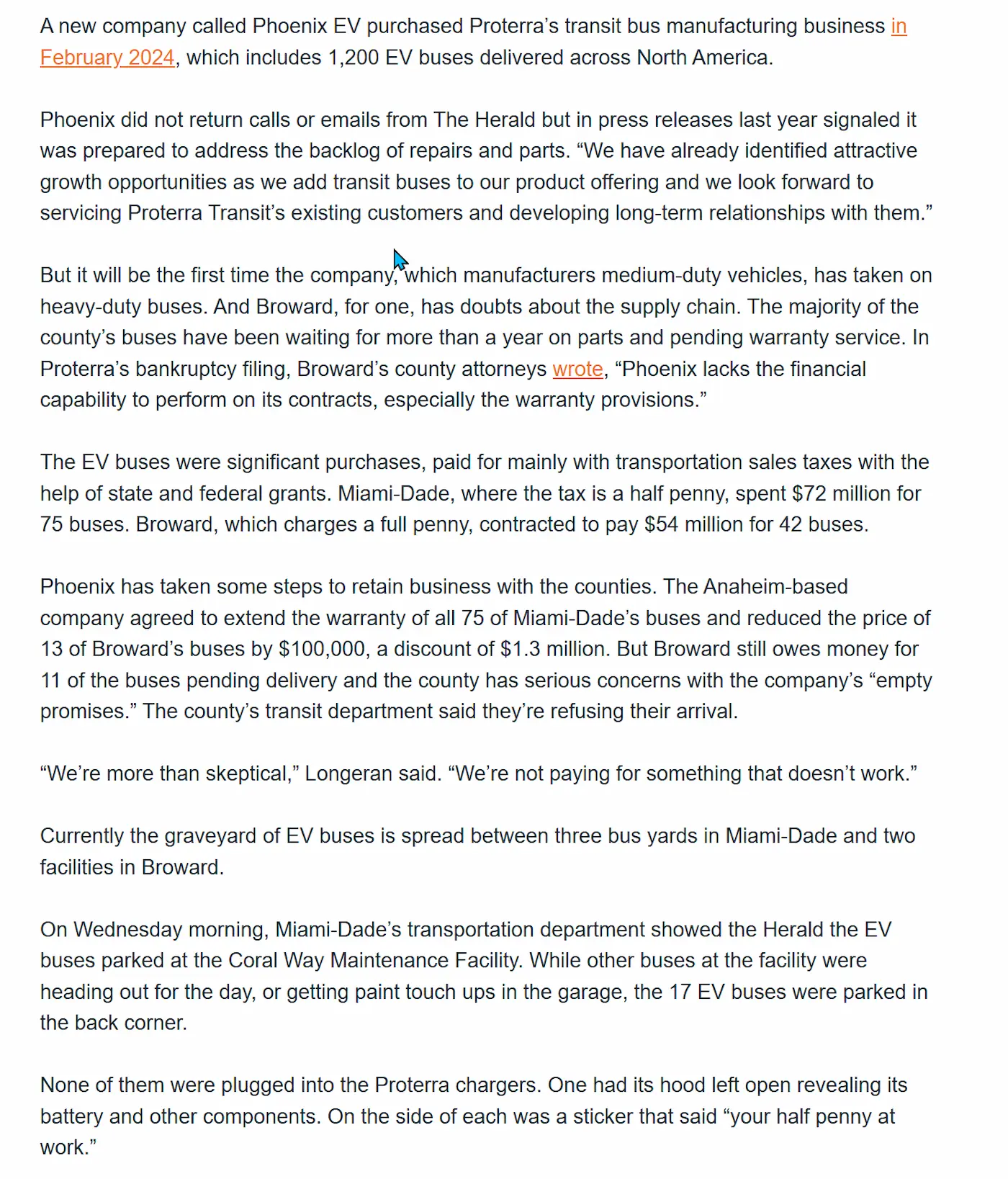
The same text mentions that Phoenix EV bought Proterra’s bus business and that there were doubts about its financial capacity to honor guarantees (this appears in bankruptcy case documents cited by the article). GovTech
Local reports: buses parked by the dozens and litigation threatened
Local media documented that by October 2025 66 buses were immobilized and that the mayor’s office was talking about legal action against those responsible/parties for supply and support. Miami Today
Minimal chronology of the “collision with the same stone”.
- 2019-2020: procurement and electrification narrative (contracts and “green” planning) are assembled.
- August 2023: Proterra enters Chapter 11 (bankruptcy), complicating parts, warranties and support. Sustainable Bus
- April 2024: OIG publishes findings of poor contract oversight and improper payments in the related contract ecosystem. miamidadeig.org
- February 2025: only 5-7 buses (out of 75) are reported to operate in Miami-Dade. GovTech
- October 2025: 66 are reported to be out of service. Miami Today
Miami-Dade and Proterra’s e-buses: the signs were there, but it went ahead.
So… why does Miami-Dade “hit the same rock”?
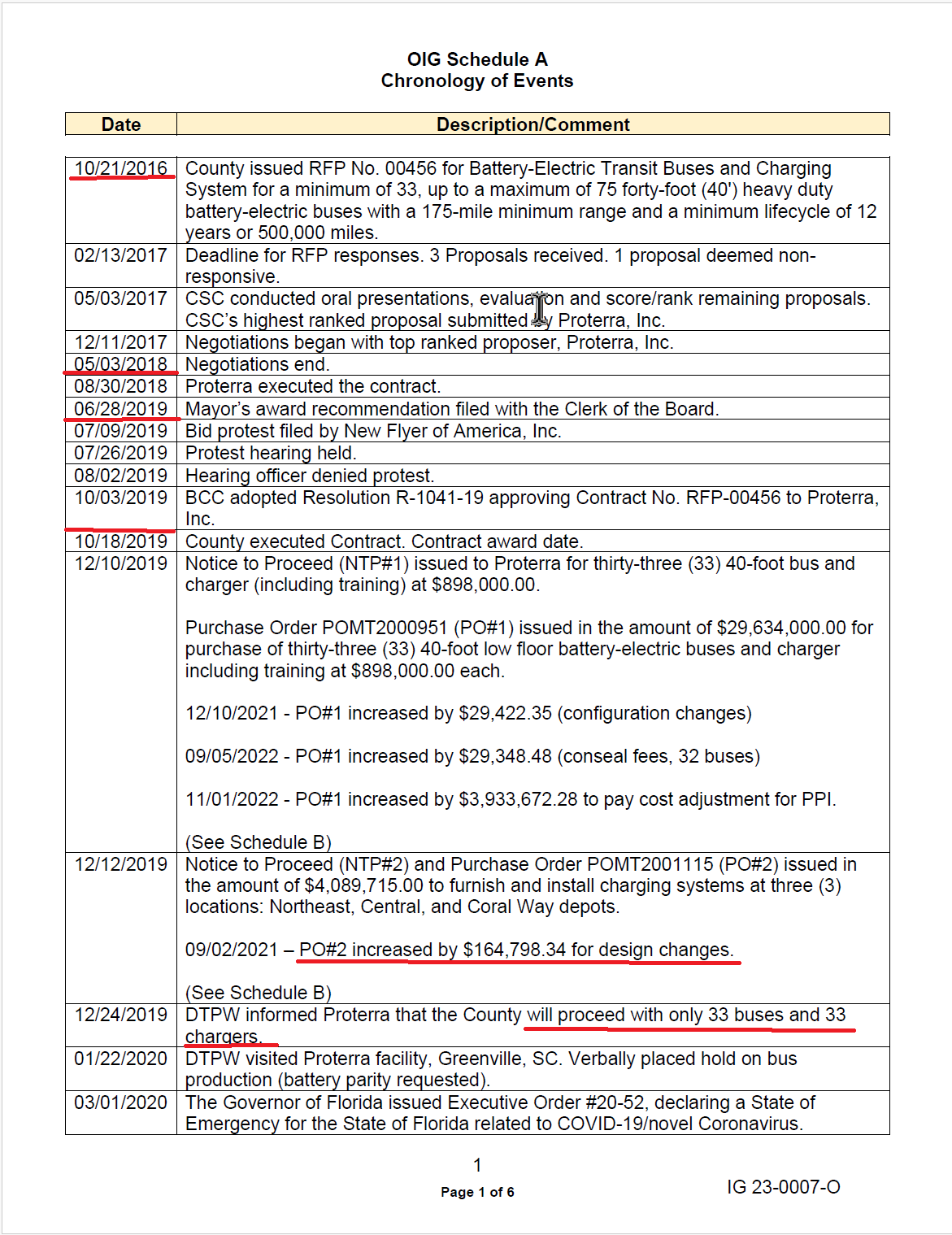
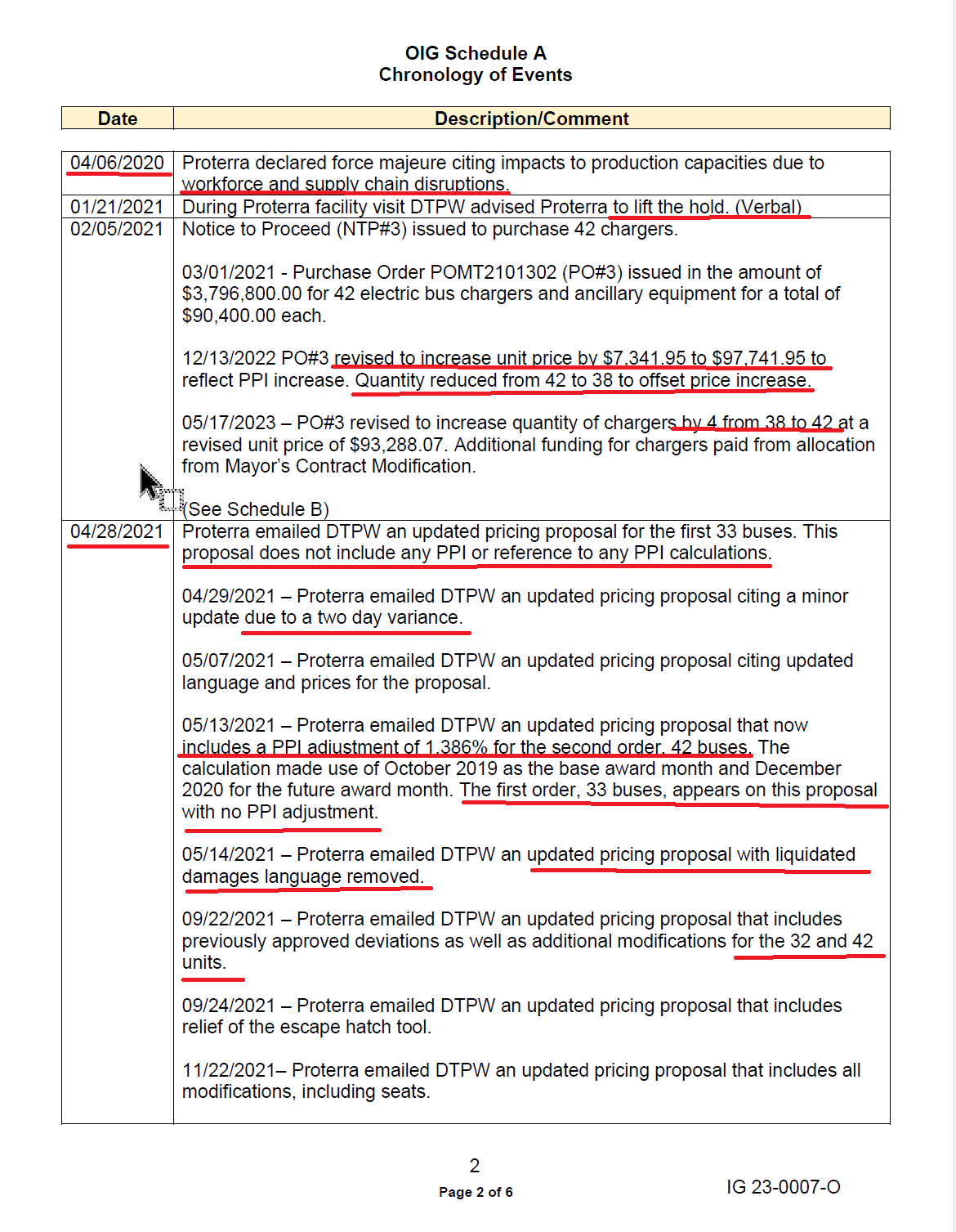
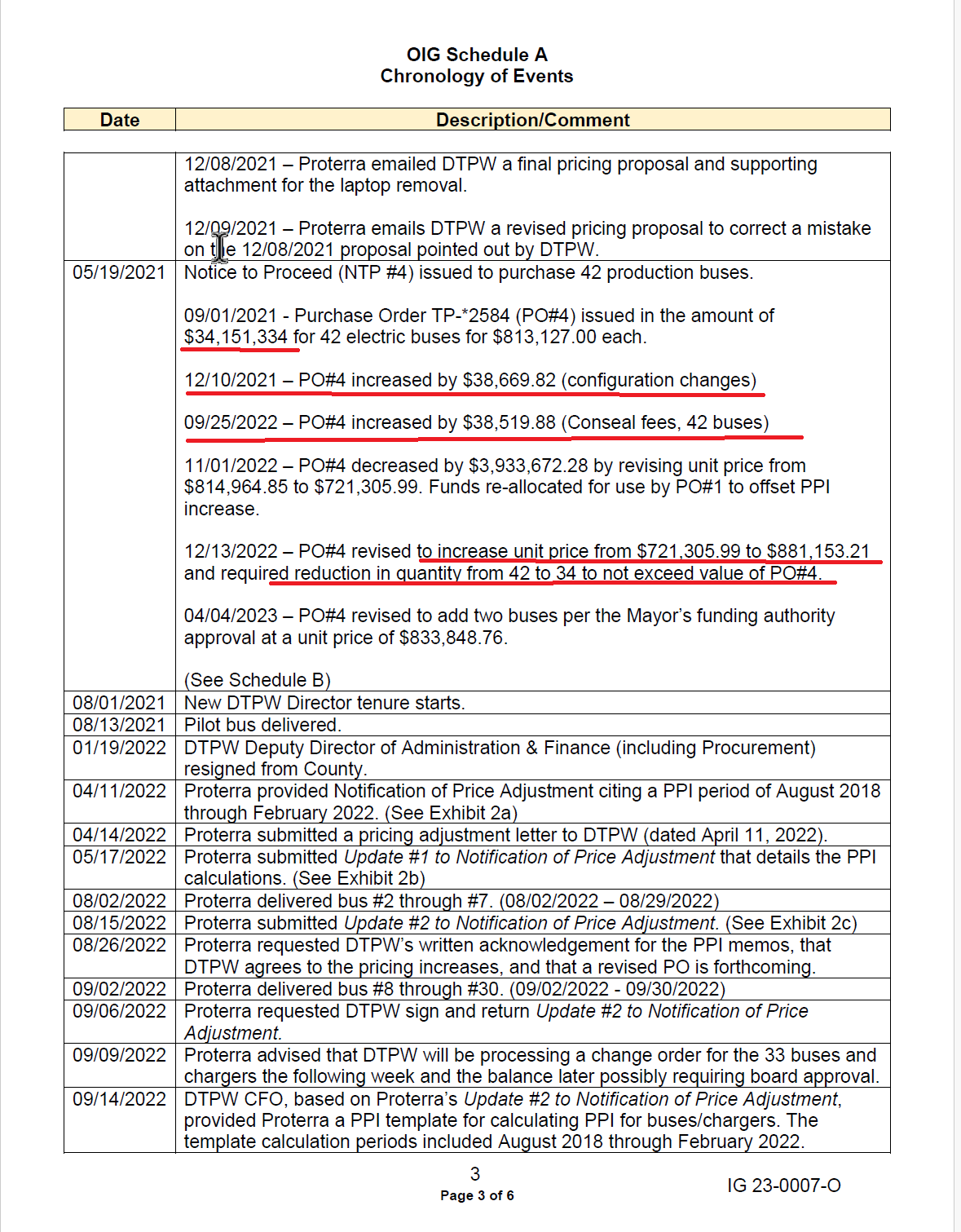
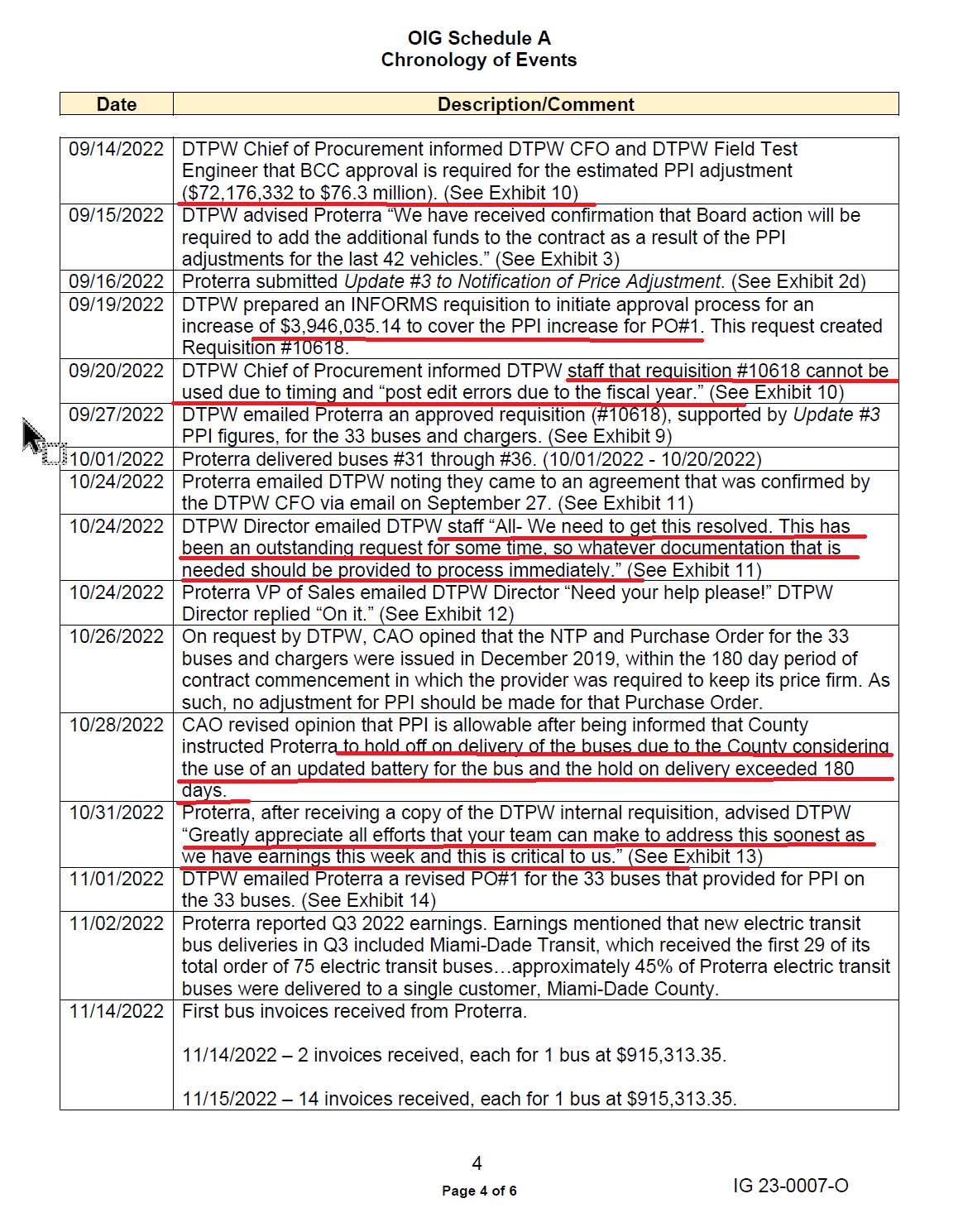
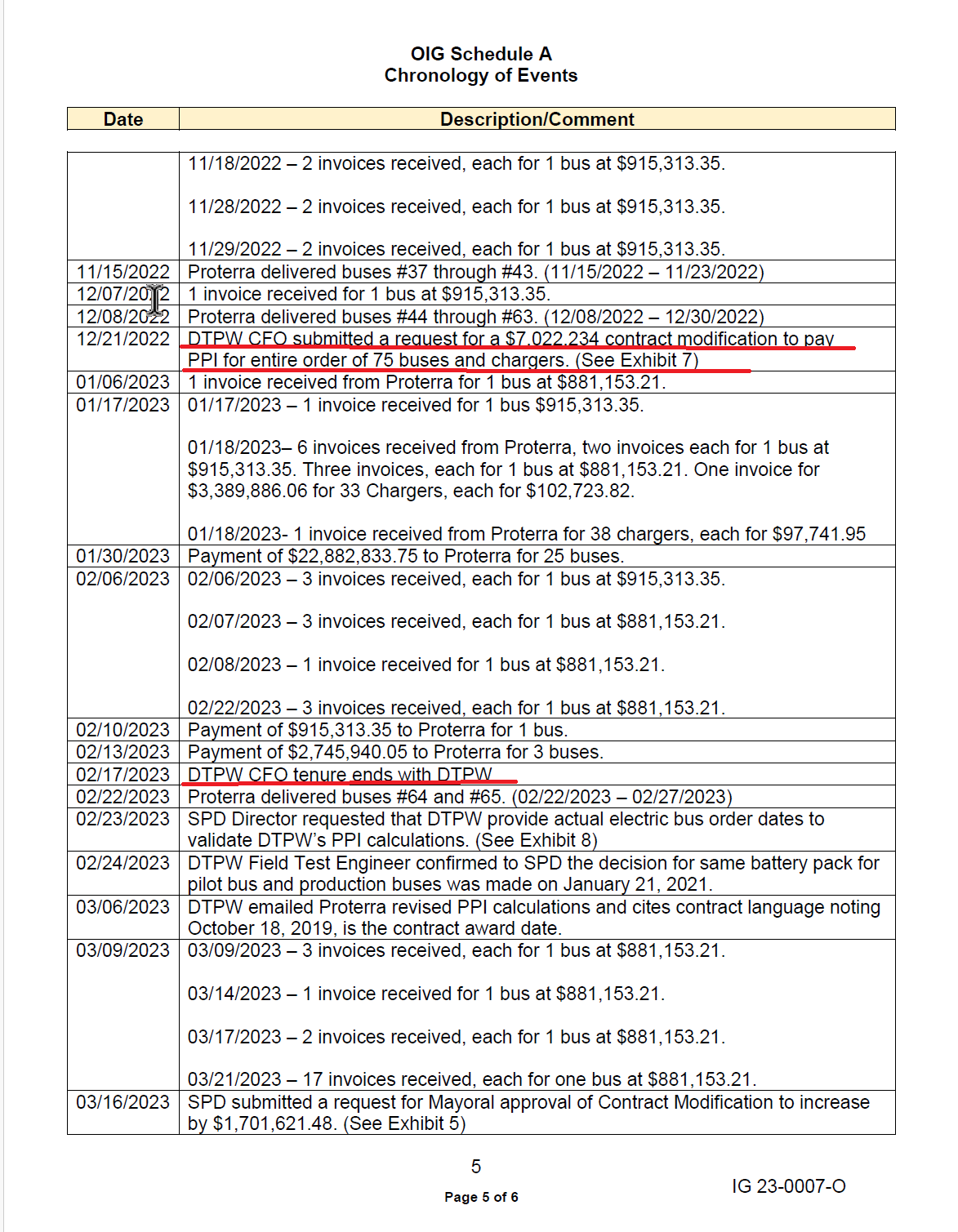
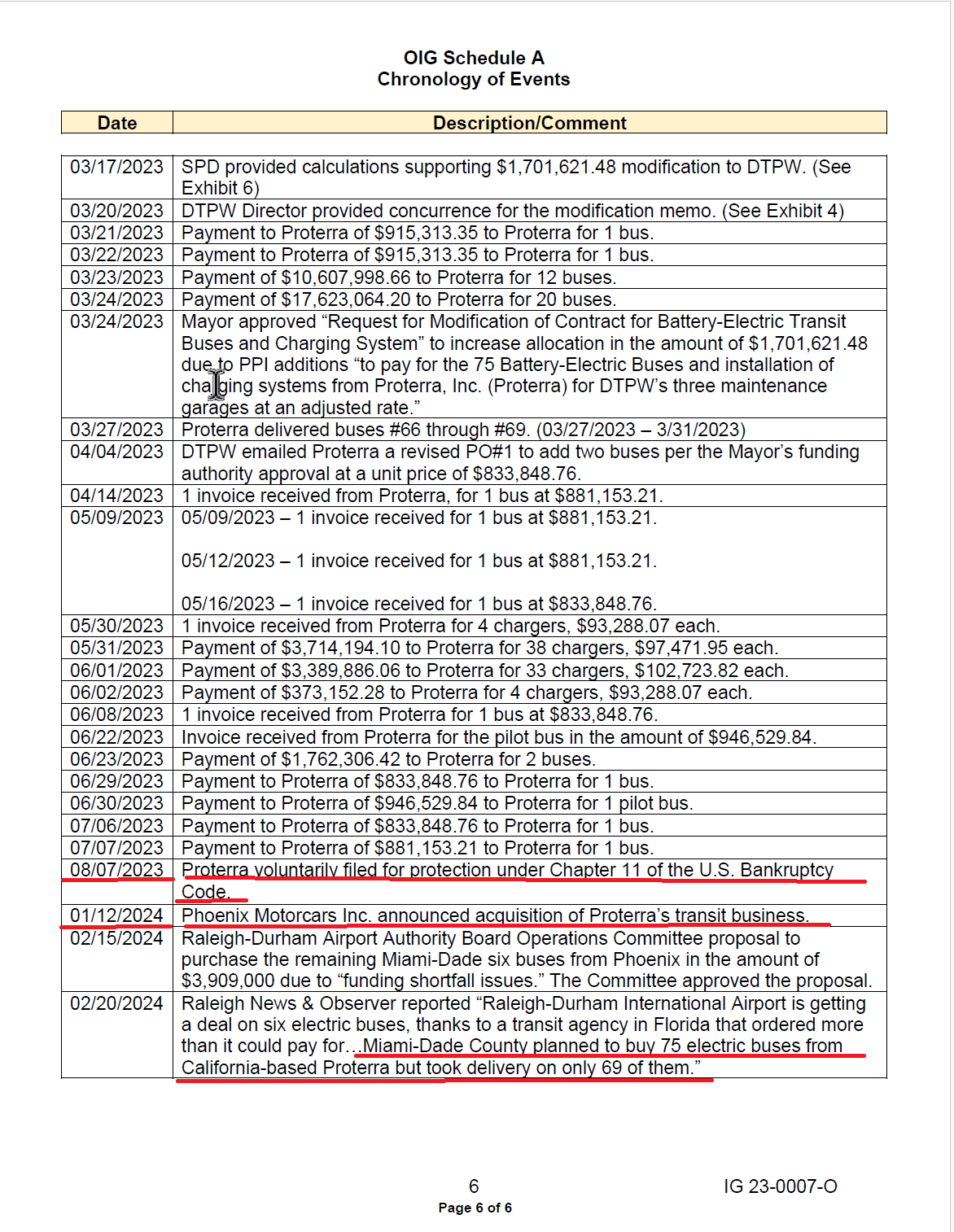
This analysis is based on Contract Oversight Report IG23-0007-O (April 8, 2024) on Contract RFP-00456 (electric buses and charging system). The document leaves a clear trail: serious operational problems, weak contractual controls, and administrative decisions that lent themselves to the disaster “seen coming.”
The hard evidence of operational collapse (what was already happening)
The report’s own post-script (already with Proterra in bankruptcy) describes a scenario that is not “theoretical”, but real and measured:
- Brutal drop in availability: the “Bus Down Report” of March 29, 2024 reports that the availability of Proterra buses dropped from 75% (May 2023) to 22% (March 2024); only 15 out of 69 operational. In addition, buses out of service 94 days on average and up to 237 days. 2024-04-08-contractoversight-rf…
- Warranty dependency and lack of parts: DTPW reported that the bankruptcy strangled the supply chain and delayed parts; DTPW had been complaining of parts shortages, recurring failures and incorrect shipments, and even asked for more parts to be kept in Miami (e.g., gearboxes). 2024-04-08-contractoversight-rf…
- The fact that portrays the lack of foresight: the contract included funds to purchase critical spare parts (powertrains), but none were purchased. 2024-04-08-contractoversight-rf…
This is key: if the report itself tells you that you had no spare parts inventory to “hold” when the warranty does not respond, then the risk of massive downtime was not a surprise; it was a consequence.
Early signals: verbal “hold”, force majeure and delays … without robust controls
The OIG’s timeline shows that execution and delivery problems appear early:
- Verbal hold on production (battery/parity): on January 22, 2020 a visit and verbal hold on production by battery (“battery parity requested”) is recorded. 2024-04-08-contractoversight-rf…
- Force majeure: on April 6, 2020 Proterra declares force majeure due to impacts on production capacity (personnel/supply chain). 2024-04-08-contractversight-rf…
- “Lift” of the hold also verbal: on January 21, 2021 it is indicated to lift the hold (verbal). 2024-04-08-contractoversight-rf…
- Critical traceability issue: the OIG finds that there is no written correspondence from the county to Proterra to request the hold or lift it; upon request for that evidence, DTPW responds that it was verbal authorization at a meeting. 2024-04-08-contractoversight-rf…
In serious public contracting, a “hold” that ends up affecting prices, deadlines and responsibilities cannot remain as “it was said in a meeting”. This documentary vacuum is gasoline for everything that followed.
The mechanics of the money: report notes “goalpost moving” and questionable PPI payments
Here is one of the most sensitive parts of the report: how they ended up justifying paying increases and how the dates were moved to allow it.
- The OIG says that no liquidated damages were collected and that arrearages attributed to the county ended up moving the “Future Award Month” from the original PO#1 date (December 2019) to February 2022. The OIG concedes that some adjustment for back pay may be reasonable, but questions moving the “goalpost” to February 2022. 2024-04-08-contractoversight-rf…
- The report details that Proterra, in price adjustment letters, used August 2018 as “Base Award Month” and February 2022 as “Future Award Month” “without explanation” for its calculations. 2024-04-08-contractoversight-rf…
This is important because it is not only “there was inflation”: the report states that the way it was calculated and the handling of dates opened the door to payments that, at the very least, should have been hyper-audited.
The OIG’s timeline includes an episode that, in practical terms, smacks of loose internal control:
- DTPW sends Proterra an approved requisition linked to the PPI adjustment. 2024-04-08-contractoversight-rf…
- Then, after receiving a copy of the internal requisition, Proterra responds: “we have earnings this week and this is critical”. 2024-04-08-contractoversight-rf…
- On November 1, 2022 the revised PO with PPI for the order is issued, and on November 2 Proterra reports its quarterly results (“Q3 2022 earnings”). 2024-04-08-contractoversight-rf…
No need to invent theories: the record itself shows that the provider connected the urgency of the payment to its earnings schedule. That, for a county, should be an immediate “stop there”.
Other evidence of contractual risk: undelivered buses and resale to third parties
The OIG also notes that, after the acquisition of the transit business, Phoenix ended up selling six buses that DTPW had ordered but did not receive to RDU Airport at a reported bargain price. 2024-04-08-contractoversight-rf…
That suggests a two-fold problem: (1) fulfillment/delivery and (2) protecting the county’s interest when the supplier changes hands.
Bankruptcies, recalls and retired fleets were also “coming” at national level
Miami-Dade was not operating in a vacuum. There were signals in the market and in the product:
- Proterra bankruptcy (chapter 11): reported by Reuters on August 7, 2023. Reuters
- NHTSA recalls Proterra:
- Recall 2024 (Phoenix already in charge) for possible fire risk on Proterra buses (NHTSA, about 483 buses). Smart Cities Dive
- Example of another city retiring its entire electric fleet due to mechanical/safety failures and low availability: Des Moines DART case (Axios, 2025). Axios
- Recognized operational risk in cold weather (consumption/efficiency): studies and reports show energy penalty in cold weather for electric buses. Cornell Chronicle+1
This is not an “anti-electric” argument. It is a reality: the transition requires hard due diligence (manufacturer’s financials, support capability, parts, warranties, recall history, actual performance), because when it fails, the one who pays is the taxpayer and the user.
The bottom line: it wasn’t just the buses that failed; the county filter failed.
Reading the report as an auditor would read a case:
- There were signs of execution (delays, force majeure, battery hold) 2024-04-08-contractversight-rf…
- There were weak control signals (verbal hold/lift with no written support) 2024-04-08-contract-versight-rf…
- There were pricing decisions that the OIG questions for moving dates and method 2024-04-08-contractversight-rf… 2024-04-08-contractversight-rf… 2024-04-08-contractversight-rf…
- There was documented pressure from the supplier tied to “earnings” 2024-04-08-contractversight-rf…
- And in the end, the operating result was 22% availability with buses stranded for months. 2024-04-08-contractoversight-rf…
When all that comes together, the honest thing to say is: it wasn’t bad luck; it was bad risk management.
Because the system (as designed) pushes to repeat mistakes. Three hard reasons:
- Policy rewards announcement, not performance. “Zero emissions” makes headlines. “Real mechanical availability” gives headaches. When “show” is the priority, due diligence becomes a formality.
- Poorly armored contracts = public risk, private gain. If the OIG is documenting payments for work not done, the message to the market is: you can bill here and fight later. miamidadeig.org
- Dependence on fragile manufacturers in an unstable industry. When the supplier goes down, the county is held hostage for parts, software and warranties. That’s not theory: it’s described in the Proterra case and the subsequent operational logjam. GovTech
Who are the “actors behind” the disaster (responsible by position and ecosystem)?
A) Institutional (within the government)
These are not “villains”; they are decision-makers. If the project fails, this is where the audit and accountability should fall:
- County Mayor’s Office: sets priorities, publicly advocates for the project and pushes policy directions (including “green” agenda) that result in purchases.
- COO/Central Administration: coordinates interdepartmental execution and is accountable for operational performance when the system collapses.
- DTPW/MDT (Direction of Transportation): defines specifications, operation/maintenance, unit acceptance, and real-world contract administration.
- Procurement/Strategic Procurement: structures the RFP, validates criteria, controls purchase/change order processes and compliance.
- County Attorney / legal counsel: drafts clauses, manages disputes and determines when to litigate or renegotiate.
- Board of County Commissioners (BCC) and transportation committees: approve, inquire (or not inquire), and audit (or not audit).
When an OIG documents oversight failures or improper payments, the obvious question is: who signed, who certified, who validated? miamidadeig.org
Connection to “The Transition to Electric Buses in the U.S.” and bankruptcies: 2025 left the lesson in big letters.
2025 was a year of bankruptcies and collapses in companies linked to the EV (electric vehicle) world – a reminder that the sector is full of promise, but also of companies that do not hold up. Noted cases include Canoo (bankruptcy), Nikola (Chapter 11) and Rad Power Bikes (Chapter 11), among others. The Verge
The lesson for public procurement is simple: if the industry is volatile, your contract must be armored as if it were war (parts, warranties, penalties, performance bonds, critical inventory, and reliability testing before payment).
Direct Closure: Failed by Governance
Miami-Dade did not fail because of “technology. It failed because of governance: large purchases without tough oversight, contracts that do not protect the taxpayer, and a political environment where access weighs too heavily.
If the county insists on electrifying (which may be valid), there is one condition: reliability first, then the incumbent.
Bankruptcies EV 2025 (references)
📰 Stay informed with the latest news!
Would you like to receive more information like this directly on your screen?
🌟 Visit our home page and find out what’s happening in South Florida: local news, events, politics and much more.
👉 Click here! newsmiamidade.com/en
Don’t miss a single detail. #MiamiDade #News #Florida