
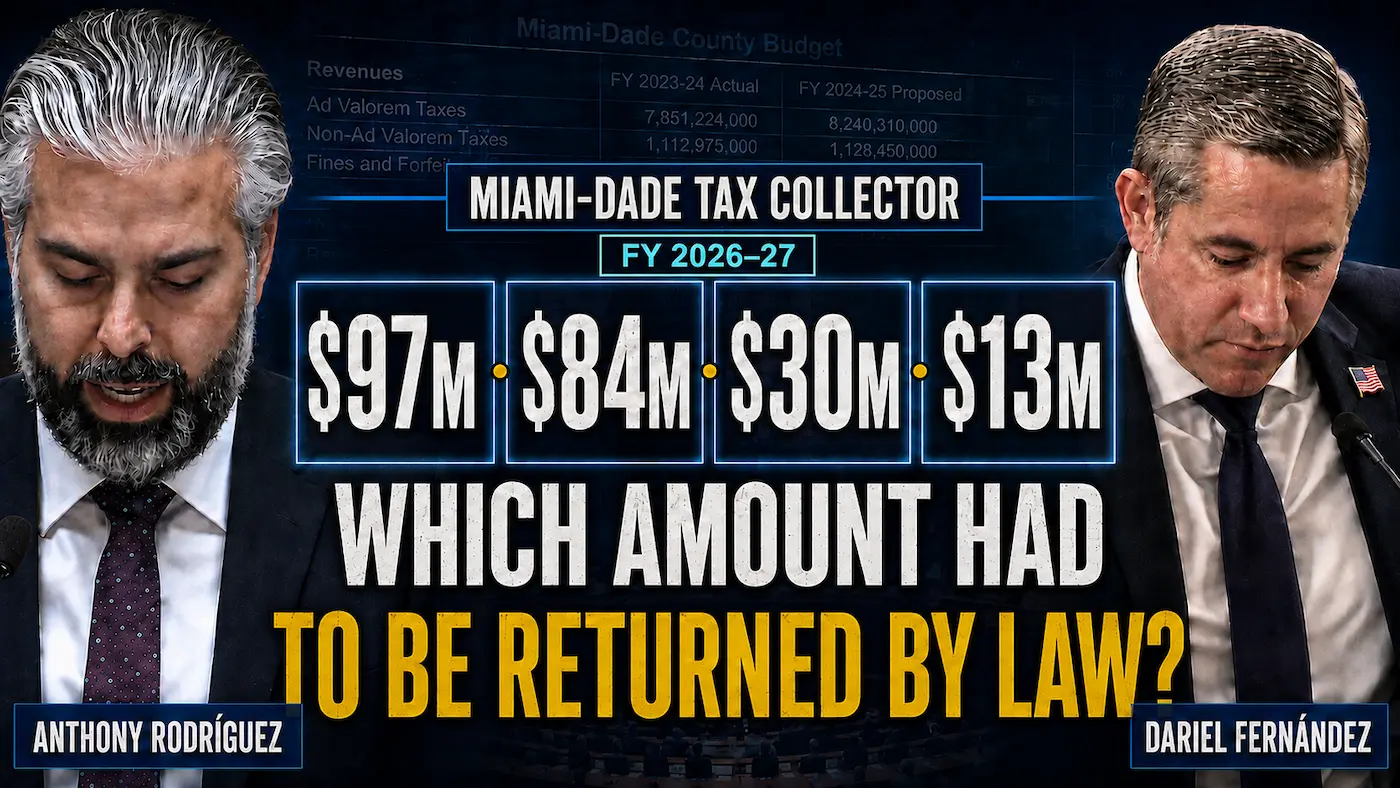
Miami-Dade Tax Collector: $97, $84, $30, or $13 million? Which amount was required by law to be refunded? A refund is not a gift.
Miami-Dade Tax Collector Dariel Fernández announced via video to the full county commission that he is waiving his commission on the school millage and will refund $97 million this year. Florida law already requires him to return the surplus, and a year ago, a commissioner stated this openly regarding a similar transaction: it was money he was going to return anyway.

The video, as it was broadcast
News Miami Dade recorded the session as it aired. Here is the full video, from the moment the chairperson announces the video until the matter is closed, with Spanish subtitles added by NMD.

Miami-Dade Board of County Commissioners Plenary Session, September 1, 2026, from 9:46 to 9:49 a.m. News Miami Dade’s own recording of the county’s live broadcast. No changes to the content. Modification: clip edited and Spanish subtitles added by NMD.
What happened?
On Tuesday, September 1, 2026, at the Board of County Commissioners’ plenary session.
The chair announced that the tax collector had been unable to attend and was sending a recorded message. Andrew López, director of Motor Services at the Tax Collector’s Office, presented the message to the full assembly, and it was played on the screen in the chamber.
In that video, Fernández announced three things.
First, she waived her commission on the school millage for fiscal year 2026-2027, and said, verbatim: “This will save Miami-Dade County residents more than 13 million.”
Second, he called for a specific use for that money: “I ask the commission to use these savings for property tax relief and to protect police, fire and rescue, emergency response, and other essential services.”
Third, he provided an overview of his office’s finances: 97 million that he expects to return this year to all tax authorities, of which 84 million would benefit county residents; 20 million already returned in April 2026 and 64 million by the end of the fiscal year; up to 24 million in advance payments to which she was entitled but did not request; and 40 million from not collecting the 2 percent commission in unincorporated areas and municipalities.
He added a verifiable statement: “Let me be very clear. No other tax collector in Florida does this.”
It’s best to distinguish between these figures from the start, because they are not the same, and only one of them depends on him.
The 97 million—and the 84 million of that amount that it attributes to county residents—is a refund: money left over at the end of the fiscal year.
The 13 million is a waiver: a fee that his office could charge but has decided not to.
And 30 million is the figure that the presiding officer of the plenary session gave that same day regarding that same resignation.
The difference matters because Statute 218.36 already requires the surplus to be distributed among the tax authorities, whereas waiving a commission is indeed a decision. What this newspaper has been unable to verify—because it is not itemized in any public document—is whether those 97 million represent the surplus that the law mandates be distributed or whether they include something else. Without that breakdown, the question of how much of the announced amount was mandatory and how much was voluntary cannot be answered based on the available documentation.
When the video ended, the chair of the plenary session, Anthony Rodríguez, added something that the video didn’t mention: “The mayor and I have been speaking with the tax collector… and we even wrote him a letter to try to get him to waive this, and he’s agreed. So this, as he mentioned, is about $30 million that I believe will be outlined in the mayor’s change memo.”
Furthermore, no one explained why the figure provided by Fernández—more than 13 million—and the one provided by the plenary’s presiding officer—about 30—do not match. Nor did his office invent the resignation: it was established by the Florida Legislature on July 1, and for 2026 , the deadline to submit it in writing was September 1— that is, the day of the announcement . A week earlier, the same office had announced the recovery of more than 20 million in back taxes from businesses. There, too, the law already required them to do so.
Two days later, at the first budget hearing, the two figures were stated aloud once again, but the speakers switched places: the chair of the plenary session spoke of thirteen million, and the tax collector—who was present in the chamber this time—spoke of more than thirty.
He announced it an hour earlier, and there were already two categories
About an hour before the session, the Tax Collector’s Office released a bilingual graphic previewing what he was going to say. Its three bullet points clearly separate the two topics that would later be presented together: “We will announce how much money our office will return to the community” on one hand, and “We will also report on the fees we have decided not to charge to ease the burden on taxpayers” on the other.
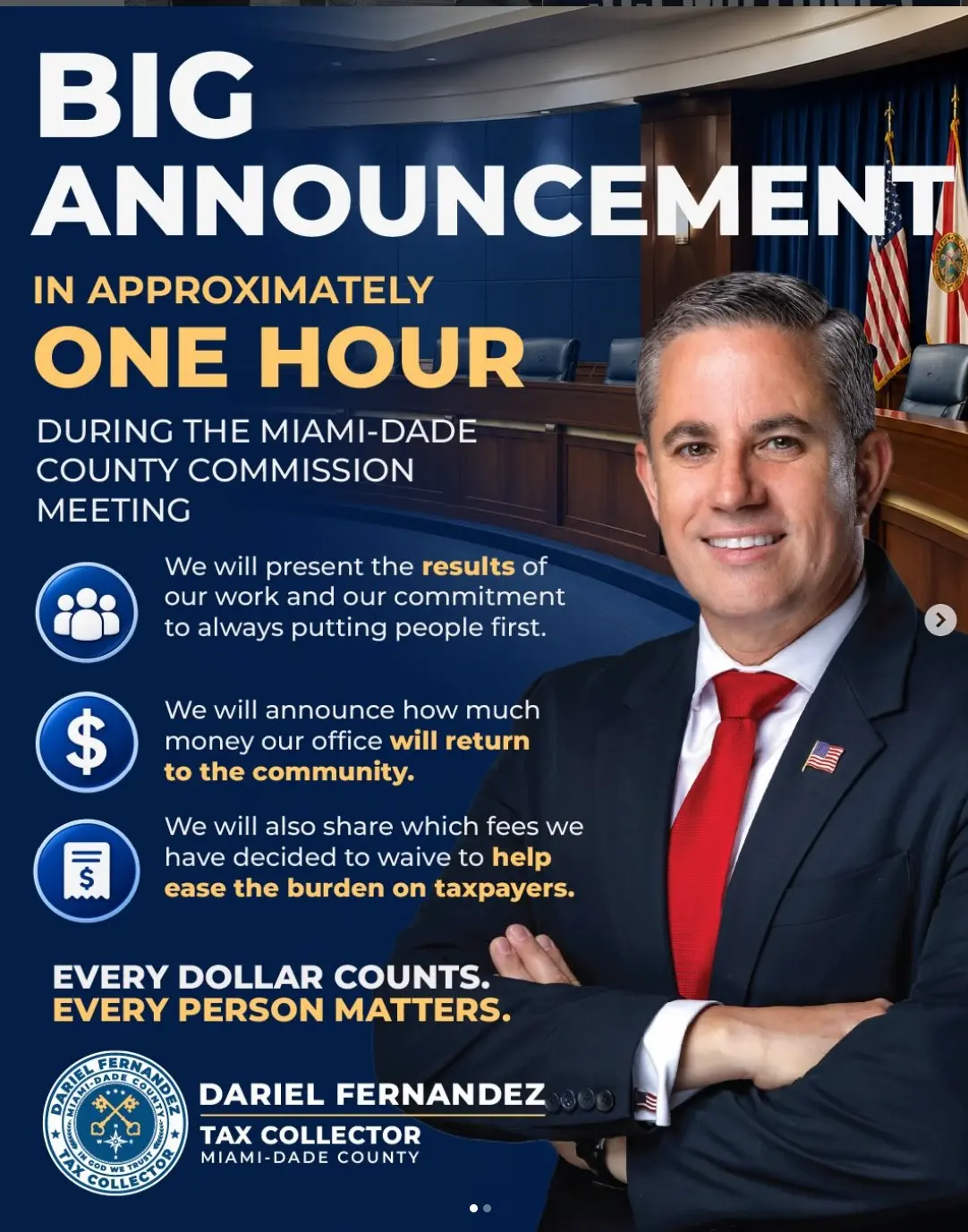
Publication from the Miami-Dade Tax Collector’s Office, September 1, 2026. Compiled by NMD on September 1, 2026. Unmodified.
That distinction matters, because one is a decision and the other is an obligation. The chart shows them together, without distinguishing between them.
And what he posted afterward
At 12:22 p.m. that same day, after the session had concluded, Fernández posted a video about the announcement. He stands by the figure he cited in the chamber: “More than $13 million in savings for Miami-Dade residents.” Thirteen million, not thirty. And he confirms, from his perspective, the prior efforts described by the chair of the plenary session: “Thank you to Chairman Anthony Rodriguez for working with my administration to make this important step possible.”
Miami-Dade Tax Collector’s Account, September 1, 2026, 12:22 p.m. Downloaded by News Miami Dade on September 1, 2026. Unmodified.
Why It Matters
Because that money doesn’t belong to the tax collector. It comes from taxes that residents have already paid, and much of what he announces isn’t his own decision but an obligation imposed on him by law.
The tax collector’s office does not receive a budget allocation like a county department. It is funded by charging a percentage of every dollar in taxes it collects for each agency. This is established by Florida Statute 192.091, which states that tax collectors “shall be entitled to receive, upon the amount of all real and tangible personal property taxes and special assessments collected and remitted, the following commissions,” and sets the rate for tax districts at 3 percent on the first portion and 2 percent on the remainder.
In other words: the office charges fees to the tax authorities based on a formula established by state law, not based on what it needs to operate. And if the announced 97 million is a surplus, then in that fiscal year, revenue exceeded expenses and authorized reserves. The reconciliation statement would explain the amount and the reason, but the reconciliation statement has not been published.
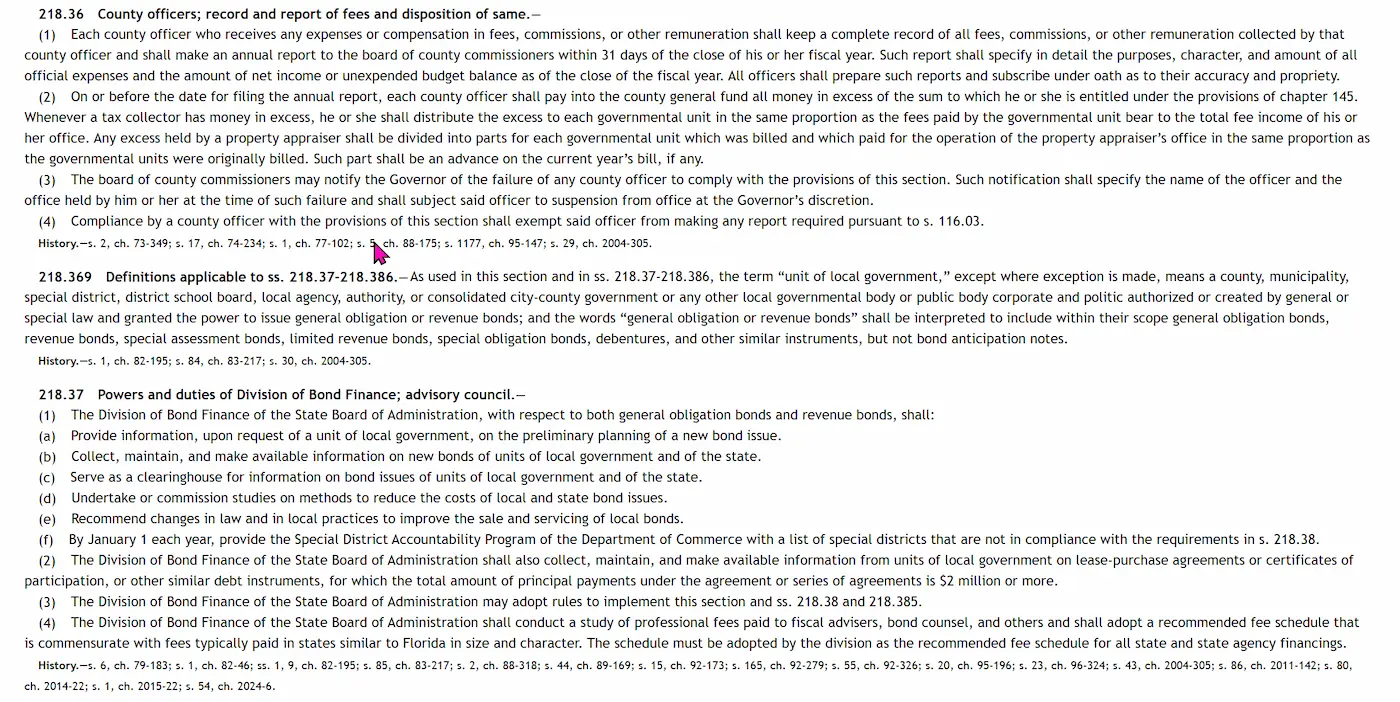
That is why Statute 218.36 exists; it leaves no room for interpretation: “Whenever a tax collector has excess funds, he or she shall distribute the excess to each governmental unit in the same proportion as the fees paid by the governmental unit bear to the total fee income of his or her office.”
And it’s worth noting when it took effect, because that changes how the notice is interpreted. The legislative history of Section 218.36 shows no amendments since 2004, and the text regarding the distribution of surplus funds dates back to the 1970s. This isn’t a new rule that the tax collector encountered upon arrival—it had been on the books for decades.
It’s worth reading that sentence slowly, because it doesn’t just order a refund—it also specifies how. The tax collector’s surplus does not go back into the county’s general fund. It goes to each tax authority in the same proportion as each one paid commissions to its office. If those 97 million are the surplus that Section 218.36 mandates be distributed, this would explain why the announcement refers to a figure distributed among all taxing authorities and to 84 million that benefit county residents: in that case, the distribution would not be based on the office’s discretion but on the arithmetic mandated by the statute, and the School Board would receive its share through the same process.
Whether or not that figure represents that surplus is precisely what is not broken down.
The same section makes it clear that this rule applies specifically to the tax collector. For county officials in general, it states something else : “each county officer shall pay into the county general fund all money in excess of the sum to which he or she is entitled under the provisions of Chapter 145”—that is, into the county’s general fund. And for the property appraiser, it isn’t even called a refund: the surplus is divided among the entities that paid for the appraisal, and “such part shall be an advance on the current year’s bill”—an advance on account of the next bill. Three different rules in the same paragraph, and the tax collector’s is the only one that distributes funds outward.
When you compare the five constitutional offices in the county, the difference becomes clearer. The sheriff and the elections supervisor do not charge fees: their budgets are allocated by the full county commission, and whatever they do not spend is unspent county funds, not a surplus to be returned. The Clerk does collect fees in its judicial capacity, but any surplus is not distributed: Statute 28.37 mandates that it be remitted “to the Department of Revenue for deposit into the Clerks of the Court Trust Fund”—a single destination, and a state one at that.
The tax collector distributes the funds on a pro rata basis to several local governments at once: the county, the municipalities, the School Board, and the special districts, each according to what it paid. The property assessor also distributes funds proportionally, although any surplus is credited as an advance against the next bill rather than as a refund. None of the other three offices has this arrangement: the sheriff and the supervisor do not collect commissions, and the Clerk’s surplus goes entirely to a state fund. That is why the ad can refer to millions distributed among tax authorities. Not because anyone in Miami-Dade designed it that way, but because the distribution is mandated by statute.
Under the law, the announcement is divided into two parts. Returning the surplus is not a decision: the statute mandates it, and what the office’s management decides is how much to spend, not whether to return it. The 13 million from the school commission waiver, on the other hand, is indeed their decision, as are the nearly 40 million from the 2 percent commission that the office claims it did not collect in unincorporated areas and municipalities.
The 24 million in advance payments are not included on that list and should be removed from it. This is not money that will go uncollected. Statute 192.102 and the agreement the office signed with the county stipulate that the county advances to it each month, from October through July, one-twelfth of the previous year’s commissions. The statute makes this conditional on his claiming them: the county pays that one-twelfth each month “on demand of the county tax collector.” In other words, they are paid when he requests them.
Not requesting them means not bringing in cash upfront and not giving up revenue. The right to those commissions remains intact. Including them alongside the waivers inflates the figure in the announcement with an item of a different nature.
Exactly where the figure of 97 million fits within that breakdown is something that cannot be determined from the published information. The office reports it as a refund for the fiscal year; News Miami-Dade has not located the document that breaks down which portion of that 97 million corresponds to the surplus required to be turned over under Statute 218.36 and which portion, if any, corresponds to resignations. That breakdown is the first of the six documents listed at the end of this article that would close out the accounts.
The discretionary aspect is significant and deserves to be stated just as clearly: waiving in advance a commission that the law authorizes you to collect reduces the amount deducted from the public funds administered by the county.
The board itself had already explained this a year ago
News Miami-Dade doesn’t need to say it. A commissioner said it at the public budget hearing on September 4, 2025, thanking the tax collector for a budget equivalent to this year’s, and he said it in no uncertain terms:
“I want to thank our tax collector, who was here with us earlier today, for meeting with me and working with me to secure over $26 million upfront—something he didn’t have to do. This is money that he would have returned at the end of next year.”
There is the figure from the previous year —26 million— and there is the nature of the transaction as described by the full council itself: money that was going to be returned anyway, paid in advance. What was discretionary was the timing, not the destination. Later in that same session, another commissioner echoed this: “Thank you for working with our tax collector to secure that $26 million early.”
Who is saving those 13 million?
The law answers that question, and it does not say what the ad said. Florida Statute 192.091, in the section that specifically regulates commissions on school millages, establishes two things in succession. First, who pays: “The commissions on the amount of taxes collected from school millages shall be paid by the board of county commissioners.” Second, the authority that took effect this year: “The tax collector may waive the commission authorized in paragraph (b) for voted school millages as described in s. 200.001(3)(c) and (e).” Section 200.001 defines what constitutes a voted school millage, which is the only type to which the waiver applies.
Taken together, they mean this: the school millage commission is paid by the county board of commissioners. When the tax collector waives collection, it is the county that stops paying. It is not the school board, nor is it the taxpayer, whose property tax bill remains unchanged by this waiver.
The county itself treats it that way. The report that the mayor signed on September 2 states that the updated revenues and expenditures resulting from the resignation are not yet reflected in the proposed budget: they are treated as county accounts. And the county council president put it in those exact words on September 3, verbatim: “That is expected to save the county approximately 13 million dollars.” To the county.
The September 1 announcement said something else: “This will save Miami-Dade County residents more than 13 million.” For that statement to be true, one step is still needed: the Board must decide to return that money to taxpayers instead of spending it on something else. And that step does not depend on the tax collector. His own video makes it clear: in the same message, he asked the Commission: “I ask the Commission to use these savings for property tax relief.”
In other words, at the very same moment, savings for residents are announced, and another body is asked to turn those savings into actual savings for residents. The first is a conclusion; the second is an acknowledgment that that conclusion has not yet been reached. As of the publication of this article, the Regional Government has not decided how to allocate that money, and the budget presented at the first hearing does not yet include it.
And it’s worth looking into who else requested something that night regarding that same money. At 5:32 p.m., the Clerk and Comptroller, Juan Fernández-Barquín, asked the full council for the exact opposite of what the tax collector requested: to keep his own savings. He explained that the mayor’s budget cuts $2,664,000 from his office and that, if he has to absorb those cuts, he would eliminate fifteen vacant audit positions in the comptroller’s office and another fifteen positions distributed among the Board’s secretariat, the finance department, the registry, and the Securities Adjustment Board.
His request, verbatim: “I’m asking that you allow me to use any additional savings I generate in fiscal years twenty-five and twenty-six… to offset a reduction of 2.664 million dollars, “ and that this be incorporated through the Second Memorandum of Changes.
That matters here for a specific reason. Hours later, at 10:16 p.m., the budget director explained where the 11 million comes from—which this budget adds to reserves that are sufficient for nine days of operations—and set a condition: “that the constitutional offices return what we’ve projected they will return.” In other words, the county’s reserve plan relies on what the constitutional offices return. And that very night, one of them requested not to return the funds. What the tax collector announces as a refund and what the Clerk requests to withhold are two sides of the same coin, and neither has been finalized.
Returning something is not the same as giving it away
Here is what a resident has the right to be told, and it is best to state this plainly and without exaggeration.
An announcement that presents what the law mandates and what the office decides as being on equal footing inevitably comes across as generosity. And much of what is advertised is not generosity—it is compliance. Statute 218.36 does not say that the tax collector may distribute the surplus; it says that the collector will do so. Section 197.413 does not say that the tax collector may pursue delinquent taxpayers; it says that the tax collector will prepare the lists, issue demands, and go to court. In both halves of the announcement, the obligation was already stipulated.
And that same article adds something that the announcement about the twenty million also failed to mention. Paragraph 10 grants the tax collector “a fee of $10 from each delinquent taxpayer at the time delinquent taxes are collected.” Pursuing delinquent taxpayers isn’t just an obligation imposed by law: when the tax collector collects, it also charges a fee for doing so.
News Miami Dade does not attribute to anyone the intention to mislead, because intent cannot be documented, and this newspaper does not publish what it cannot prove. What is on record—and is dated—is the effect and a sequence of events. One hour before the session, the notice issued by the office itself separated the two categories into two distinct bullet points: the money it would refund on one hand, and the fees it had decided not to collect on the other. In the chamber, one hour later, they were treated as a single balance and a single achievement.
And last year, in connection with a transaction involving the advance payment of funds that would later have to be repaid, it was the plenary session itself that put it in no uncertain terms: money that was going to be repaid anyway.
That does not diminish the significance of the decision, which is its own, and it deserves to be stated just as clearly: the office attributes 13 million to the new waiver of certain school taxes and nearly 40 million to fees it claims not to have charged to municipalities and unincorporated areas. Both have legal basis, and both would reduce the amount deducted from taxes, but for neither has the calculation, the time period, or the supporting document been published. The objection is not that it did nothing. It is that what it did on its own initiative and what it did because required by law were presented to the plenary session mixed together, without anyone separating them on the floor.
A resident who hears that 97 million has been returned assumes that someone has given him something. What the law says is that the surplus—once the office’s expenses were paid—had to be returned. What portion of those 97 million constitutes that surplus is the breakdown that no one has published.
At that hearing in September 2025, the mayor had proposed a specific use for that money: “We recommend using the new revenue collected by the tax collector to strengthen reserves in our UMSA, fire department, and library budgets.”
What the budget reveals—and the blank space it leaves
The budget document adopted for 2025–26 includes a table showing funding and positions by department.
On page 25, in the section on constitutional offices, the line for the tax collector reads as follows: 31,968 for fiscal year 2023–24, 42,505 for 2024–25, and in 2025–26, a dash. The figures are in thousands, so we’re talking about roughly 32 and roughly 42.5 million dollars.
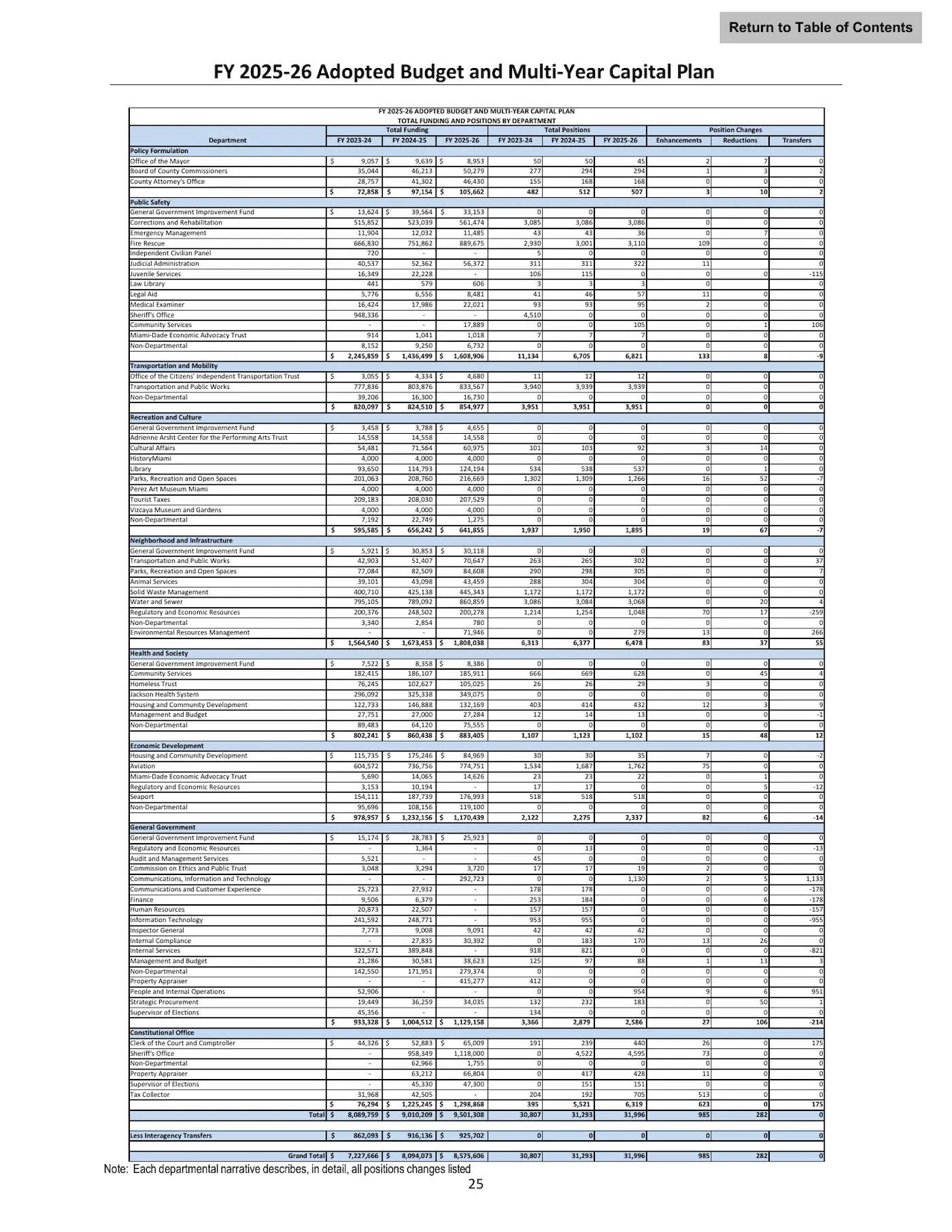
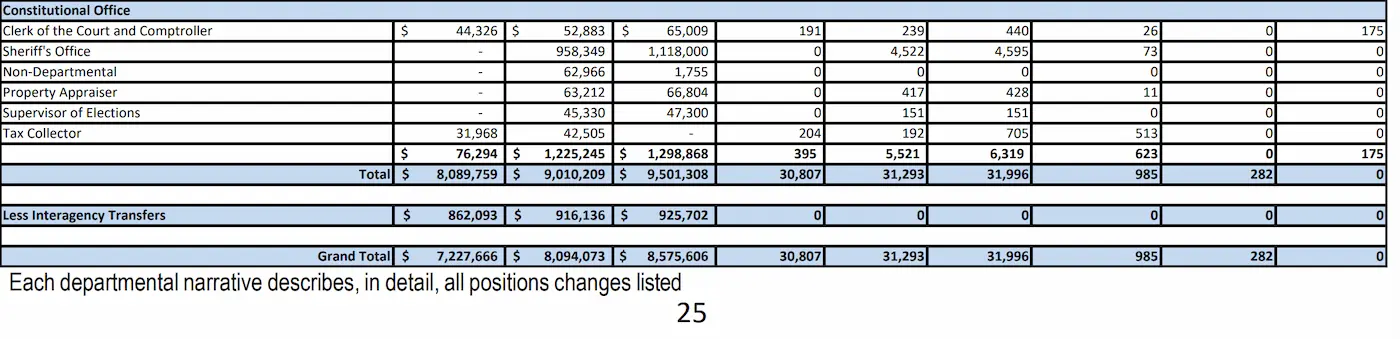
The number of seats in the same row goes from 204 to 192 and then to 705, with a column labeled “additions” showing 513, which is exactly the difference.
In short: the year the office becomes a constitutional body, its staff grows nearly fourfold, and the county stops allocating funding to it.
Page 25 of Volume 1 of Miami-Dade’s adopted budget for fiscal year 2025–26, published by the county. Source 10 in the list. Downloaded by News Miami Dade on July 18, 2026, and read by opening the rendered page, not via text extraction. Unmodified.
The blank space is not an error in the book. It is written into the law. Chapter 218 of the Florida Statutes defines “county fee officers”—a category that includes the tax collector—as those officials “whose budgets are established independently of the local governing body.” And Section 218.35 drives the point home: “Each county fee officer shall establish an annual budget for carrying out the powers, duties, and operations of his or her office.”
Those who do approve it are elsewhere—and not in Miami-Dade. Statute 195.087 states it plainly: “On or before August 1 of each year, each tax collector, regardless of the form of county government, shall submit to the Department of Revenue a budget for the operation of the tax collector’s office for the ensuing fiscal year.” And the state department “shall examine the budget and, if it is found adequate to carry on the work of the tax collector, shall approve it.”
That circuit was confirmed aloud that very same night by the other official involved. The property appraiser, Tomás Regalado, appeared at 6:36 p.m. and said , “We already sent our budget to the DOR. It was approved.” He added a second sentence regarding a reduction in his own request: “We reduced it from the original proposal of $4 million.” This is reproduced verbatim because it allows for two interpretations: either that he reduced it by four million, or that he reduced it from a proposal of four million; and the document that would confirm this is his approved budget, which the mayor’s report states was approved by the Department of Revenue in mid-August.
What is clear, however, is the contrast. It’s the same procedure as in 195,087 and the same Department of Revenue, and that night one of the two officials announced what they would no longer collect, while the other spoke of what they had stopped requesting.
The county’s own audited financial report confirms this on page 65 and clarifies the role that remains for the full commission: the assessor’s and collector’s budgets are governed by Chapter 195.087 and are submitted to the Florida Department of Revenue. Verbatim: “Copies are also submitted to the Miami-Dade Board of County Commissioners for information. The Department of Revenue provides final approval of these budgets.” Copies, for information. Final approval is granted by Tallahassee.

That is why the column appears empty. And that is why the money now comes from the commission that the office charges on the amount it collects, rather than from a budget item approved in a public session.
That is also why eliminating a fee can be presented as a cost-saving measure. The fee did not exist as such before the office was established.
How much does the office cost, according to its own form?
That budget exists and includes a specific amount. It is listed on state form DR-584, “Budget Request for Tax Collectors,” which the Miami-Dade Tax Collector’s Office submitted on September 30, 2025, and publishes on its website.
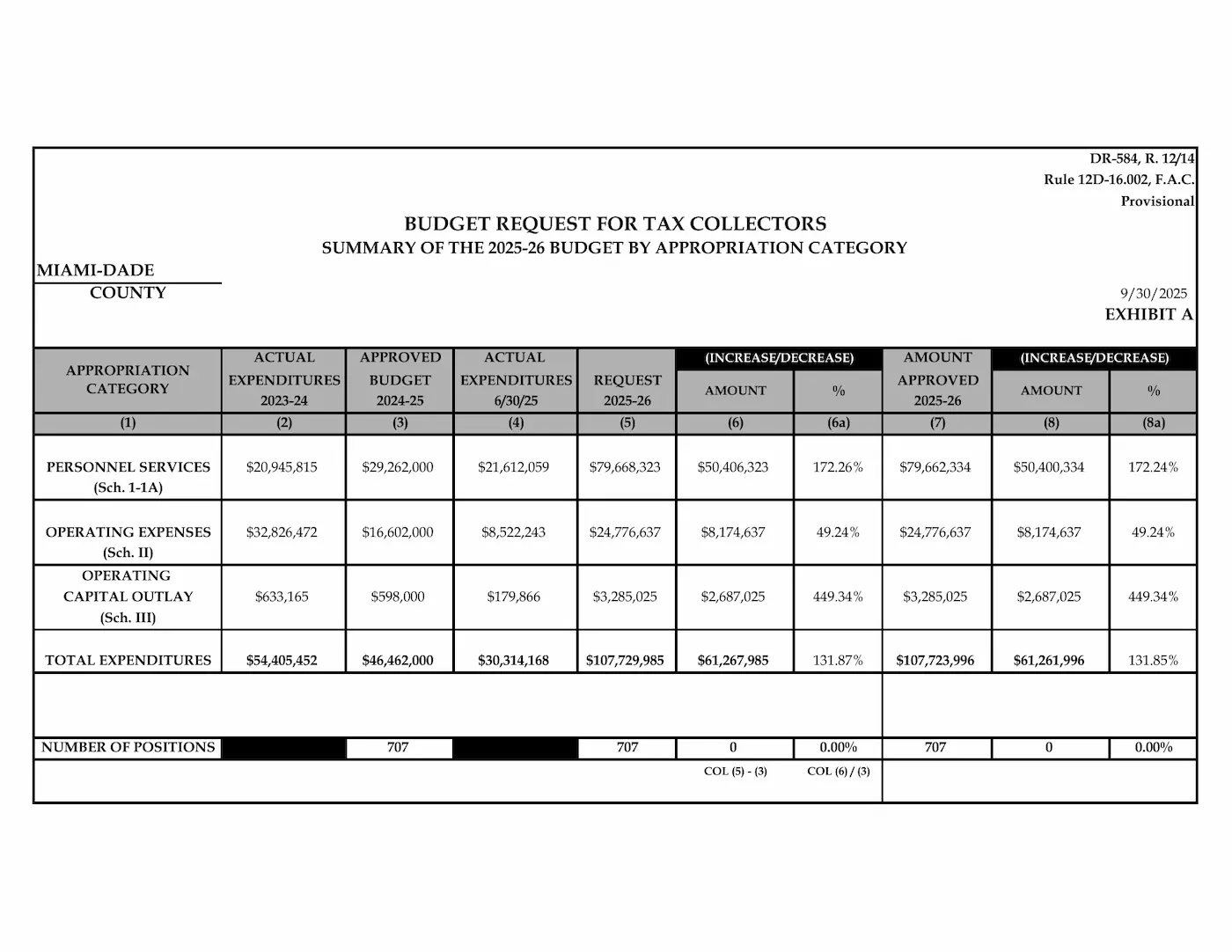
The total approved expenditure for fiscal year 2025–26 is $107,723,996. The approved budget for the previous fiscal year, 2024–25, was $46,462,000. The table itself calculates the difference: an increase of 61.3 million, or 131.85 percent. The personnel budget rises from 29.3 to 79.7 million.
We must be careful with the positions, because the two documents do not say the same thing. The county budget book lists 705. The state form, approved later, shows 707 requested and 707 approved for 2025–26, and does not provide a comparable figure for the previous fiscal year. Without additional documentation, it cannot be determined whether the difference is due to the cutoff date for each table, their scope, or two positions added during the approval process. The discrepancy is noted rather than one explanation being chosen.
And there is an explanation for this growth that should be provided because the data alone does not suggest it: much of it coincides with the relocation of driver’s license and motor vehicle registration services to this office, not solely with its constitutional independence.
This change is not an interpretation by this newspaper: it was explicitly stated in the ordinance itself, which the full council approved at this first hearing—in the vote held in the early morning hours of September 4—and which will be definitively adopted on the 17th. Upon reading the title of Item H, one of its effects is the repeal of sections 2-119 through 2-127 of the Miami-Dade Code, which regulated vehicle registration offices, with the following wording: “Repealing sections 2-119 through 2-127 of the code relating to branch offices of auto tag agencies now under the tax collector’s jurisdiction.” If that ordinance is adopted on the 17th, the county will remove certain offices from its code because they no longer belong to it.
Here is the official explanation of the relocation process behind those positions.
That jump calls for a caveat, because without it, the data is misleading. The basis for comparison is not consistent: in 2024–25, tax collection was still part of the county government, and its costs were spread across other county budget lines; therefore, a large increase upon the office’s independence is to be expected and does not, by itself, prove anything. What is certain and verifiable, however, is the absolute figure: an approved operating budget of 107.7 million.
It’s best not to read too much into it: the published page shows only the expenditure side, and the office is funded from various sources—including tax commissions as well as fees for services, licenses, and registrations. Based on that document alone, it’s impossible to say what portion of those 107.7 million comes from each source.
And we must call it by its exact name, because it is not the same as the total cost to the taxpayer. The agreement that the office signed with the county on January 7, 2025, stipulates that the county provides the main office, including utilities, free of charge, pursuant to Article VIII, Section 1(k) of the Florida Constitution. And that during the 2024–25 fiscal year, the costs of the branch offices were paid by the county’s Non-Departmental General Fund; for subsequent years, the same agreement states, those expenses are determined in the annual budget.
With a three-category breakdown, it is impossible to know which facilities and services funded by the county are included in that 107.7 million and which are not. Therefore, the figure is described here for what it is—the office’s approved operating budget—and not as the total cost that office imposes on taxpayers. That total cost includes at least the main headquarters and its utilities, which the county pays for separately, and there is no public document that allows for calculating it.
A budget approved by Tallahassee that the county does not adopt
Here’s the gap—it’s the kind you only see when you look for the document.
The budget is approved by the Florida Department of Revenue. That department publishes the forms and instruction manuals for requesting the budget—including the DR-584—on its website, but it does not publish the approved budgets on a county-by-county basis. The county does not publish them either: it receives a copy for informational purposes, and the corresponding field in its budget book remains blank.
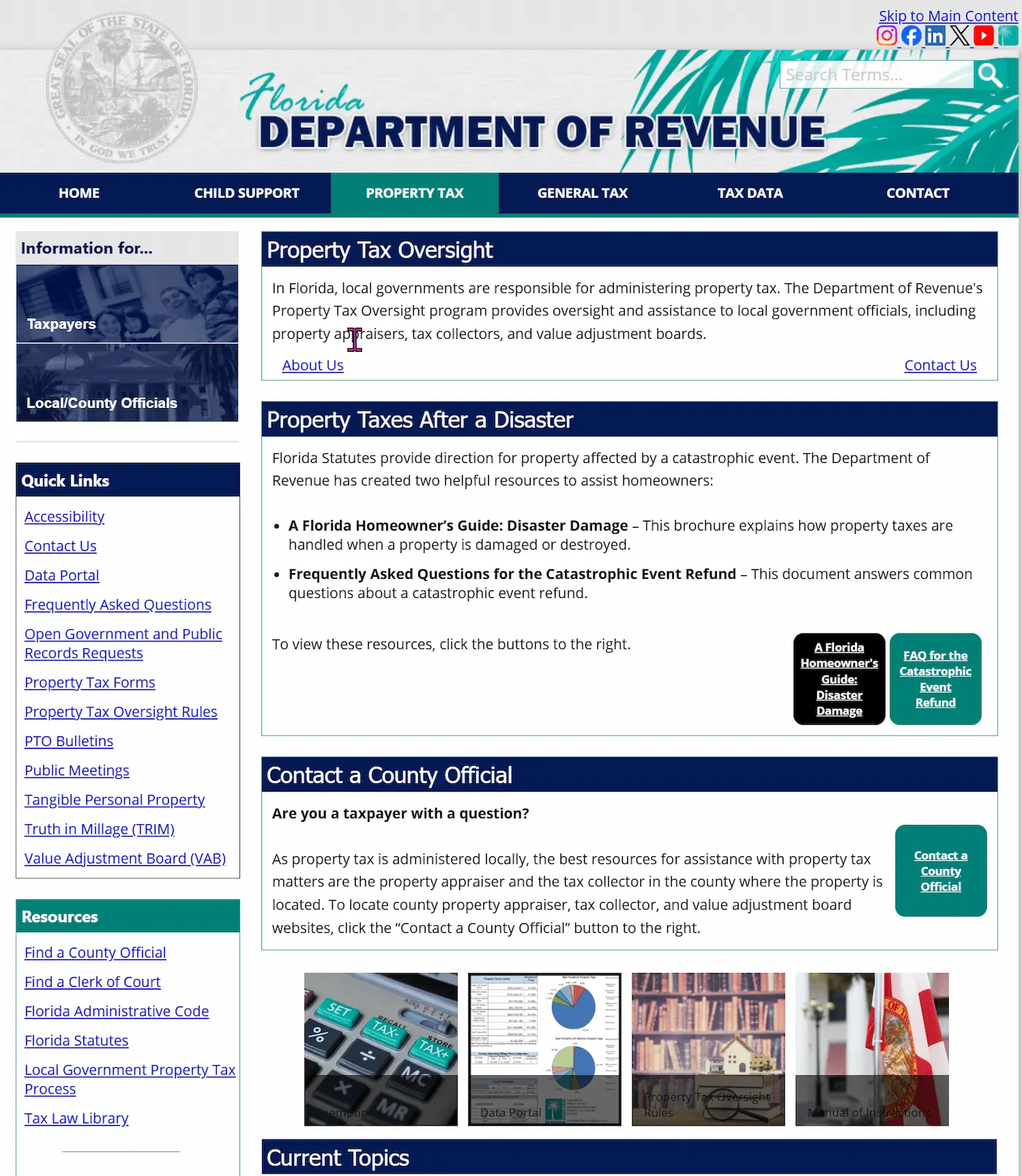
The only place where that document is posted is on the Tax Collector’s Office website itself, in a section called “Office Budget.” And in this regard, the office does comply with the law, because Statute 195.087 is explicit in Section 6: “Each property appraiser and tax collector must post their final approved budget, including all supporting schedules, on their official website within 30 days after adoption.”
Those four words in the middle— “including all supporting schedules“—weren’t there until this summer. They were added by the very same Chapter 2026-239 that allowed him to resign from the commission, and they take effect on July 1, 2026. The law no longer requires just the budget; it requires the budget along with all its attachments.
It is important to be precise with the dates, because they determine which budget that obligation falls under. The deadline begins on the date of adoption, and the budget published by the office is that for fiscal year 2025–26, which was adopted the previous fall, when the requirement for the annexes did not yet exist. The budget for the 2026–27 fiscal year was required to be submitted to the Department of Revenue by August 1, 2026; when that department approved it—and thus when the thirty-day period began—is not publicly recorded.
This newspaper does not, therefore, claim that the obligation to publish the attachments has not been fulfilled. It states that this obligation has existed since July, that the document posted consists of one page, and that this page refers to attachments that are not included with it.
107 million explained on one page
The document that News Miami-Dade downloaded from that section on September 1, 2026, is one page long. It is Exhibit A of state form DR-584, and it contains three lines—personnel, operating expenses, and capital—plus a total and a row for positions.
It’s not that the office drafted a one-page budget. It’s that that page is the cover of a document that has additional sections, and we know this because the page itself lists them: next to “personnel” it says “(Sch. 1-1A),” and next to “capital” it says “(Sch. II).” The published document refers to annexes that are not included with it. Those annexes would contain the details regarding positions, contracts, rent, and internal services.
The only page of the approved budget published by the Miami-Dade Tax Collector’s Office for fiscal year 2025-26, state form DR-584, Exhibit A, dated September 30, 2025. Source 13 on the list. Downloaded by News Miami Dade on September 1, 2026. Unmodified.
To find out if this is standard practice, simply look at another Florida tax collector who uses the same form. The Orange County tax collector publishes four documents, which include: the same Exhibit A, followed by the appendices, detailing salaries by position and a breakdown of personnel by expense code, including the incumbent’s salary, permanent and temporary employees, overtime, social security contributions, retirement benefits, life and health insurance, workers’ compensation, and unemployment benefits.
And publish four items, not just one. The summary of the current fiscal year, 2025–26, which is not just a total: it compares actual expenditures for 2023–24, the approved budget for 2024–25, actual spending through June 30, the requested amount for 2025–26, and the variation in both amount and percentage. The complete breakdown of 2024–25 by expenditure code. And the two approved amendments for that fiscal year: the first bearing the handwritten signature of the Department of Revenue dated October 1, 2024, and the second bearing the digital signature of Gavrielle Alday, from her office of Property Tax Oversight, dated December 13, 2024.
That office has 332 positions and an approved budget of $40.5 million for the current fiscal year. The Miami-Dade office has 707 positions and $107.7 million, and it publishes a website.
Two more details you shouldn’t miss.
First: Orange had already published the document for the 2022–23 fiscal year—four years before the reform that made the appendices mandatory. News Miami Dade downloaded it from that same page and still has it; today, the page lists four documents, and that one is no longer among them. In other words, they were publishing them without anyone requiring them to, and they continue to publish them now that they are required to.
Second: publish the amendments. A budget that is amended midway through the fiscal year no longer resembles the one that was approved, and anyone who publishes only the approved version is presenting a document that is no longer in effect.
A necessary clarification and a caveat. The clarification: When Fernández says during the session , “No other tax collector in Florida does this,” he is referring to the waiver of the commission, not to what is published—and those are two distinct matters that should not be conflated. Regarding the waiver, this newspaper has not reviewed the other 66 counties and makes no claims. The caveat: the Miami-Dade tax collector’s website returns an error to this publication’s automated queries, so what is being stated is that the downloaded file consists of a single page and refers to attachments that were not included with it—not that there are no other documents posted on that website.
That same section imposes a second requirement, and this one applies not to the office but to the county: “Each county’s official website must include a link to the websites of the property appraiser or tax collector where the final approved budget is posted.”
News Miami-Dade reviewed the two pages on the county’s website where that link should be located: the page dedicated to the tax collector and the page for constitutional offices. On the first page, there is only one link to the tax collector’s website, under the heading “Pay Taxes,” which leads to the home page and does not mention the budget. On the second page, the word “budget” appears only in the navigation bar.
This newspaper has not reviewed the entire county website, so it does not claim that the link does not exist anywhere: it claims that it is not on the two pages where a resident would look for it, and that whether the law is satisfied by a generic link to the home page or requires a link directly to the document is a matter for the County Attorney’s Office to interpret.
That leaves a budget of 107 million dollars per year, approved by a state agency that does not publish the approved budgets on a county-by-county basis, which is not included in the county budget book, and is accessible only if one knows in advance that one has to look it up on the agency’s website.
The documents that the law requires to exist, but that no one has shown us
Just because the plenary session does not vote on that budget does not mean there is no accountability. There is accountability—in writing, with deadlines—and neither of the two components of that accountability has been presented.
The first one is dated, and the date is striking. Section 218.35 provides that “the proposed budget of a county fee officer shall be filed with the clerk of the county governing authority by September 1 preceding the fiscal year for the budget, except for the budget prepared by the clerk of the circuit court for court-related functions.” That exception applies to the Clerk and does not extend to the fee officer. His proposed budget for the 2026–27 fiscal year was therefore due to the Clerk on September 1, 2026—the very same day he announced via video that he was resigning from the commission.
The second one is the one that really finalizes the figures. Section 218.36 requires every county official who collects commissions to keep a complete record of all amounts collected and to report to the full board in writing: “shall make an annual report to the board of county commissioners within 31 days of the close of his or her fiscal year.” It also specifies what the report must contain: “the purposes, character, and amount of all official expenses and the amount of net income or unexpended budget balance as of the close of the fiscal year.” That report is signed under oath.
It is important to be precise about what that report can and cannot account for, because each figure in the announcement pertains to a different fiscal year. The 2024–25 report reflects the commissions actually collected, the expenses, and the surplus for that fiscal year, which ended on September 30, 2025. It does not account for the 97 million, which corresponds to the announcement regarding 2025–26. It does not account for the 13 million, which is a projected waiver for 2026–27 and not a commission collected. And it does not need to include the 40 million if it was never actually invoiced. The report for the 2025–26 fiscal year is due within 31 days after September 30, 2026, which means it is not yet due.
What should have been available for the past ten months is the 2024–25 audited report. News Miami-Dade has not been able to locate a published version, and that is the first question this article leaves unanswered.
There is also an inconsistency worth noting because it appears in the same section. Section 218.35 requires the Clerk of Courts to publish the approved budget on the county’s official website “within 30 days after adoption.” For other fee officers, including the tax collector, there is no such publication requirement. The law requires that the document be submitted to the Clerk and that a report be presented to the full council, but it does not require that it be posted where a resident can see it.
That is exactly the difference between public information and accessible information.
What the county itself promised to require, but there is no record of it
There is a document that is not a statute but is more binding than many others: the intermunicipal agreement that the county and the Tax Collector’s Office signed on January 7, 2025, the day the office became independent. In that agreement, the two parties set forth obligations with specific deadlines, and there is no record in the public file that three of them have been fulfilled.
The first requirement applies to the office itself and has already been mentioned: to submit to the county, by August 1 of each year, a copy of the budget it submits to the Department of Revenue. The budget for fiscal year 2026–27 should have been in the county’s possession a month ago.
The second are the service level agreements. Section 6 required both parties to negotiate and sign them within ninety days following January 7, 2025, and then submit them to the full council for approval. They cover the services the county continues to provide: technology, personnel, procurement, budgeting, and internal services. News Miami-Dade has not found them in the published legislative record, nor the resolutions that would have approved them. That does not prove they do not exist. It raises the question of what services the county currently provides, how much they cost, and who pays for them.
The third is the most specific and the one that has received the least attention. Section 7 states that the office must “distribute and properly account for any interest earned on the revenues collected on behalf of the County… and include it as part of the distribution to the County.” The interest earned on the funds belonging to others that the office holds while distributing them does not remain there: it is accounted for and turned over.
And it’s not just the contract. Statute 219.075 applies this to all state tax collectors, specifying the frequency and criteria: the returns on those investments “shall be apportioned at least quarterly on a pro rata basis to the appropriate taxing authorities, ” although the office may deduct “such reasonable amounts as are necessary to provide for costs of administration.” Distributing the interest, at least quarterly and on a pro rata basis, is not a matter of discretion either.
The office has indeed provided figures. On its own blog, on July 26, 2025, and again on August 6, it stated that it had returned “more than 15 million dollars in interest earnings to taxing authorities through quarterly distributions.” Eight days later, on August 14, the figure rose: “Our office has disbursed more than $17 million in interest earnings to over 30 taxing authorities.”
Another two million in eight days, yet neither publication explains where this jump came from. There may be a simple explanation—such as a quarter having been settled in the meantime—but the document does not provide it.
What’s missing isn’t the figure—it’s the accounting. No reconciliation has been found that identifies the gross interest generated, where it was invested, how much was deducted as an administrative cost, how it was distributed among each tax authority, or whether those 17 million are included in the 97 announced or are a separate amount. There is a legal and contractual obligation to account for it, and figures have been released, but no published financial statement supports them.
Those same publications contain another piece of information that should be dated. The figure of nearly 40 million that Fernández mentioned before the plenary session on September 1, 2026—referring to the commission that is not charged to municipalities and unincorporated areas— had already been published by his office in July and August 2025, using the exact same wording: “nearly 40 million dollars being returned directly to local governments.” Thirteen months earlier.
To give an idea of the sheer amount of money that passes through there. The county’s audited financial report, in its combined statement of custodial funds as of September 30, 2025, on page 237, lists $173,457,000 in cash in the Tax Collector Fund. And opposite that, the exact same amount in liabilities: $137,235,000 owed to other governments and entities, $28,719,000 owed to other county funds, and $7,503,000 owed to trust funds. The net position is zero. Everything there belongs to others.
That photo, moreover, was taken on September 30—the low point of the year—because tax bills are sent out in November. At the peak, there will be quite a few more.
A reservation that this newspaper puts in writing
All of the above assumes that the procedure set forth in Statute 195.087 applies to this office, with budget approval by the Department of Revenue. That section has two exceptions: charter counties whose charters establish a different method, and counties where a resolution under Statute 145.022 is in effect, which allows the county council to guarantee the official’s salary in exchange for the official turning over to the county all fees collected.
The Miami-Dade Home Rule Charter, when read in its entirety, does not establish a specific method: it makes no mention of the tax collector except to state that the position was abolished in 1958. Furthermore, no resolution under Section 145.022 referring to this office has been found. What is clear, however, is that both parties act as if Section 195.087 applies: the office submits its form to the state department, and the intermunicipal agreement expressly refers to that section. Unless the county or the office identifies a document to the contrary, that is the interpretation, and it is stated with reservation rather than asserted as a certainty.
The Legislature paved the way two months earlier
The resignation that Fernández announced was not something his office came up with. It had been established by the Florida Legislature two months earlier, with a short window to take advantage of it during the first year.
On July 1, 2026, Chapter 2026-239 of the Florida Statutes took effect, which rewritten Statute 192.091. That provision does two things. First, it transfers responsibility for paying the commission on school taxes to the full county commission: “The commissions on the amount of taxes collected from school millages shall be paid by the board of county commissioners.” Second, it authorizes a waiver of the commission, but only in part: “The tax collector may waive the commission authorized in paragraph (b) for voted school millages.”
That’s where the point made earlier comes in: it’s the county that stops paying that commission. And this leads to something that section did not mention. Asking the full county commission to allocate that money toward property tax relief and to the police, fire department, and emergency services is not an anomaly: it is consistent with the law, because the money belongs to the county.
And that leads to something else, which saves us from having to discuss it further. The law only allows him to waive the school tax committee that was voted on. Whatever the exact word heard in the recording may be, that is the only waiver he can make—and no other.
That leaves the date, which neither party mentioned in the chamber. The law sets a general deadline for notifying the full chamber of the resignation in writing— “no later than March 1”—and adds an exception for the first year. The enacted text of Chapter 2026-239 states: “For the 2026 calendar year only, the deadline for communicating a waiver under subparagraph b. is September 1, 2026. This sub-subparagraph is repealed on January 1, 2027.”
The announcement was made on September 1, 2026. The last day.
This redefines the role of a document that seemed incidental during the session. The Tax Collector’s Office stated that morning that it had delivered a letter to the Clerk detailing the announcement. In light of the statute, that letter is not a courtesy: it is, in all likelihood, the document required by law for the resignation to be valid, and it had to be delivered that day. It has not been found in the reviewed records, which does not mean it is not a public record that can be requested.
It remains unclear whether submitting the letter to the Clerk for distribution satisfies the requirement to notify “the board of county commissioners.” This is a matter of legal interpretation and falls within the purview of the County Attorney’s Office, not this newspaper.
The resignation doesn’t last a year: it lasts until he decides otherwise
There is a clause in the statute that the announcement did not mention and that alters the scope of what was announced. The waiver, the text states, “shall remain in effect unless rescinded in writing by the tax collector.” And the rescission has its own deadline: it must also be communicated in writing to the full council before March 1 of the fiscal year in which it takes effect.
There are two sides to that, and both are important.
The first point works in favor of the announcement. It’s not a one-time payment of 13 million. It’s 13 million every fiscal year as long as the waiver remains in effect, so the real value of the decision is a multiple of the figure cited in the chamber. No one mentioned this—neither he nor the chair of the plenary session—and pointing it out would have made the decision seem even more significant, not less so.
The second one works against us. What was announced before the full assembly, on camera, and in a video posted that afternoon can be undone with a letter before any given March 1—without a hearing, without a session, and without an announcement. The law only requires that it be communicated in writing.
A commitment announced on camera that can be rescinded in writing—without a public session—keeps its validity out of sight of those who heard it.
The Two Numbers That No One Could Make Sense Of
Fernández says more than 13 million during the session and repeats the same figure in his own post that afternoon. The chair of the plenary session says about 30 million. It’s the same resignation, but not the same amount. No one explained the difference, and no one asked.
There may be straightforward explanations: perhaps the 30 includes other line items from the same advertisement, or perhaps it reflects a different calculation by the county. But as long as the document does not specify this, the discrepancy stands as what it is—a figure that remains unexplained in the public record.
Two days later, the figures were announced again, and the source had changed
On September 3, 2026, during the first public hearing on the budget for fiscal year 2026–27, the matter returned to the plenary session. This time, Fernández was in the chamber. News Miami Dade recorded the session as it aired. This is the complete segment, uncut, from the moment the plenary session chair brings up the topic until the tax collector finishes speaking, with Spanish subtitles added by NMD.

First public hearing on the Miami-Dade Board of County Commissioners’ budget, September 3, 2026, from 5:23 to 5:27 p.m., according to the clock displayed on screen during the broadcast. News Miami Dade’s own recording of the county’s live broadcast. Content unaltered. Modifications: clip edited and Spanish subtitles added by NMD.
The chair of the plenary session, Anthony Rodríguez, spoke first, saying verbatim: “I also want to take this moment to thank our tax collector, Dariel Fernandez, who is with us here tonight, for working with us and with me personally to waive the commission on collecting approved school millages for fiscal year 26-27. That is expected to save the county approximately 13 million dollars.”
In other words: the presidency, which on September 1 had spoken of some thirty million, two days later put the figure at thirteen. And it repeats—now with Fernández at the helm—the account it had already given on September 1: that the resignation stems from work “with us and with me personally.” This stands in contrast to what this newspaper had already documented: that the resignation provision was created by the Florida Legislature, effective July 1, 2026, with a deadline for written notification set for September 1.
Two minutes later, Fernández spoke, having been invited by the presidency along with the other constitutional offices. He said, verbatim: “…found ways to save taxpayers’ money—dollars, millions of dollars—including more than $30 million in commissions that our office chooses not to collect, putting that money back where it belongs, with the people of Miami-Dade County.”
That’s the problem, and it’s not the same as it was two days ago. On September 1, he said thirteen and the presidency said thirty. On September 3, the presidency said thirteen and he said more than thirty. The two figures still don’t add up, but it can no longer be attributed to one of them having made a slip of the tongue: both figures have been stated by both sides.
There is a technical difference between the two figures that should not be overlooked, and it is detailed below, along with the table showing the four statements.
And there is a document that states this earlier and more clearly than either of them. The report that Mayor Daniella Levine Cava signed on September 2 for this very hearing states it verbatim: “The Florida Legislature recently amended Section 192.091, Florida Statutes, allowing county tax collectors to waive the applicable commissions on voted school millages. On September 1, 2026, the Tax Collector, via written communication to the Board, agreed to waive this commission for FY 2026–27. Updated revenue and expenditures resulting from this waiver are not yet reflected in this proposed budget and will be addressed in the Second Changes Memorandum.”
Three things have been established by the county itself. That the position was created by the Legislature, not the office. That the written notice arrived on September 1, the deadline. And that the effect of the resignation is not reflected in the budget presented at this hearing and will be addressed in the Second Change Memorandum. It’s worth noting this detail: on September 1, the mayor’s office had stated that the thirty million would appear in the mayor’s change memo. The September 2 report refers to the Second Change Memo. That document is where the difference between the two figures should be broken down, and as of the publication date of this article, it has not been released.
The four statements, and where to verify them
The figures for the office’s lost revenue have been mentioned four times in public sessions over three days, and they conflicted. Here are all four in a row and in order, each with the date and time it was mentioned.

The four statements regarding the same resignation, in chronological order. Miami-Dade Board of County Commissioners meetings on September 1 and 3, 2026. News Miami Dade’s own recording of the county’s live broadcast. No changes were made to the content of the remarks: each clip begins where the sentence starts and ends where it ends. The first segment includes the tax collector’s full set of figures: the resignation, the thirteen million, the intended use of those savings, and the ninety-seven million he says he expects to return, along with a breakdown. Modifications by NMD: the four segments were combined in order, Spanish subtitles were added, and a date and time caption was placed in the upper-left corner.
The time shown on each sign is not calculated by this newspaper: it is taken from the clock that the county’s own broadcast displays on screen. In the video, you can see both at the same time in the same frame—ours in the upper left and the county’s in the lower right—and verify that they match.
The following table presents the same information in written form, with the timestamp for each video embedded in this article, where you can verify each one.
| Date and time | Who says so? | Figure | Verbatim | Where is it checked? |
|---|---|---|---|---|
| September 1, 2026, 9:46 AM | Dariel Fernández, tax collector, via a recorded video | More than 13 million | “This will save Miami-Dade County residents more than 13 million.” | Video from September 1 embedded in this article, at 01:05 |
| September 1, 2026, 9:48 a.m. | Anthony Rodríguez, President of the Plenary | About 30 million | “So this, as he mentioned, is about $30 million, which I believe will be outlined in the mayor’s memo on the changes.” | Same video from September 1, at 03:24 |
| September 3, 2026, 5:24 p.m. | Anthony Rodríguez, President of the Plenary | Approximately 13 million | “That is expected to save the county approximately 13 million dollars.” | Video from September 3 embedded in this article, at 00:17 |
| September 3, 2026, 5:26 p.m. | Dariel Fernández, tax collector, in person | More than 30 million | “…including more than $30 million in commissions that our office chooses not to collect.” | Same video from September 3, at 02:23 |
Read from top to bottom, the table shows this: each of the two figures came from both speakers, two days apart. It can no longer be explained away by saying that one of them made a mistake when speaking. And on none of the four occasions was the discrepancy explained, nor did anyone in the room ask about it.
The only distinction that the documents themselves allow us to make is this: the 13 million includes a line item and fiscal year—the commission for collecting the school district fees approved for 2026–27. The thirty do not specify a period or provide a breakdown. Both figures could be correct and refer to different things. But none of the four statements or any of the published documents mention this.
An office that has been in operation for twenty months
According to the Miami-Dade County Tax Collector’s Office itself, Fernández was “Elected on November 5, 2024. “ And the county budget book itself dates the start: on January 7, 2025, the elected sheriff, elections supervisor, and tax collector “commenced performing each of their respective statutory duties independent of county government.” This all stems from Amendment 10, approved by Florida voters on November 6, 2018, which required the county to create these offices.
Hence the remark made by a commissioner at that 2025 hearing, which sums up the change better than any report: “We used to be one government. We are now six governments.”
What it has done, however—and this must be stated just as clearly—
On August 25, 2026—one week before all of this—the same office issued a press release on official letterhead announcing that it had recovered more than $20 million in back taxes on tangible business property through a compliance initiative launched at the beginning of the administration.
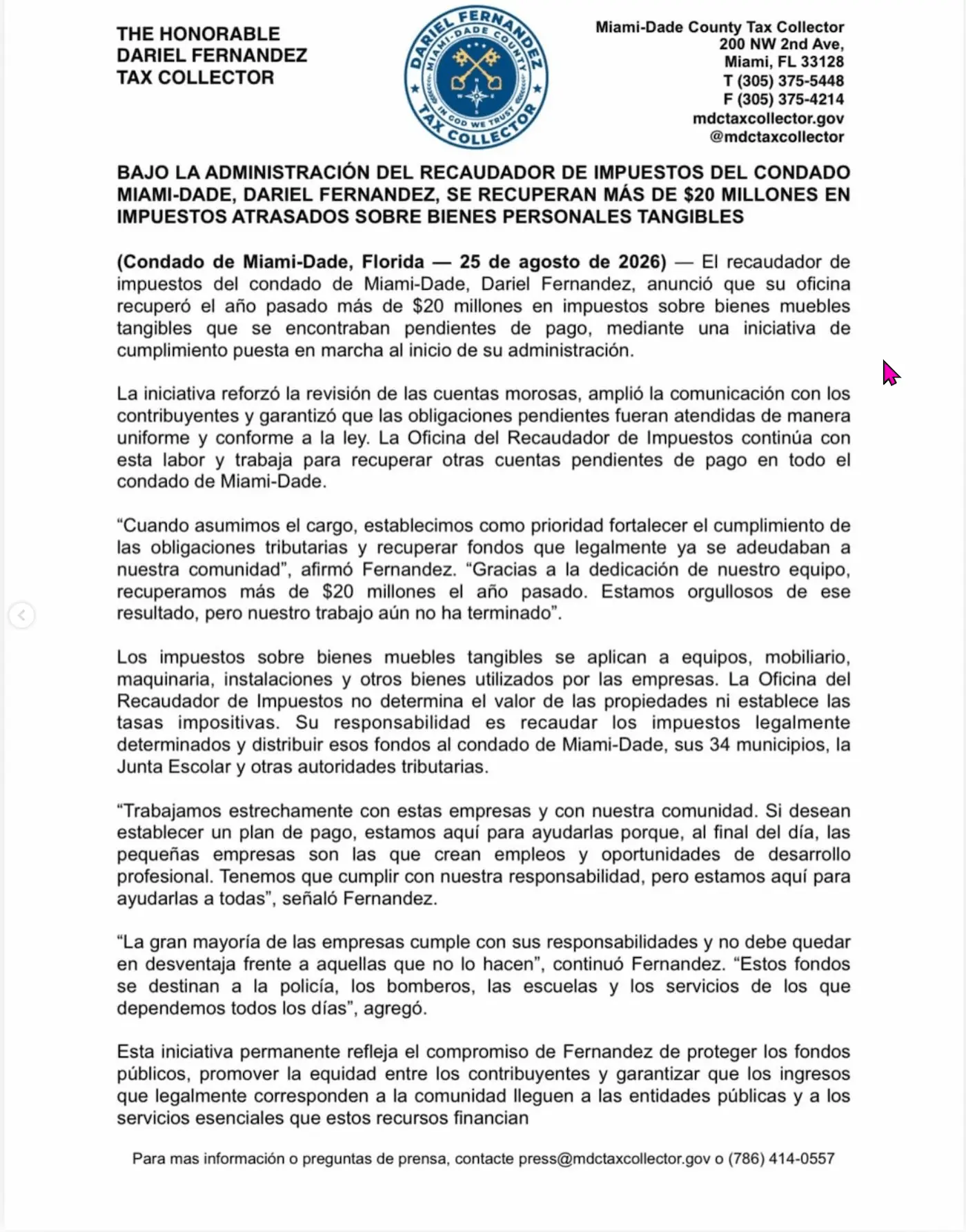
Press release from the Miami-Dade Tax Collector’s Office, August 25, 2026, Spanish version. Compiled by NMD on September 1, 2026. Unmodified.
The office head’s statement, verbatim: “When we took office, we made it a priority to strengthen compliance with tax obligations and recover funds that were legally owed to our community. Thanks to our team’s dedication, we recovered more than $20 million last year. We are proud of that result, but our work is not yet done.”
That is not an act of generosity, nor does it need to be: it is precisely the job of that office, and doing it well has consequences for everyone. Families do not pay that tax on their homes. Businesses pay it on their equipment, furniture, and machinery. When a business fails to pay it, the burden doesn’t disappear: the service that money supported goes unfunded, and the businesses that did pay are put at a disadvantage. As the article itself states, “the vast majority of companies fulfill their responsibilities and should not be at a disadvantage compared to those that do not.” Collecting from those who did not pay protects those who did.
The same notice also contains the clearest description of what that office is and is not, as well as the office’s own statement: “The Tax Collector’s Office does not determine property values or set tax rates. Its responsibility is to collect legally assessed taxes and distribute those funds to Miami-Dade County, its 34 municipalities, the School Board, and other taxing authorities.”
In other words: those 20 million are distributed among the agencies that provide the services. They do not remain with the agency that collected them.
Collecting that debt wasn’t optional either
Here we see the same pattern as in the waiver of the commission, and it’s worth noting—without exaggerating it—that collecting from a delinquent payer is not a management decision; it is a written obligation, and the verb used in the bylaws leaves no room for interpretation.
Florida Statute 197.413 provides that, by May 1 of the year following the year of assessment, the tax collector “shall prepare a list of the unpaid personal property taxes.” And by April 30 of the year following that, “the tax collector shall prepare warrants against the delinquent taxpayers providing for the levy upon, and seizure of, tangible personal property.”
It doesn’t end there. Within thirty days of issuing those demands, the tax collector “shall cause the filing of a petition in the circuit court” asking the judge to ratify them and order the seizure of the debtor’s property. The law exempts the tax collector from issuing a demand notice when the debt is less than $50, yet it clarifies that the tax “shall remain due and payable.”
The same article provides that the tax collector may hire attorneys for these lawsuits and pay them from his office’s general expenses fund. In other words: collecting taxes costs money, and that cost comes from the same fund that finances the office—the commission’s fund.
None of this detracts from the achievement. It simply puts it into perspective. Collecting a debt that had not been collected is a job well done, and the law entrusts that task to that office. The remaining questions are different: how does this result compare to those of previous years, and how much remains to be collected?
There are four questions, and none of them is hostile. How much was recovered in the past, because without the figures from previous years, it’s impossible to know whether twenty million is a significant increase or a typical amount. How much remains outstanding? Because the press release itself states that the office “continues this work and is working to recover other outstanding payments throughout the county” without specifying the total amount of that outstanding debt—which is the figure that truly measures the scale of the problem.
To which period does this refer, since the note says “last year” without specifying whether it refers to the fiscal year or the calendar year, or to which tax years the collected debt pertained? And how much did it cost to collect it? Because the bylaws provide for paying attorneys’ fees out of the office’s budget, and it’s not clear what portion of those twenty million went toward the collection itself.
News Miami Dade has not verified the figure of 20 million against tax collection records. The official statement—which includes the date, letterhead, and attributed quote—is reproduced here as a statement from the office, not as information verified by this media outlet.
Timeline
| Date | Who generates it? | Fact | Document or session |
|---|---|---|---|
| November 6, 2018 | Florida Electoral College | Amendment 10 is approved, requiring the county to establish the constitutional offices of tax collector, election supervisor, and assessor. | Adopted Budget Book for FY2025-26, Volume 1, County Profile section. Date verified. |
| November 5, 2024 | Miami-Dade Electoral District | Dariel Fernández has been elected county tax collector. | Tax Collector’s Office, official website, verbatim: “Elected on November 5, 2024.” Date verified. |
| January 7, 2025 | Miami-Dade County | The elected tax collector begins to perform his or her duties independently of the county government. | Adopted Budget Book for FY2025-26, Volume 1. Date verified. |
| January 7, 2025 | Miami-Dade County and the Tax Collector’s Office | They sign the intermunicipal agreement governing the transition. It stipulates that a copy of the budget must be submitted to the county by August 1; the distribution of the surplus and the sworn report must be submitted within 30 and 31 days of the fiscal year-end, respectively; interest must be accounted for; and the headquarters and its assets must be transferred free of charge. | Intermunicipal agreement, 18 pages, signed by the tax collector and the mayor’s office. Date and signatures verified by opening to page 18. |
| Start of the administration; no specific date is given in the document | Miami-Dade Tax Collector’s Office | It launches the compliance initiative regarding delinquent accounts for tangible business assets. The document announcing it does not specify a start date. | Press release dated August 25, 2026. Date undetermined; marked as missing. |
| Fiscal Year 2025–26 | Board of County Commissioners | The adopted budget bill leaves the funding for the tax collector blank and allocates 705 positions, compared to 192 the previous year. | Adopted Budget Book for FY2025-26, Volume 1, page 25. Verified by opening the page. |
| August 1, 2025 | Miami-Dade Tax Collector’s Office | The deadline for submitting the office’s 2025-26 budget to the Florida Department of Revenue is approaching. Approval rests with the state department; a copy is sent to the full county commission for informational purposes only. | Florida Statute 195.087(2), 2026 edition, verbatim: “on or before August 1 of each year.” Deadline verified in the statute. Section 195.087 was amended on July 1, 2026, but the change affected subsection 6—the one regarding the publication of annexes—not this subsection 2, the text of which is the same as that in effect in August 2025. |
| September 4, 2025 | Mayor Daniella Levine Cava | He proposes allocating the new revenue from the tax collector to bolster the reserves of UMSA, the fire department, and the libraries. | Public budget hearing, recording in the NMD archive, minute 00:20:54. Date verified. |
| September 4, 2025 | Anthony Rodríguez, City Council President and District 10 Commissioner | He thanks the tax collector for advancing more than 26 million and explains that it was money he was going to repay at the end of the following year. | Same hearing, minute 04:51:13. Date verified. Speaker identified by NMD on September 7, 2026: he declares himself president in that speech, presides over the session, his nameplate identifies him as such, and the Board’s record confirms it. |
| September 30, 2025 | Miami-Dade Tax Collector’s Office | Date of the DR-584 form published by the office: $107,723,996 approved for 2025–26 and 707 positions, compared to $46,462,000 in the previous fiscal year. | Form DR-584, Budget Request for Tax Collectors, Exhibit A. Verified by opening the page. |
| Year not specified in the document | Author unknown | More than 20 million in back taxes have been collected. The article says “last year” without specifying whether it refers to a fiscal year or a calendar year, or which tax years the debt was from. | Press release dated August 25, 2026. Period undetermined, declared a gap. |
| July 1, 2026 | Florida Legislature, 2026E Special Session | Chapter 2026-239 takes effect, transferring responsibility for paying the commission on school levies to the county council, authorizing the tax collector to waive the commission on voted levies, and requiring the publication of the approved budget along with all its appendices. | Chapter 2026-239, Laws of Florida, HB 7031E, enacted text. Effective date verified in the statute itself. |
| Between July 1 and September 1, 2026; no date listed in the public record | Mayor Daniella Levine Cava and President Anthony Rodríguez | They write a letter to the tax collector asking him to waive the commission. Both parties confirm the arrangement verbally; the letter is not made public. The gap is part of the finding. The discrepancy stems from the fact that the law allowing for such a waiver did not exist before July 1. | Declared by the chair during the September 1 session and acknowledged by the treasurer that afternoon. Document not located. |
| August 1, 2026 | Miami-Dade Tax Collector’s Office | The deadline under the intermunicipal agreement to provide the county with a copy of the budget submitted to the Department of Revenue has passed. News Miami-Dade has not been able to locate that published document. The gap is noted. | Intermunicipal Agreement of January 7, 2025, Section 10.1(a). Deadline verified in the signed document; compliance not verified. |
| August 25, 2026 | Miami-Dade Tax Collector’s Office | A press release announces the collection of more than 20 million in overdue taxes on tangible business assets, citing a statement attributed to the tax collector. | Press release on letterhead, in English and Spanish. Date verified in the document itself. |
| September 1, 2026, at approximately 8:30 a.m. | Miami-Dade Tax Collector’s Office | It has released a bilingual chart announcing that in one hour it will reveal how much money it is refunding and which fees it has decided not to charge. | Publicity material compiled by NMD. Approximate time, inferred from the text itself. |
| September 1, 2026, legal deadline | Miami-Dade Tax Collector’s Office | The deadline for submitting the office’s proposed budget for fiscal year 2026-27 to the Clerk has passed. News Miami Dade has not been able to locate a published copy of that document. The gap is noted. | Florida Statute 218.35, 2026 edition, verbatim: “by September 1 preceding the fiscal year.” Deadline verified in the statute; compliance not verified. |
| September 1, 2026, legal deadline | Florida Legislature, Chapter 2026-239 | The special deadline—applicable only for the year 2026—to notify the full assembly in writing of the withdrawal from the committee on school taxes that were voted on is expiring. Today is the day of the announcement. | Chapter 2026-239, enacted text, verbatim: “For the 2026 calendar year only, the deadline for notifying a waiver under subparagraph b. is September 1, 2026.” Deadline verified in the statute. |
| September 1, 2026, 9:46 AM | Andrew López, Director of Motor Services at the Office of the Tax Collector | Present the tax collector’s recorded message to the plenary session. | NMD’s own recording of the plenary session, part 1. Date verified. |
| September 1, 2026, 9:46–9:48 a.m. | Dariel Fernández, tax collector | He announces his resignation from the school millage committee, estimates the savings at more than 13 million, and calls for the funds to be allocated to tax relief, the police, and the fire department. | NMD’s own recording; verbatim transcript attached. Date verified. |
| September 1, 2026, 9:48 a.m. | Miami-Dade Tax Collector’s Office | He states that he gave the Clerk a letter to distribute to the commissioners containing the details of the announcement. | NMD’s own recording. Letter not located; not public. |
| September 1, 2026, 9:48 a.m. | Anthony Rodríguez, Chair of the Board of County Commissioners | He puts the figure at about 30 million and says it will be included in the mayor’s change memo. No one can reconcile that figure with the 13 million shown in the video. | NMD’s own recording; verbatim transcript attached. Date verified. |
| September 1, 2026, 12:22 p.m. | Dariel Fernández, tax collector | He posted a video about the announcement, confirmed the figure at over 13 million, and thanked the president of the plenary session for working with his administration. | Publication downloaded by NMD on the same day, along with its metadata. Date and time verified. |
| September 2, 2026 | Daniella Levine Cava, Mayor of Miami-Dade | Sign the report to the Board for the first hearing. Note that the written notice of resignation was received on September 1 and that the impact on revenue and expenses is not included in the proposed budget and will be addressed in the Second Memorandum of Changes. | File 261530, “Tax Collector” section, page 3. Date verified. |
| September 3, 2026, 5:01 p.m. | Board of County Commissioners | First public hearing on the budget, during which the mayor’s change memo—which, according to the chair of the plenary session, is said to contain a breakdown of the 30 million—will be discussed. | Resolution R-627-26 and the official website for the FY2026-27 budget process. Date and time confirmed by two independent sources. |
| September 3, 2026, 5:24 p.m. | Anthony Rodríguez, Chair of the Board of County Commissioners | He thanks the tax collector, who is present in the chamber, for waiving the commission on the school millages approved for the 2026–27 fiscal year, and estimates the savings at approximately thirteen million dollars. He says the waiver is the result of collaboration with the governor’s office and with him personally. | NMD’s own recording of the county’s live broadcast, verified verbatim by two independent transcripts. The time shown on the clock in the broadcast itself. |
| September 3, 2026, 5:26 p.m. | Dariel Fernández, Miami-Dade Tax Collector | He addresses the plenary session in person and says that his office has found ways to save taxpayers money, including more than thirty million in commissions that it has decided not to collect. He does not provide a timeframe or a breakdown. | Same recording. The caption on the broadcast identifies him as Director of the Tax Collector Department. |
| September 17, 2026 | Board of County Commissioners | Second public hearing on the budget, scheduled to adopt the budget for fiscal year 2026-27. | Official County Budget Timeline for FY2026-27. |
The six documents that would close the accounts
None of the above requires a lengthy investigation. There are six documents that, if laid out on the table, would turn the announcements into verifiable figures. Some are documents that must be produced by law or under the terms of a contract; others are simply the calculations behind a figure that has already been released. No published version of any of them has been found.
One. Reconciliation of the 97 million: opening balance, actual revenue, actual expenses, reserves, and distributable surplus, with a breakdown by tax authority.
Two. The written waiver of the school millage, which the law required to be submitted to the full council no later than September 1, 2026, along with the calculation of 13 million.
Three. The basis, time frame, and calculation of the 40 million in commissions that the office claims it did not collect in municipalities and unincorporated areas.
Four. The status of the calculations for the advance payments required by the intermunicipal agreement for fiscal year 2025–26, and how much was actually requested out of the total amount that could have been requested.
Five. The service-level agreements with the county, their costs, and the resolutions under which they were submitted and approved.
Six. The interest accounting required by Section 7 of the intermunicipal agreement, and the annual audited report for the 2024–25 fiscal year required by Statute 218.36.
Sources consulted
Level 1, official sources:
- 1. Miami-Dade Board of County Commissioners meeting on September 1, 2026. News Miami-Dade’s own recording of the county’s live broadcast, captured as it aired, with its transcript. Excerpt cited: 04:53 to 08:39 of the first part.
- 2. Agenda for that session, Preliminary Agenda dated September 1, 2026, published by Miami-Dade County on its agenda system. Official agenda.
- 3. Florida Statute 192.091, Commissions of Property Appraisers and Tax Collectors, 2026 edition, published by the Florida Senate. Official Statutes.
- 4. Florida Statute 218.36, “County Officers; Record and Report of Fees and Disposition of the Same,” 2026 edition, published by the Florida Senate. Official Statutes.
- 5. Miami-Dade Tax Collector’s Office, official homepage featuring the office holder. Official website.
- 6. Video post by the Miami-Dade Tax Collector on September 1, 2026, at 12:22 p.m., regarding the announcement made that morning before the full council. Original post. Copy downloaded with its metadata and stored in
sources/01-primarias/. - 7. Bilingual outreach materials from the Miami-Dade Tax Collector’s Office dated September 1, 2026, announcing the message to the full council.
- 8. Press release from the Miami-Dade Tax Collector’s Office dated August 25, 2026, in English and Spanish, regarding the collection of delinquent property taxes on business assets. The office publishes its press releases on its official website.
- 9. Official recording of the first public budget hearing on September 4, 2025, published by Miami-Dade County on its video portal, clip 8641. This recording includes the clip of the commissioner thanking everyone for the 26 million and the verbatim transcript of that hearing. Downloaded by News Miami-Dade on June 12, 2026, and stored in the newsroom along with its transcript. County video portal.
- 10. Miami-Dade County’s adopted budget for fiscal year 2025–26 and multi-year capital plan, Volume 1, page 25 and county profile sections. County budget portal.
- 11. Chapter 218 of the Florida Statutes, “Financial Matters Pertaining to Political Subdivisions,” 2026 edition, published by the Florida Senate; specifically sections 218.31, “Definitions,” and 218.35, “County Fee Officers.” Official chapter.
- 12. Florida Statute 195.087, “Property Appraisers and Tax Collectors to Submit Budgets to the Department of Revenue,” 2026 edition, published by the Florida Senate. Official Statutes.
- 13. Form DR-584, Budget Request for Tax Collectors, Summary of the 2025–26 Budget by Appropriation Category, Miami-Dade County, dated September 30, 2025, published by the Miami-Dade County Tax Collector’s Office in its budget section. Form on file at the newsroom; the county does not publish it on its budget website.
- 14. Miami-Dade County’s Annual Comprehensive Financial Report for the fiscal year ended September 30, 2025, published by the Office of the Clerk of the Courts and Comptroller. Excerpts cited: page 65, section “Property Appraiser and Tax Collector,” and page 237, tax collector’s fund balances. File downloaded by NMD on September 1, 2026, and retained in the case file. County annual financial reports. Published by the Clerk and Comptroller, not on miamidade.gov.
- 15. The Florida Department of Revenue’s county officials’ budget page, accessed to verify which documents the department publishes. Accessed on the Florida Department of Revenue’s “Property Tax Oversight” website.
- 16. Full recording of the September 1, 2026, session broadcast by Granicus, preserved in the News Miami-Dade archive, covering the period starting at 8:18 a.m. and including the segment that was omitted from the broadcast on another channel. Recording preserved in the NMD archives. The session is available on the county’s video portal.
- 17. Florida Statute 197.413, Delinquent personal property taxes; warrants; court order for levy and seizure of personal property; seizure; fees of tax collectors, 2026 edition, published by the Florida Senate. Downloaded from the News Miami-Dade document database. Official statute.
- 18. Chapter 2026-239 of the Florida Statutes, a session bill passed as HB 7031E during the 2026 special session, effective July 1, 2026. It rewrites Section 192.091 and amends Section 195.087. The enacted text has been uploaded to the News Miami-Dade document database. Official session law.
- 19. Intergovernmental agreement between Miami-Dade County and the Constitutional Office of the Miami-Dade County Tax Collector, effective January 7, 2025, 18 pages, signed by the tax collector and the mayor’s office. Copy on file with News Miami Dade. Document held at the newsroom; not found on the county’s website as of the date of publication.
- 20. Florida Statute 192.102, 2026 edition, regarding monthly advances of commissions paid by the county to the tax collector at the collector’s request. Official Statute.
- 21. Florida Statute 219.075, regarding the investment of collected funds and the distribution of their returns, 2026 edition. Official Statutes.
- 22. Florida Statute 145.022, 2026 edition, regarding the guaranteed salary established by resolution of the county commission. Official Statutes.
- 23. Florida Statute 28.37, 2026 edition, regarding the remittance to the Department of Revenue of surplus court fees collected by the Clerk of the Court. Official Statutes.
- 24. Miami-Dade County Home Rule Amendment and Charter, consolidated version as of November 8, 2022, published by the county. Read in full. Official document.
- 25. Budgets published by the Orange County Tax Collector, used as a basis for comparison: Summary DR-584 for fiscal year 2025–26, dated September 30, 2025; the breakdown by expenditure code for 2024–25; and its two approved amendments.
- Of those two amendments, the first bears a handwritten signature from the Department of Revenue dated October 1, 2024, and the second bears a digital signature from Gavrielle Alday of the Property Tax Oversight Office dated December 13, 2024; and the document for the 2022–23 fiscal year, prior to the reform, which is cited in the text and retained in the draft without being attached. The first four were downloaded by News Miami-Dade on September 4, 2026, and the one for fiscal year 2022–23 was downloaded no later than September 2, 2026, when the website still listed it. All five are kept on file at the newsroom. Orange County Tax Collector’s Budget.
- 26. Publications by the Miami-Dade Tax Collector’s Office dated July 26, August 6, and August 14, 2025, in which the office itself quantifies the interest distributed and the uncollected commission owed to municipalities and unincorporated areas. All three are attached to this document as working copies from News Miami-Dade, with bilingual covers and the office’s official address: the July 26 edition, the August 6 edition, and the August 14 edition. Downloaded by NMD on September 3, 2026, and stored in
sources/01-primarias/. - 27. Resolution R-627-26 of the Board of County Commissioners and the county’s official FY2026-27 budget process schedule, which lists the dates and times of the two public hearings. The schedule is available on the county’s budget portal, the address for which is provided in Source 10.
- 28. News Miami-Dade’s own recording of the county’s live broadcast of the first public hearing on the fiscal year 2026–27 budget, held on September 3, 2026. Remarks by the chair of the plenary session at 5:24 p.m. and by the tax collector at 5:26 p.m., according to the clock displayed on screen during the broadcast; the times were verified by capturing a still frame during each of the two remarks. The complete file is kept on file at the newsroom. NMD’s own recording, not publicly available: the complete file is kept on file at the newsroom.
- 29. Miami-Dade County, report by Mayor Daniella Levine Cava to the Board of Commissioners for the first public hearing on the fiscal year 2026–27 budget, file no. 261530, signed on September 2, 2026. Tax Collector section, page 3. Copy downloaded by News Miami-Dade and retained by the newsroom. Official document.
- 30. Official recording of the first public budget hearing on September 3, 2026, published by Miami-Dade County on its video portal, clip 9010, nine hours and thirteen minutes, from 5:01 PM to 2:14 AM on the 4th. This recording contains the verbatim transcripts of the property appraiser, the Clerk, the budget director, and the reading of Item H. Downloaded by News Miami-Dade on September 4, 2026, and stored in the newsroom. County video portal.
- 31. Florida Statute 200.001, Millages; Definitions and General Provisions, 2026 edition, published by the Florida Senate. This statute defines what constitutes a voted school tax, which is the only type covered by the waiver in Section 192.091(2)(c). Official text. Downloaded by News Miami Dade on September 4, 2026, and attached to this article as a working copy.
Disclaimer
News Miami Dade cites the original sources for this article: its own recording of the public session of the Board of County Commissioners, the current edition of the Florida Statutes, and Chapter 2026-239 of the Florida Statutes, the intergovernmental agreement between the county and the Tax Collector’s Office, the state form DR-584 published by the office, the county’s audited financial report, the adopted budget, and the Miami-Dade Home Rule Charter.
This article references government materials published by the relevant jurisdiction and direct quotes from a public meeting broadcast by the county. Each factual statement is backed by an identifiable primary source. Statements of position are cited with the source and quoted verbatim when available.
The figures attributed to Dariel Fernández, Anthony Rodríguez, and the mayor are direct quotes from their statements during public sessions or from publications issued by their own offices; they are not calculations by News Miami-Dade. The interpretation of statutes 192.091 and 218.36 provided in this article is based on the verbatim text of the law; their application to a specific case is the responsibility of the County Attorney’s Office and the regulatory agencies.
Stay up to date with the latest news!
At News Miami Dade, we read the bylaws and review the documents before reporting on what’s being advertised with your money. Don’t miss a single detail. 👉 Click here!
#MiamiDade #News #Florida #Budget #Tax Collector