
Florida’s SAVE Act: HB 991, 4 federal lawsuits, and what’s changing. Where non-citizen residents can vote today in local elections, and what the courts have said
In summary
HB 991, the Florida law that cross-checks voter registration data with that of the Department of Highway Safety to verify citizenship and requires documentary proof when the system cannot confirm it, was signed into law on April 1, 2026, and is Chapter 2026-26. Its provisions regarding voter registration take effect on January 1, 2027; until then, registering to vote in Florida does not require any new documentation. Three federal lawsuits—already consolidated into a single case—challenge the law, a fourth was filed on October 19, and no court has yet ruled on whether the state’s interpretation or the plaintiffs’ interpretation is correct.
It is important for any voter or candidate to register in Florida, and especially in Miami-Dade, whose Supervisor of Elections is one of the defendants. The federal bill of the same name, the SAVE America Act, has not yet become law and is covered in a separate article by this publication.
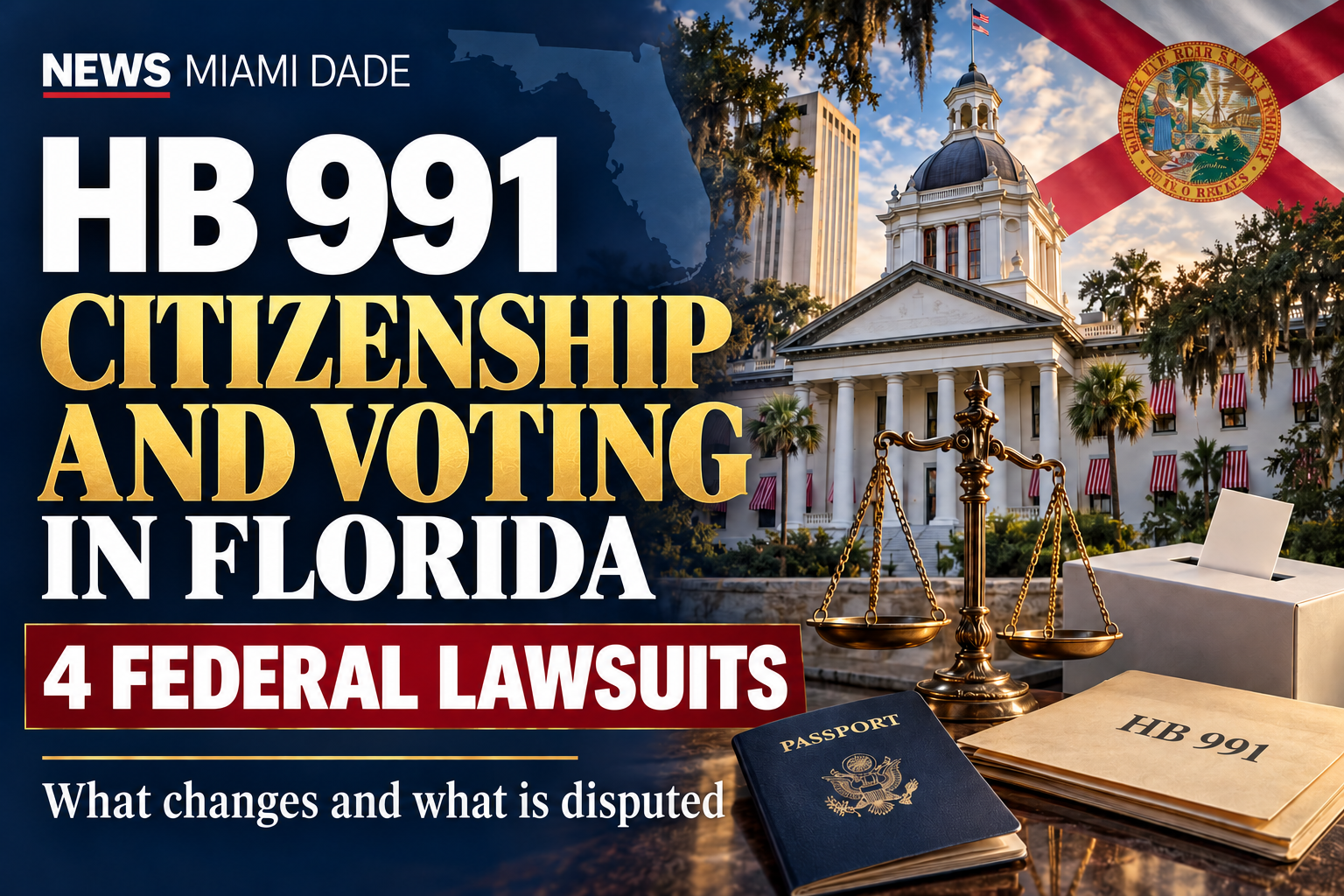
Florida didn’t wait for Congress. The state already has its own law requiring proof of citizenship to vote: HB 991, also known as the Florida SAVE Act, signed on April 1, 2026, with three consolidated federal lawsuits and a fourth filed, the bulk of which takes effect on January 1, 2027. This publication reviewed the 72 pages of the law, the lawsuits, the Secretary of State’s directive, and the October court filings.
The federal bill of the same name, the SAVE America Act—anacronym forthe Safeguard American Voter Eligibility Act—which would require proof of citizenship via a document in order to register to vote, has yet to become law; its legislative process is the subject of a companion article in this publication. HB 991 is the Florida law that serves the same purpose as the SAVE Act, which is why it is known by that name.
Exactly what it does is, in part, a matter of dispute: the Secretary of State maintains that registration takes place first and verification comes later; the plaintiffs argue that the law makes registration contingent on that verification. Here we explain what the letter of the law says, what the lawsuits are seeking, who is filing them and with what funding, how the state is responding, and what changes for a Miami-Dade voter, with the relevant documents laid out at every step.
What Happened: Florida Passed Its Law While the Federal Bill Was Pending
The SAVE America Act has yet to become law, but that does not mean that nothing has changed in Florida yet or that nothing will change. On April 1, 2026—the same day the first lawsuit was filed against it— Governor Ron DeSantis signed HB 991 into law.
This publication reviewed the 72 pages of the text approved by the Legislature, which contains neither the date of signature nor the chapter number. These two details are recorded in the bill’s official history on flsenate.gov, which is filed in the case record; its action log lists “Approved by Governor” on April 1, 2026, and “Chapter No. 2026-26” on April 2.
View the original at flsenate.gov
CS/CS/HB 991 (2026), text adopted by the Florida Legislature, Chapter 2026-26, signed by Governor Ron DeSantis on April 1, 2026, 72 pages. Source 1.
The approved text has several effective dates, not just one. Seven sections take effect immediately upon signing: Section 6 (page 19, minimum office hours for the election supervisor), Section 10 (page 31, the candidate’s oath of party affiliation), Section 11 (page 35, the new procedure for challenging a candidacy), Section 12 (page 36, the list of documents a candidate must submit to qualify, including their oath), Section 26 (page 60, the same documents for candidates for judicial or school board offices), 27 (page 62, the candidate’s oath that he or she meets the qualifications for office), and the effective date clause itself, 34 (page 72).
- Of those seven, three pertain to citizenship—but that of the candidate, not the voter:
- Sections 12 and 26 require the candidate to take an oath regarding whether he or she holds dual citizenship,
- and Article 27 requires him to swear, in general terms, that he meets all the legal and constitutional requirements for the office he is seeking, without specifically mentioning citizenship.
- None of the seven address the voter citizenship verification system, which is the focus of this article.
- Three others will take effect on July 1, 2026, and are already in force:
- Article 25 (page 60, five-year statute of limitations for election fraud),
- Article 28 (page 63; prohibits campaign contributions from foreigners)
- and Article 30 (page 65, which adds the offenses related to citizens’ initiatives —Articles 104.185 through 104.188—to the list of predicate offenses for organized crime); none of them address the voter registry.
The bulk of the law—the registration sections (page 72)—takes effect on January 1, 2027. And there is another date—July 1, 2027 (page 64)—by which driver’s licenses and state-issued identification cards for citizens must display their citizenship status.
What the law actually does is, in part, a point of contention between the state and the plaintiffs. The law cross-checks voter registration data with that of the Department of Highway Safety and Motor Vehicles (DHSMV) to verify citizenship; if the system cannot confirm citizenship, it requires documentary proof, and Section 8 applies not only to those registering for the first time but also to the retroactive verification of voters who were already registered, according to the UnidosUS lawsuit (page 5).
That same lawsuit further argues that the practical effect is not limited to the period following registration. Regarding Section 3 of the law, which deals with online registration, it states, verbatim (pages 4 and 5): “Such applications will be processed for registration only if DHSMV records indicate that the voter has previously provided proof of U.S. citizenship. If the records do not show that the registrant has previously provided proof of U.S. citizenship, the Department of State must flag the issue for the relevant county supervisor.” It further argues that a provisional ballot counts only if the required documentation is submitted within two days.
This publication compared that reading with the text of Section 3 of the approved document (pages 12 and 13), which rewrites subsection (4) of Article 97.0525. Subsection (b) requires that the application be forwarded to the supervisor when the name and date of birth match those in the DHSMV’s records and those records indicate that the applicant has already submitted a citizenship document.
Subsection (c) covers the other case: if the name and date of birth match but the DHSMV records indicate that “the applicant is not a United States citizen or has not provided a document acceptable as evidence of United States citizenship, ” the system “must notify the supervisor of elections that the applicant’s legal status as a United States citizen could not be verified and transmit… the applicant’s registration application… to the supervisor of elections.”
In other words: according to the wording of Section 3, the online application is forwarded to the supervisor in both cases; the difference is that, in the second case, it is accompanied by a notice stating that the applicant’s citizenship could not be verified. What happens next with that application—verification through other sources, notification to the applicant, issuance of a provisional ballot, or removal from the voter rolls—is governed by Section 4 (Article 97.053(6), pages 16 and 17), and that is where the State’s interpretation diverges from that of the plaintiffs. Submitting the application, verifying citizenship, and being able to vote with a regular ballot are three distinct steps, and this article does not merge them.
There is a third interpretation of this same procedure—that of the State itself— and no court has ruled on it in contrast to the plaintiffs’ interpretation. On July 29, 2026, Florida Secretary of State Cord Byrd signed Directive 2026-03 to election supervisors—a written instruction from the Secretary of State in his capacity as Florida’s highest electoral authority, which, according to its own text, verbatim, remains in effect “until such time as it is superseded or revoked by an act of Congress, state law, subsequent directive, or final court order”—until it is superseded or revoked by an act of Congress, a state law, a subsequent directive, or a final court order—.
It states, verbatim, that HB 991 “does not condition registration on an applicant’s submission of documentary proof of citizenship along with the voter registration application”: it does not make registration contingent on submitting documentary proof of citizenship along with the application. The supervisor must register every applicant, to quote the text, “just as you always have, ” just as he or she has always done.
View the original at floridados.gov
Directive 2026-03 from Florida Secretary of State Cord Byrd to election supervisors regarding the implementation of HB 991, July 29, 2026, 3 pages. Source 2.
According to that same directive, verification comes later. The DHSMV marks the applicant’s status as citizen or “not/unknown, ” and if it is unclear, the supervisor must consult state and federal sources, including the SAVE system.
If the status remains unverified, the supervisor must notify the applicant and issue a provisional ballot; and only if another source definitively confirms that the applicant is not a citizen—not if the status remains “unknown”—should the supervisor initiate the termination notice under Section 98.075(7). The directive does not mention any of the three lawsuits cited above nor does it state that their interpretation is incorrect; it merely sets forth the state’s interpretation of the same text. No court has yet ruled on which of the two interpretations prevails.
Effective January 1, 2027, the law will also narrow the types of identification accepted for in-person voting. This is set forth in Section 13 of the law, which amends Section 101.043 of the Florida Statutes (adopted text, pages 38 and 39, lines 946 through 973), as reviewed directly by this publication. It eliminates debit or credit cards, as well as student IDs, retirement center IDs, neighborhood association IDs, and public assistance IDs. It replaces military ID with identification from uniformed services or the Merchant Marine. And it expressly excludes cards issued by educational institutions.
According to that same text, the following remain valid: a Florida driver’s license; a DHSMV state ID; a U.S. passport or passport card; uniformed services or Coast Guard identification; the Department of Veterans Affairs veteran health card; a concealed weapons permit; and any other identification issued by a federal, state, county, or municipal entity, except for those issued by educational institutions. This provision takes effect on the law’s general effective date, January 1, 2027 (page 72), because Section 13 is not among those that have their own effective date.
Three federal lawsuits, which have already been consolidated, challenge the Florida law, and a fourth has been filed
On April 1, 2026, the first lawsuit against HB 991 was filed: UnidosUS et al. v. Byrd, Case No. 1:26-cv-22257, in the U.S. District Court for the Southern District of Florida. This publication downloaded and read the full complaint.The plaintiffs are UnidosUS, the League of Women Voters of Florida, Florida Rising Together, the Hispanic Federation, the Florida Immigrant Coalition, and Common Cause, represented by the ACLU, the ACLU of Florida, and other law firms. The defendant is Cord Byrd, Florida’s Secretary of State, along with the election supervisors of Broward, Miami-Dade, and Palm Beach counties.
The brief argues that the law violates the First and Fourteenth Amendments, that it disproportionately burdens naturalized citizens, elderly Black voters who were born without birth certificates during the era of segregation, married women who changed their last names, and low-income individuals, and that the databases cross-referenced by the law—the DHSMV and the federal SAVE system—produce false positives.
View the copy hosted by the ACLU
United States et al. v. Byrd, 1:26-cv-22257, complaint against HB 991, Southern District of Florida, April 1, 2026. Copy hosted by the ACLU, one of the law firms representing the plaintiffs; this is not the court’s website. Source 3.
That same day, about two hours later, a second lawsuit was filed: Florida State Conference of Branches and Youth Units of the NAACP et al. v. Byrd, in the Northern District of Florida, Case No. 4:26-cv-00147.
This is stated in the May 1, 2026, order by District Judge Jacqueline Becerra, Document 61 of the UnidosUS docket, filed in the case record, as per the copy hosted by Democracy Docket: the UnidosUS complaint was filed at 9:32 a.m.; “about two hours later, ” the NAACP State Conference and the Florida Alliance for Retired Americans filed a lawsuit in the Northern District against the Secretary of State, the executive director of the DHSMV, and the state’s 67 election supervisors (page 2).
That order granted the NAACP’s motion to transfer the case to the Southern District and denied, without prejudice to a future request, a full consolidation (page 8). This publication has not read the NAACP’s brief and does not state what its exact arguments are.
And on September 1, 2026, a third lawsuit was filed: Black Voters Matter Fund et al. v. Byrd, Case No. 1:26-cv-26047, Miami Division of the Southern District of Florida. This publication obtained and reviewed the full 43-page complaint from the copy hosted by the Southern Poverty Law Center—one of the law firms representing the plaintiffs—in the case file. The plaintiffs arethe Black Voters Matter Fund and the League of United Latin American Citizens (LULAC). The defendants, all acting in their official capacities, are Cord Byrd and the election supervisors of Broward (Joe Scott), Palm Beach (Wendy Sartory Link), Miami-Dade (Alina García), Orange (Karen Castor Dentel), and Osceola (Mary Jane Arrington) (page 1).
View a copy hosted by the Southern Poverty Law Center
The complaint contains six charges, and here lies the difference from the first complaint as filed on April 1, 2026: five are for violations of the National Voter Registration Act (NVRA) of 1993—the use of federal and state forms, the timely registration of applicants, limits on the reduction of registered voters, the uniform and nondiscriminatory maintenance of voter rolls, and the 90-day quiet period prior to a federal election—and the sixth is based on the due process clause of the Fourteenth Amendment (pages 31–41).
The brief is signed by Jennifer Thelusma of the Southern Poverty Law Center (page 42). Also listed as attorneys for the plaintiffs are Matletha Bennette, of the same organization, and—with her application for special admission to the court (pro hac vice) yet to be filed— according to the brief itself (“Pro Hac Vice Application Forthcoming”), Bradley E. Heard and Brady Miller of the SPLC, as well as Norman L. Eisen, Andrew Warren, Pooja Chaudhuri, and Beauregard Patterson of the Democracy Defenders Fund (page 43).
Black Voters Matter Fund et al. v. Byrd, 1:26-cv-26047, complaint challenging HB 991, Southern District of Florida, Miami Division, September 1, 2026, 43 pages. Copy hosted by the Southern Poverty Law Center, one of the law firms representing the plaintiffs; this is not the court’s website. Source 5.
Of the three lawsuits, this publication filed and read the entire complaint for the first and third cases, but has not read the complaint for the second case.
Regarding whether they are consolidated: the order dated May 20, 2026, Document 64, filed and read in its entirety in the same copy of Democracy Docket, states, verbatim, that the NAACP case, already assigned case number 26-cv-23135-JB, is “CONSOLIDATED for purposes of trial, and timing of pleadings, hearings, and depositions and other discovery” within UnidosUS et al. v. Cord Byrd et al., 26-cv-22257-JB, which is now the sole case number under which pleadings are filed, and orders the court clerk to close the 26-cv-23135-JB case file (page 2).
United States et al. v. Byrd, 26-cv-22257-JB, Order on Consolidation by Judge Jacqueline Becerra, Document 64, Southern District of Florida, May 20, 2026, 2 pages. Copy hosted by Democracy Docket. Source 4.
The first two lawsuits have thus been consolidated for trial and scheduled for May 20, 2026, by order of Judge Becerra. The third, filed by Black Voters Matter, was later joined. According to the case record on CourtListener —a mirror site of PACER, not the court’s official website—archived by this publication on October 20, 2026, Judge Becerra signed an order on September 28, 2026, which entry 28 describes, verbatim, as “ORDER CONSOLIDATING CASES Closing Case, ” and case 1:26-cv-26047 is listed as closed on that date.
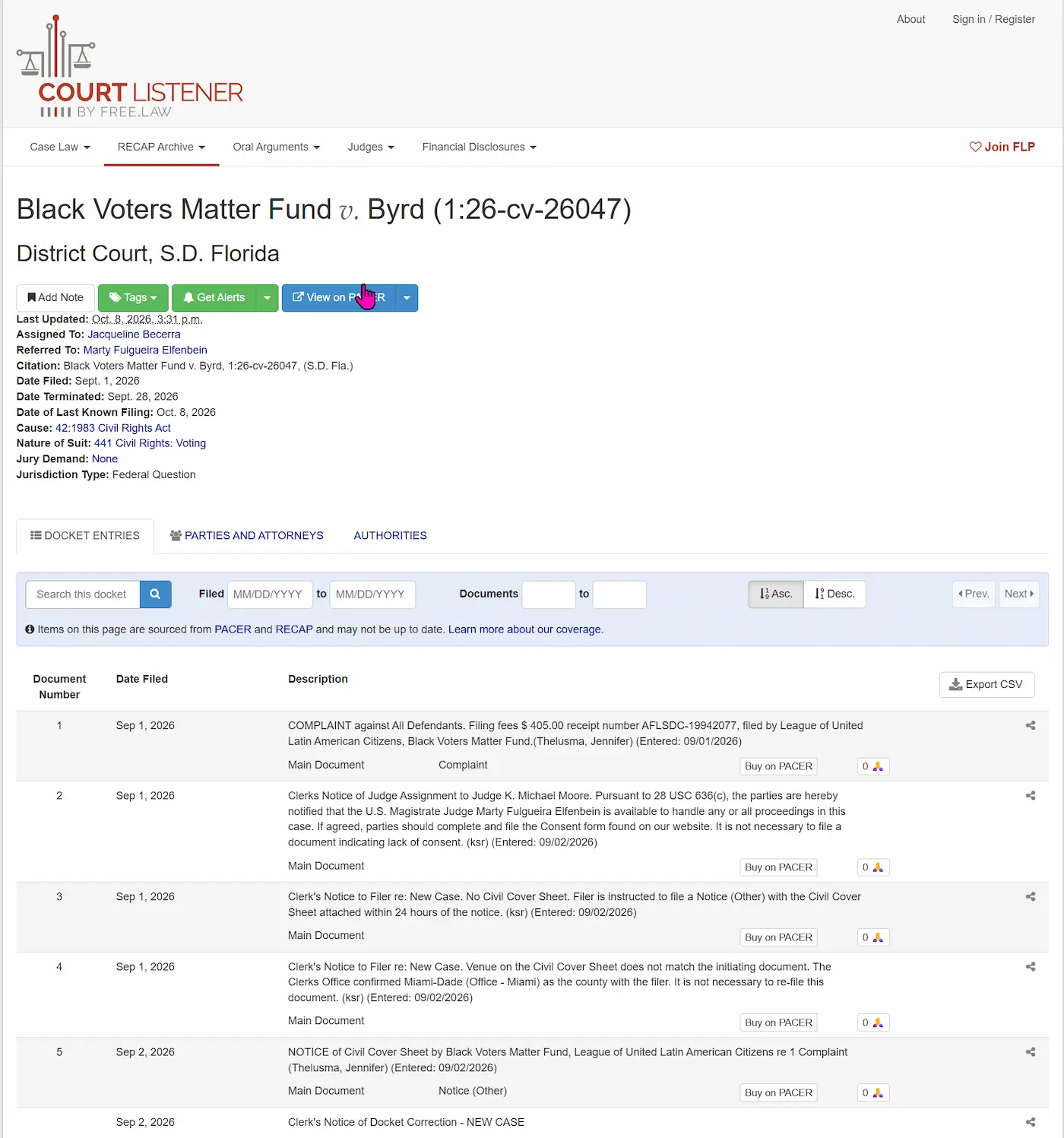
This publication has not read that order. What it has read are the subsequent pleadings, filed under the single case number 1:26-cv-22257-JB, whose headings refer to the Black Voters Matter Fund as “Consolidated Plaintiffs” and to the case as “Consolidated Case No. 1:26-cv-22257-JB.”
That procedural stage then moved forward. In an order signed on July 10, 2026, and entered into the case file on July 13, Judge Becerra scheduled the trial for the consolidated case for the two-week period beginning Monday, November 8, 2027, with a pretrial conference on November 2, 2027 (Document 88 of the case file), which this publication filed and read in its entirety.
On July 22, 2026, within the deadline set by that same order for amending complaints, UnidosUS and the other plaintiff organizations filed an amended complaint (Document 89), which this publication filed and read in its entirety. Unlike the original, this one DOES include claims alleging violations of the National Voter Registration Act: five new charges under sections 5, 6(a), 6(b), 7, and 8 of the NVRA, in addition to the original charge regarding the First and Fourteenth Amendments and a new charge regarding the ban on student identification. The complaint states that it sent a notice letter on April 22, 2026, and that Secretary Byrd did not respond.
And on September 16, 2026, the State filed its reply in support of its motion to dismiss (Document 134), which this publication filed and read in its entirety. The State argues—as its own position and not as the conclusion of any court—that the dispute is not whether Florida can verify citizenship but when: it states that most applicants are registered without providing any documentation because their information is cross-checked against DHSMV records and, if necessary, with the federal SAVE system, and that documentary proof may only be required—for those who could not be verified through those channels—before issuing a “regular… ballot,” that is, an ordinary ballot, not before registration.
That judicial interpretation by the government is consistent with the one already established in Secretary Byrd’s Directive 2026-03, cited above: registration comes first, and document verification—when necessary—comes afterward. No court has yet accepted or rejected it.
The case continued to move forward in October. According to the consolidated case record on CourtListener, the case was dismissed by this court on October 20, 2026, and reopened, in descending chronological order, on October 26, 2026.
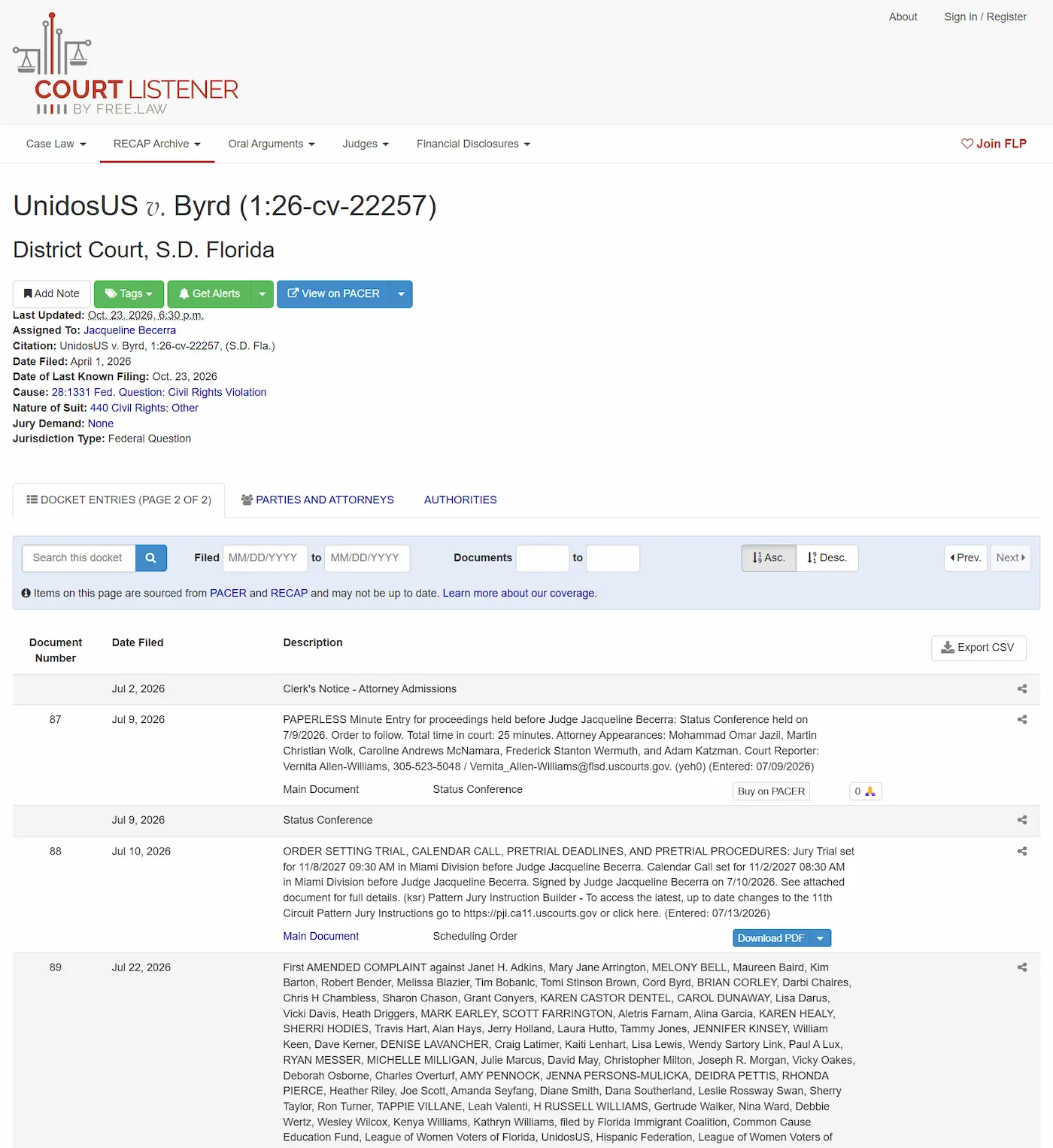
(Local copy: sources/01-primaries/docket-unidosus-v-byrd/2026-10-26_courtlistener-com_docket-73126706-unidosus-v-byrd_page2_seat-158.html)On October 2, Secretary Byrd filed a motion to dismiss the lawsuit brought by Black Voters Matter (Document 146, 22 pages, of which this publication read the first three), using the same underlying argument, verbatim: “Nothing in HB 991 requires the applicant to attach a birth certificate, passport, or any other documentary proof of citizenship when registering to vote.”
On the same day, he filed a supplemental notice of authority (Document 147, three pages, read in full) citing the Supreme Court’s stay order in DHS v. League of Women Voters, No. 26A308, dated September 25, 2026, regarding the use of the federal SAVE system during the 90 days prior to an election.
The plaintiffs from UnidosUS responded on October 7 (Document 152) that this order, verbatim, “has no bearing” on the motions to dismiss.
On October 23, the day the deadline expired, the State filed its final reply in support of the motion to dismiss (Document 158, 7 pages, read in its entirety by this publication).
It raises two arguments specific to the State that no court has yet accepted: that Black Voters Matter did not provide the specific advance notice required by the National Voter Registration Act for two of its claims, and that its due process argument does not hold because the Fourteenth Amendment allows a hearing to be postponed until after the administrative proceedings (Cleveland Bd. of Educ. v. Loudermill, 470 U.S. 532, 542). As of that same date, the case file shows no court decision on the motions to dismiss, and entry 158 remains, as of October 26, 2026, the last entry in the consolidated case file.
On October 16, Black Voters Matter and LULAC filed their opposition to the motion (Document 156, 27 pages; this publication reviewed the cover page and table of contents, section II of whichA states, verbatim, “HB 991 conditions completed registration on citizenship verification despite the Defendant’s contrary characterization”). The State’s reply is due on October 23, 2026, and as of the date of this article, no decision has been made on any of the motions to dismiss.
And on October 19, 2026, in the most recent filing in the case, the Florida NAACP and the Florida Alliance for Retired Americans filed a notice of related action (Document 157, three pages, read in full): It notifies of a new lawsuit, Florida State Conf. of Branches and Youth Units of the NAACP v. Byrd, No. 1:26-cv-27307, which, verbatim, “concerns the same student identification provision of HB 991.” That fourth filing has not been unsealed or read, and this publication makes no claims about it beyond what is stated in the notice.
United States et al. v. Byrd, 1:26-cv-22257-JB, Notice of Pending, Related, or Similar Action by the Florida State Conference of the NAACP and the Florida Alliance for Retired Americans, Document 157, Southern District of Florida, October 19, 2026, 3 pages. RECAP copy; this is not the court’s website. Source 10.
Regarding the rest of the proceedings—other motions, statements, and the NAACP’s own brief—this publication has not read any other documents and makes no claims.
Two interpretations, and the data each side cites
The dispute over HB 991 has two sides, each with its own names, titles, and documents. This section presents them side by side: who governs and signed the bill, who is suing and with what funds, and what each party says in its own words. It does not determine who is right, because that is a matter for the courts; it presents the facts so that each reader can judge for themselves what each side is seeking.
Florida officials, by office and party
The votes on the bill are recorded in the official legislative history on flsenate.gov, which has already been cited and archived: the House passed it on February 25, 2026, by a vote of 83 to 31; the Senate rejected an amendment on March 11 by a vote of 12 to 24 and passed the bill on March 12 by a vote of 27 to 12; and the House accepted the Senate’s version that same day by a vote of 77 to 28. This record shows the overall results, not the vote of each legislator.
Each member’s vote is recorded on the four official roll-call voting sheets linked in that same record, which this publication archived on October 21, 2026: the House vote from February 25 (83 in favor, 31 against, 3 abstentions)
, the Senate vote on March 11 on Amendment 305574 (12 in favor, 24 against, 3 abstentions)
, the Senate vote on March 12 (27 in favor, 12 against, no abstentions)
and the House vote on March 12 (77 in favor, 28 against, 12 abstentions). The sheets list each lawmaker’s name, district, and vote; they do not indicate their party.
The five state officials named by this media outlet in the proceedings are listed in the table, with their positions and political parties verified—where possible—against the official record; where verification was not possible, this is noted as such.
| Name | Position | Match | Role in HB 991 | Verification and Source |
|---|---|---|---|---|
| Ron DeSantis | Governor of Florida | Republican | He signed the law on April 1, 2026 (“Approved by Governor,” official record) | Position and signature: verified; official record from flsenate.gov cited above. Party: public information widely known |
| Cord Byrd | Florida Secretary of State; defendant in all three cases | Republican, according to the internal analysis of the case; the official record on file does not specify a party | Appointed by the governor, with his term beginning on May 17, 2022; the Senate did not consider that initial appointment, but renominated him on January 3, 2023, and confirmed him on April 26, 2023. He signed Directive 2026-03 and introduced motions to dismiss | Appointment and Confirmation: Verified, Florida Senate Registry of Executive Appointments |
| Alexis Calatayud | State Senator, District 38 (part of Miami-Dade) | Republican | She voted against the measure during the Senate plenary session on March 12, 2026 (27 in favor, 12 against): “N Calatayud-38” on the official roll call vote sheet. She was the only Republican to vote against it: the other eleven votes against (Arrington, Berman, Bernard, Bracy Davis, Davis, Jones, Osgood, Polsky, Rouson, Sharief, and Smith) are listed as Democrats on the official Senate roster. On March 11, she had voted in favor of Amendment 305574, which was rejected 12–24. | Name, party, and district: verified via the official website at flsenate.gov and the official Florida Senate roster. |
| Jason Pizzo | State Senator, District 37 (parts of Broward and Miami-Dade) | According to his official website, he has no party affiliation; according to an internal analysis of the case, he was a Democrat and Senate minority leader until April 2025. | He voted in favor during the Senate plenary session on March 12, 2026: “Y Pizzo-37” on the official roll call ballot. In the vote on Amendment 305574 on March 11, he was listed as excused (“EX”). | Name, current affiliation, and district: verified on the official website at flsenate.gov |
| Ashley Gantt | State Representative, District 109 (Miami-Dade) | Democrat | He voted against the bill in both House votes: “N Gantt-109” on February 25, 2026 (83-31) and on March 12 (77-28), according to the official roll call records. He introduced Amendment 818439 to HB 991 (“Representative Gantt offered the following,” official 48-page PDF, approved for record on February 20, 2026), which the House rejected on February 25 (“House: Failed 2/25/2026,” official record). According to the Florida Phoenix, during the February 25 debate, he said that the amendment sought to address cases such as that of his aunt, who was born at home in South Carolina during the Jim Crow era and was never issued a birth certificate, and that the law, verbatim, “will block eligible U.S. citizens from registering to vote and remove longtime voters from the rolls. “ | Office, party, and district: verified, official page at flhouse.gov (“District: 109 — Democrat”; “I proudly represent House District 109 in Miami-Dade County”), archived on October 21, 2026. The amendment and its outcome: verified; official PDF of Amendment 818439; its wording and the case involving his aunt: verified as published by the Florida Phoenix on February 25, 2026. |
Who is filing the lawsuit, what each organization does, and where the funding comes from
Five organizations are leading the lawsuits, and a sixth, the ACLU, is representing them. The information regarding the founding, mission, and history of each organization is based on this publication’s internal analysis dated October 20, 2026, cross-referenced with each organization’s own websites and public sources not included in the case file; it is presented as a description, not as a disputed fact.
The funding figures come from data aggregators that compile data from the IRS Form 990 (ProPublica Nonprofit Explorer, CauseIQ, InfluenceWatch, Kindora). Each organization has a stated public position against the law; none is treated as a neutral source regarding its own litigation.
UnidosUS. According to its own description, it is the largest advocacy and community service organization for the Hispanic community in the United States. It was founded in 1968 in Phoenix, Arizona, as the Southwest Council of La Raza by Herman Gallegos, Julian Samora, and Ernesto Galarza; in 1972, it was renamed the National Council of La Raza, and in 2017, it adopted the name UnidosUS. Its stated mission is to improve opportunities for Hispanics through applied research, public policy analysis, advocacy, and a network of affiliate organizations. It is the lead plaintiff in the consolidated case.
How it is funded: This could not be verified against the original Form 990. Aggregators report, for the most recent fiscal year available, approximately $75.9 million in revenue, $72.3 million in expenses, and $139.6 million in assets, with $78.8 million in grants from 75 different foundations, none of which exceeds half of that amount; sources disagree on whether the period is fiscal year 2024 or tax year 2025, and this publication does not resolve the issue. No major individual donor was identified.
Why he considers the law harmful, in his own words: Jared Nordlund, state director of UnidosUS in Florida, in the ACLU’s joint statement dated April 1, 2026, filed with this publication on October 20, 2026
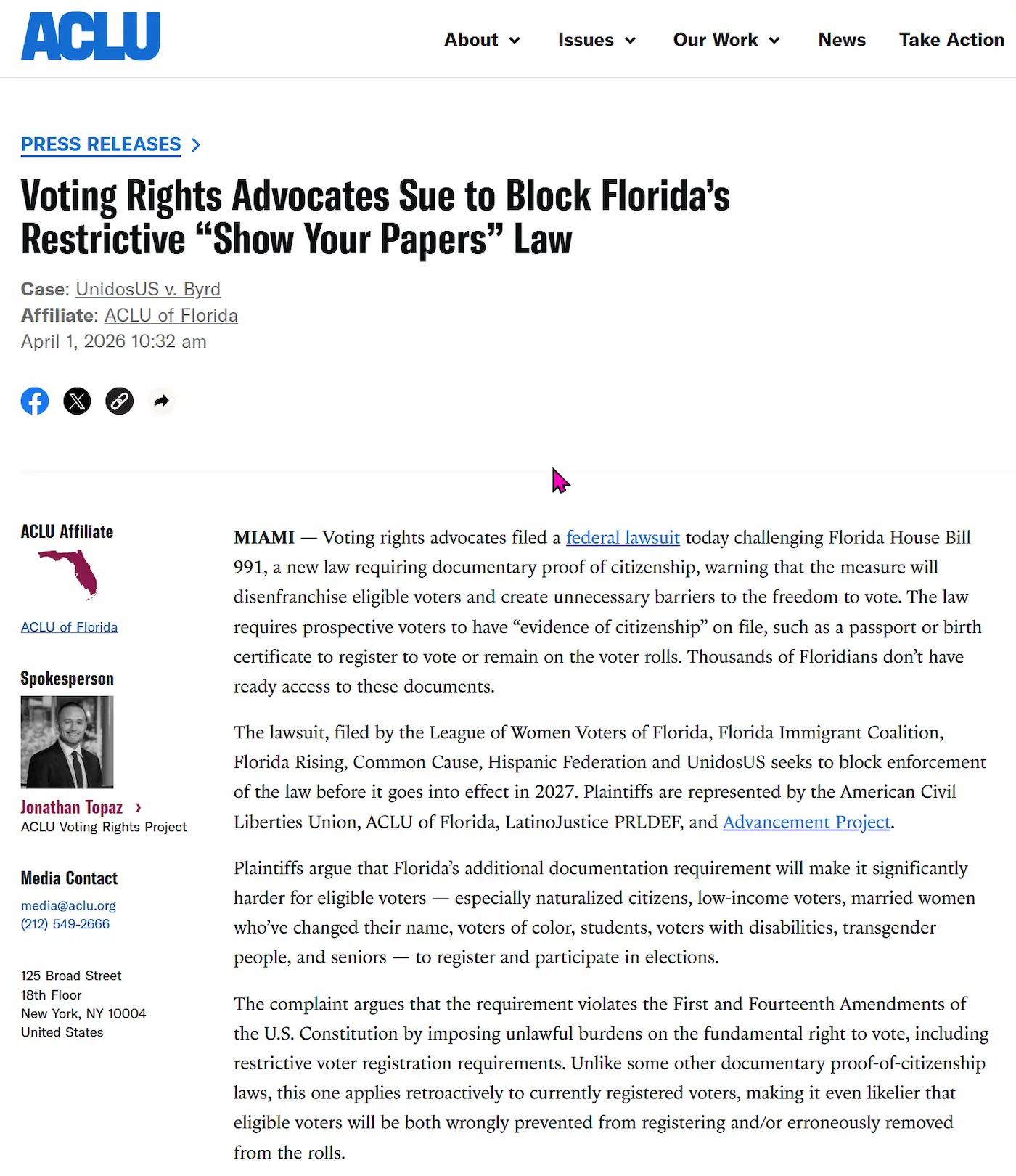
“HB 991 is another solution in search of a problem.” The lawsuit alleges, as previously reported, that the law violates the NVRA and the First and Fourteenth Amendments, that it imposes a retroactive burden on already registered voters, and that it disproportionately affects naturalized citizens, married women who have changed their last names, and low-income voters.
Florida State Conference of the NAACP. It is the state chapter of the NAACP, the nation’s oldest civil rights organization, founded in 1909. The Florida Conference was formed in October 1941, the first state conference of chapters in the country, with Harry T. Moore as its first president; Moore and his wife Harriette were killed in 1951 by a bomb at their home. Lawsuit filed jointly with the Florida Alliance for Retired Americans in the consolidated case and, according to the October 19, 2026, notice cited above, in the fourth lawsuit regarding student identification. This media outlet has not read their brief.
How it is funded: could not be verified; this media outlet’s search did not find any revenue figures or donor information for the state conference, either in Form 990 aggregators or through its own sources. A verbatim quote from an identified spokesperson regarding HB 991: could not be verified; the NAACP’s national press release dated April 2, 2026—which this outlet did not archive—does not attribute any statement to a named individual, according to an internal analysis. What it alleges, according to that analysis regarding a lawsuit not reviewed by this publication: that the eligibility review would affect all already-registered voters and that the greatest burden would fall on Black, low-income, young, and elderly voters.
Black Voters Matter Fund. A 501(c)(4) organization co-founded in 2016 by LaTosha Brown and Cliff Albright to increase the political power and voter participation of Black communities; It has a sister 501(c)(3) organization, the Black Voters Matter Capacity Building Institute, launched in 2017. It filed a lawsuit alongside LULAC in the September case, represented by the Southern Poverty Law Center and the Democracy Defenders Fund. No other previous litigation by the organization regarding voter ID could be verified.
How it is funded: verified only against a Form 990 aggregator, not against the form itself. ProPublica Nonprofit Explorer reports $9.3 million in revenue and $5.2 million in expenses for the Fund in 2024, with $4.53 million in assets; that figure does not include the sister institute. In 2021, co-founder LaTosha Brown said that the brand as a whole received more than $30 million in donations in 2020 from about 90,000 donors, most of whom were small donors; according to the Chronicle of Philanthropy, which reported this, that figure should not be confused with the Fund’s revenue.
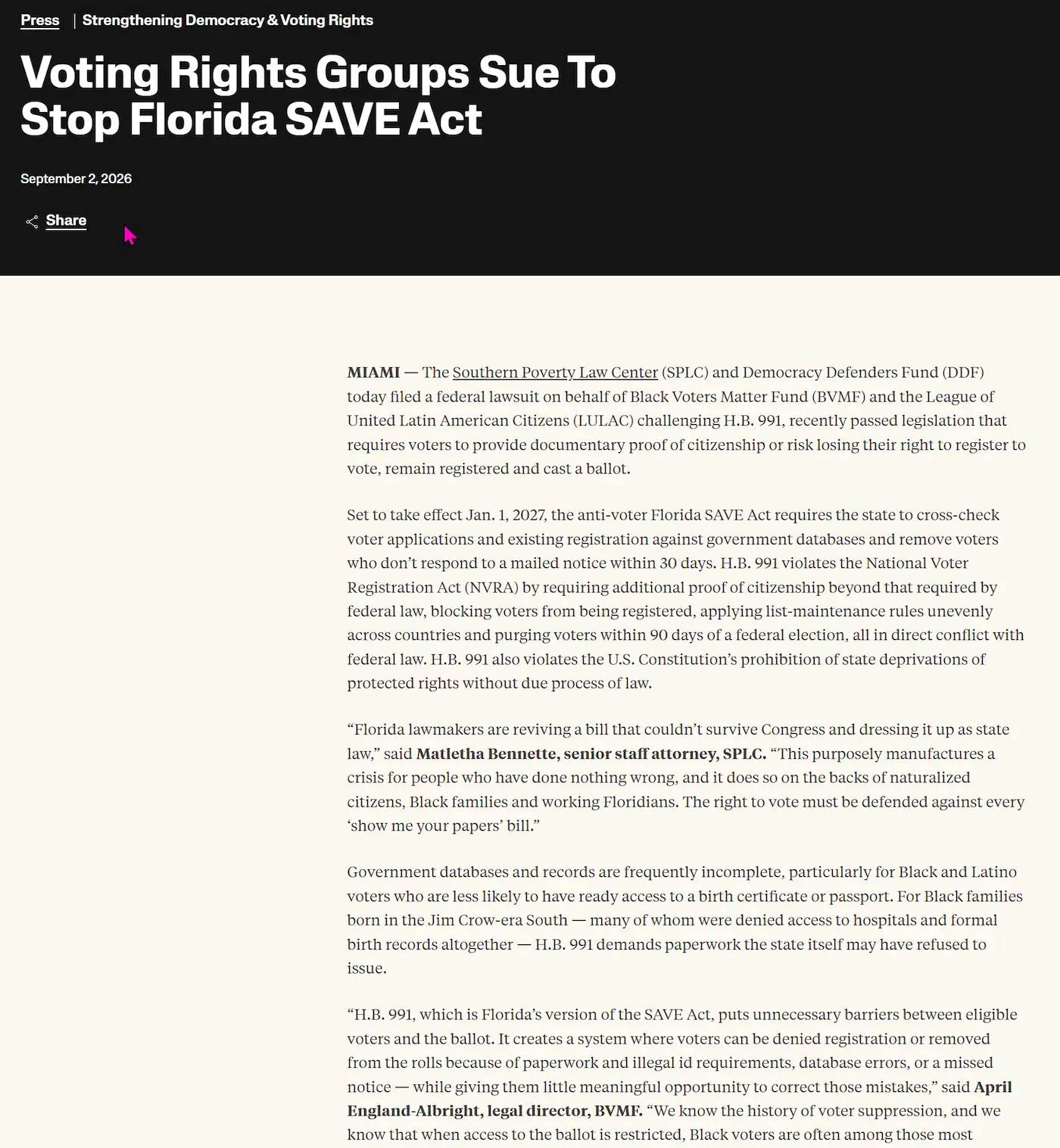
In her own words: April England-Albright, the Fund’s legal director, in the Southern Poverty Law Center’s press release dated September 2, 2026, archived by this publication on October 20, 2026
“We are challenging this law because every eligible voter deserves a fair and accessible opportunity” and “H.B. 991, which is Florida’s version of the SAVE Act, creates unnecessary barriers between eligible voters and the ballot.” Their lawsuit, as previously noted, includes five claims under the NVRA and one based on due process.
LULAC (League of United Latin American Citizens). According to its own description and independent sources, it is the oldest and largest Hispanic civil rights organization in the country, founded on February 17, 1929, in Corpus Christi, Texas, through the merger of several groups, mostly Mexican-American veterans of World War I. Its stated mission encompasses the economy, education, political influence, housing, health, and civil rights of the Hispanic population. Co-plaintiff with the Black Voters Matter Fund. Previous litigation by the organization regarding proof of citizenship for voting could not be verified.
How it is funded: This could not be verified against the original Form 990. InfluenceWatch, an aggregator with a stated editorial stance, reports $1,220,449 in revenue and $1,617,976 in expenses for the national organization in 2024; local councils—separate tax-exempt entities—collectively contribute about $1 million a year in grants, according to the organization itself. In the words of Juan Proaño, executive director, in the same Southern Poverty Law Center press release: “Naturalized citizenship is not provisional. Florida cannot treat it as if it is.”
League of Women Voters of Florida. State chapter of the League of Women Voters, a nonpartisan national organization founded in 1920 by Carrie Chapman Catt, whose bylaws prohibit it from endorsing candidates or political parties; its stated mission is to promote informed participation and influence public policy through education and advocacy. The founding date of the Florida chapter could not be determined: the sources consulted list 1921 and 1939. Co-plaintiff in the UnidosUS case, represented by the ACLU. Chapters in other states are challenging similar laws, as described below.
How it is funded: verified only against a Form 990 aggregator. ProPublica Nonprofit Explorer reports approximately $209,000 in revenue and $197,000 in expenses for 2024, with $27,700 in assets; it is a 501(c)(4) organization, so donations to it are not tax-deductible. There is a sister 501(c)(3) organization, the League of Women Voters of Florida Education Fund, with a different financial profile; it has not been confirmed whether it is involved in the litigation. In her own words: Jessica Lowe-Minor, president, in the aforementioned ACLU statement: “No eligible Floridian should be pushed off the voter rolls simply because of red tape.”
The ACLU, as legal counsel. Founded in 1920, it operates through two entities: the ACLU, a 501(c)(4) organization, and the ACLU Foundation, a 501(c)(3) organization. Together with the ACLU of Florida, LatinoJustice PRLDEF, and the Advancement Project, it represents the plaintiffs in the UnidosUS lawsuit; the copy of that complaint filed by this media outlet is hosted by the ACLU itself, not the court.
How the ACLU is funded: It states that it does not receive government funding and is financed through membership dues, donations, and grants from foundations; a secondhand figure—not verified against its annual report—puts its combined budget for 2024 at $383 million. In the same statement, Jonathan Topaz of the ACLU’s Voting Rights Project calls the law “a blatant attempt to add unnecessary barriers to the ballot box” and says it “targets Florida’s most vulnerable voters”; Carrie McNamara of the ACLU of Florida: “This anti-voter law is the latest entry in that playbook.”
The Government’s Response
On the other hand, the State of Florida has based its interpretation on three documents already cited in this article: Secretary Byrd’s Directive 2026-03, which states that the law “does not condition registration on an applicant’s submission of documentary proof of citizenship” and orders that all applicants be registered “just as you always have”; the September 16, 2026, reply, which argues that the dispute is over when—not whether—citizenship is verified; and the October 2 motion, verbatim: “Nothing in HB 991 requires the applicant to attach a birth certificate, passport, or any other documentary proof of citizenship when registering to vote.” These are partisan arguments, not the conclusions of any court.
What neither side has yet is a court ruling: the motions to dismiss remain pending, the State’s reply is due on October 23, 2026, and the trial is scheduled for November 2027. The plaintiffs invoke the NVRA, the First and Fourteenth Amendments, and the Kansas precedent discussed below; the State relies on the plain language of the law and a recent Supreme Court order regarding the SAVE system. The court will determine who is right; what each party seeks is set forth in their own documents, cited above.
Florida isn’t the only state with this dispute
Similar lawsuits exist in other states, according to an internal map compiled by this publication on October 20, 2026, based on searches, the websites of the litigating organizations themselves, and legislative tracking tools—not on a review of the case files: Ohio, South Dakota, Wyoming, New Hampshire, Indiana, and Louisiana have or have had lawsuits challenging citizenship documentation requirements, and the Arizona case is before the Supreme Court, which, according to that mapping, agreed to hear it on June 29, 2026.
Several of the same organizations appear repeatedly: chapters of the League of Women Voters, the ACLU, and the Campaign Legal Center. This publication has not reviewed any of those case files, does not confirm their current status, and reserves them for a separate article.
The Precedent Governing HB 991: Arizona v. Inter Tribal Council
UnidosUS’s original complaint did not cite this case among its claims, which were solely constitutional; its amended complaint of July 22, 2026, does cite it (paragraph 256, page 85), in one of its new claims under the NVRA. The Black Voters Matter complaint also cites it (page 32) in support of its first claim; the NAACP’s complaint has not been reviewed. It is mentioned here because it is the key precedent regarding how far a state can go with the citizenship test.
In Arizona v. Inter-Tribal Council of Arizona, 570 U.S. 1, the Supreme Court ruled, by a 7-2 vote, that the National Voter Registration Act requires states to “accept and use” the federal registration form, which requires only an affidavit of citizenship under penalty of perjury. This publication read the full opinion, including the two dissenting opinions, in the official edition of the United States Reports.
Justice Antonin Scalia wrote the majority opinion, joined by Justices Roberts, Ginsburg, Breyer, Sotomayor, and Kagan, and partially joined by Justice Kennedy. The Arizona law requiring documentary proof of citizenship was struck down, the opinion states, “as applied to Federal Form applicants”—that is, in its application to those who use the federal form—but not invalidated in general. The ruling also leaves the door open: a state may ask the Election Assistance Commission (EAC) to add the documentary proof requirement to the federal form for that state, and if the commission refuses, the state may challenge that refusal in court.
It may also require proof on its own state form and “deny registration based on information in its possession establishing the applicant’s ineligibility,” as stated verbatim in the summary, pages 1 and 2.
The Elections Clause, according to that same summary, “imposes on the States the duty to prescribe the time, place, and manner of electing Representatives and Senators, but it confers on Congress the power to alter those regulations or supplant them altogether”: it requires the states to determine the time, place, and manner of electing Representatives and Senators, and empowers Congress to alter those regulations. It is not a power that the clause reserves for Congress; rather, the opposite is true, and it does not extend to the presidential election, which is governed by another article of the Constitution.
Justices Clarence Thomas and Samuel Alito dissented, each on his own. Thomas wrote, verbatim, that the Constitution gives the states the power to determine who may vote, and that this power “necessarily includes the related power to determine whether those qualifications are satisfied.”
Alito opened his dissenting opinion with a phrase that has been widely quoted ever since: “The Court reads an ambiguous federal statute in a way that brushes aside the constitutional authority of the states and produces truly strange results,” because the success of a registration application comes to depend on which form—the federal one or the state one—the applicant chooses to fill out. Neither of the two dissenting opinions prevailed.
Kansas has already tried a similar law and lost in court
Before Florida, it was Kansas. Its Secure and Fair Elections Act, in effect since January 1, 2013, required documentary proof of citizenship from anyone registering to vote, even when doing so as part of the driver’s license application process. The lawsuit, Fish v. Kobach, was filed by citizens who were prevented from registering and by the Kansas League of Women Voters against then-Secretary of State Kris Kobach. This publication read the full text of both rulings by the Tenth Circuit Court of Appeals that decided the case.
In October 2016, the Tenth Circuit upheld a preliminary injunction requiring the registration of those affected. On June 18, 2018, the U.S. District Court for the District of Kansas issued a permanent injunction preventing the enforcement of the requirement—“entered a permanent injunction against the enforcement of the DPOC requirement,” as stated on page 6 of the appellate ruling— and in April 2020, the Tenth Circuit affirmed this in Fish v. Schwab, with a panel consisting of two judges acting as a quorum following the death of Judge McKay.
The central argument: The NVRA allows a state to require only the minimum information necessary to verify eligibility, and that minimum is the affidavit, unless the state demonstrates with concrete evidence that a substantial number of non-citizens register based solely on that affidavit. Kansas was unable to demonstrate this.
The district court found, as stated on page 15 of the 2020 appellate ruling, that “at most, 67 noncitizens registered or attempted to register in Kansas over the past 19 years,” and of those, only 39 actually succeeded in registering between 1999 and 2013. In contrast, 31,089 applicants were denied registration, and the same court found (page 16) that more than 99 percent of those whose applications were put on hold were citizens.
This publication does not claim that Florida’s HB 991 will face the same fate. Whether the differences between the Florida and Kansas laws are sufficient to save it is what the UnidosUS lawsuit addresses, and no court has ruled on this yet.
A 2013 case involving another law, and the legislative response that followed
It is important to be precise regarding a second case from 2013 that is sometimes conflated with the previous one, even though they are distinct: Shelby County v. Holder, 570 U.S. 529, decided by the Supreme Court eight days after Arizona v. Inter-Tribal Council and by the same panel of justices. It concerns a different law—the Voting Rights Act of 1965—and a different mechanism: federalpreclearance of electoral changes in jurisdictions with a history of discrimination. It does not concern proof of citizenship. This publication read the full opinion.
By a vote of 5 to 4, with a concurring opinion by Chief Justice John Roberts, the majority declared the formula used to determine which jurisdictions required such prior approval to be unconstitutional, on the grounds that it was based on data from the 1960s and 1970s. Without the formula, the prior approval mechanism became inoperative in practice, although the ruling did not repeal it as such.
Justice Ruth Bader Ginsburg, in her dissenting opinion, wrote the phrase that has been most frequently quoted ever since: discarding prior approval when it has worked and continues to work is “like throwing away your umbrella in a rainstorm because you are not getting wet.” The quote appears, verbatim, in the archived ruling.
Congress has not passed a new bill since 2013. The bill currently pending in the 119th Congress is the John R. Lewis Voting Rights Advancement Act, introduced in the House as H.R. 14 by Representative Terri Sewell on March 5, 2025.
, and in the Senate as S. 2523 by Senators Dick Durbin and Raphael Warnock on July 29, 2025.
This news outlet reviewed the text of the two bills, which would establish a new coverage formula based on voting rights violations over the past twenty-five years rather than on data from sixty years ago. This media outlet filed the two submitted texts but did not keep a record of their subsequent progress; it does not specify exactly where in the process the two bills currently stand.
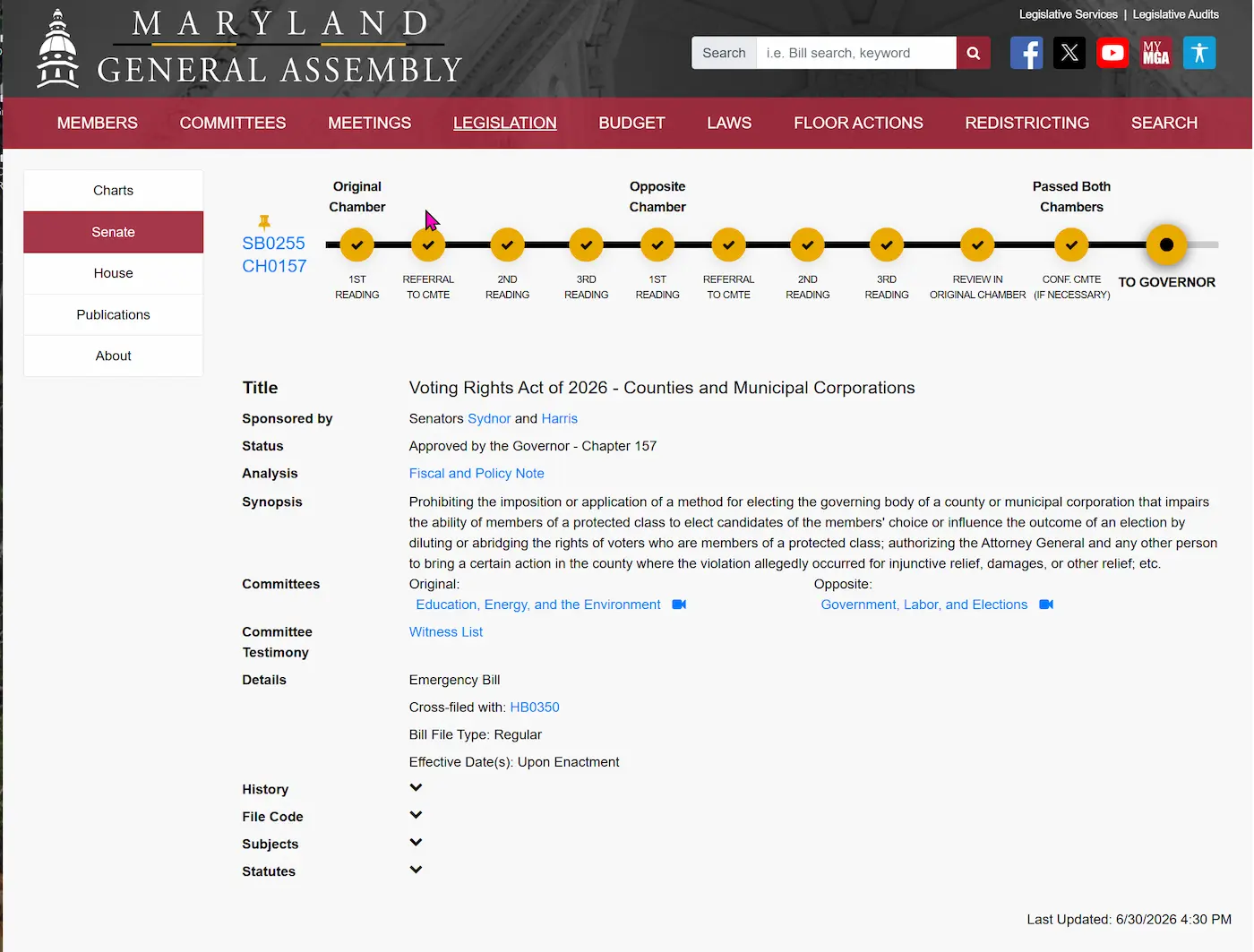
In 2026, three states passed their own state voting rights laws. The three statutes are recorded in official records that this media outlet filed in the case file on September 26, 2026. Maryland was the first: on April 28, 2026, Governor Wes Moore signed SB 255, “Voting Rights Act of 2026—Counties and Municipal Corporations, ” Chapter 157, into law, according to the Maryland General Assembly’s record; the law prohibits counties and municipalities from using election methods that dilute the vote of a protected class.
The following day, April 29, 2026, the Supreme Court, in Louisiana v. Callais, 608 U.S. ___, reinterpreted Section 2 of the Voting Rights Act itself—which remains in effect following Shelby County—to require proof of intentional discrimination in redistricting, rather than merely a result leading to reduced representation. This publication read the headline and the main body of that ruling, not the full opinion. It is a case about Louisiana’s electoral maps, not about proof of citizenship, and it does not address HB 991 or the SAVE America Act.
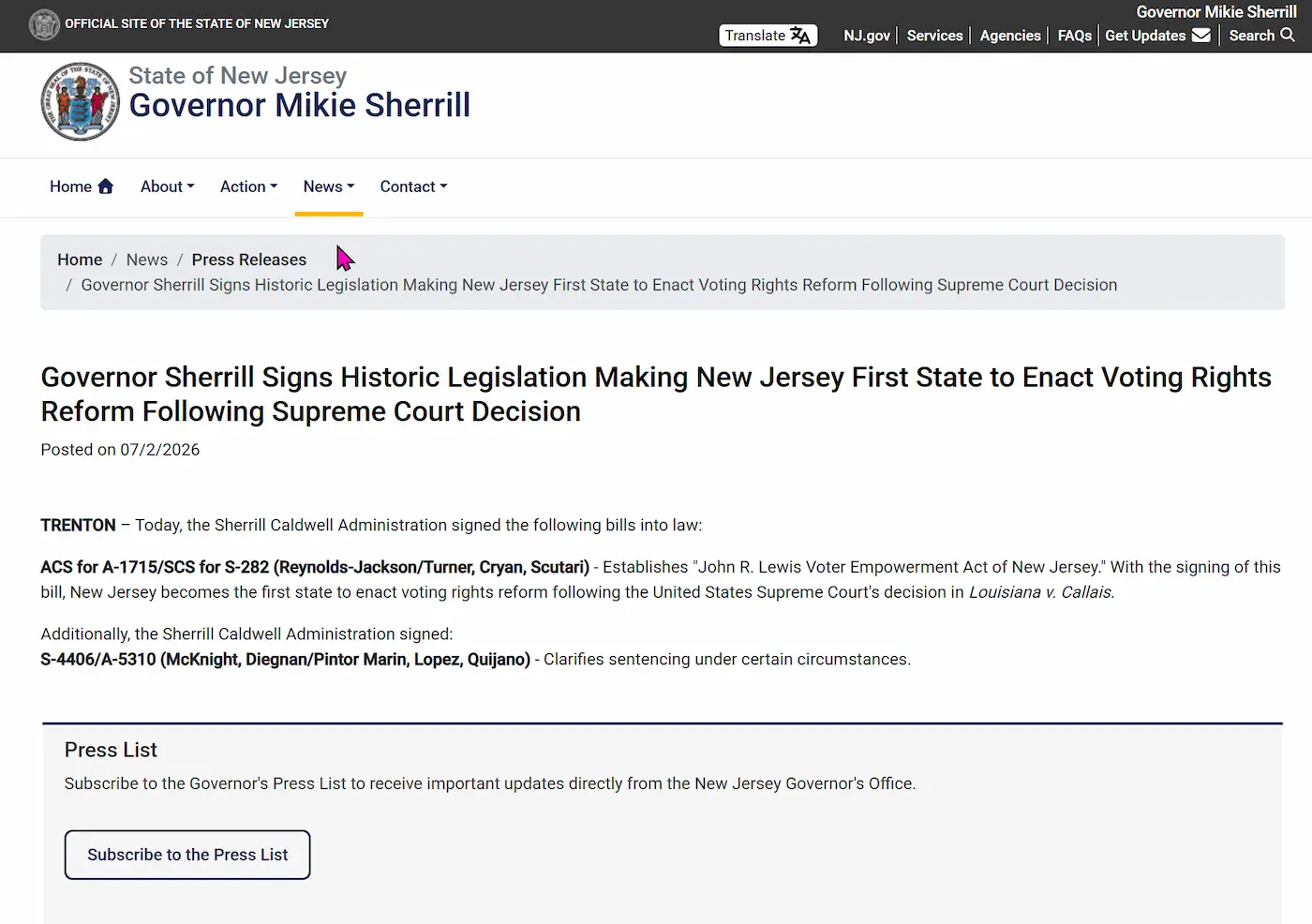
Next came New Jersey and Delaware. On July 2, 2026, Governor Mikie Sherrill signed the John R. Lewis Voter Empowerment Act of New Jersey (A-1715/S-282), and a press release from her office states that the state is “the first state to enact voting rights reform following the United States Supreme Court’s decision in Louisiana v. Callais”: the connection to the ruling is made by the governor’s office itself, not this media outlet.
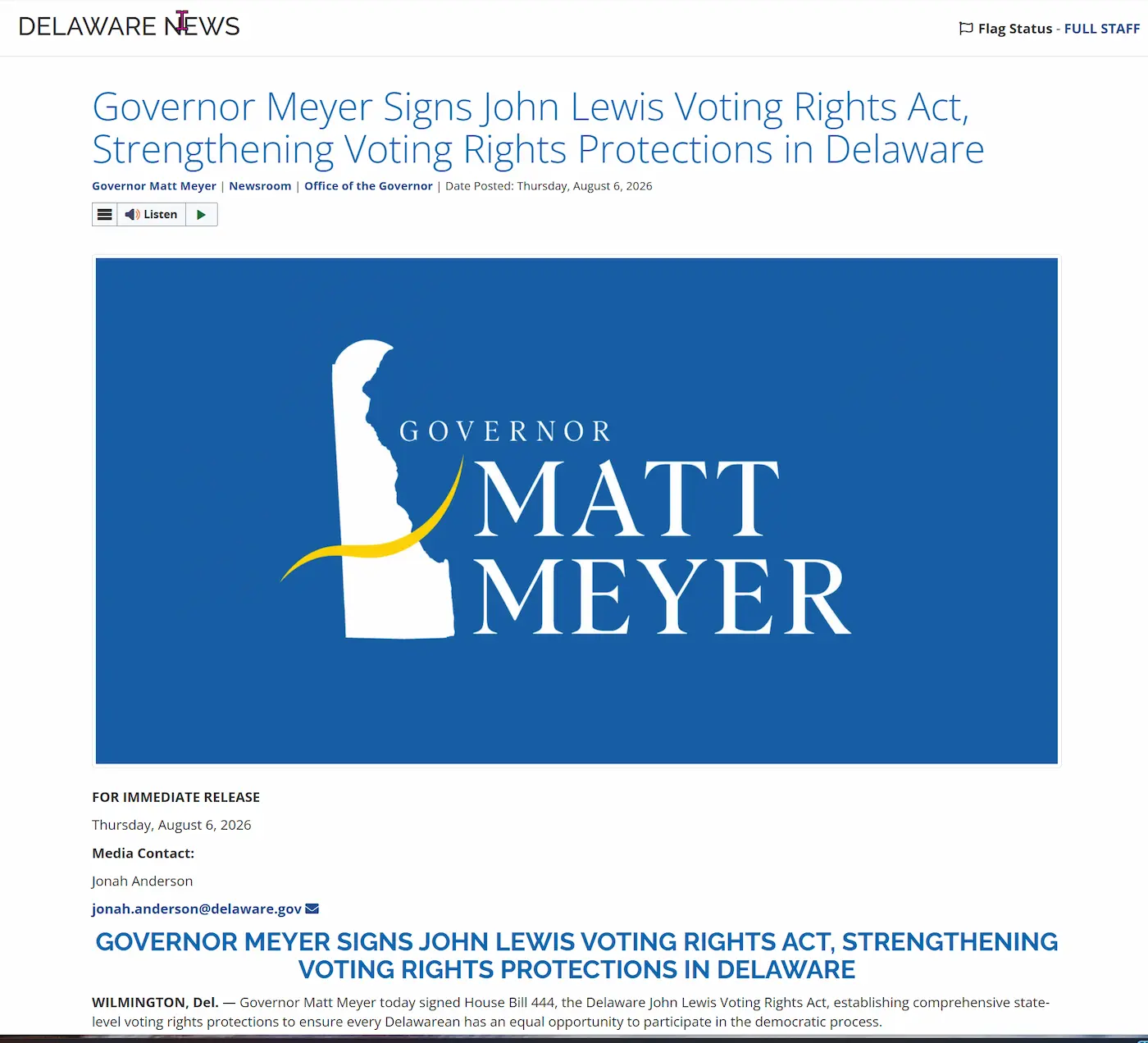
On August 6, 2026, Governor Matt Meyer signed HB 444, the Delaware John Lewis Voting Rights Act, into law, effective July 1, 2027, according to the official statement. This does not apply to Maryland: its law predates the ruling.
Documented cases of voting by non-citizens, and their verification
Senator Marsha Blackburn, a Republican from Tennessee, did not cite specific cases during the Senate plenary session: she said, in her own words, on page S1069 of the Senate Journal of Proceedings dated March 17, 2026, which this publication read online and reviewed page by page in its official PDF:
“When you look at states like California and New York, which are home to more than 3½ million illegal aliens combined, that’s what you see—making it easier to cheat, making it easier for noncitizens to vote.”
His words suggest that certain laws make it easier for non-citizens to vote, not that such voting is widespread today: that interpretation is not in the quote, and this publication does not attribute it to him. This publication searched, state by state, for documented cases of non-citizen voting. Four states have figures supported by a document filed in this case with their respective addresses: Michigan, Texas, Iowa, and New Jersey. These figures are listed below, each with its source; figures for no other states are provided because this publication has no documents on file containing them.
Michigan: 15 credible cases of non-citizens voting out of more than 5.7 million ballots cast in the 2024 general election, according to a press release from the state’s Department of State dated April 3, 2025, which describes these cases as “extremely rare” and states that 13 were referred to the attorney general’s office for possible charges, one person had died, and one case was still under investigation.
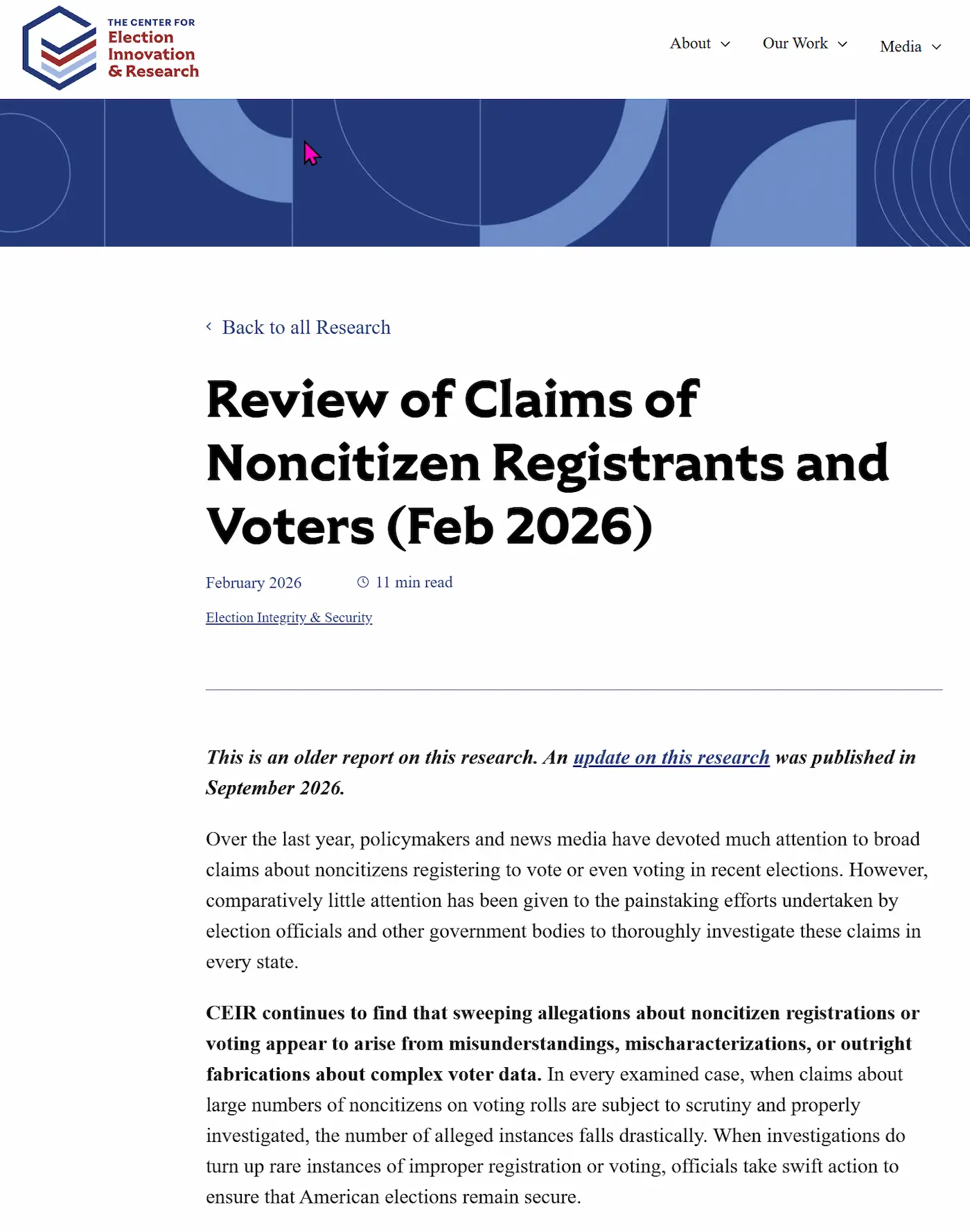
The same press release explains the figure of 16 used by the tracker from the Center for Election Innovation and Research (CEIR), a research center and not an official agency: It states, verbatim, that those 15 cases, “along with the single case identified in October 2024 of a Chinese national who allegedly voted illegally,” account for 0.00028 percent of the votes cast. In other words, 15 plus 1 equals CEIR’s 16. According to that same press release, none of the 16 cases resulted in a conviction: they are cases that have been referred, are alleged, or are under investigation.
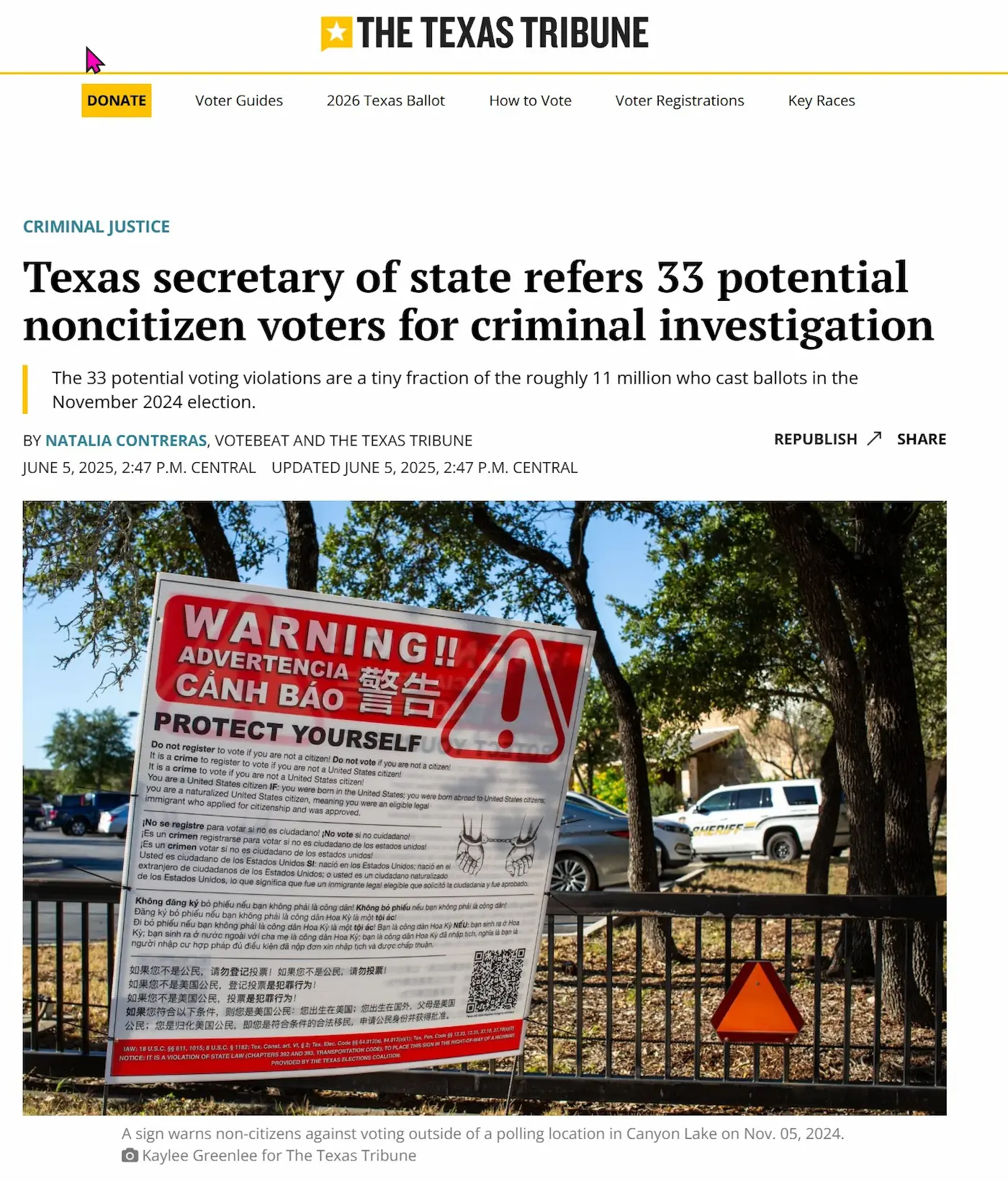
Texas: 33 names referred by the Secretary of State to the Attorney General’s Office in June 2025 for investigation, regarding approximately 11 million votes cast in November 2024, according to a Texas Tribune article dated June 5, 2025, filed by this publication; This is a referral for investigation, not a completed audit. The CEIR tracker adds a subsequent episode: in October 2025, Texas flagged 2,724 records through the federal SAVE system, and county reviews in December attributed “a large percentage” of them to confirmed citizens or to individuals registered in error by the agencies themselves.
Iowa, according to the CEIR tracker, filed on September 25, 2026: 2,176 records flagged in October 2024, which CEIR describes as approximately one-tenth of one percent of the active voter rolls; 277 confirmed non-citizens in March 2025; and 35 alleged non-citizen votes counted in the 2024 general election. This media outlet also archived, on September 26, 2026, the Iowa Secretary of State’s press release dated March 20, 2025. It confirms the 277 and the 35, and adds 5 ballots cast by non-citizens that were rejected.
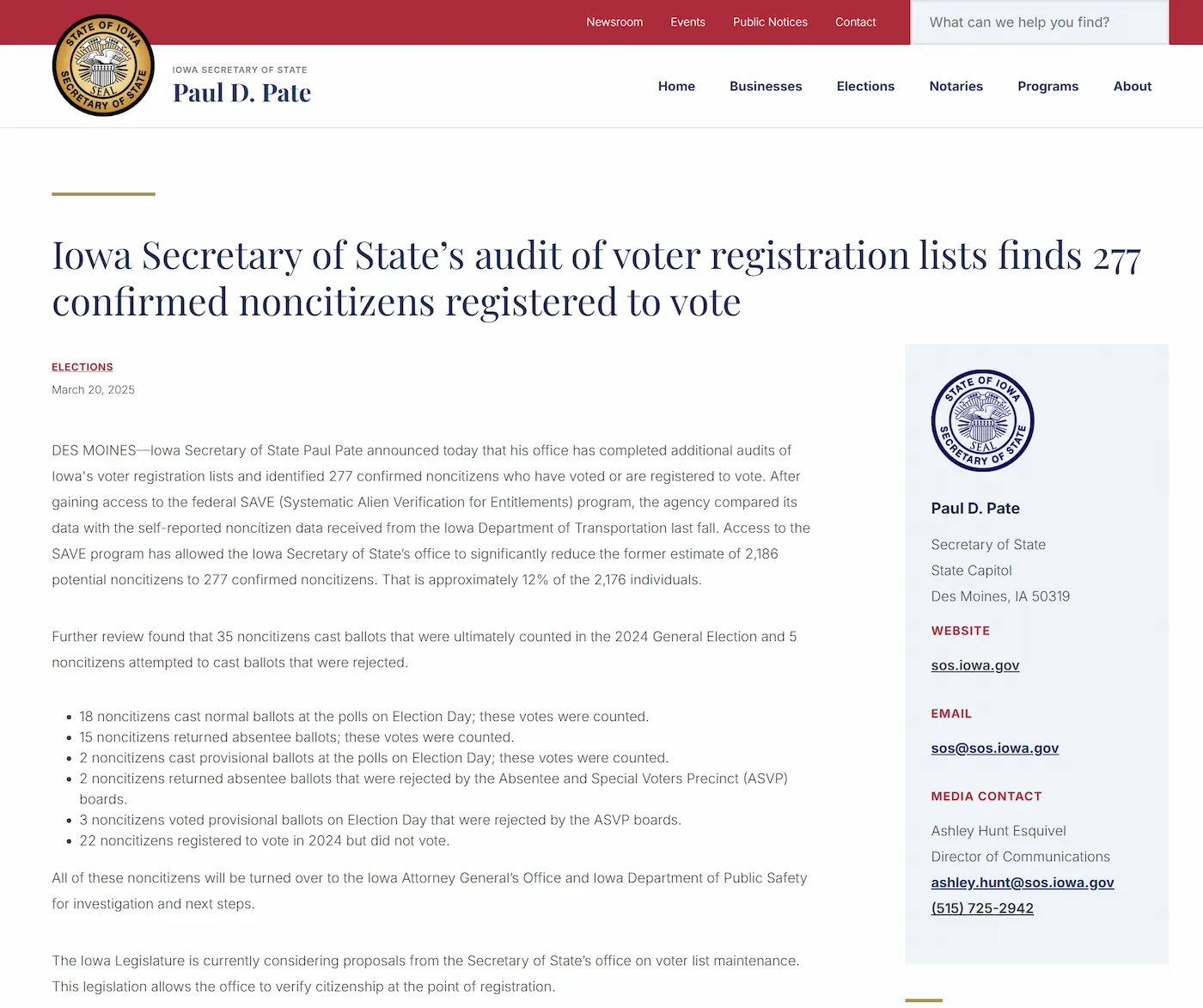
But that press release gives the initial figure twice, in two different ways, in consecutive sentences: “the former estimate of 2,186 potential noncitizens” and, immediately afterward, “approximately 12% of the 2,176 individuals. “ CEIR uses 2,176. The difference of ten individuals is not explained in the press release, and this publication does not choose between the two figures: it notes both.
New Jersey, the fourth case, confirmed today. Some 6,600 people who indicated on their applications to the New Jersey Motor Vehicle Commission (MVC) that they were not U.S. citizens were nonetheless registered to vote between June 2023 and June 2024 due to a glitch in the agency’s computer system, according to a July 21, 2026, statement from Governor Mikie Sherrill, which this media outlet downloaded and archived on the same day it verified it.
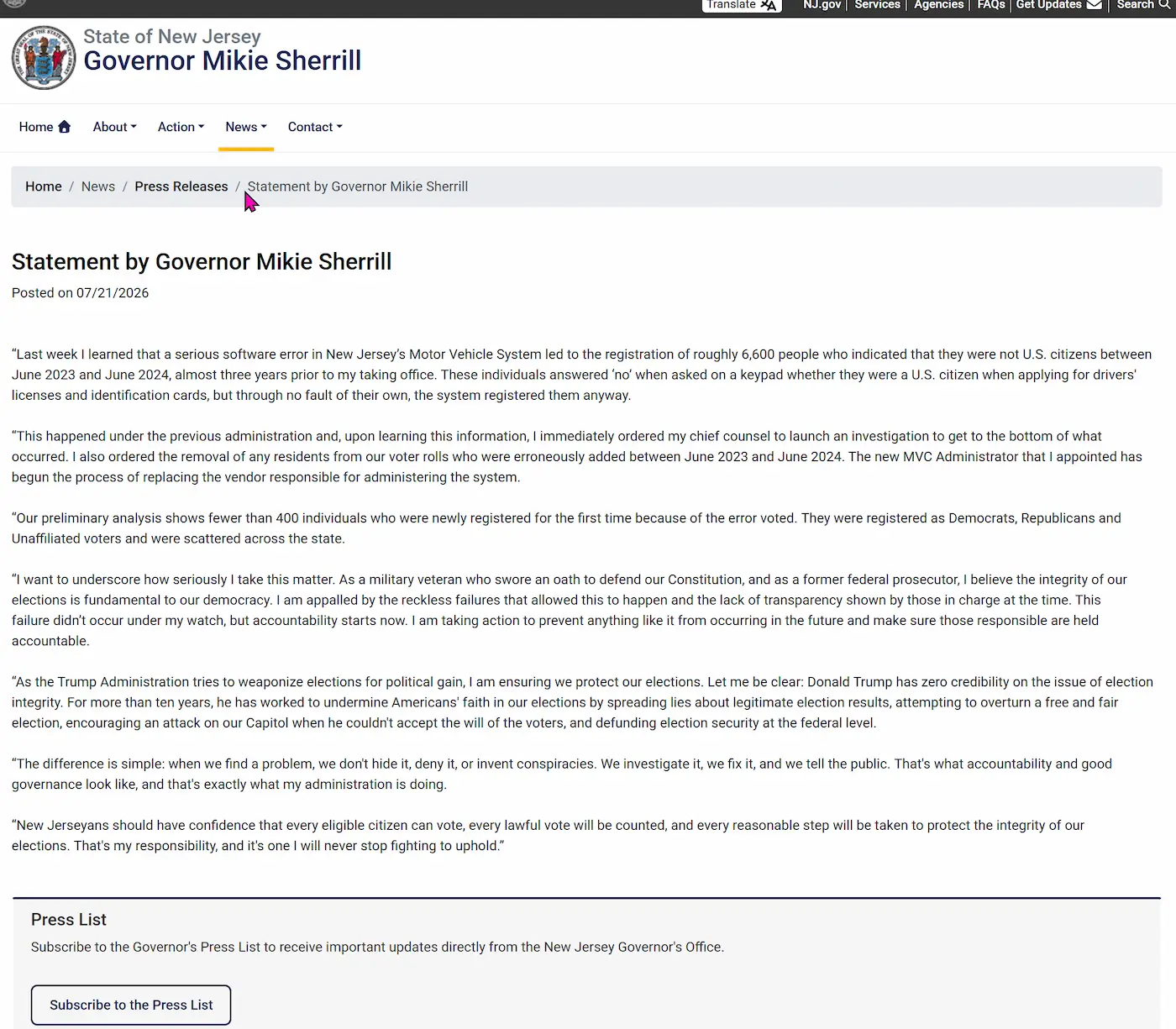
Direct quote from the statement itself: “Roughly 6,600 people who indicated that they were not U.S. citizens” remained on the voter rolls. The ruling originated under the previous administration, that of Governor Phil Murphy; Sherrill said he had learned of it the week before the announcement.
Of the total, according to the press release itself, “fewer than 400 individuals” voted. The official statement does not name any software provider. The press (NBC News, by Dareh Gregorian and Jane C. Timm, July 21, 2026) identified Idemia as the company that, according to Sherrill, would be replaced; this outlet does not present that identification as an official fact, because the governor’s press release does not include it, and it expressly attributes it here to that secondary news source.
Idemia denies responsibility for the error. The August 11, 2026, statement from the House Judiciary Committee, cited below, reads, verbatim: “IDEMIA has refuted Governor Sherrill’s claims that the software error was the cause of the improper voter registrations, instead blaming the New Jersey state agencies.” NBC News also reports on the company’s own response regarding its role: it states that its function “is to transmit information through the motor vehicle system.” Here, the news outlet cites only these two versions from Idemia—one from the governor’s office and one from the company itself—presenting them as opposing positions.
There is a subsequent update, dated August 19, 2026, regarding these same records, with more detailed figures. This news outlet had previously attempted to access it on the New Jersey Monitor website, which returned a 403 error; however, the governor’s office itself published its official update, in Spanish, which this news outlet was able to access and save. It provides four figures from different categories that the press release itself does not add together: they should not be added together here either.
First, verbatim: “Approximately 5,100 registered voters have been removed from the system because they were erroneously entered into the system and had no other records or documentation certifying their eligibility to register to vote. “
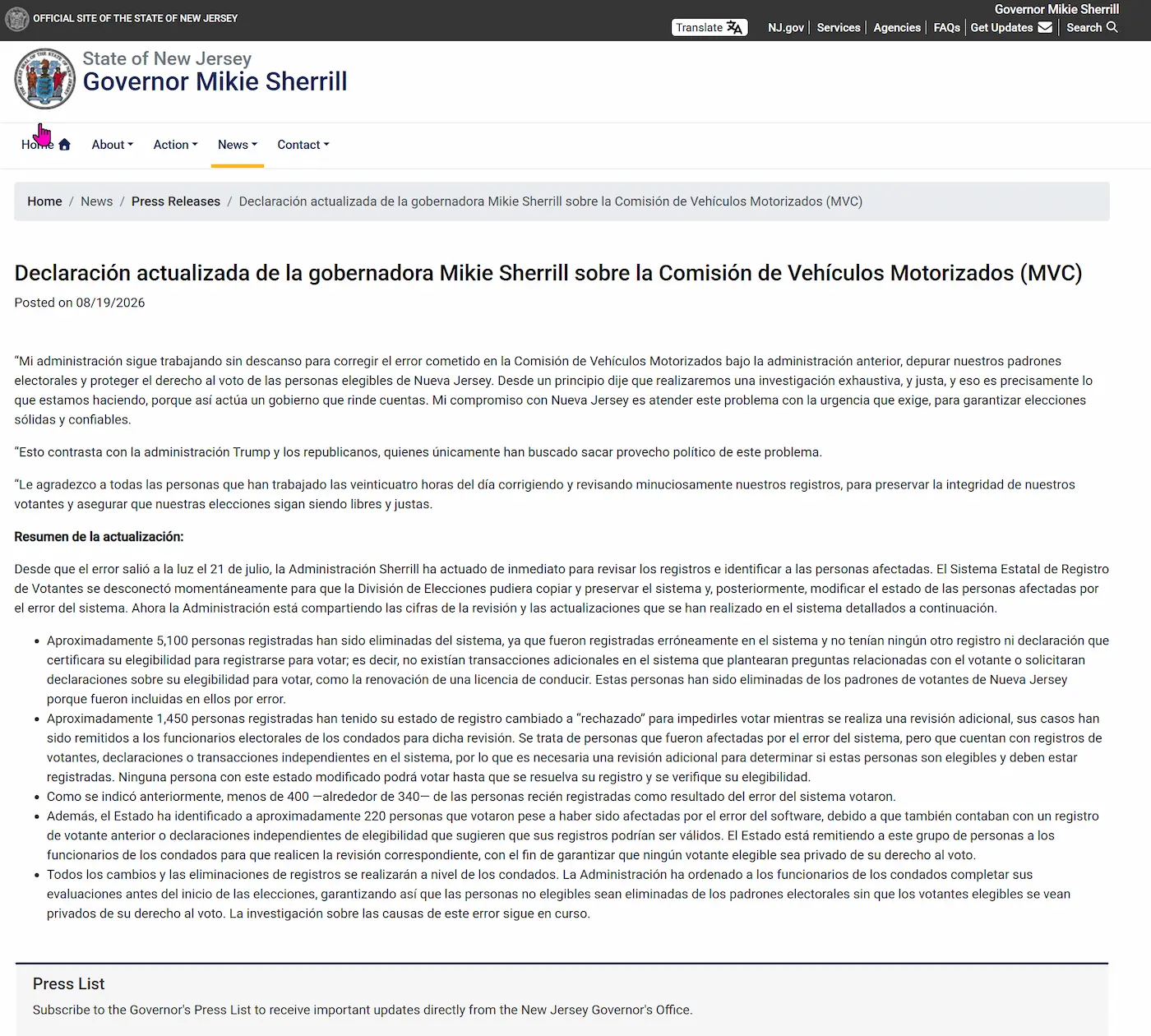
Second, a separate group of people whose cases have been under review for some time: “Approximately 1,450 registered voters have had their registration status changed to ‘rejected’ to prevent them from voting while a further review is conducted, “ and their cases have been referred to the counties; the statement clarifies that none of them may vote while that review is ongoing.
Third, how many of those newly registered due to the error actually voted: “Fewer than 400—about 340—of the people newly registered as a result of the system error voted.” And fourth, a separate group, which the statement expressly distinguishes from the previous one: “The state has identified approximately 220 people who voted despite being affected by the software error, because they also had a prior voter registration” or independent declarations of eligibility.
The statement does not call either of the two figures for the number of people who voted—neither 340 nor 220—fraud, nor does it mention convictions or court rulings: it describes removals from the voter rolls, changes in status, and referrals to the counties for review, and states that the investigation into the causes of the error is still ongoing. This publication does not add 340 and 220 together, because the statement describes two groups with different origins (one with no other record; the other with a prior record or declaration that could establish their eligibility), and adding them together would present as a single figure something that the source itself deliberately separates.
Statements and letters from lawmakers regarding the cases reviewed
This news outlet investigated which senators or representatives have cited these four states—Iowa, Michigan, Texas, and New Jersey—with actual documentary evidence, rather than a vague mention, starting with Florida’s lawmakers. It reviewed Senator Blackburn’s March 17, 2026, remarks, cited above, in their entirety: she does not name any of the four states by their specific figures. It also searched, outside of that debate, for press releases and statements from legislators of any party and state, and verified each finding against the legislator’s own source before attributing it to them—not against a press summary.
Florida, first: two representatives linked to the letters regarding New Jersey, and no verified statements from the Miami-Dade representatives. This media outlet found no representative from a Miami-Dade district—not Díaz-Balart, Giménez, or Salazar—citing any of the four cases with specific figures in any archived or located press release. Nor did this media outlet find, in the statements by Senators Rick Scott and Ashley Moody that it was able to access, any citation of the exact figures for Iowa, Michigan, Texas, or New Jersey.
Scott did cite a figure, but in a different episode and on a different date: in an opinion column in the Washington Examiner on September 10, 2024, he wrote, verbatim: “In the first two weeks of August, Texas, Alabama, and Virginia—all under Republican governors—released reports showing they had removed a combined 16,000 non-citizens from their states’ voter rolls.” He added that Texas Governor Greg Abbott said that up to 2,000 non-citizens may have voted in previous state elections.
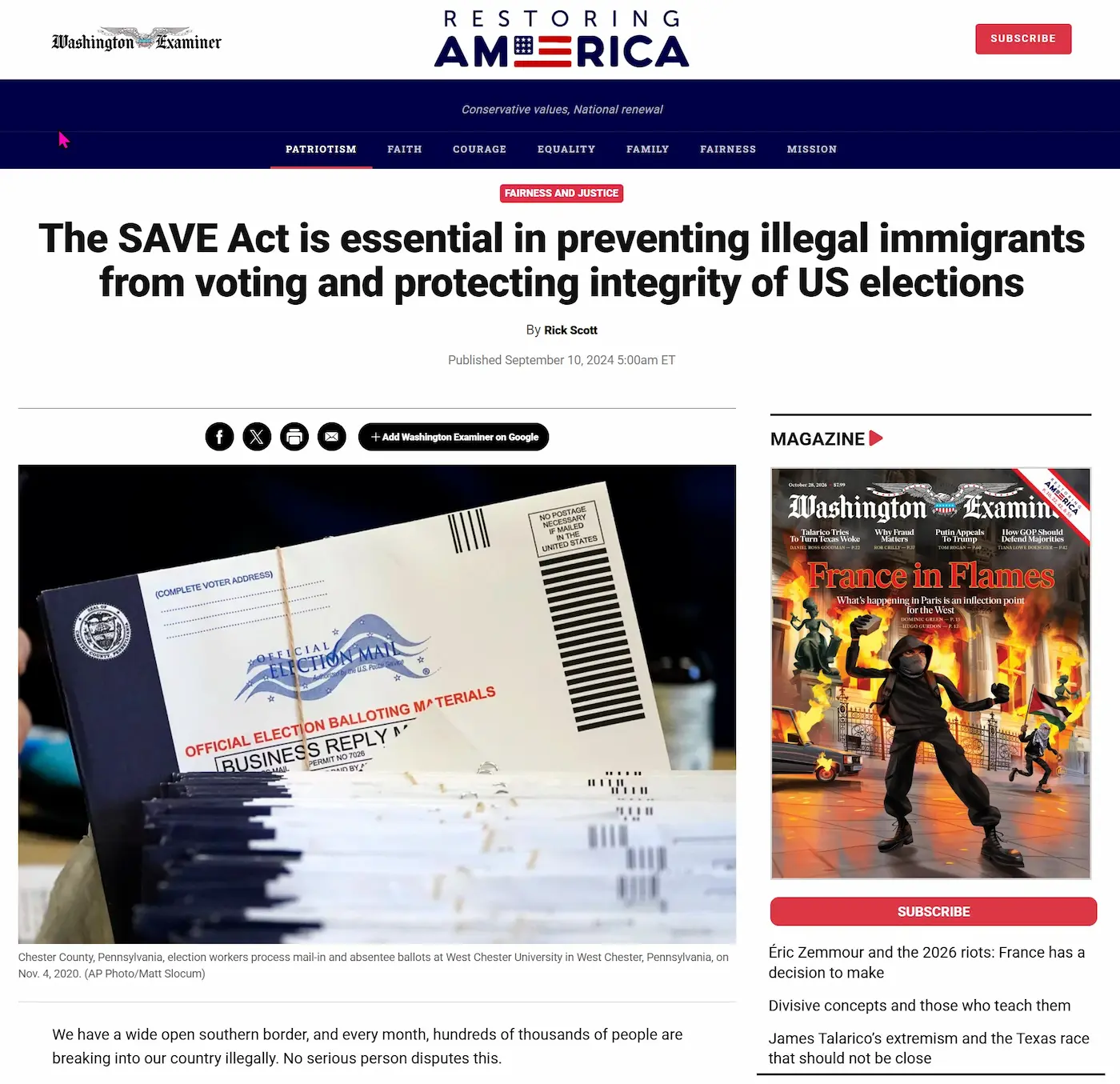
This news outlet verified the online column on September 28, 2026, against the Washington Examiner’s own website and against its reproduction on the senator’s official website, and filed it in the case file that same day. Neither of Scott’s two figures matches the Texas case already documented above (2,724 records via SAVE, October 2025): these are two separate incidents with different dates and figures, and Scott does not cite the second one.
There is, in fact, one Florida lawmaker linked to the New Jersey case, although she is not quoted directly: Representative Laurel Lee, a Republican from Florida’s 15th District—not a Miami-Dade district—and chair of the House Administration Committee’s Subcommittee on Elections.
According to the official press releases from those committees—dated August 3 and 11, 2026, cha.house.gov and judiciary.house.gov, on file with this publication—Lee, together with the chairman of the Administration Committee, Bryan Steil of Wisconsin, the chairman of the Judiciary Committee, Jim Jordan of Ohio, and New Jersey Representative Jeff Van Drew—sent separate letters requesting records from New Jersey and its software provider regarding the case of the 6,600 and approximately 400 votes, the figure provided in the statements themselves (“approximately 400”).
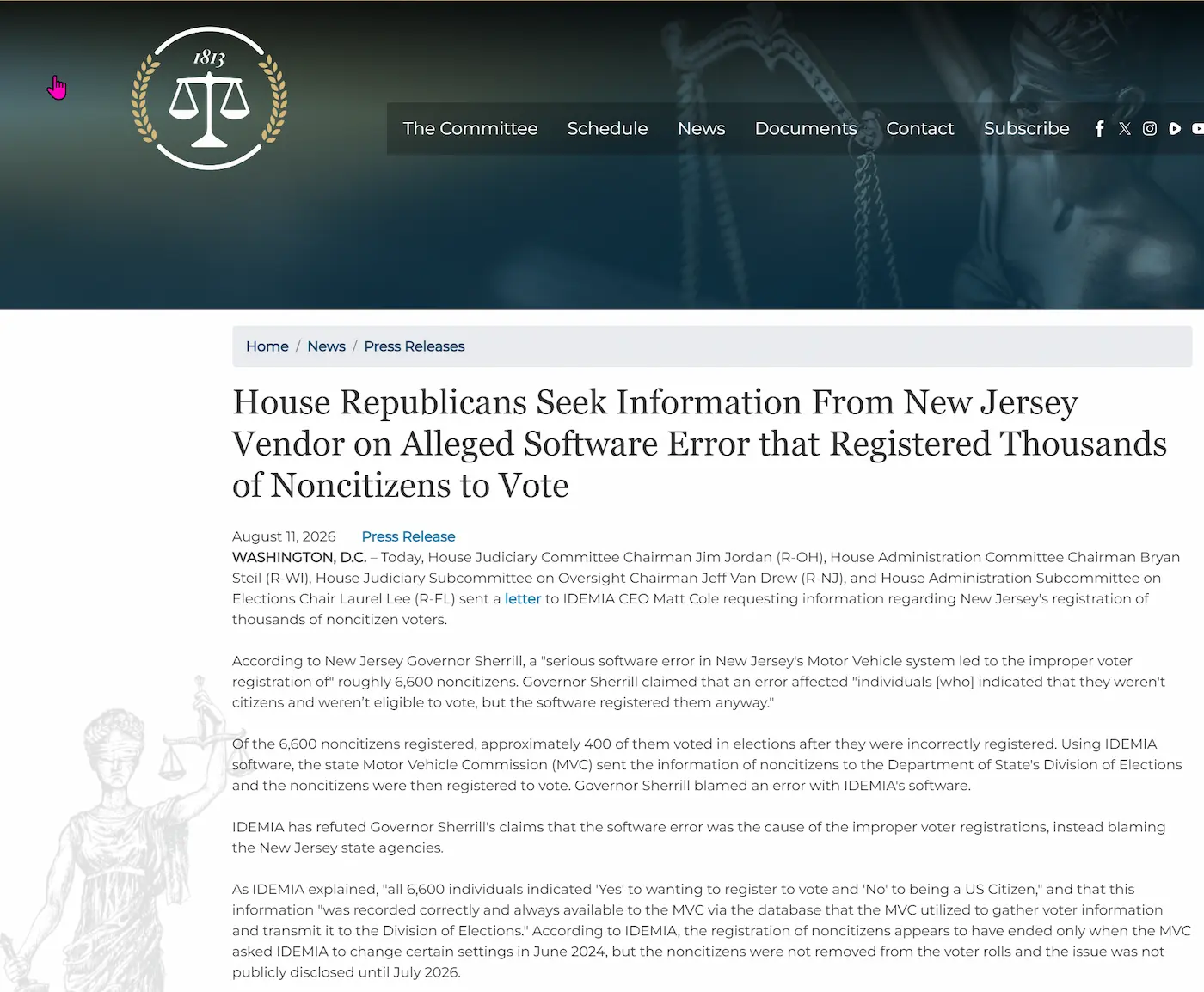
Of the two letters, this publication located, downloaded, and read the one dated August 3 in its entirety (the direct link from cha.house.gov has been down since at least October 5, 2026; local copy below), addressed to New Jersey Lieutenant Governor and Secretary of State Dale G. Caldwell: four pages, containing the exact same wording regarding the 6,600 and the “around 400” already cited in the press releases, and a request for documents and communications regarding compliance with the Help America Vote Act (HAVA), the National Voter Registration Act (NVRA), and the Civil Rights Act of 1960 (CRA), for the period beginning January 1, 2023, and thereafter.
The signatories, in closing: Bryan Steil, Chair of the House Administration Committee; Jim Jordan, Chair of the Judiciary Committee; Laurel Lee, Chair of the Elections Subcommittee; and Jeff Van Drew, Chair of the Oversight Subcommittee. This is a joint committee signature, not an individual statement in their own words, and the letter does not mention the SAVE America Act either.
Letter from Representatives Bryan Steil, Jim Jordan, Laurel Lee, and Jeff Van Drew to New Jersey Lieutenant Governor and Secretary of State Dale G. Caldwell regarding the case of the 6,600 records, August 3, 2026, 4 pages. Source 32.
The second letter, dated August 11, which is mentioned in the aforementioned press release from judiciary.house.gov, has yet to be found in PDF format: this publication has not read it and does not claim that it says the same thing as the first one, only what the press release announcing it states.
One lawmaker cited the case of his own state, providing figures and speaking in his own words: Senator Chuck Grassley, a Republican from Iowa. In his own statements archived on his official website, grassley.senate.gov, dated December 8, 2025, Grassley quotes verbatim, “277 people from Iowa’s 2024 voter registration list were noncitizens,” and adds that Iowa’s own Secretary of State, Paul Pate, had previously requested confirmation of the status of “2,176 voters” identified by Iowa’s traffic and driver’s license records (“Driver Motor Vehicle records,” as quoted verbatim by Grassley), and that “35 unlawful ballots were actually tallied.”
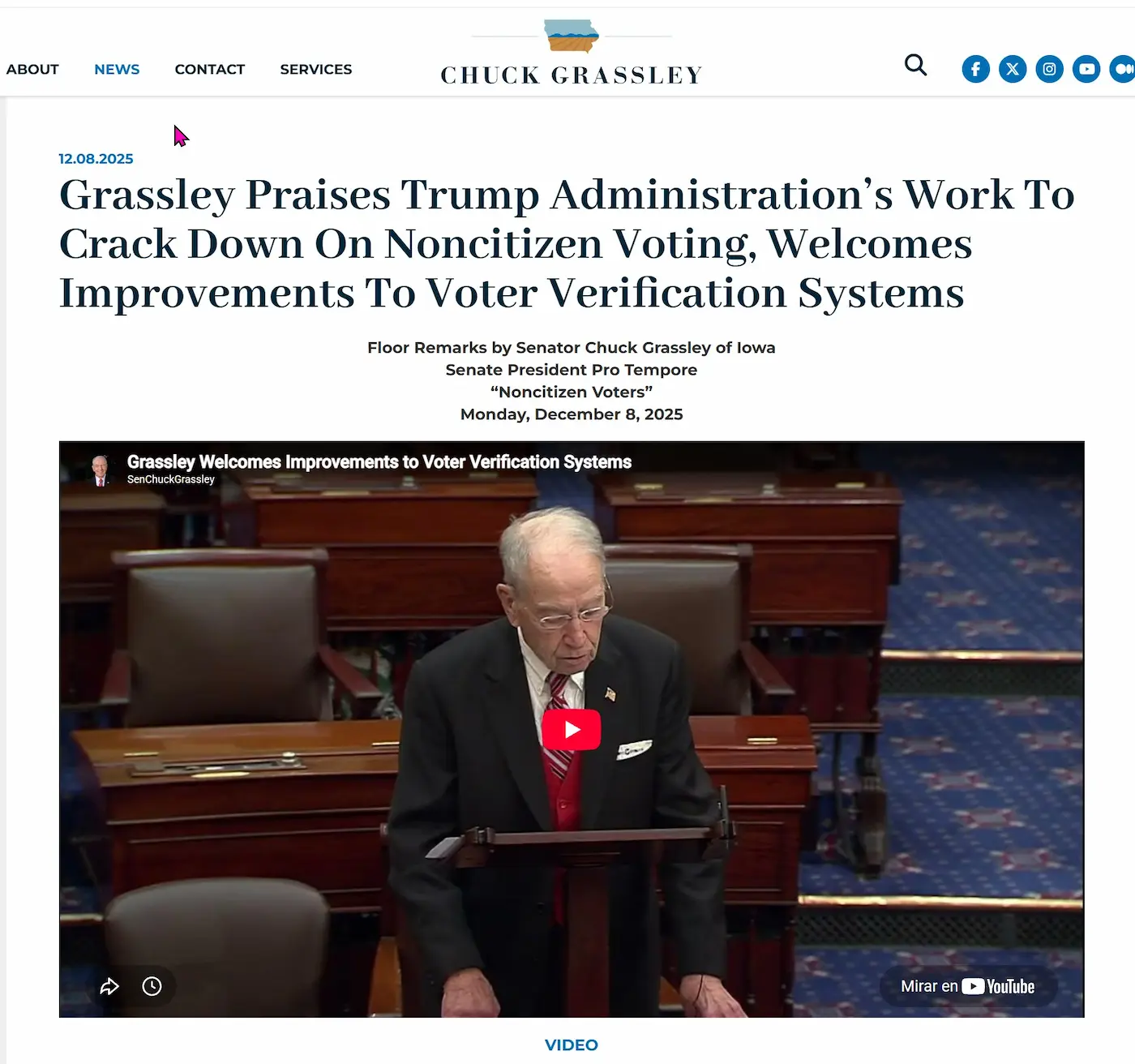
These three figures correspond to the Iowa case documented above. Those statements concern access to the federal SAVE system—the verification database, distinct from the SAVE America Act—and do not refer to S. 1383 or the SAVE America Act by their legislative names; Grassley does not mention Michigan, Texas, or New Jersey in them.
A second letter regarding the New Jersey case, this one containing individual statements. Apart from the committee letters cited above, there is a third document related to the same case: a letter dated July 24, 2026, led by Representative Jeff Van Drew of New Jersey on behalf of the Republican Study Committee (RSC)—a party committee, distinct from the official House committees that signed the letters to Caldwell and the software provider—addressed directly to Governor Sherrill.
The official RSC statement, which this media outlet downloaded and archived, lists 19 signatories or co-signatories, including Florida Representative Randy Fine of District 6—which is also not a Miami-Dade district—though the statement does not attribute any individual statement to him.
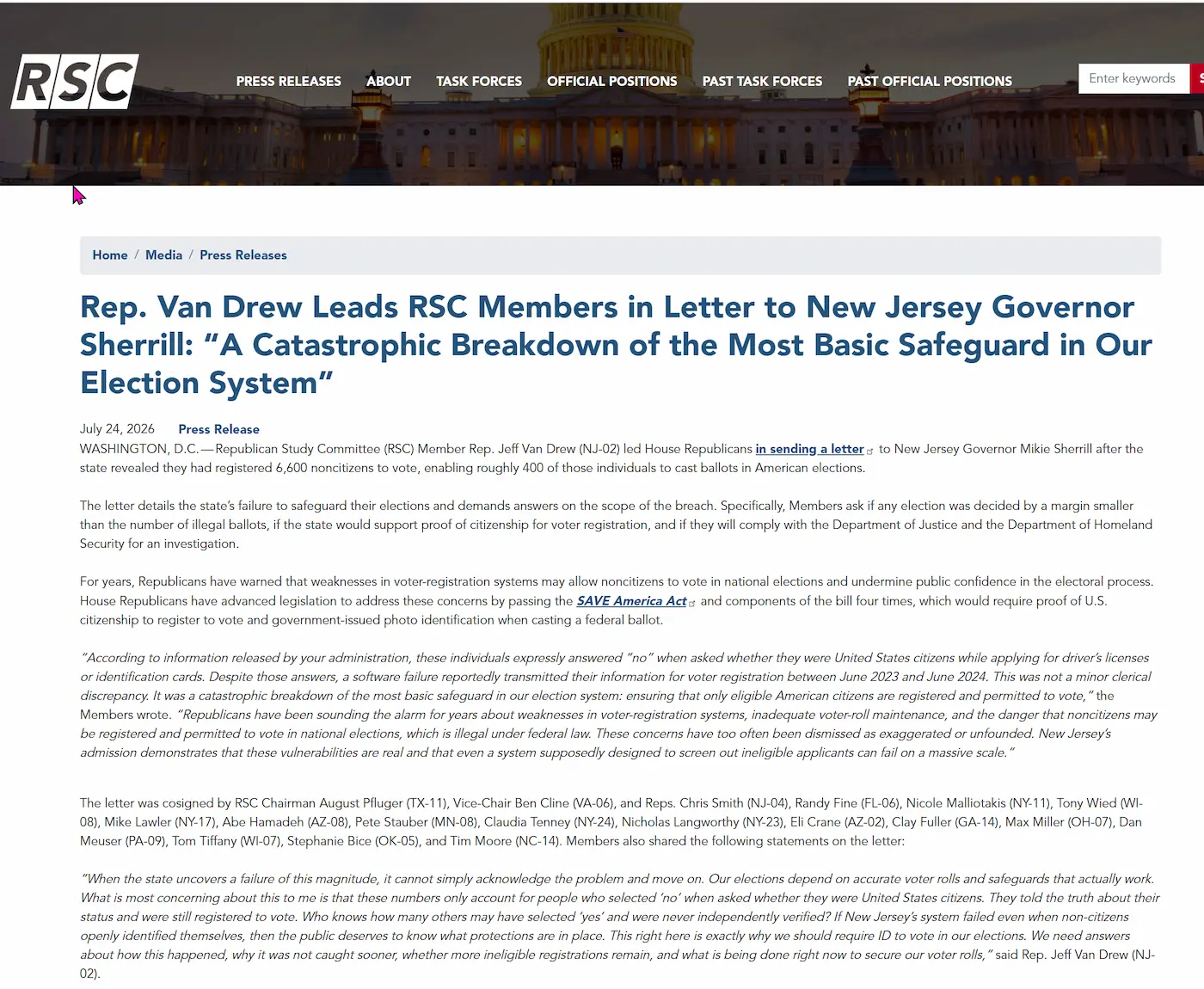
Two of those 19 do have their own individual statements in that same press release, in their own words and not just as signatories. Representative Nicole Malliotakis of New York, verbatim: “I join Rep. Jeff Van Drew and colleagues in requesting answers from New Jersey Governor Mikie Sherrill following a failure in her state’s voter-registration system that improperly added approximately 6,600 noncitizens to the voter rolls and enabled roughly 400 to cast ballots. It’s the latest example of why we need safeguards to ensure that only American citizens vote in American elections.” She cites the New Jersey case with its exact figures but does not mention the SAVE America Act.
Rep. Tim Moore of North Carolina has his own statement in that same press release dated July 24, as well as a second, more extensive statement in a separate RSC press release dated August 3, 2026, which this media outlet also downloaded and archived. That press release reproduces excerpts from a radio interview Moore gave to *The Wilkow Majority* on SiriusXM Patriot; the ellipses in the quote are omissions made by the RSC itself, not by this publication, and what has been archived is that partial transcript, not the audio.
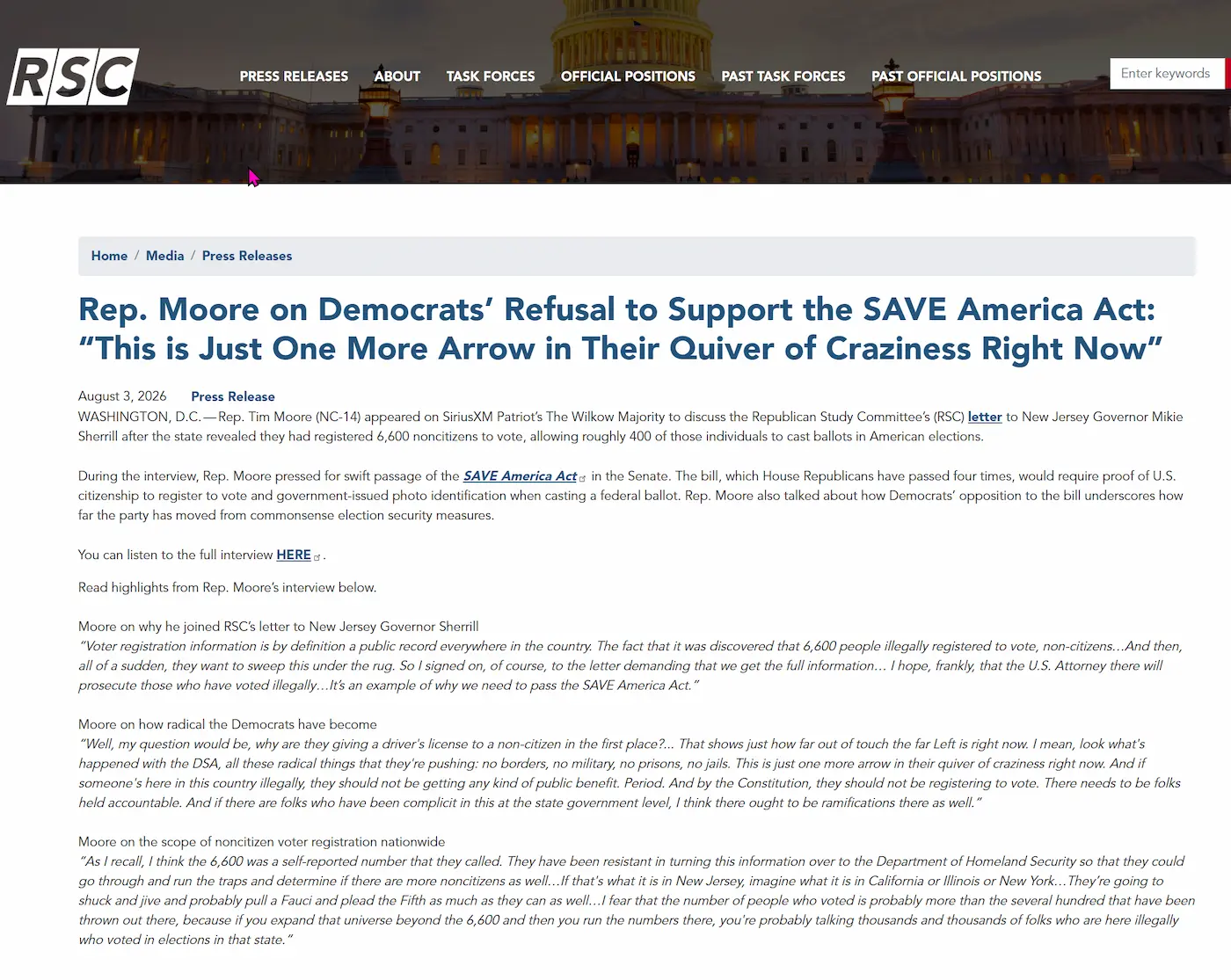
In that second statement, Moore is the only lawmaker this publication found who cited the New Jersey case with an exact figure and, in the same quote, referred to the SAVE America Act by its legislative name:
“Voter registration information is, by definition, a public record everywhere in the country. The fact that it was discovered that 6,600 people—non-citizens—registered to vote illegally… And then, all of a sudden, they want to sweep this under the rug. So I signed the letter, of course, demanding that we receive the full information… I hope, frankly, that the U.S. Attorney there will prosecute those who voted illegally… It’s an example of why we need to pass the SAVE America Act.”
Statements and letters related to the cases reviewed—not a definitive account. This is what this publication found and was able to verify against each legislator’s own source; it is not an exhaustive account of everything that has been said in Congress: there may be additional statements, from these or other legislators, in press releases that this publication did not locate.
With that caveat in mind: Senator Grassley cited a case—that of his own state, Iowa—using the exact figure and in his own words, without mentioning the SAVE America Act. A representative from Florida, Laurel Lee, along with three other representatives from other states, signed a committee letter—read in full by this publication—that cites the case of New Jersey with its exact figure, without using her own words and without mentioning the SAVE America Act.
Another Florida representative, Randy Fine, co-signed a separate letter from a party committee without issuing his own individual statement. Two representatives from outside Florida, Malliotakis and Moore, did include their own individual statements citing the New Jersey case with exact figures; of the two, only Moore, in his second statement, also refers to the SAVE America Act by its legislative name in the same citation.
Blackburn, the only voice in favor of the bill quoted verbatim in the March 17 debate, did not cite any of the four cases by number: her remarks were made on March 17, 2026, months before the New Jersey case became public on July 21, so he could not have cited it, and this article does not state or imply otherwise at any point.
Beyond these findings, this news outlet was unable to verify that any other lawmaker—from Florida or any other state—has cited the Michigan or Texas cases—the only two for which there is no verified, by-name citation—with actual documentary evidence: It is not claimed that such a citation does not exist in some other, as-yet-unlocated statement; rather, this publication did not find it and cannot verify it at this time.
Where do non-citizen residents vote today in local elections, and what have the courts said?
There is one aspect of the issue that is rarely discussed alongside the others, and it answers a direct question: How can someone without citizenship legally vote in an election? The answer lies in the wording of specific local regulations. The official documents that follow were filed by this media outlet in the case file on September 26, 2026.
Takoma Park, Maryland, extended the right to vote in municipal elections to its non-citizen residents through Charter Amendment Resolution 1992-5A, passed in 1992, and the first election in which non-citizens voted took place in November 1993. This is stated in the proclamation issued by Mayor Talisha Searcy on November 8, 2023, commemorating the 30th anniversary: “the first Takoma Park election that included noncitizen voters took place 30 years ago, in November 1993.” The same proclamation states that several small jurisdictions in Montgomery County had already allowed this earlier.
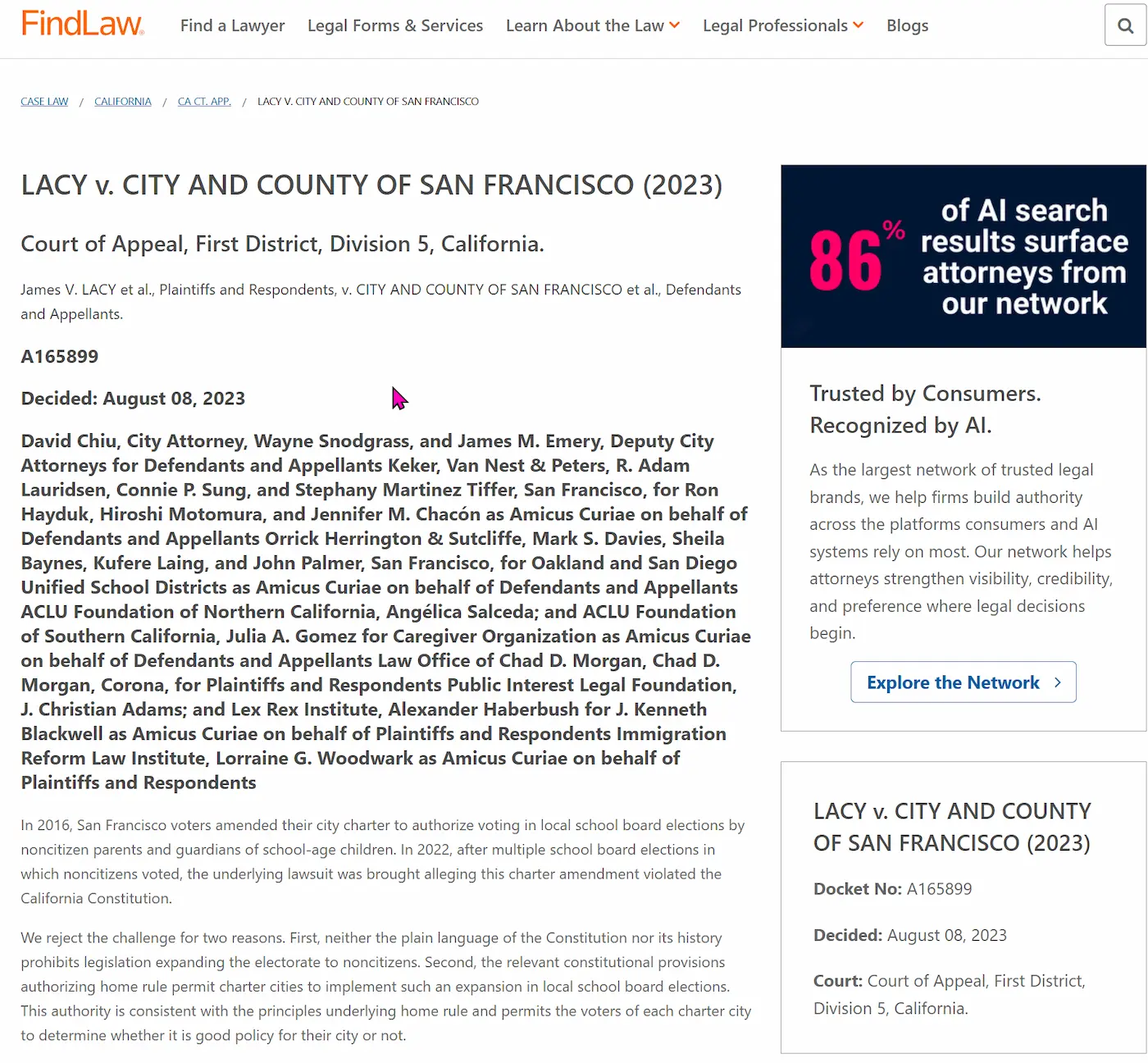
San Francisco’s Proposition N, approved by voters in 2016, amended the city charter to allow non-citizen residents who are parents or guardians of children under 19 living in the city to vote in school board elections; the Board of Supervisors implemented it by ordinance in 2018. This is described in the appellate ruling in Lacy v. City and County of San Francisco (California Court of Appeal, First District, Division 5, Case No. A165899, August 8, 2023), as available online in the copy hosted by FindLaw; the official copy has yet to be filed.
Regarding whether these programs distinguish between legal residents and undocumented immigrants: San Francisco’s official webpage on that ballot measure states that voters must be residents of the city, be the parent, guardian, or caregiver of a minor living in the city, be 18 years old on Election Day, and not be disqualified under state law. Immigration status is not among these requirements.
And on the same page, under the heading “IMPORTANT NOTICE FOR NON-UNITED STATES CITIZENS, “ the applicant is warned with these words—the four sentences of the notice, which was reopened on September 26, 2026:
“Any information you provide to the Department of Elections, including your name and address, may be obtained by Immigration and Customs Enforcement (ICE) and other agencies, organizations, and individuals. In addition, if you apply for naturalization, you will be asked whether you have ever registered or voted in a federal, state, or local election in the United States. You may wish to consult with an immigration attorney, an organization that protects immigrant rights, or another knowledgeable source before providing any personal information to the Department of Elections and before registering to vote in San Francisco Board of Education elections. You can find a list of nonprofit organizations that specialize in protecting the rights of immigrants on sfelections.org.”
Regarding Takoma Park, this publication has not read the text of the 1992 resolution and does not state what it says about the status.
As for whether this is legal: San Francisco’s legal history is not straightforward, and the whole story must be told. James V. Lacy and other plaintiffs challenged the program, and in July 2022, the San Francisco Superior Court ruled in their favor and declared the ordinance “void and unenforceable, ” as stated in the appellate court’s ruling itself; the press release from the San Francisco City Attorney dated August 8, 2023, dates that invalidation to July 2022. The date the lawsuit was filed is not recorded in either of the two sources and is not provided.
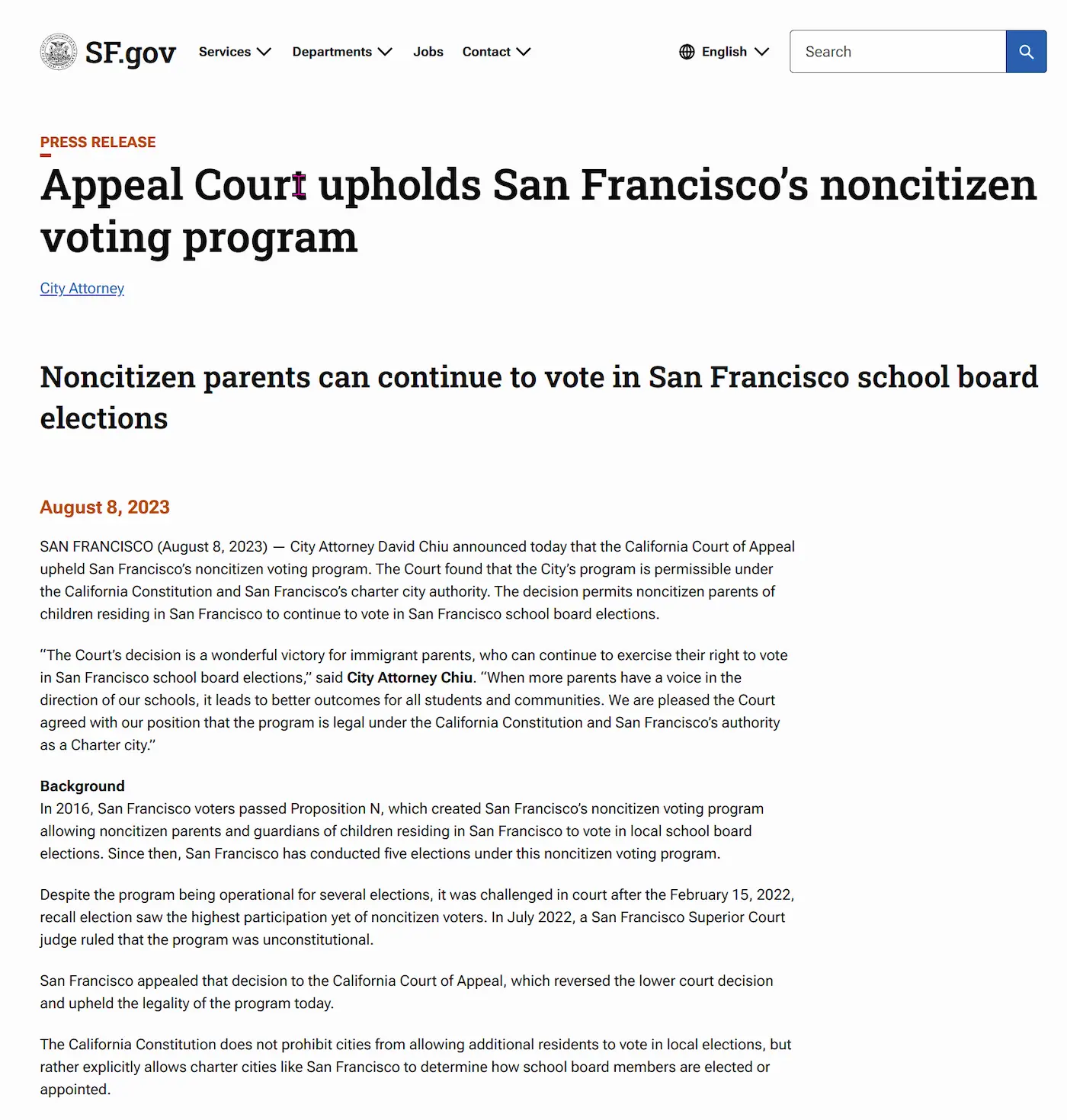
On August 8, 2023, the Court of Appeals reversed the decision: “The judgment is reversed and remanded to the trial court with directions to enter a new judgment in favor of the City, “ and held that the program is valid under the California Constitution and San Francisco’s authority as a charter city.
The name of the trial judge does not appear in the appellate ruling or in the press release, and is not provided here. In Maryland, this publication was unable to locate any ruling—either in favor of or against—the Takoma Park program: two searches conducted on September 26, 2026, turned up no litigation against Amendment 1992-5A, though this does not prove that none exists. Regarding the general legal basis for this municipal authority, this publication does not cite any federal constitutional provision as a basis: what is on record or cited is what Lacy ruled for California and the Takoma Park municipal charter for Maryland—and nothing else.
Why It Matters
It matters in Miami-Dade for an arithmetic reason backed by data. Florida ranks second in the country in naturalizations: 93,240 Florida residents became U.S. citizens in fiscal year 2024, accounting for 11 percent of the national total, second only to California (149,800), according to the annual report *U.S. Naturalizations: 2024* from the DHS Office of Homeland Security Statistics, which this publication accessed and archived on October 20, 2026; the complaint filed by Black Voters Matter (page 27, paragraph 100) cites that same figure from that same publication. How many of those individuals live in Miami-Dade is not stated in any document filed in this case, nor is it asserted.
They are citizens with the right to register and vote. How many of them are registered and how many vote is also not recorded in any document on file in this case: the DHS figure counts naturalizations, not registrations or votes, and on its own does not indicate whether the new requirements would change their participation. Neither the federal bill nor HB 991 would strip them of their citizenship; what would change is what they would have to prove—and when—in order to register or have their vote counted, and that is precisely the issue at the heart of the lawsuits.
Here is the specific question that this article cannot yet answer: How many registered voters in Miami-Dade were born outside the United States, and how many of them have a citizenship document on hand if the DHSMV cross-check does not verify their status? A lost naturalization certificate is replaced using USCIS Form N-565, for which the fee, according to the official G-1055 fee schedule (October 16, 2026 edition, page 31), is $555 for the paper application and $505 for the online application.
The lawsuits cite figures consistent with that table: UnidosUS reports more than $500 (page 58); Black Voters Matter reports up to $555 and an average processing time of 6.9 months, which it attributes to USCIS (page 26). This media outlet was unable to independently verify that processing time because the USCIS processing times page could not be accessed on October 20, 2026, and it remains an allegation by the party involved. It is not impossible. It involves money and time, and those can be measured.
And there is a local detail that ties directly into that question: Miami-Dade’s own Supervisor of Elections, Alina García, is one of the defendants—in her official capacity—in UnidosUS v. Byrd and Black Voters Matter Fund v. Byrd, the lawsuits challenging HB 991. Her office administers the county’s voter registration system; this publication did not verify whether its systems store, in a specific field, the country of birth of each registered voter, and makes no such claim.
It is also important for the second reason: as of today, the registration process has not yet changed. Anyone in Miami-Dade who says you already need to bring your passport to register is stating something that, as of today, is false: the registration provisions of HB 991 take effect on January 1, 2027, not before. Ten sections of the law are already in effect (seven since the bill was signed, three since July 1, 2026, as detailed above), but they pertain to candidate eligibility, the statute of limitations for election fraud, and the candidate’s declaration of citizenship: none of them directly affect the voter registration process.
Timeline
| Date | Who | Fact | Verification document or status |
|---|---|---|---|
| 1992 (verified, no date) | Takoma Park City Council, Maryland | Resolution Amending Charter 1992-5A: Extends the right to vote in municipal elections to non-citizen residents | verified, mayor’s proclamation dated November 8, 2023, PDF on file |
| Nov. 1993 (verified, no date) | City of Takoma Park | First municipal election with non-citizen voters | the same proclamation |
| Jan. 1, 2013 (verified) | State of Kansas | The Secure and Fair Elections Act Takes Effect, Requiring Documentary Proof of Citizenship | Verified, Fish v. Schwab on file, page 7 |
| June 17, 2013 (verified) | U.S. Supreme Court, Opinion by Justice Antonin Scalia | Arizona v. Inter-Tribal Council of Arizona, 570 U.S. 1: The NVRA requires that the federal registration form be accepted as is, 7 votes to 2 | Verified; full text of the ruling on file |
| June 25, 2013 (verified) | U.S. Supreme Court, Opinion by Chief Justice John Roberts | Shelby County v. Holder, 570 U.S. 529: The coverage formula for prior approval under the Voting Rights Act was ruled unconstitutional, 5 votes to 4 | Verified; full text of the ruling on file |
| Oct. 19, 2016 (verified) | Tenth Circuit Court of Appeals | Fish v. Kobach, 840 F.3d 710: Injunction Against Kansas’s Citizenship Verification Law Uphheld | Verified; full text of the ruling on file |
| Nov. 2016 (probable: the year is listed in the Lacy ruling and on sf.gov; the day has not been verified) | Voters in San Francisco | Proposition N Approved: Non-Citizen Parents and Guardians to Vote in School Board Elections | Verified; official sf.gov webpage on file; Lacy ruling on file (FindLaw copy, unofficial; official copy pending filing) |
| 2018 (verified, no date) | San Francisco Board of Supervisors | Ordinance Implementing Proposition N | Lacy ruling on file (FindLaw copy, unofficial) |
| June 18, 2018 (verified) | U.S. District Court, District of Kansas (judge’s name not verified against the district judgment, which has not been filed) | Issues a permanent injunction preventing the enforcement of Kansas’s citizenship requirement | date cited in Fish v. Schwab, page 9 (“Findings of Fact & Conclusions of Law, filed June 18, 2018”), and scope on page 6; district court judgment not filed |
| April 29, 2020 (verified) | Tenth Circuit Court of Appeals | Fish v. Schwab, 957 F.3d 1105: Upholds the ruling against the Kansas law; a two-judge panel constitutes a quorum | Verified; full text of the ruling on file |
| July 2022 (verified, no specific date) | San Francisco Superior Court (judge not named in publicly available sources) | Declares Ordinance No. N null and void | Verified; City Attorney’s statement on file; and appellate ruling on file (FindLaw copy, unofficial) |
| Aug. 8, 2023 (verified) | California Court of Appeal, First District, Division 5 | Lacy v. City and County of San Francisco, A165899: Overturns the annulment and declares the program valid | Verified; judgment on file (FindLaw copy, unofficial); official copy pending filing |
| Nov. 8, 2023 (verified) | Talisha Searcy, Mayor of Takoma Park | Proclamation Marking the 30th Anniversary of the Non-Citizen Vote | verified, PDF on file |
| March 5, 2025 (verified) | Rep. Terri Sewell (D-AL) | Introduces the John R. Lewis Voting Rights Advancement Act as H.R. 14 | Verified; draft text on file |
| March 20, 2025 (verified) | Paul Pate, Iowa Secretary of State | Press Release: 277 non-citizens confirmed on the voter rolls, 35 votes counted in 2024 | Verified; official statement on file; initial figure given in two forms (2,186 and 2,176) |
| April 3, 2025 (verified) | Michigan Department of State | Press Release: 15 credible cases of non-citizens voting out of 5.7 million ballots | verified, HTML in file |
| June 5, 2025 (verified) | Texas Secretary of State’s Office, according to the Texas Tribune | Refers 33 non-citizen voters to the attorney general’s office | Archived Texas Tribune article (Level 2) |
| July 29, 2025 (verified) | Sen. Dick Durbin and Sen. Raphael Warnock | The John R. Lewis Voting Rights Advancement Act Is Introduced in the Senate as S. 2523 | Verified; draft text on file |
| Dec. 8, 2025 (verified) | Sen. Chuck Grassley (R-IA) | Statements from the organization itself on its official website: it cites the case of Iowa with its own figures (277 confirmed non-citizens, 2,176 flagged, 35 ballots counted), regarding access to the federal SAVE system, without mentioning the SAVE America Act | verified, archived on September 28, 2026 |
| Feb. 25, 2026 (verified) | Florida House of Representatives | The House passed CS/CS/HB 991 on third reading, with 83 votes in favor, 31 against, and 3 abstentions; that same day, it rejected Amendment 818439, introduced by Representative Ashley Gantt (D-109), who voted against the bill | Verified, official roll call vote record of the Chamber (Source 14) and official history of the bill (Source 1), on file. |
| March 11, 2026 (verified) | Florida Senate | Amendment 305574 to HB 991 was rejected on second reading, with 12 in favor, 24 against, and 3 abstentions | Verified, official Senate roll call vote sheet (Source 14), on file. |
| March 12, 2026 (verified) | Florida Senate | CS/CS/HB 991 (1st Eng.) is approved on third reading, with 27 in favor and 12 against; no one abstained: “N Calatayud-38,” “Y Pizzo-37” | Verified, official Senate roll call vote sheet (Source 14), on file. |
| March 12, 2026 (verified) | Florida House of Representatives | The Senate version of HB 991 is approved, with 77 in favor, 28 against, and 12 abstentions; the Legislature passes the bill | Verified, official roll call vote record of the Chamber (Source 14), on file. |
| April 1, 2026 (verified) | Ron DeSantis, Governor of Florida | Sign HB 991, Chapter 2026-26 (state citizenship verification law, distinct from the federal SAVE America Act) | text of the law on file; date of signature and chapter number in the official record on flsenate.gov, filed in the case file |
| April 1, 2026 (verified) | UnidosUS and other plaintiffs | First lawsuit against HB 991, UnidosUS et al. v. Byrd, 1:26-cv-22257, Southern District of Florida, at 9:32 a.m. | Verified; full text on file; time as stated in the May 1, 2026, ruling, page 2 |
| April 1, 2026 (verified) | NAACP Florida State Conference and the Florida Alliance for Retired Americans | Second lawsuit, 4:26-cv-00147, Northern District of Florida, about two hours later | as noted in the court order dated May 1, 2026, pages 1 and 2, on file; brief not read |
| April 28, 2026 (verified) | Wes Moore, Governor of Maryland | Approves SB 255, the Voting Rights Act of 2026, Chapter 157 | verified, record from the Maryland General Assembly on file |
| April 29, 2026 (verified) | U.S. Supreme Court, Opinion by Justice Samuel Alito | Louisiana v. Callais, 608 U.S. ___: reinterprets Section 2 of the Voting Rights Act; does not rule on HB 991 or the SAVE America Act | verified; the heading and main body of the ruling were read, but not the entire ruling |
| May 1, 2026 (verified) | Judge Jacqueline Becerra, Southern District of Florida | Order (Document 61): Grants the NAACP’s motion to transfer the complaint to the Southern District and denies the motion for full consolidation without prejudice | Verified; complete transcript on file (copy from Democracy Docket) |
| May 20, 2026 (verified) | Judge Jacqueline Becerra, Southern District of Florida | Order (Document 64): Consolidates 26-cv-23135-JB (NAACP) with 26-cv-22257-JB (UnidosUS) for trial and scheduling; closes the NAACP’s case file | Verified; complete transcript on file (copy from Democracy Docket) |
| July 1, 2026 (verified) | State of Florida | Sections 25, 28, and 30 of HB 991 take effect | verified; text of the law on file, pages 60, 63, and 65 |
| July 2, 2026 (verified) | Mikie Sherrill, Governor of New Jersey | Sign the John R. Lewis Voter Empowerment Act of New Jersey (A-1715/S-282) | Verified; official statement from the governor’s office on file |
| July 10, 2026 (verified; entered into the record on July 13) | Judge Jacqueline Becerra, Southern District of Florida | Order (Document 88): Sets the trial date for the consolidated case for the two-week period beginning Monday, November 8, 2027 | Verified; complete petition on file (copy from Democracy Docket); signature on page 6; registration in the header |
| July 21, 2026 (verified) | Mikie Sherrill, Governor of New Jersey | Press Release: A system error at the Motor Vehicle Commission resulted in the registration of approximately 6,600 people who had indicated they were not citizens between June 2023 and June 2024; fewer than 400 voted | Verified; official statement from the governor’s office on file, downloaded and verified on September 28, 2026 |
| July 22, 2026 (verified) | UnidosUS and the other plaintiff organizations | Amended complaint (Document 89) against HB 991: adds five new claims under Sections 5, 6(a), 6(b), 7, and 8 of the NVRA and one regarding the ban on student identification | Verified; complete 98-page document on file (copy from Democracy Docket) |
| July 24, 2026 (verified) | Rep. Jeff Van Drew (R-NJ), on behalf of the Republican Study Committee, with 18 co-signers | Letter to Governor Sherrill regarding the New Jersey case; press release containing individual statements from several signatories, including Nicole Malliotakis (NY) and Tim Moore (NC), citing the case with the exact figure; Randy Fine (FL-06) co-signed without an individual statement | Verified; official statement from rsc-pfluger.house.gov, archived on September 28, 2026 |
| July 29, 2026 (verified) | Cord Byrd, Florida Secretary of State | Directive 2026-03 to Election Supervisors Regarding the Implementation of HB 991: Registration is not contingent upon documentary proof of citizenship; verification comes later, with a provisional ballot issued if citizenship cannot be verified, and a notice of removal from the voter rolls issued only if another source confirms that the voter is not a citizen | Verified, Directive 2026-03 (Source 2), 3-page PDF read in its entirety and embedded in the body of the text. |
| Aug. 3, 2026 (verified) | Rep. Bryan Steil (R-WI), Rep. Jim Jordan (R-OH), Rep. Laurel Lee (R-FL), and Rep. Jeff Van Drew (R-NJ) | House Administration Committee and Judiciary Committee Request Records from New Jersey Regarding the Case of the 6,600 Records; Four-Page Joint Letter Addressed to Secretary of State Dale Caldwell, with No Individual Citation or Mention of the SAVE America Act | Verified: the original letter in PDF format was read in its entirety, and the official statement from cha.house.gov was reviewed; both were archived on September 28, 2026 |
| Aug. 3, 2026 (verified) | Rep. Tim Moore (R-NC) | Second press release from the Republican Study Committee, containing a more extensive statement; the only lawmaker identified by this publication who cites the New Jersey case with an exact figure and mentions the SAVE America Act in the same quote | Verified; official statement from rsc-pfluger.house.gov, archived on September 28, 2026 |
| Aug. 6, 2026 (verified) | Matt Meyer, Governor of Delaware | Sign HB 444, the Delaware John Lewis Voting Rights Act | Verified; official statement from the governor’s office on file |
| Aug. 11, 2026 (verified) | Rep. Jim Jordan (R-OH), Rep. Bryan Steil (R-WI), Rep. Jeff Van Drew (R-NJ), and Rep. Laurel Lee (R-FL) | House Judiciary Committee Requests Information from New Jersey Software Provider Regarding the Same Case | Verified; official statement from judiciary.house.gov archived on September 28, 2026 |
| Aug. 19, 2026 (verified) | Mikie Sherrill, Governor of New Jersey | Official update on the case: approximately 5,100 records deleted, approximately 1,450 with their status changed to “rejected” during review, approximately 340 people newly registered due to the error who voted, and approximately 220 additional people who voted using a prior registration or independent declaration of eligibility; four categories that the statement itself does not add up to | Verified; official statement in Spanish from the governor’s office (nj.gov) archived on September 28, 2026; a previous attempt to apply this same update to the New Jersey Monitor resulted in a 403 error and was not used |
| September 1, 2026 (verified) | Black Voters Matter Fund and LULAC | Third lawsuit against HB 991, Black Voters Matter Fund et al. v. Byrd, 1:26-cv-26047, Miami Division; six claims, five under the NVRA and one under the Fourteenth Amendment; filed by Jennifer Thelusma (SPLC) | Verified, 43-page document on file (copy from the SPLC); pages 27, 42, and 43 viewed as images |
| September 16, 2026 (verified) | State of Florida (Secretary Byrd and co-defendants) | Reply in support of his motion to dismiss (Document 134): He argues that the dispute concerns when—not whether—citizenship can be verified, and that most applicants are registered without documentary proof based on cross-checks with the DHSMV and the SAVE system. | Verified; complete 12-page brief on file (copy from Democracy Docket); the State’s argument, not a ruling by any court |
| September 28, 2026 (verified) | Judge Jacqueline Becerra, Southern District of Florida | Order consolidating Black Voters Matter Fund v. Byrd, 1:26-cv-26047, into 1:26-cv-22257-JB and dismissing the former | Verified in the record of Case No. 26047 on CourtListener (Entry 28, “ORDER CONSOLIDATING CASES Closing Case”; “Date Terminated: Sept. 28, 2026”), filed on October 20, 2026; the order itself has not been read. |
| Oct. 2, 2026 (verified) | Cord Byrd, Florida Secretary of State | Motion to dismiss the complaint filed by Black Voters Matter (Document 146) and notice of supplemental authority (Document 147) citing the Supreme Court’s stay order in DHS v. League of Women Voters, No. 26A308, dated September 25, 2026 | Verified: Document 146 (22 pages; the first three pages were read) and Document 147 (3 pages; read in its entirety); RECAP copies filed on October 20, 2026. |
| Oct. 7, 2026 (verified) | UnidosUS and the other plaintiff organizations | Response to the notice of supplementary authority (Document 152): The DHS v. League of Women Voters order “has no bearing” on the motions to dismiss | Verified, Document 152 (3 pages; the first page has been read), RECAP copy filed on October 20, 2026. |
| Oct. 16, 2026 (verified) | Black Voters Matter Fund and LULAC | Objection to the motion to dismiss (Document 156); the State’s reply, due by October 23, 2026 | Verified: Document 156 (27 pages; the cover page and table of contents were read) and registry entry (“Replies due by 10/23/2026”), filed on October 20, 2026. |
| Oct. 19, 2026 (verified) | NAACP Florida State Conference and the Florida Alliance for Retired Americans | Notice of Related Action (Document 157): Notifies of the new lawsuit , Florida State Conference of Branches and Youth Units of the NAACP v. Byrd, 1:26-cv-27307, regarding the student identification provision of HB 991 | Verified, document 157 (3 pages, read in full), RECAP copy filed on October 20, 2026; file 27307 has not been opened. |
| Jan. 1, 2027 (verified) | State of Florida | The registration provisions of HB 991 take effect | Verified; text of the law on file, page 72 |
| July 1, 2027 (verified) | State of Florida | State-issued licenses and identification cards for citizens must include their citizenship status printed on them | Verified; text of the law on file, page 64 |
The question this article leaves open
How many registered voters in Miami-Dade will not be able to be verified as citizens through the DHSMV cross-check starting January 1, 2027, and will have to provide a document—a passport or a naturalization certificate that costs up to $555 to replace—in order for their vote to count on a regular ballot? Neither the state nor the plaintiffs have provided that figure in any document this publication has reviewed, and the office that would have it—the Supervisor of Elections’ office—is one of the defendants.
Frequently Asked Questions
What is Florida’s SAVE Act, HB 991?
This is Florida’s election law, signed on April 1, 2026, as Chapter 2026-26. Starting January 1, 2027, the system will cross-check the information of anyone who registers with that of the DHSMV to verify their citizenship.
The issue at hand is what happens if that verification fails: According to the Secretary of State’s interpretation in Directive 2026-03—which the plaintiffs dispute—registration proceeds as usual, and the document is only required afterward to vote using a standard ballot; the plaintiffs argue that the law makes registration contingent on that verification. Its provisions on registration are not yet in effect; the law faces three consolidated federal lawsuits and a fourth that has been served, and no court has yet ruled on the two differing interpretations.
Do you already need a passport to register to vote in Florida?
No. The registration provisions of HB 991 take effect on January 1, 2027, not before. Ten sections of the law are already in effect today—seven since the bill was signed and three as of July 1, 2026—but they pertain to candidate eligibility, the statute of limitations for election fraud, foreign contributions, and candidates’ citizenship declarations: none of them address the voter registration process. Anyone in Miami-Dade who says you already need to bring your passport to register is stating something that, as of today, is false.
Who is suing over HB 991, and what are their claims?
UnidosUS, the Florida League of Women Voters, Florida Rising Together, the Hispanic Federation, the Florida Immigrant Coalition, and Common Cause—represented by the ACLU—as of April 1, 2026; the NAACP Florida State Conference and the Florida Alliance for Retired Americans, on the same day; and the Black Voters Matter Fund and LULAC, effective September 1. The three are consolidated under a single case number, and the NAACP filed a fourth complaint on October 19. They allege violations of the National Voter Registration Act and the First and Fourteenth Amendments, as well as a disproportionate burden on naturalized citizens, elderly Black voters, women who have changed their last names, and low-income individuals. The state is seeking dismissal.
How many documented cases of non-citizens voting are there?
This report does not provide a national figure, because no such figure exists in any document on file for this case. It verified cases in Iowa, Michigan, Texas, and New Jersey, with the source identified in the body of the text for each—an official in Iowa, Michigan, and New Jersey; a press release and data from a research center in Texas—and without adding them together, because each state measures something different: flagged records, referrals for investigation, or suspected votes. None of these figures represents a tally of convictions.
What forms of identification will be accepted for in-person voting starting in 2027?
According to Section 13 of the law, effective January 1, 2027: a Florida driver’s license; a DHSMV state ID; a U.S. passport or passport card; identification issued by uniformed services or the Merchant Marine; a veteran’s health card; a concealed carry permit; and any other identification issued by a federal, state, county, or municipal entity, except for those issued by educational institutions. Debit and credit cards, as well as student IDs, retirement center IDs, neighborhood association IDs, and public assistance IDs, will no longer be valid.
What is the difference between HB 991 and the federal SAVE America Act?
HB 991 is a state law: it applies only in Florida, has been enacted, and the provision regarding voter registration takes effect on January 1, 2027. The SAVE America Act is a federal bill that, if passed, would apply nationwide for federal elections; however, until it completes the legislative process in Congress and receives the president’s signature, it has no legal force in any state; as of October 26, 2026, it has not yet become law (this session sought a final Senate vote after the one held on March 24, 2026, and found none). Neither of these depends on the other, and the lawsuits against HB 991 do not affect the federal legislative process.
Sources consulted
Level 1, officers
- Florida Legislature. CS/CS/HB 991 (2026), Elections, adopted text, 72 pages, all 72 pages read, archived PDF ( Download PDF). Official bill history, including the date of signature (April 1, 2026) and Chapter 2026-26, filed in the case record ( View history).
- Florida Secretary of State Cord Byrd. Directive 2026-03 – Implementation of HB 991 Citizenship Verification, memorandum to election supervisors, July 29, 2026, 3 pages, 3 pages long. Archived PDF. Download PDF
- U.S. District Court, Southern District of Florida. UnidosUS et al. v. Byrd, 1:26-cv-22257, complaint dated April 1, 2026. Archived PDF, originally hosted by the ACLU, one of the law firms representing the plaintiffs. Download PDF
- U.S. District Court, Southern District of Florida, Judge Jacqueline Becerra. Order dated May 1, 2026 (Document 61 of Case No. 1:26-cv-22257) granting the transfer of Florida State Conference of Branches and Youth Units of the NAACP et al. v. Byrd, 4:26-cv-00147 (Northern District), and denies full consolidation without prejudice, 8 pages ( Read Order); and order dated May 20, 2026 (Document 64) consolidating 26-cv-23135-JB into 26-cv-22257-JB for trial and scheduling purposes and dismissing the former, 2 pages ( Read order). Both are filed in the case docket, in the copies hosted by Democracy Docket, which is not the court’s website. The NAACP’s complaint has not been read.
- U.S. District Court, Southern District of Florida, Miami Division. Black Voters Matter Fund et al. v. Byrd, 1:26-cv-26047, complaint dated September 1, 2026, 43 pages, all 43 of which were read in the copy hosted by the Southern Poverty Law Center, one of the law firms representing the plaintiffs; pages 27, 42, and 43 viewed as images; filed in the case record. Download PDF
- U.S. District Court, Southern District of Florida. Record of Entries for the consolidated case United States v. Byrd, 1:26-cv-22257-JB, on CourtListener (a PACER mirror site, not the court’s website), pages 1 and 2, entries 1 through 157, filed on October 20, 2026; and record of the case Black Voters Matter Fund v. Byrd, 1:26-cv-26047 (entry 28, “ORDER CONSOLIDATING CASES Closing Case,” September 28, 2026; “Date Terminated: Sept. 28, 2026”). See consolidated case file, see case file 26047
- U.S. District Court, Southern District of Florida, Judge Jacqueline Becerra. Order signed on July 10, 2026, and entered into the record on July 13 (Document 88, Case No. 1:26-cv-22257-JB), setting the trial for the two-week period beginning November 8, 2027; 9 pages; read at 9 a.m. Filed on September 27, 2026, in the copy hosted by Democracy Docket, which is not the court’s website. Read the order
- U.S. District Court, Southern District of Florida. Amended complaint by UnidosUS and the other plaintiff organizations, filed on July 22, 2026 (Document 89, Case No. 1:26-cv-22257-JB), 98 pages, all 98 pages read. It adds five claims under the NVRA (sections 5, 6(a), 6(b), 7, and 8) and cites Arizona v. Inter Tribal Council of Arizona in paragraph 256 (page 85). Filed on September 27, 2026, in the copy hosted by Democracy Docket, which is not the court’s website. Read the amended complaint
- U.S. District Court, Southern District of Florida. State’s Reply in Support of Its Motion to Dismiss, filed on September 16, 2026 (Document 134, Case No. 1:26-cv-22257-JB/Torres), 12 pages, read at 12. Filed on September 27, 2026, in the copy hosted by Democracy Docket, which is not the court’s website. Read the reply
- Same case file, copies of RECAP documents, filed on October 20, 2026: 146, Byrd’s motion to dismiss the Black Voters Matter lawsuit, October 2, 22 pages, the first three pages read; 147, notice of supplemental state authority, October 2, 3 pages, read in full; 152, response from UnidosUS, October 7, 3 pages, the first page read; 156, opposition to that motion, October 16, 27 pages, cover page and table of contents read; 157, notice of related action, October 19, 3 pages, read in full. Read document 157
- Florida Senate. Executive Appointments Registry, Appointee Cord Byrd, 2023, Secretary of State: first appointment with a term beginning May 17, 2022, not considered by the Senate (“Failed to Confirm—Not Considered,” May 5, 2023); reappointment effective January 3, 2023, confirmed on April 26, 2023. No party affiliation listed. HTML archived on October 20, 2026. See record
- Florida Senate. Official website of Senator Alexis Calatayud, District 38 (“Party: Republican; District 38 consisted of part of Miami-Dade County”; terms: 2022–2024 and 2024–2026). HTML archived on October 20, 2026. View page
- Florida Senate. Official website of Senator Jason W. B. Pizzo, District 37 (“Party: No Party Affiliation”; “Consists of parts of Broward and Miami-Dade counties”; in office since 2018). HTML archived on October 20, 2026. View page
- Florida Legislature. Official roll call records for CS/CS/HB 991 (2026), a one-page PDF per vote, linked from the bill’s official history and archived on October 21, 2026; list each legislator’s name, district, and vote, not their party. House, February 25, 2026, third reading, 83 in favor, 31 against, 3 abstentions, “N Gantt-109” ( Download PDF). Senate, March 11, 2026, Amendment 305574, second reading, 12 in favor, 24 against, 3 abstentions ( Download PDF). Senate, March 12, 2026, third reading, 27 in favor, 12 against, no abstentions, “N Calatayud-38,” “Y Pizzo-37” ( Download PDF). House of Representatives, March 12, 2026, acceptance of the Senate version, 77 in favor, 28 against, 12 abstentions, “N Gantt-109” ( Download PDF).
- Florida Senate. Official roster of senators (name, district, party, and counties), as of October 21, 2026, not as of March 2026. Breakdown of the twelve “no” votes cast on March 12: Arrington (25), Berman (26), Bernard (24), Bracy Davis (15), Davis (5), Jones (34), Osgood (32), Polsky (30), Rouson (16), Sharief (35), and Smith (17) are listed as Democrats; Calatayud (38) is listed as a Republican. HTML archived on October 21, 2026. See roster
- Florida House of Representatives. Official website of Representative Ashley Viola Gantt, District 109 (“District: 109 — Democrat”; “I proudly represent House District 109 in Miami-Dade County”), HTML archived on October 21, 2026 ( View page); and House Amendment 818439 to CS/CS/HB 991, “Representative Gantt offered the following,” approved for filing on February 20, 2026, 48 pages, read the first time, rejected by the House on February 25 according to the official record (Source 1). PDF hosted on flsenate.gov, archived on October 21, 2026 ( Download PDF).
- U.S. Supreme Court. Arizona v. Inter-Tribal Council of Arizona, Inc., 570 U.S. 1 (2013), June 17, 2013, full opinion with two dissenting opinions. Archived PDF from the United States Reports (Library of Congress). Download PDF
- Tenth Circuit Court of Appeals. Fish v. Kobach, 840 F.3d 710, October 19, 2016 ( Download PDF) and Fish v. Schwab, 957 F.3d 1105, April 29, 2020 ( Download PDF), both read in full. CourtListener mirror; the court’s direct link returned a 404 error.
- U.S. Supreme Court. Shelby County v. Holder, 570 U.S. 529 (2013), June 25, 2013, full opinion with dissenting opinion. Archived PDF from the U.S. Reports. Download PDF
- 119th Congress. John R. Lewis Voting Rights Advancement Act of 2025: H.R. 14 (March 5, 2025) and S. 2523 (July 29, 2025). Texts submitted via GovInfo, archived.
- Maryland General Assembly. Record of SB 255 (2026), Voting Rights Act of 2026—Counties and Municipal Corporations, signed into law by the governor on April 28, 2026, Chapter 157. Filed in the case record on September 26, 2026. See record
- U.S. Supreme Court. Louisiana v. Callais, 608 U.S. ___ (2026), April 29, 2026. Heading and main body read. Official archived PDF. Download PDF
- Office of the Governor of New Jersey. “Governor Sherrill Signs Historic Legislation Making New Jersey the First State to Enact Voting Rights Reform Following a Supreme Court Decision.” July 2, 2026. Filed in the case record on September 26, 2026. See press release
- Office of the Governor of Delaware. “Governor Meyer Signs the John Lewis Voting Rights Act, Strengthening Voting Rights Protections in Delaware.” August 6, 2026. Filed in the case record on September 26, 2026. See press release
- United States Congress. Congressional Record, Volume 172, Number 48, March 17, 2026, pages S1066–S1088. Accessed online on September 23 and 26, 2026; pages S1066, S1067, and S1074–S1078 viewed as images in the official GovInfo PDF on September 26; filed in the case record. Access the Journal of Proceedings, official PDF
- Michigan Department of State. “Michigan Department of State review confirms that instances of noncitizen voting are extremely rare.” April 3, 2025. Archived HTML. See press release
- Iowa Secretary of State. “Iowa Secretary of State’s audit of voter registration lists finds 277 confirmed noncitizens registered to vote.” March 20, 2025. Filed in the case record on September 26, 2026. See press release
- Office of the Governor of New Jersey. “Statement by Governor Mikie Sherrill” regarding the Motor Vehicle Commission system failure (approximately 6,600 non-citizen registrations, fewer than 400 votes). July 21, 2026. Downloaded and archived by this outlet on September 28, 2026, the same day it was verified. See press release
- Office of the Governor of New Jersey. “Updated Statement by Governor Mikie Sherrill on the Motor Vehicle Commission (MVC),” Spanish version. August 19, 2026. Archived on September 28, 2026. A previous attempt to publish this same update, targeting newjerseymonitor.com, returned a 403 error and was not used. See press release
- House of Representatives Administration Committee (committee statement: Level 1 as evidence that the statement was made and that the letter was sent, not that the statement is true). “Steil, Jordan, Lee, and Van Drew Demand Answers from New Jersey Officials After Admitting 6,600 Non-Citizens Were Added to the State’s Voter Rolls.” August 3, 2026. Filed in the case record on September 28, 2026. See press release
- Judiciary Committee of the U.S. House of Representatives (committee statement: Level 1 as evidence that the statement was made and that the letter was sent, not that the statement is true). “House Republicans Seek Information From New Jersey Vendor on Alleged Software Error that Registered Thousands of Noncitizens to Vote.” August 11, 2026. Filed in the case record on September 28, 2026. See press release
- House Administration Committee and House Judiciary Committee of the U.S. House of Representatives. Original four-page letter to the Lieutenant Governor and Secretary of State of New Jersey, Dale G. Caldwell, signed by Representatives Bryan Steil, Jim Jordan, Laurel Lee, and Jeff Van Drew. August 3, 2026. Official PDF, read in full, archived on September 28, 2026.
- Senator Chuck Grassley (R-IA). Statement attributed to him (political statement on official website: Level 1 as evidence that it was said, not that what was said is true), “Grassley Praises Trump Administration’s Work to Crack Down on Noncitizen Voting, Welcomes Improvements to Voter Verification Systems.” December 8, 2025. Filed in the case record on September 28, 2026. See statements
- Republican Study Committee, U.S. House of Representatives (party committee, hosted on the House’s official website, house.gov; political statement: Level 1 as evidence that the statement was made, not that it is true). “Rep. Van Drew Leads RSC Members’ Letter to New Jersey Governor Sherrill.” July 24, 2026, with individual statements from several signatories, including Nicole Malliotakis and Tim Moore. Archived on September 28, 2026. See press release
- Republican Study Committee, U.S. House of Representatives (party committee; political statement: Level 1 as evidence that it was said, not that what was said is true). “Rep. Moore on Democrats’ Refusal to Support the SAVE America Act.” August 3, 2026, individual statement by Rep. Tim Moore. Archived September 28, 2026. See press release
- City of Takoma Park, Maryland. “Mayoral Proclamation Recognizing the 30th Anniversary of Noncitizen Voting and the 10th Anniversary of Voting by 16- and 17-Year-Olds in Takoma Park.” November 8, 2023. Full PDF filed in the case record on September 26, 2026. Download PDF
- California Court of Appeal, First District, Division 5. Lacy v. City and County of San Francisco, A165899, August 8, 2023. Accessed online on September 26, 2026, and filed in the case record via the copy hosted by FindLaw, which is not the court’s official website; official copy pending filing. Read the decision
- City and County of San Francisco. “Non-citizen voting rights in local Board of Education elections.” Filed in the case record on September 26, 2026, after being read four times. See official website
- San Francisco City Attorney. “Appellate Court Upholds San Francisco’s Noncitizen Voting Program.” August 8, 2023. Filed in the case record on September 26, 2026. See press release
- Department of Homeland Security, Office of Homeland Security Statistics. U.S. Naturalizations: 2024, annual report in HTML, “Last updated: June 4, 2026”: “Florida (93,240),” “Florida is home to 11% (93,240),” second only to California (149,800). Archived on October 20, 2026, along with the annual reports index. See report
- U.S. Citizenship and Immigration Services. Form G-1055, Fee Schedule, October 16, 2026 edition, 60 pages; page 31, N-565: “Paper Filing: $555 | Online Filing: $505”. Official PDF archived on October 20, 2026, along with the official page for Form N-565. The USCIS processing times page could not be accessed on that day. Download PDF
Level 2, media, research centers, unofficial records, and statements from interested parties
- Florida Phoenix. “Florida House passes election bill requiring U.S. citizenship to register to vote.” February 25, 2026 (published, according to the file itself, at 00:21 UTC on February 26, the night of the 25th in Florida). Source for Representative Ashley Gantt’s remarks regarding her amendment and her aunt’s case, verified verbatim in the file; the facts regarding the vote and the amendment are based on Sources 1, 14, and 16, not on this note. HTML archived on October 21, 2026. Read article
- American Civil Liberties Union (litigating organization; party statement: Level 2 based on its custodian, proof that it was said and who said it, not that what was said is true). “Voting Rights Advocates Sue to Block Florida’s Restrictive ‘Show Your Papers’ Law.” April 1, 2026, case UnidosUS v. Byrd, with statements by Jared Nordlund (UnidosUS), Jessica Lowe-Minor (League of Women Voters of Florida), Jonathan Topaz (ACLU), and Carrie McNamara (ACLU of Florida), transcribed verbatim in the file. HTML archived on October 20, 2026. See press release
- Southern Poverty Law Center (plaintiffs’ counsel; party statement: Level 2 by its custodian, evidence that it was said and who said it, not that what was said is true). “Voting Rights Groups Sue To Stop Florida SAVE Act.” September 2, 2026, Black Voters Matter Fund et al. v. Byrd, with statements by April England-Albright (Black Voters Matter Fund) and Juan Proaño (LULAC), transcribed verbatim in the file. The short URL redirects to splcenter.org/presscenter/lawsuit-anti-voter-florida-save-act/; the final page was archived. HTML archived on October 20, 2026. See press release
- Center for Election Innovation and Research (research center, not a government agency). “Noncitizen registration and voting: analysis update.” HTML archived on September 25, 2026. The file contains figures for Iowa (2,176, 277, and 35), Michigan (16), and Texas (2,724, October 2025); it does not contain figures for any other states. See analysis
- The Texas Tribune. “Texas Secretary of State Refers 33 Potential Noncitizen Voters for Criminal Investigation.” June 5, 2025. Archived HTML. Read article
- NBC News. “6,600 noncitizens were registered to vote in N.J. because of a ‘software error,’ governor says.” By Dareh Gregorian and Jane C. Timm. July 21, 2026. Filed in the case record on September 28, 2026; source for the attribution of the software provider, Idemia, and the company’s own response regarding its role, which the governor’s official statement does not mention. Read article
- Sen. Rick Scott (R-FL). Opinion column in a private media outlet (Level 2 as determined by its custodian; proof that he wrote it, not that the content is true), “The SAVE Act is essential in preventing illegal immigrants from voting and protecting the integrity of U.S. elections.” Washington Examiner, September 10, 2024. Verified online on September 28, 2026, against the publication’s own website and against its reproduction on the senator’s official website, and filed in the case record that same day. Read column
- ClickOrlando. “Non-citizens, felons on probation among 20 charged in Florida election fraud crackdown.” September 24, 2026. Archived HTML; consulted but not used in the main text, because it concerns twenty arrests and not the January 2026 state report that was being sought. Read article
Disclaimer
News Miami Dade provides the original sources for public hearings, Legistar documents, memos from the County Attorney’s Office, recommendations from staff at the Department of Regulatory and Economic Resources, Granicus files, and records from the Florida Division of Elections and the Miami-Dade Commission on Ethics. Each factual claim is grounded in its identifiable primary source; positions are cited with the source and verbatim when available.
In this article, those primary sources are the adopted text of Florida’s HB 991 and its official legislative history on flsenate.gov, Secretary of State Directive 2026-03, the briefs and court orders in the federal cases challenging HB 991, the court decisions cited as precedent, the texts of federal voting rights bills, the official statements from each named state and municipality, the Florida Senate’s official records regarding its members and appointments, and the statements from the plaintiff organizations, which are cited as party submissions.
This article does not take sides in the legal disputes described here, and any information that could not be verified against an official document is stated as such and is not presented as an established fact. No claim is made as to whether Florida’s HB 991 is constitutional or unconstitutional: that will be decided by the courts before which it is pending.
The individuals named are identified in their official or public capacity, or as parties or attorneys in a legal proceeding whose case file is public. Organizations are described based on their own documents, their own litigation, and their own quoted statements; no motive or intention is attributed to them or to the State.
Stay up to date with the latest news!
Would you like to receive more information like this directly on your screen?
A Florida law that is already in effect and will take full effect on January 1, 2027; three consolidated federal lawsuits and a fourth on the way; and the Miami-Dade Supervisor of Elections among the defendants. At News Miami-Dade, we’re following the litigation with the document in hand. Don’t miss a single detail.
#MiamiDade #News #Florida #HB991 #SAVEAct