

Amendment 3: Mayor Daniella Levine Cava vs. Property Owners’ Pocketbook and What the Proposed Budget Presented by Her Administration Says
On July 15, 2026, the Mayor’s Office warned in writing that Amendment 3 could result in losses equivalent to “more than 10%” of the Miami-Dade General Fund. News Miami Dade compares that estimate and Daniella Levine Cava’s public statements with the revenue figures and impact projections included in her own administration’s proposed FY2026-27 budget.
The amendment, which will be put to a vote on November 3, 2026, expands the homestead exemption and reduces the annual cap on the increase in the assessed value of properties without that exemption from 10% to 5%.
This analysis coincides with the announcement of five community meetings under the title “Conversations with Cava: Your Tax Dollars at Work.” In an official email sent on October 5, the Mayor’s Office announced sessions between October 8 and 17 at four county libraries and a senior center to discuss the budget and the services funded by property taxes.


“News Miami-Dade,” featuring clips from the mayor’s presentation at the West Kendall Library (Oct. 9, 2026) and Tomás Regalado’s interview with “Cao Live.” A point-by-point analysis, with sources
Mayor Daniella Levine Cava warned in July 2026 that Amendment 3—which Florida will vote on November 3—could cost Miami-Dade more than 10% of its general fund; Property Assessor Tomás Regalado and Governor Ron DeSantis respond that the law does not require cuts to public safety. News Miami Dade compares both positions with the county’s own budget.
What happened?
The official statement dated July 15 mentions a loss of “more than 10%” of the general fund, without breaking it down by year; the two-year figure—10% in the first year, 20% in the second—is a later statement by Cava, dated September 3, as reported by WFLX.
Property Assessor Tomás Regalado and Governor Ron DeSantis maintain that the amendment does not require cuts to public safety. This article reviewed the complete proposed FY2026-27 budget, the text of the amendment, and Statute 106.113, and found that the amendment’s text lists public safety as a permitted use of the tax, but does not establish, in the text itself, a guaranteed minimum level of spending—an interpretation by NMD based on the document, not a position that Regalado or DeSantis have articulated in those terms. This article compares, figure by figure, what each official says against those documents.
Why It Matters
The outcome of the November 3 vote directly affects how much each Miami-Dade property owner pays in property taxes, and where the money for police, firefighters, libraries, and transportation comes from. The figures cited by each side—which sometimes contradict one another, even within the county’s own official statement—form the basis for voters’ decisions. This article documents, figure by figure, which of those claims hold up against the actual budget, which do not, and which could not be verified.
This is how Amendment 3 appears on the ballot, word for word
Before comparing what each official says, here is the text that voters will actually read on November 3. Leon County Circuit Judge David Frank called it “clearly and conclusively defective,” granted summary judgment to the plaintiffs, and ordered it to be rewritten within 10 days.
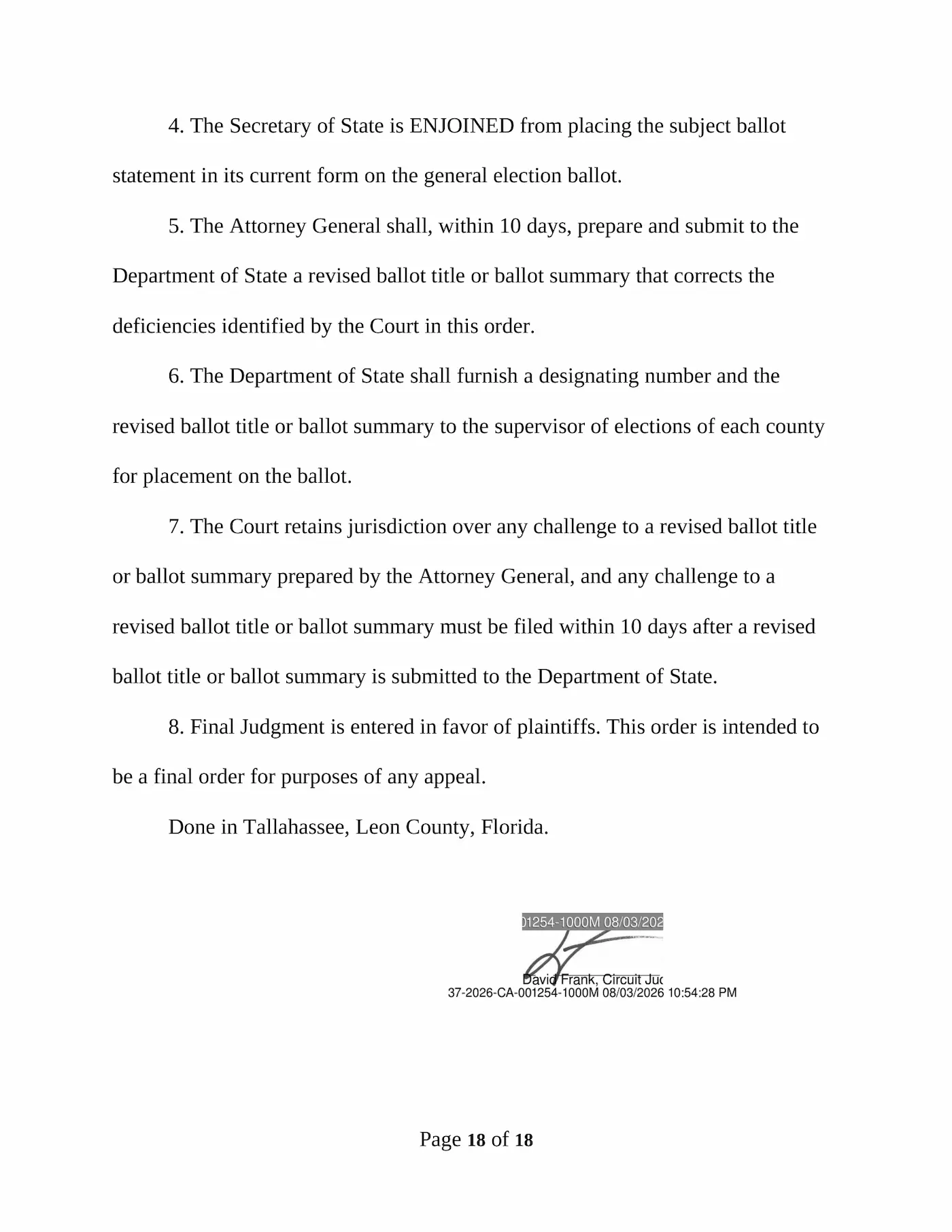
Attorney General James Uthmeier submitted the revised text to the Secretary of State on August 13, 2026, following notification that there would be no further appeals in the case Save Our Voters From Misleading Ballot Language, Inc. v. Byrd.
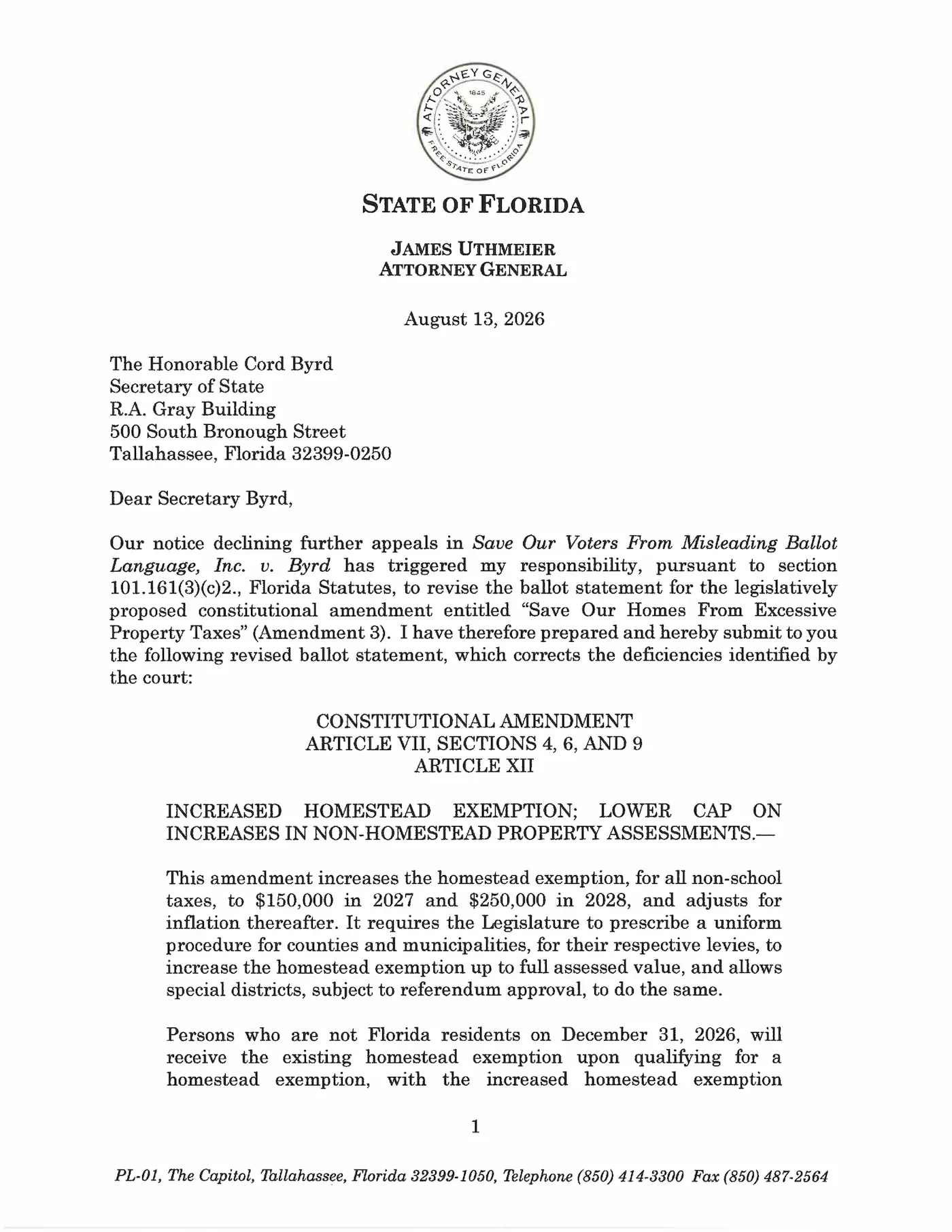
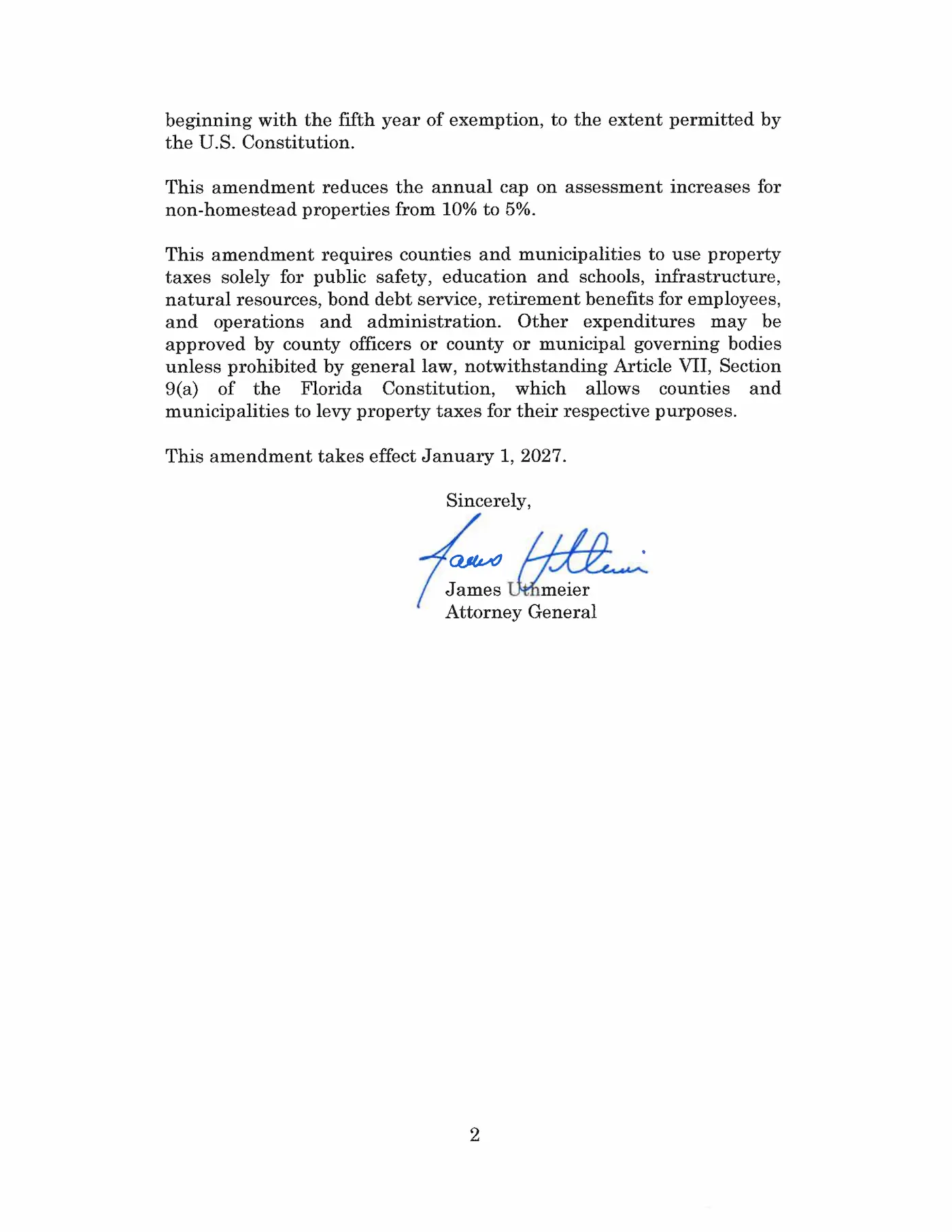
It needs 60% of the votes to pass. This is the Florida state measure—not to be confused with Miami City Referendum 3 on the Virginia Key marinas, a separate local issue that News Miami-Dade covers in a separate article.
The July 15 press release, and what the county itself defines as “the General Fund”
On July 15, 2026, upon presenting the proposed budget, the Mayor’s Office issued an official statement that reads as follows: “The budget also prepares Miami-Dade for potential statewide property tax reform, which could cost the County an estimated $385.8 million in General Fund revenue in the first year alone.” And, it continues: “That is more than 10% of the County’s General Fund.” For the second year, the statement DOES provide a dollar amount—“nearly $697 million”—but does not convert it to a percentage.
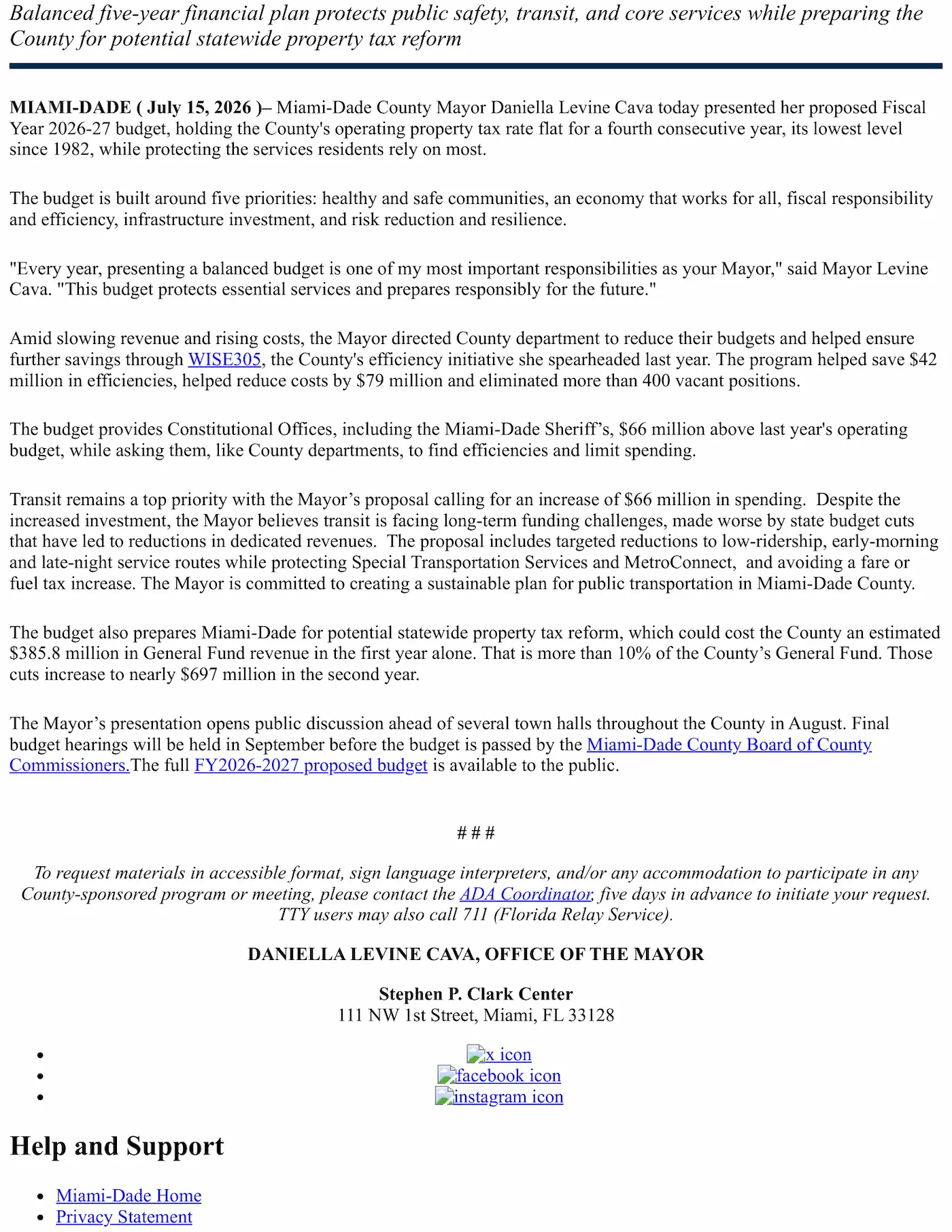
The budget itself defines what the “General Fund” is in its “Our Financial Structure” section (pp. 39–40): “The General Fund is the County’s primary operating fund… Within the General Fund, the operating budget separates countywide expenditures… from UMSA expenditures.” In other words: the General Fund is not just the “countywide” portion—it consists of both the countywide and UMSA portions together, two taxing jurisdictions WITHIN the same fund. The same document states, however, that Fire and Libraries “operate within their own special revenue funds”—separate funds that are not part of the General Fund. The amounts, taken directly from the budget’s appendices:
| Background | Total Revenue for FY2026-27 | Source |
|---|---|---|
| Countywide General Fund | $2,873.605 million | Appendix C, p. 134 |
| UMSA General Fund | $748,189 million | Appendix D, p. 135 (literally titled “General Fund Revenue”) |
| Combined General Fund (Countywide + UMSA) | $3,621.794 million | Sum of the previous two |
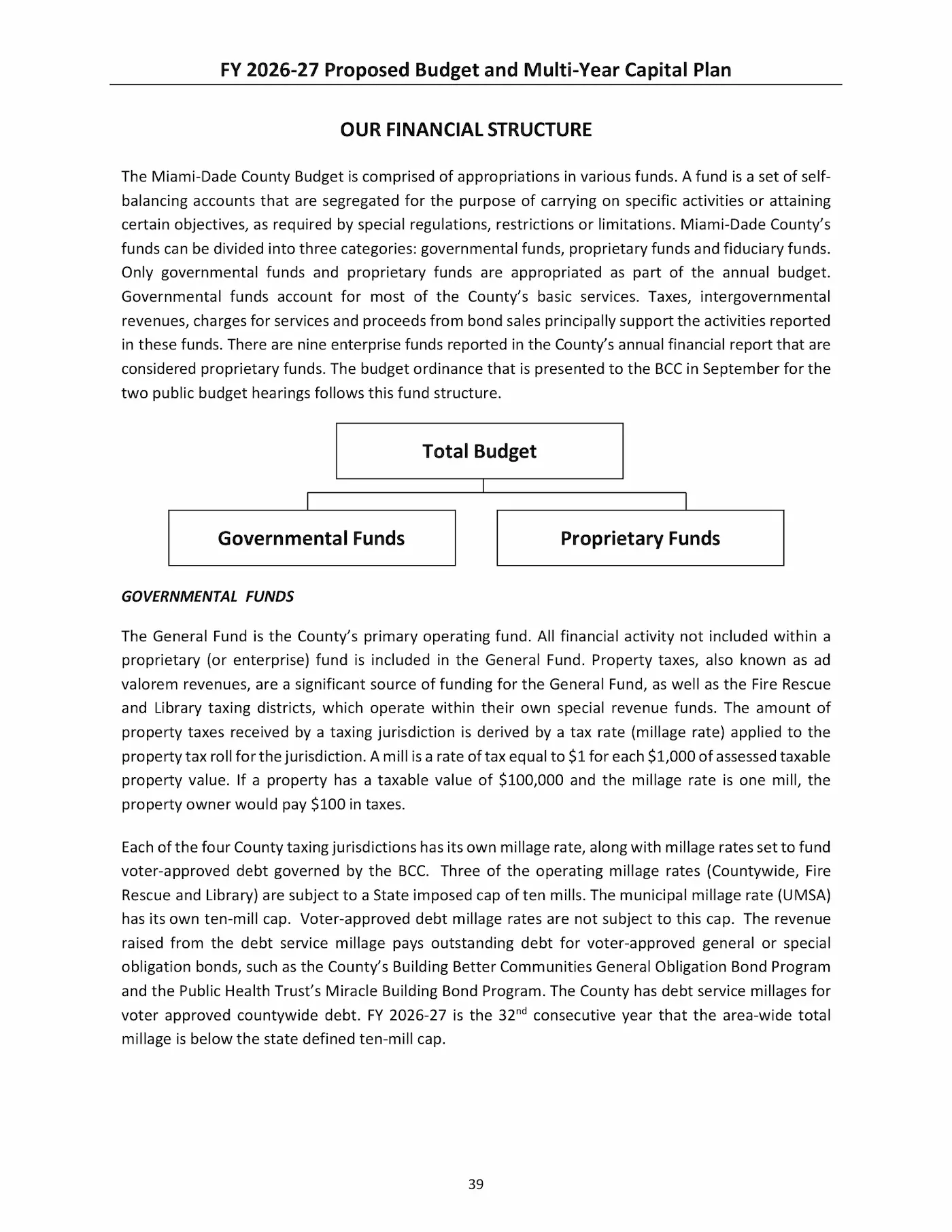
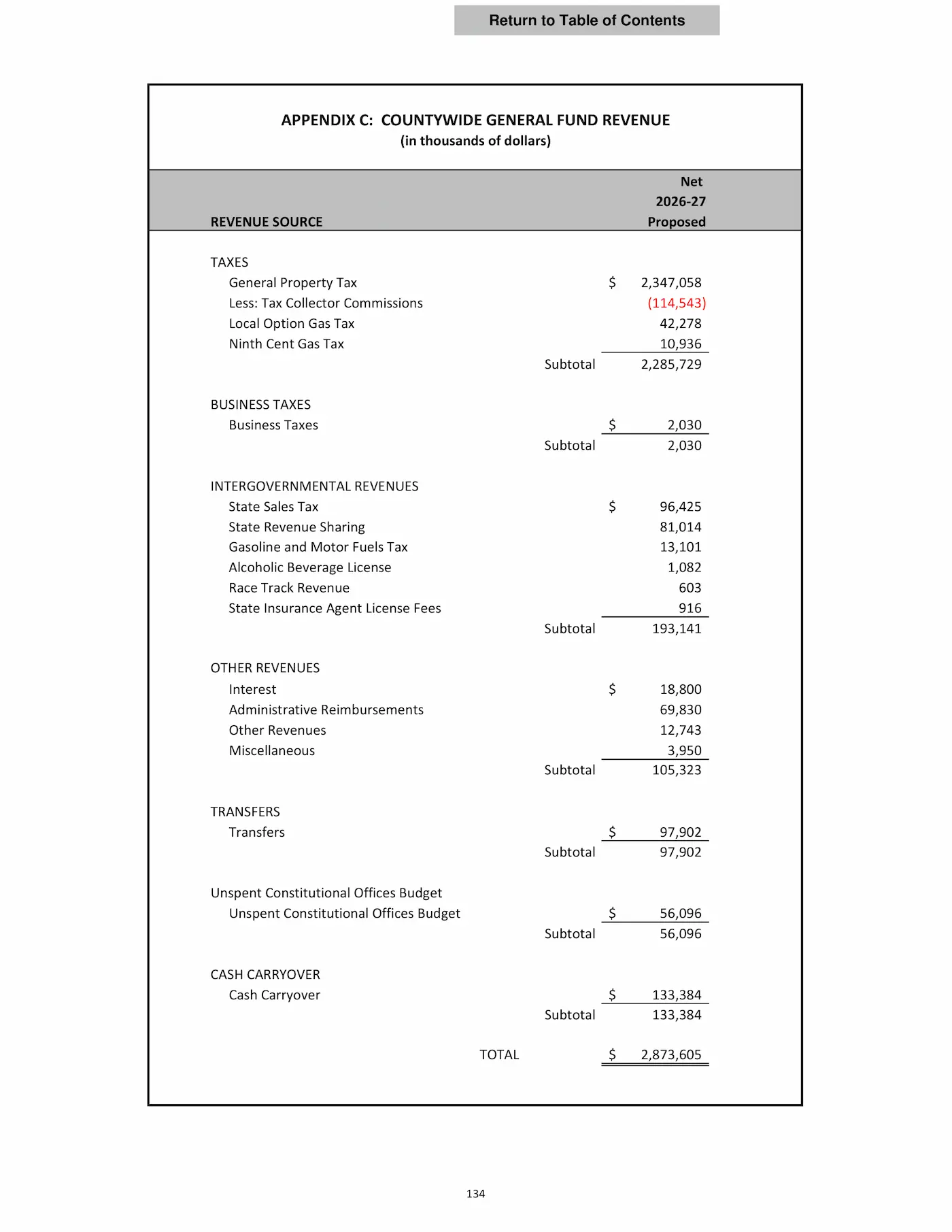
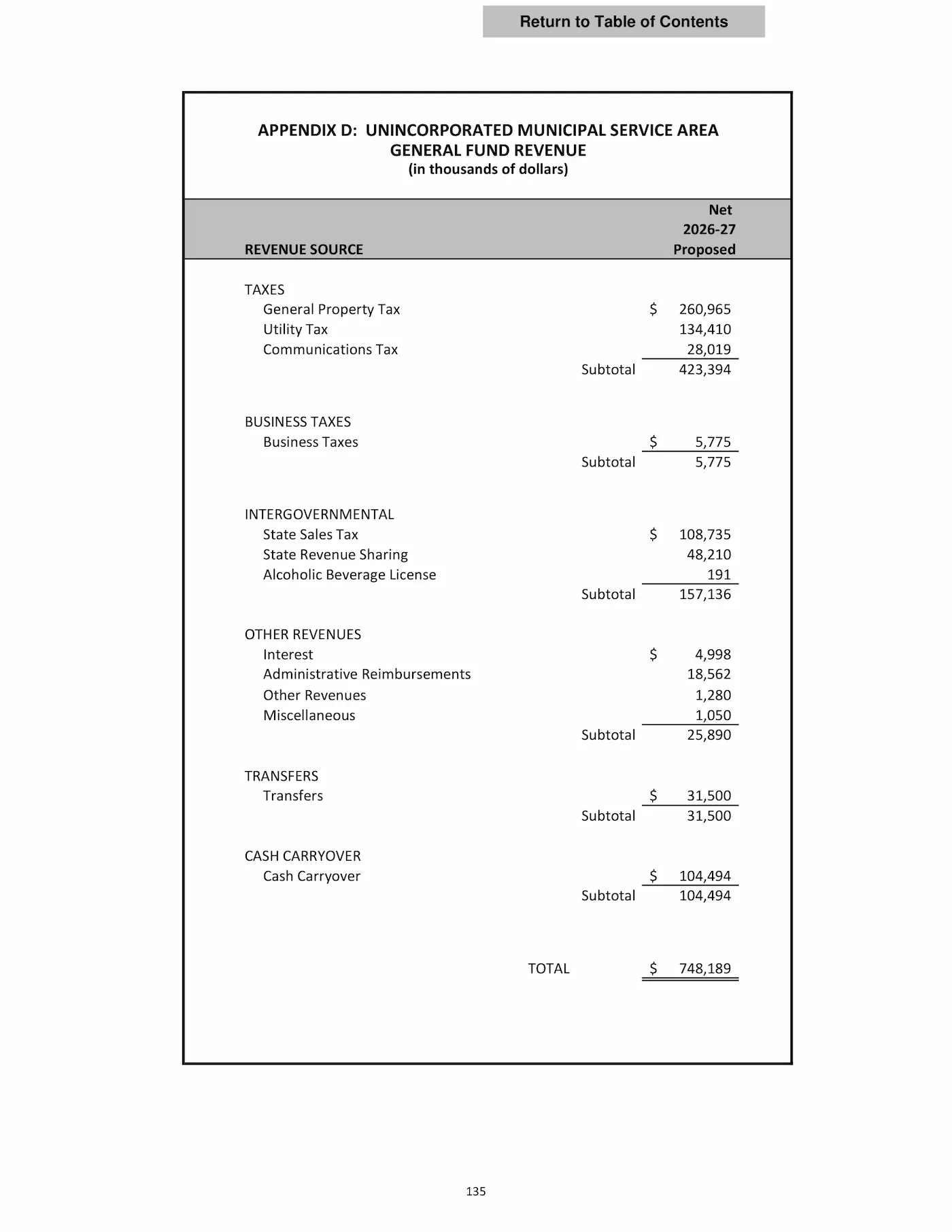
And the impact of Amendment 3, in essence, according to page 26 of the Executive Summary:
| Exercise | Countywide General Fund | UMSA General Fund | Fire Department (separate fund) | Library District (separate fund) | All in all, the four of them |
|---|---|---|---|---|---|
| FY 2027–28 | $236 million | $44.8 million | $83.6 million | $21.1 million | $385.5 million |
| FY2028–29 (“cumulative impact”) | $433.4 million | $78.5 million | $146 million | $38.7 million | $696.7 million* |
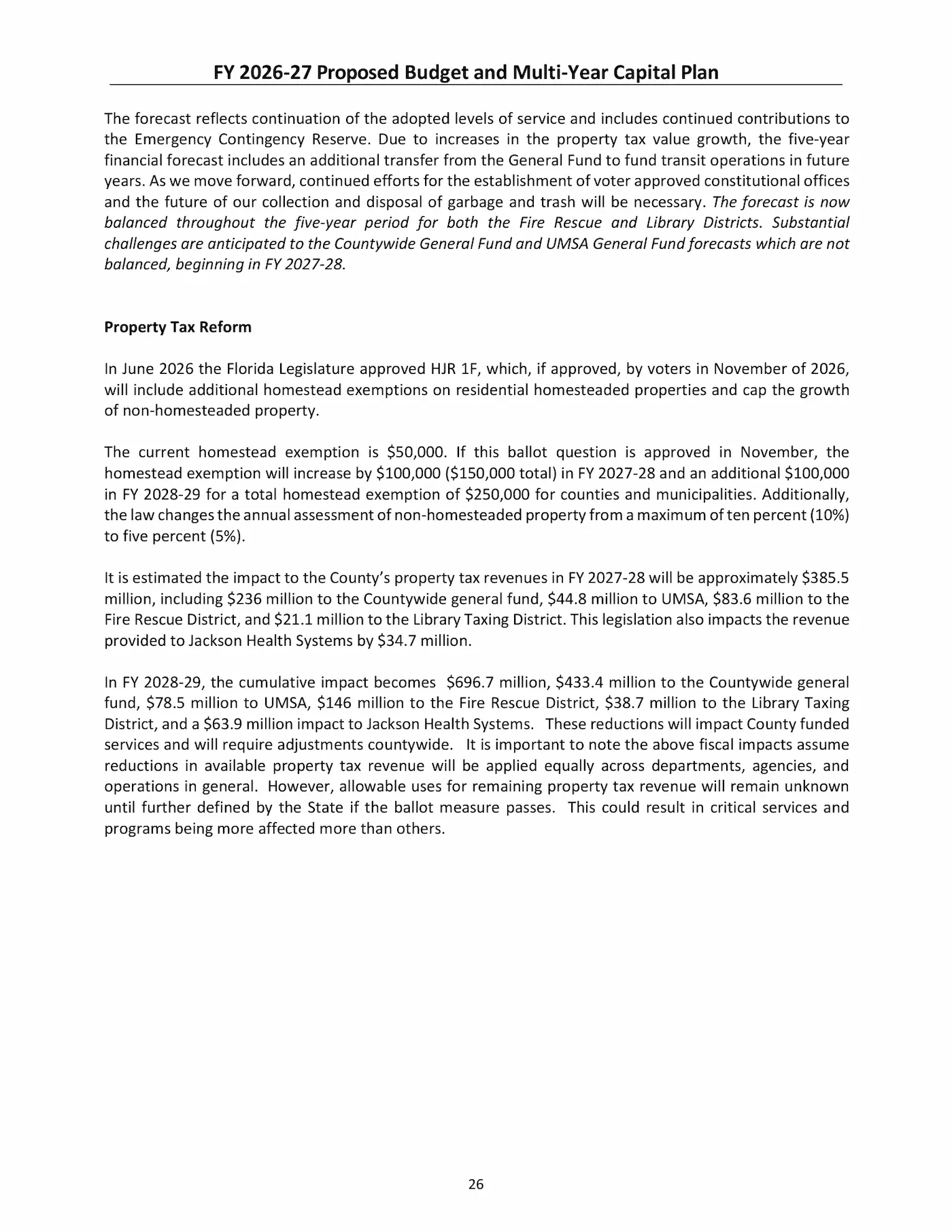
*The four components in this row total $696.6 million; the budget lists $696.7 million as the total. This section identifies the latter figure as the total published by the county, without speculating on the cause of the $0.1 million difference—it may be due to rounding in one of the four components.
(The Executive Summary separately notes an impact of $34.7 million on Jackson Health in FY2027-28 and $63.9 million in FY2028-29 — this is not included in the totals above because Jackson Health is not part of the General Fund or the other three funds in this table.)
These figures allow for several comparisons, and not all of them compare like with like (all of the following calculations are from News Miami-Dade; they are not figures published by the county in this form):
- Countywide vs. Countywide: $236M / $2,873.6M = 8.2%. Same budget base, same scope—but it excludes the UMSA, which the budget itself also refers to as the “General Fund.”
- Total impact of the four funds compared to the combined General Fund: $385.8M / $3,621.8M = 10.65% — arithmetically close to the “more than 10%” mentioned in the press release, but it conflates the impact of FOUR funds (including the two that the budget itself defines as separate from the General Fund) against only TWO of those funds.
- Impact on the combined General Fund (Countywide + UMSA, the only two categories the budget refers to as “General Fund”) relative to the combined General Fund: ($236M + $44.8M = $280.8M) / $3,621.8M = 7.75%. This figure encompasses both components of the General Fund—no more, no less.
The third comparison is based on the complete definition of the General Fund used in the budget itself: the projected revenue reduction for the General Fund (Countywide + UMSA) is $280.8 million, not $385.8 million — the $83.6 million for Fire and the $21.1 million for Libraries come from their own special revenue funds, which the budget explicitly distinguishes from the General Fund. That figure, 7.75%, is below “more than 10%.” It is not stated why the July 15 press release calculated the impact in this way—this article found no explanation in the document itself, and no explanation is assumed.
Two methodological caveats. First: the numerator ($280.8 million) is a projected loss for FY2027-28, while the denominator ($3,621.8 million) represents the revenue from the PROPOSED budget for FY2026-27, the previous fiscal year—these are the only two figures the budget provides for this calculation, but they are not from the same fiscal year.
Second: That denominator isn’t just recurring revenue—it includes $237,878 million in cash surpluses (fund balance) between Countywide and UMSA, as well as other non-recurring items. The 7.75% figure is, therefore, a comparison of NMD between two different fiscal years and against a revenue base that combines recurring revenue with fund balances—not a figure that the county publishes as such.
The document literally uses the term “cumulative impact” for FY2028-29, but this article has been unable to confirm—using the annual calculation table— whether this refers to the impact for THAT year with both phases of the reform already in effect, or the sum of the two years—the figure is cited without resolving this interpretive issue.
A third figure, from a source independent of the county: the Florida Association of Counties estimates it to be lower than the figure in Cava’s own press release. The Florida Association of Counties (an association of Florida’s 67 counties) published its own county-by-county estimate of the impact of HJR 1F, using a consistent methodology: data from the state’s Ad Valorem Revenue Estimation Conference (January 2026) and the Florida Department of Revenue’s aggregated 2025 mill rates—not each county’s internal budget figures.
For Miami-Dade, that estimate breaks down as follows: homestead exemption, $256.98 million (FY2027-28) and $445.38 million (FY2028-29); non-homestead assessment cap: $47.21 million and $96.68 million; total impact: $304.2 million (FY2027-28) and $542.06 million (FY2028-29). These figures are LOWER than the $385.5 million and $696.7 million cited in the county’s own budget (the sum of the four funds).
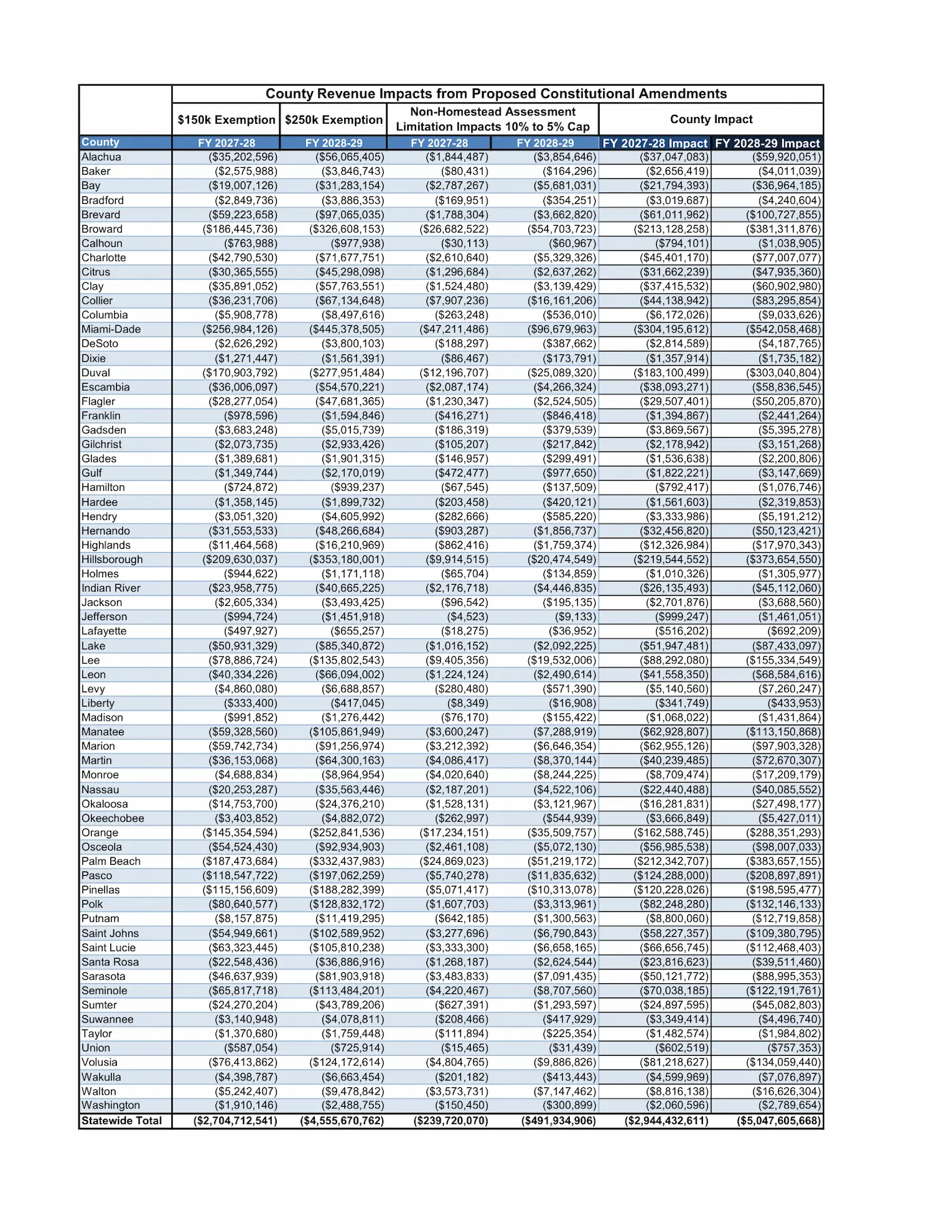
This article does NOT claim that the FAC figure validates or comes close to the 7.75% calculated above: these are two calculations with different scopes—the NMD calculation divides a numerator and denominator specific to the county budget; FAC’s calculation uses its own state methodology, and this article has not reconciled which funds, fiscal years, or assumptions each uses—and the closeness or distance between the dollar figures proves nothing about which percentage is correct.
Nor is it claimed that the FAC is a “neutral” or disinterested source: it is an association of local governments with an institutional interest in documenting its members’ loss of revenue, just like the county itself. The only thing this article asserts is that an external source, using its own stated methodology, arrives at a different and lower figure than the one that has been most widely circulated in press coverage—not which of the two is correct.
The broadest figure of all: the statewide impact, including ALL of Florida’s local governments—not just counties. The House of Representatives’ Final Analysis on CS/HJR 1F (June 16, 2026; nonpartisan committee staff; final floor vote: 75 in favor, 26 against) cites the official estimate from the state’s Revenue Estimating Conference: the cash impact on non-school local property tax revenue would be -$4.95 billion in FY2027–28 and -$8.78 billion in FY2028–29, with an estimated recurring impact of -$11.86 billion once the reform is fully in effect (a figure representing the cash impact for FY2031-32).
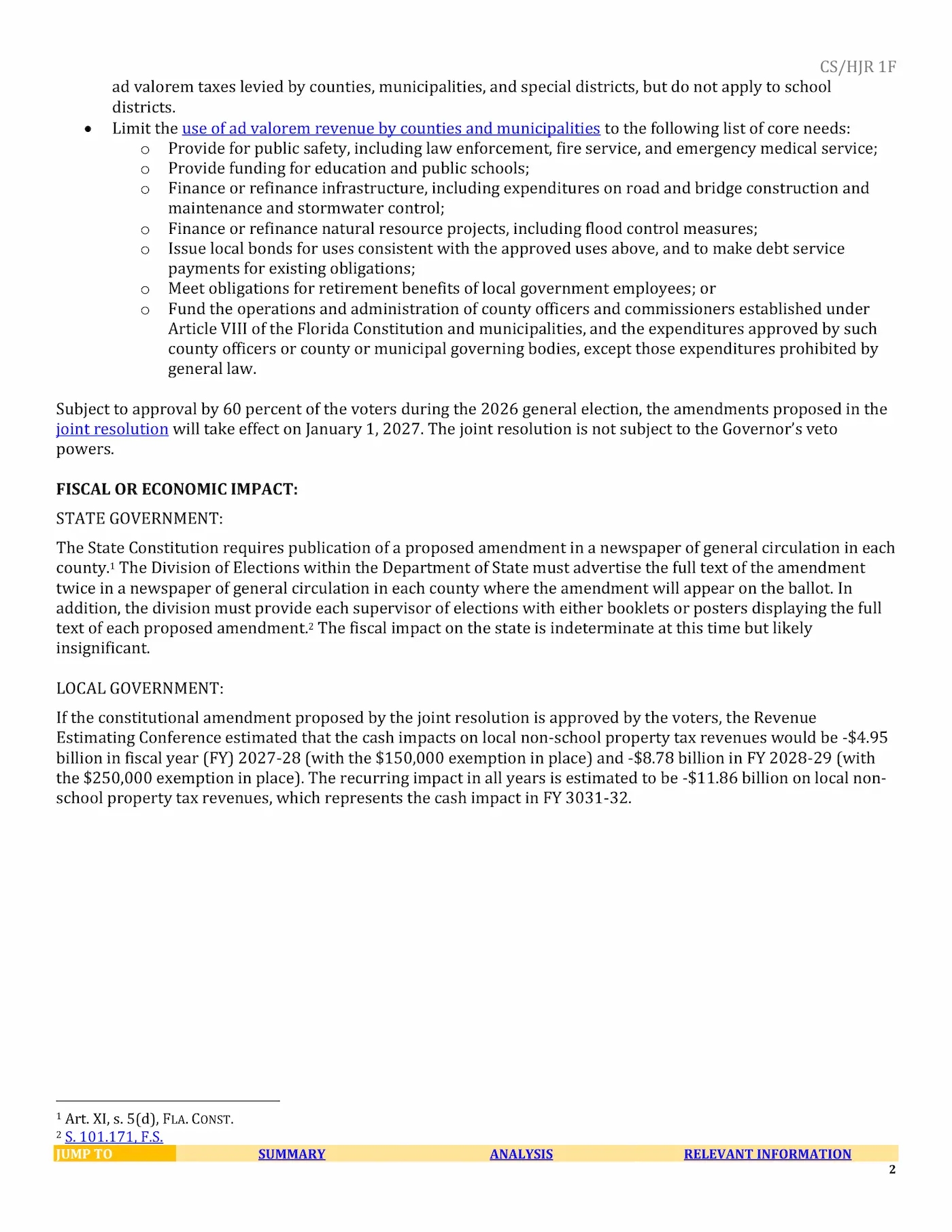
This figure includes counties, municipalities, and special districts across Florida’s 67 counties; it cannot be directly compared to the Miami-Dade figures above, but it gives a sense of the true scale of what is at stake at the state level.
Beyond the County: The Impact Varies Widely Among Miami-Dade’s 34 Municipalities
None of the figures above—neither those from the county nor those from FAC—measure the impact on the 34 cities in Miami-Dade, which levy their own property taxes separate from the county. The Florida League of Cities (a state association of municipalities) published its own table, city by city for all 67 counties, showing the percentage of the HOMESTEAD (homestead) that would disappear once the exemption reaches $250,000 in 2028. When viewed in full for the 34 municipalities in Miami-Dade, the variation is wide—ranging from less than 1% to more than 90%:
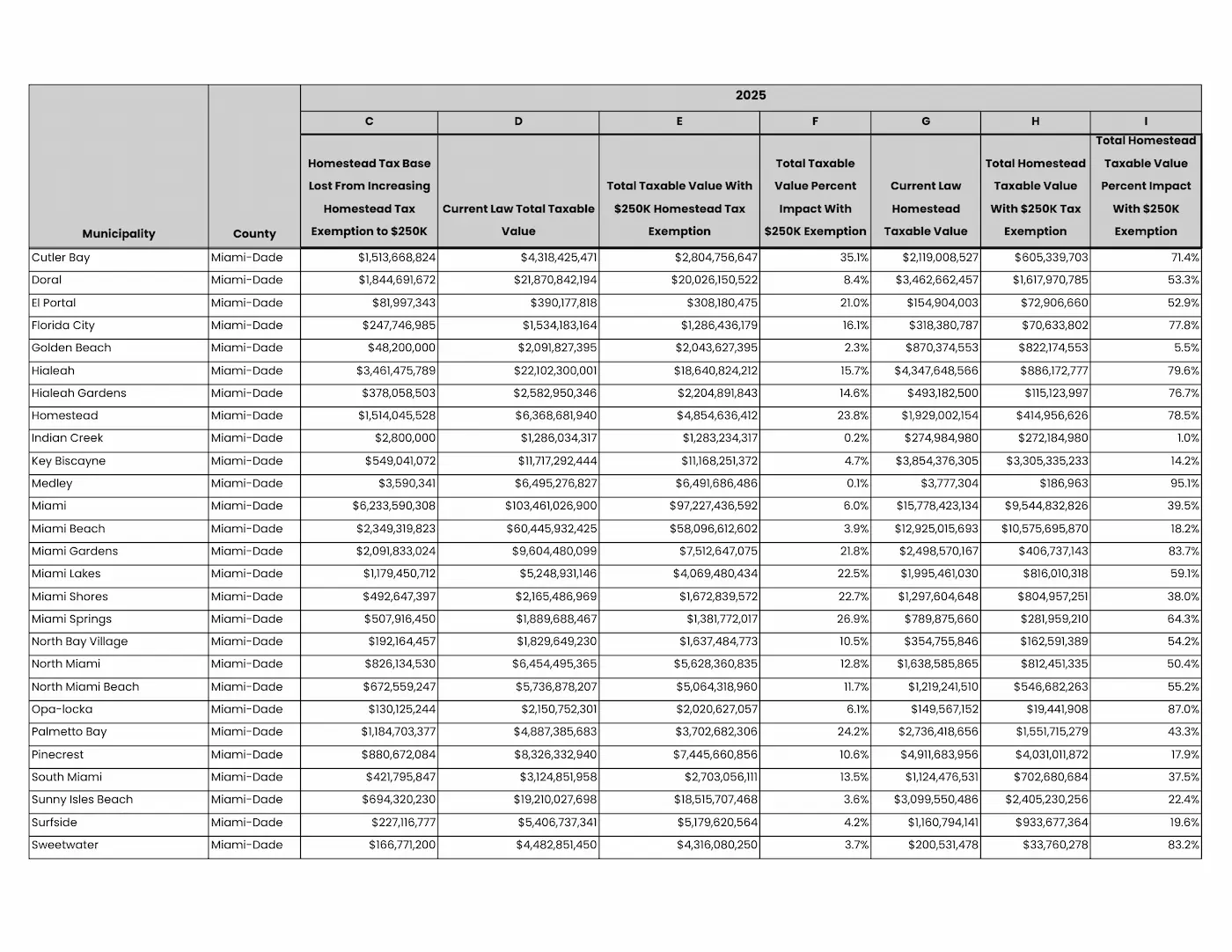
The pattern in this table does not depend on whether a municipality has a large commercial or tourist base: it depends on two distinct factors, each measured by a different column in the table itself. The RESIDENTIAL BASE column primarily reflects the typical value of homes relative to the fixed exemption of $250,000: in municipalities with less expensive housing, that exemption covers almost the entire value of a typical home, so almost the entire residential tax base is exempt (hence the 95.1% in Medley or the 87.0% in Opa-locka).
In areas where housing is very expensive, $250,000 is a small fraction of the value of a typical home, so the housing stock is barely reduced (1.0% in Indian Creek, 5.5% in Golden Beach).
The “TOTAL” column shows something different: how much of each municipality’s revenue comes from residential properties to begin with, compared to commerce, industry, or other uses. Medley has a very small residential tax base in absolute terms compared to its industrial and commercial tax bases, so even if it loses 95.1% of that small portion, the impact on its total tax base is just 0.1%. Cutler Bay is the opposite case on this list: it has an overwhelmingly residential base, so its loss of total tax base (35.1%) is the highest among the 34, even though its loss of residential tax base (71.4%) is not the highest.
Neither column represents “the impact on each city’s budget”: that figure also depends on what proportion of each municipality’s revenue comes from property taxes versus other sources, which this table does not measure.
The email about the town hall meetings, and what it literally says
The email, sent from the official account [email protected] invites residents to five sessions: October 8 at the Naranja Library, October 9 at the West Kendall Library, October 10 at the North Dade Library, October 16 at the Arcola Lakes Senior Center, and October 17 at the Hialeah Gardens Library. The text of the invitation does not mention Amendment 3 or ask for a specific vote: it states that the mayor “is hosting a series of town halls to discuss Miami-Dade County’s budget and the essential services funded by property tax dollars.”
Separately, Cava was scheduled to participate on October 7 in “Decode the Ballot,” an event organized by the Miami-Dade League of Women Voters—a nonpartisan civic organization—on the amendments and referendums on the November ballot; the invitation confirms that she was invited, not that she attended, and the fact that it is organized by an external entity does not in itself prove that no county public funds were involved. That same event has a virtual session scheduled for October 14.

“Conversations with Cava: Your Tax Dollars at Work,” a full recording of the event held at West Kendall Library on October 9, 2026, in actual chronological order, featuring the mayor’s presentation and the Q&A session with the audience.
What Cava said in West Kendall, as verified against his own presentation, the budget, and the county payroll
News Miami Dade recorded Levine Cava’s entire presentation at the West Kendall Library on October 9 and compared it, line by line, to the proposed budget and the county’s public payroll.
Wise305: The $121 million figure is supported by a press release; the job count figures require reconciliation. Cava said in the presentation: “We were able to save $121 million… over two years by eliminating 800 positions.” The Executive Summary of the PROPOSED budget (July 2026) only mentioned $42 million for one year.
However, the county’s official press release dated September 18, 2026, announcing the ALREADY ADOPTED budget, states verbatim: “The fiscally conservative budget reflects efficiencies identified through the Mayor’s Wise305 initiative, which has saved taxpayers $121 million since 2025, including the elimination of 400 vacant positions.” The amount matches, word for word and with the same “Wise305” label: $121 million.
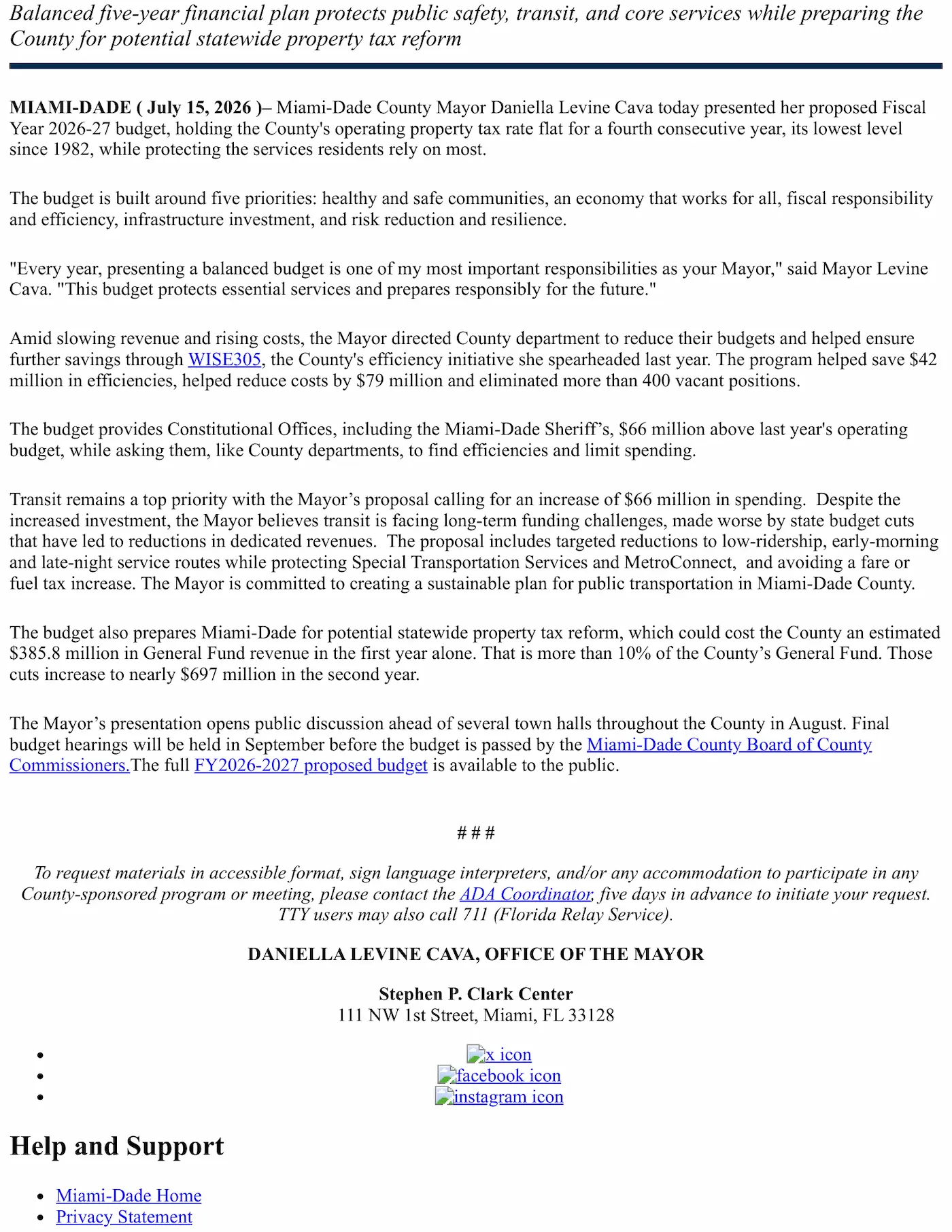
Not the job openings yet: The county itself states in that press release that 400 vacant positions were eliminated, compared to the 800 mentioned by Cava in West Kendall three weeks later—it was not established whether these figures cover the same period, the same scope, or the same job category, so it cannot yet be called a coincidence or a contradiction, just a figure that needs to be reconciled.
An additional distinction: the budget letter (“Message from the Mayor”) separates more than $42 million in efficiencies ALREADY ACHIEVED during FY2025-26 from $79 million in PROPOSED reductions for FY2026-27 — which, when added together, total the $121 million mentioned in the September statement; however, matching an announced figure does not mean that those savings have already been fully realized.
“Message from the Mayor,” featuring more than $42 million in WISE305 efficiency savings for FY2025-26 and $79 million in proposed cuts for FY2026-27.
The total budget isn’t going down—it’s going up. The proposed FY2026-27 budget, on page 54, states: “The FY 2026-27 Proposed Budget is balanced at $14.261 billion.” That compares to $13.233 billion in the adopted FY2025-26 budget (official figure)—an increase of more than $1 billion in a single budget cycle.
This article does not claim that this increase represents funds available to offset the loss that Amendment 3 would cause: the total budget combines operating, capital, and funds with uses restricted by law or by bond, which the document itself distinguishes from one another, and this article did not track which specific line items the increase corresponds to.
The portion that truly depends on property taxes—what page 54 itself refers to as “tax-supported budgets”: the Countywide General Fund, the UMSA General Fund, the Library System, and the Fire District—amounts to $4.266 billion in the PROPOSED FY2026-27 budget, 3.8% more than the previous cycle according to the document itself, and less than one-third of the total of $14.261 billion.
What the county earns while warning of cuts: the public payroll, in context. This section does not refute a specific statement by Cava about salaries—none was found—but rather presents the county’s payroll as context in light of the warnings of cuts.
According to a snapshot of the county’s payroll dated internally May 3, 2026 (the “DataDate” field), with 23,718 active salaried employees, the “AnnualSalary” field (the annual base salary, NOT the amount actually paid—that figure, which the county reports separately as “GrossYTD,” may include overtime, back pay, and other adjustments not used in this analysis): County Attorney Geraldine Bonzon-Keenan has a base salary of $455,541.64 per year—more than the President of the United States ($400,000) and more than triple that of the Governor of Florida ($141,400).
At least 79 employees have an annual base salary exceeding $300,000; 42 earn more than $330,000; and 355—1.5% of the workforce—earn more than the mayor’s own base salary of $206,000.06. The public portal for accessing this payroll is the county’s salary search tool, “Search Employee Salaries,” linked from the Miami-Dade Transparency Portal; the specific file used here (23,718 rows, snapshot “ArcGIS MDC 2026-05-03″ according to its own internal metadata) is archived at 1-BASES/tables/salary-table/2026/mdc-county-2026.xlsx, with its complete source information, so that the count can be reproduced.
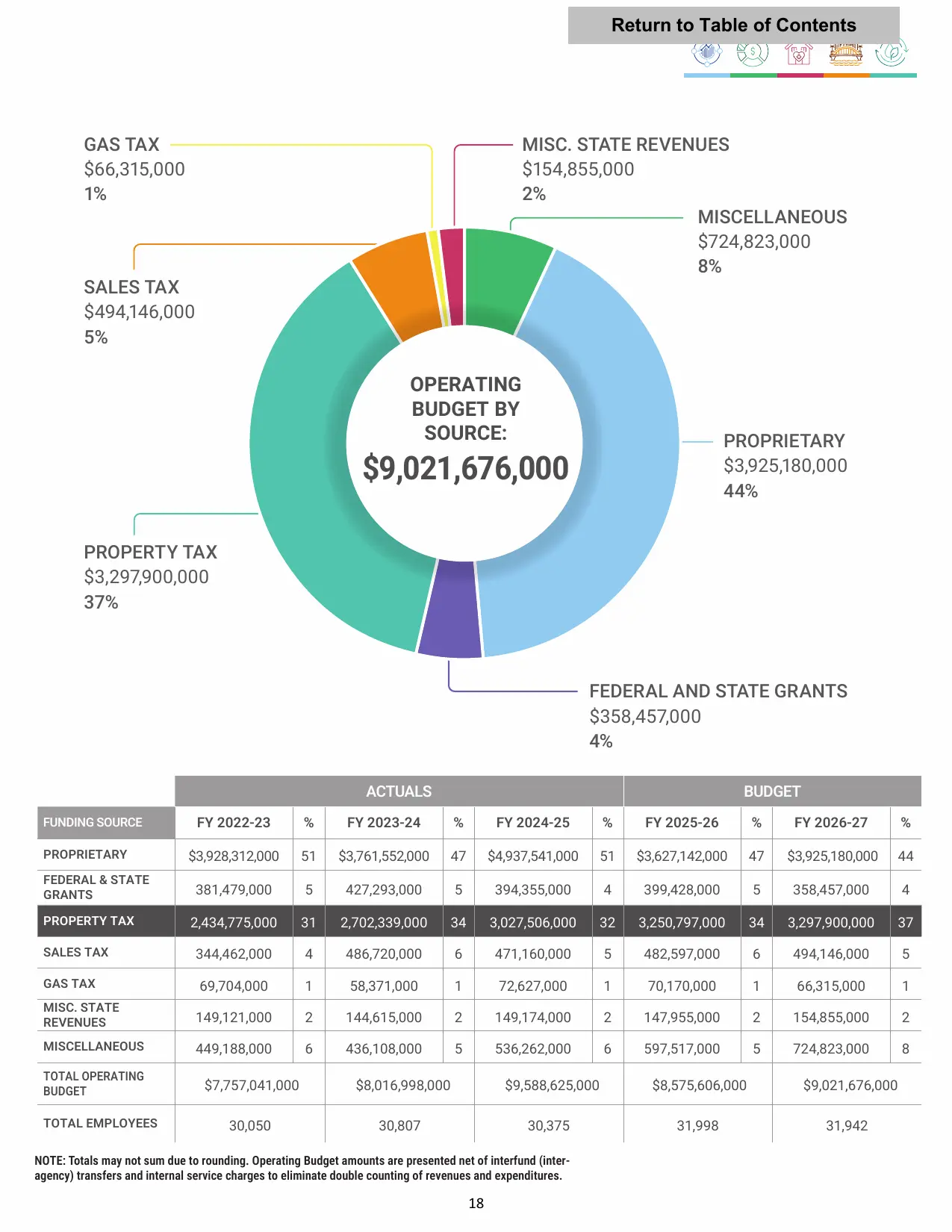
The county itself reports its total workforce, separate from the individual payroll figures cited above: 31,942 employees in the proposed FY2026-27 budget, a slight decrease from the 31,998 in the previous fiscal year (FY2025-26), but still well above the 30,050 from four fiscal years ago (FY2022-23)—a workforce that, viewed over four years, has grown by nearly 1,900 employees—although this growth has not been continuous: it fell from 30,807 to 30,375 between FY2023-24 and FY2024-25 (432 fewer positions), and has fallen again, by 56 positions, in the most recent cycle (proposed FY2025-26 to FY2026-27).
The full text of the proposed amendment (the vote is still pending): “shall” mandates spending limits. Regalado argues, in his September 12, 2026, interview with Juan Manuel Cao (3:45 mark), that the law uses the word “ shall” to require local governments to fund public safety: “That law states very clearly—and uses the word ‘shall,’ which means ‘must’—that county governments, all 67 counties, and municipalities […] are obligated to have funds to finance basic services.”
The text of CS/HJR 1-F, Section 9(a)(2) of Article VII—read in its entirety herein—reads as follows: “Ad valorem taxes levied by counties and municipalities shall be used only to, ” and lists seven uses: public safety (police, fire, emergency medical services); education and public schools; infrastructure; natural resource projects; local bonds for those same purposes and existing debt; public employee retirement obligations; and, seventh, to fund the operation and administration of the county officials and commissioners themselves, and the expenses they themselves approve, unless prohibited by general law.
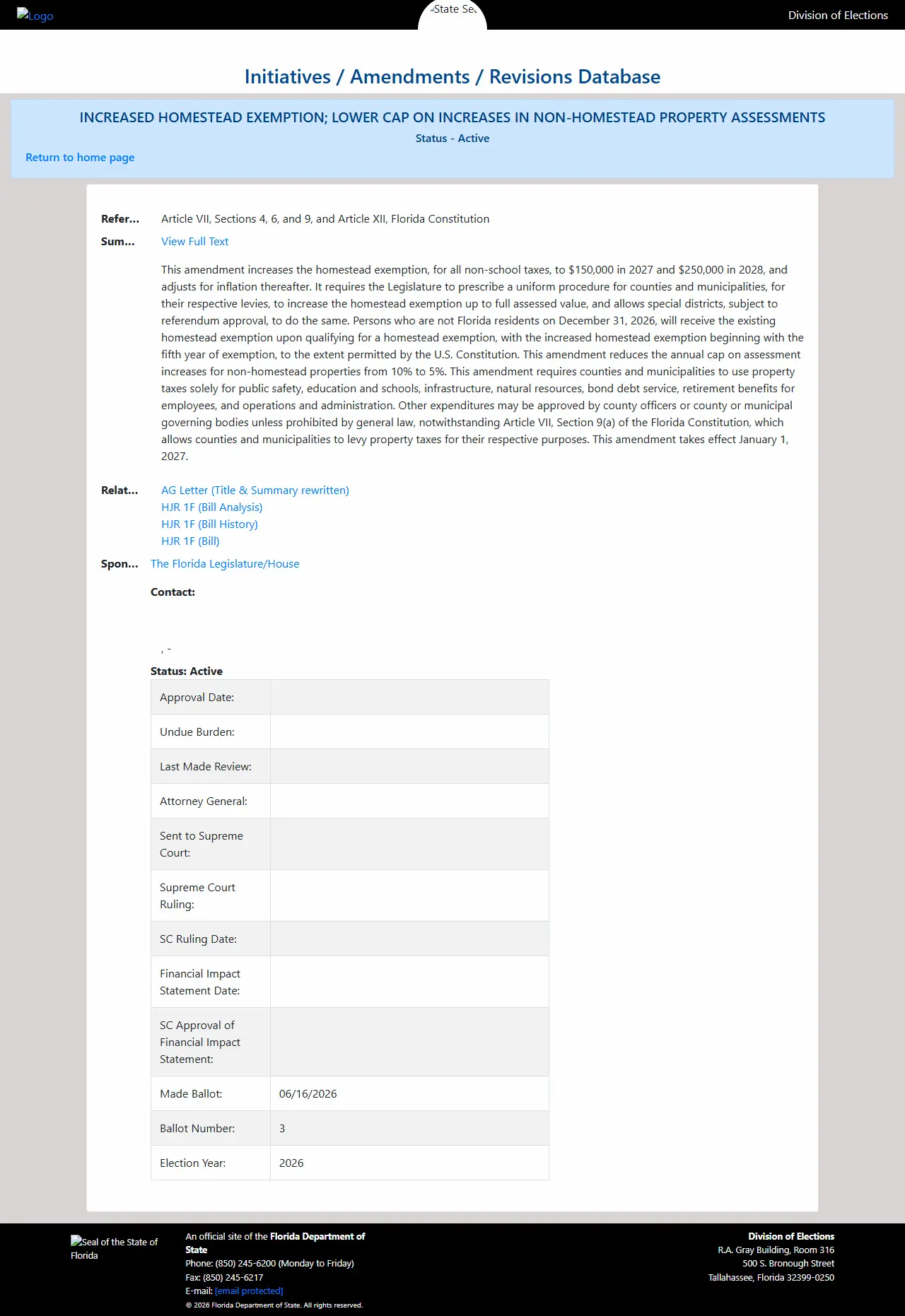
Screenshot of the official record for Initiative 10-110 (HJR 1F) in the Florida Department of State’s amendment database, showing the current ballot summary, the “View Full Text” link to the full text of the amendment, “Ballot Number: 3,” and “Election Year: 2026.”
The text is, in fact, mandatory: the money can ONLY be used for those seven purposes. But that requirement is a CAP on what can be spent, not a MINIMUM that sets a minimum amount for police or fire departments—the seventh purpose, which is so broad, allows for funding almost any expenditure approved by the commissioners themselves, and nothing in the text requires the administration to request—or the Commission to approve—the amount requested by each public safety agency.
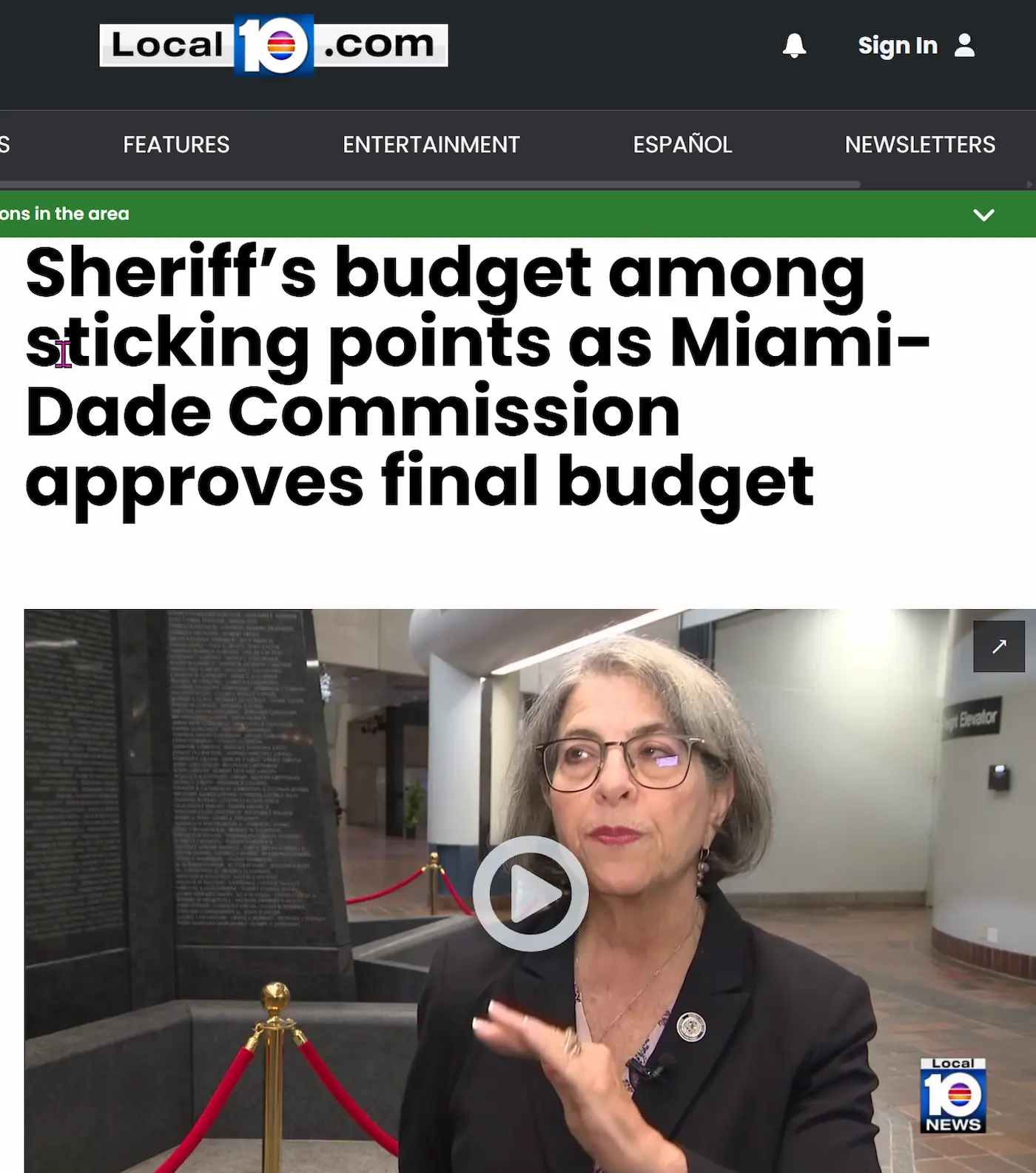
This is not an abstract question: it has a recent precedent in the county itself. In July 2025, when presenting its proposed budget for FY2025-26, the Cava administration allocated an increase of about $38 million to the Sheriff’s Office; Sheriff Rosie Cordero-Stutz requested at least $93 million to fill vacancies, hire civilian staff, and cover staffing costs—a gap of more than $55 million between what was requested and what was proposed at that stage of the process (WLRN). This article did not verify the final outcome of that shortfall when the final budget for that fiscal cycle was adopted.
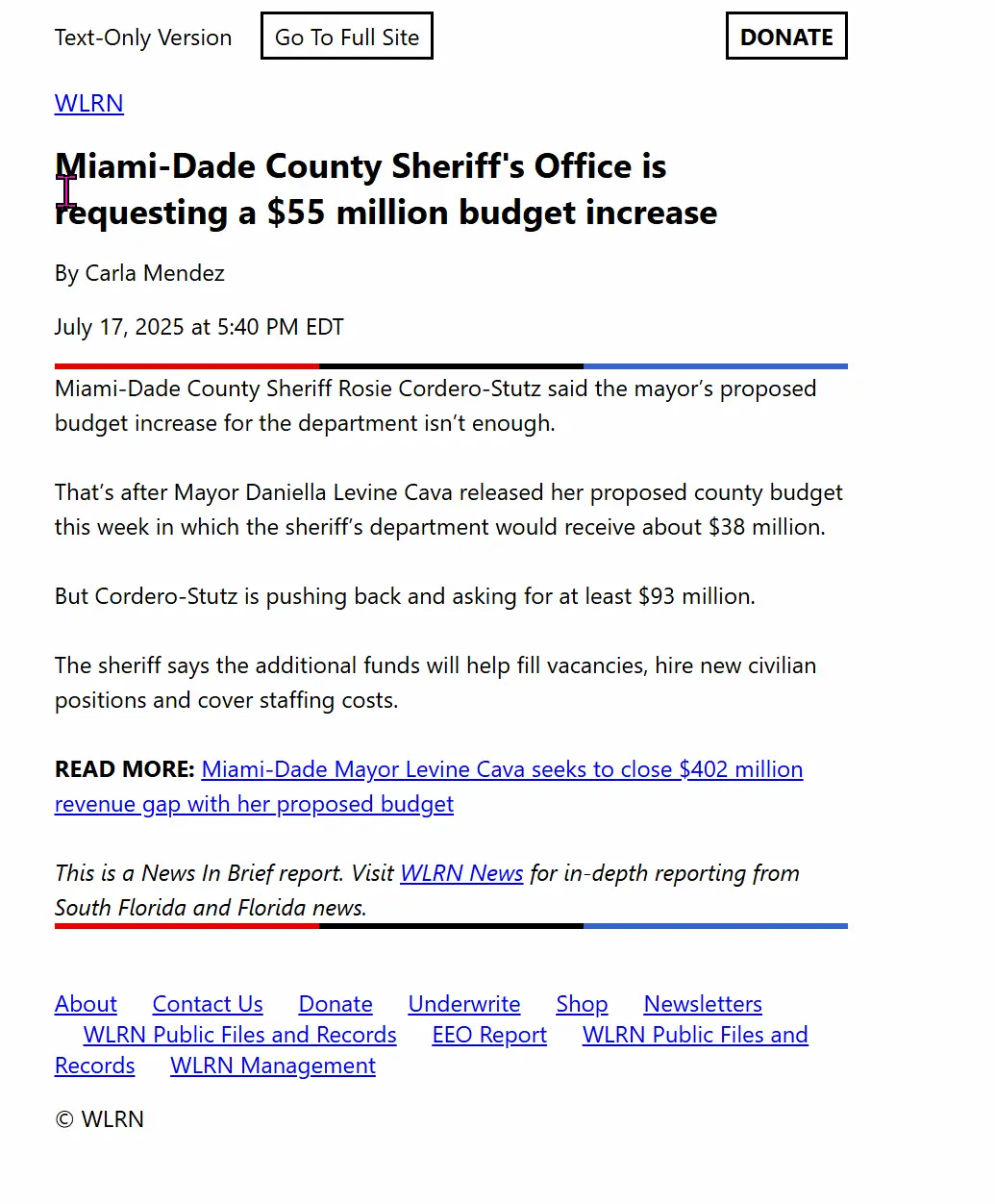
For the FY2026-27 budget cycle, adopted on September 18, 2026, following a Commission meeting that lasted from the afternoon into the early morning, Cava said that what was approved was “an additional $66 million in the general fund… but on top of that, her total budget is $1.2 billion”; Cordero-Stutz herself, during that same session, told the commissioners that she would consider appealing to the Florida Cabinet’s Administration Commission —chaired by Governor Ron DeSantis— if her agency’s needs were not met, and specifically noted that her agents’ starting salaries “are not where they need to be” (Local10).
Update as of October 13, specifically searched for by descending date: Cava and Commission Chair Anthony Rodríguez signed, pursuant to Section 30.49(4) of the Florida Statutes, the formal notice of the Board’s action regarding the MDSO FY2026-27 budget—a 5-page document, read in its entirety by this publication—dated October 7, 2026, and sent to Cordero-Stutz, according to Local10, on Thursday, the 8th.
The Sheriff had certified her request at $1,048,109,115 on May 1, 2026; the Board approved $1,234,439,000—$186,329,885 more than the certified amount, according to the letter itself. In the official statement accompanying the submission, Cava said: “We approved the largest Sheriff’s Office budget in Miami-Dade history.”
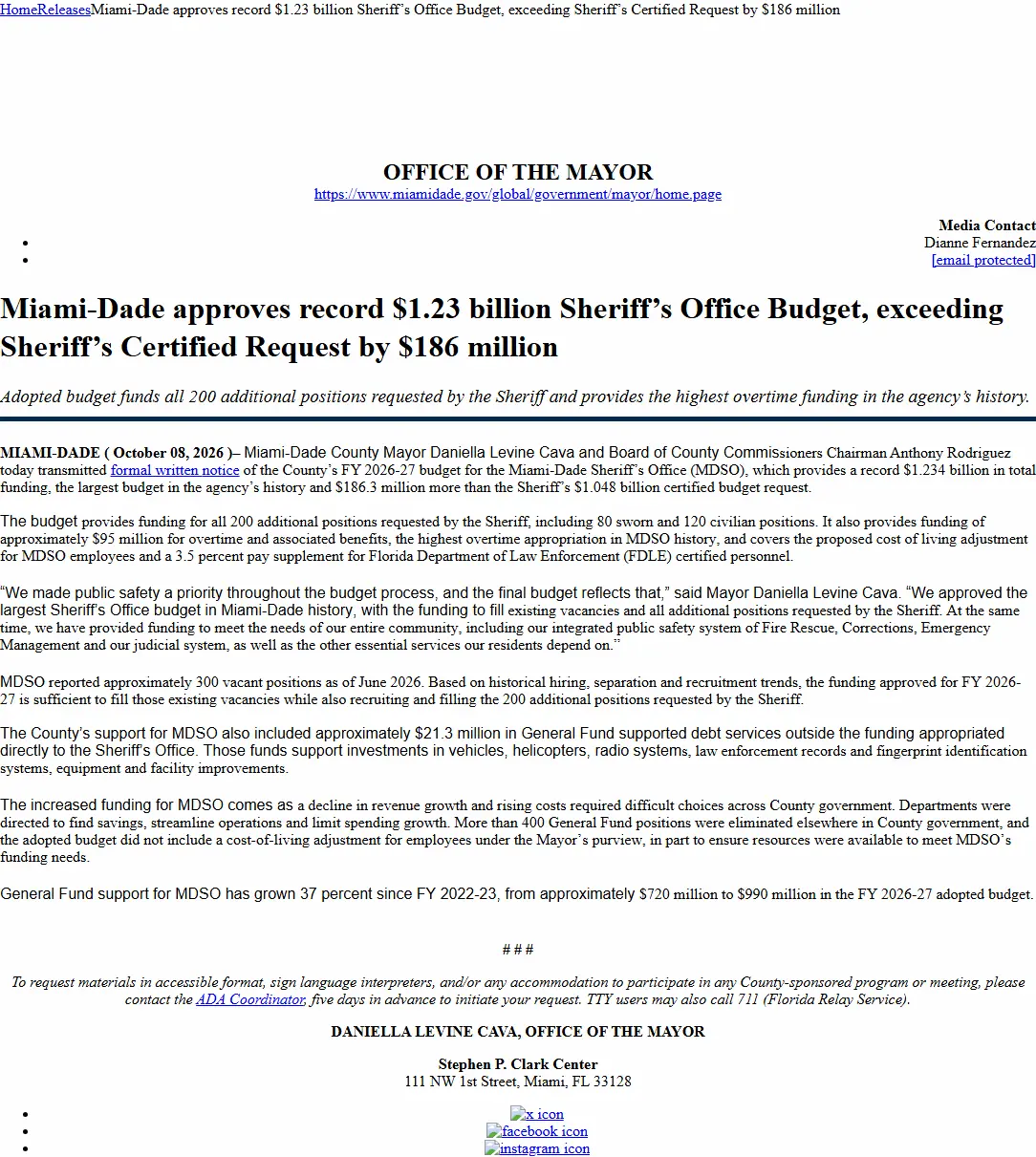
Screenshot of the official press release dated October 8, 2026, titled “Miami-Dade Approves Record $1.23 Billion Sheriff’s Office Budget, Exceeding the Sheriff’s Certified Request by $186 Million,” featuring the quote: “We approved the largest Sheriff’s Office budget in Miami-Dade history.”
That total figure, however, does not indicate that the Board granted him more than he requested for each line item. Table 1 of the notice itself, when read in its entirety, shows that within what Cordero-Stutz certified as requested for this cycle—general security and court services combined—the Board approved $46,142,115 LESS than what was requested.
Its May certification includes a third line item, the School Crossing Guard Program, $9,972,000, which the Board approved exactly as requested, without any changes: that is why it is not included in the comparison above, and it is the missing piece that ensures $1,048,109,115 (your total certified request) minus $1,001,967,000 (the amount approved for your three line items) also equals the same $46,142,115.
Comparing only general security—the only one of the two that has figures for previous fiscal years in the same table; court services is a new line item of $33,475,000 this fiscal year—the approved amount did increase compared to last year: from $929,428,000 in FY2025–26 to $958,520,000 in FY2026–27, an increase of $29,092,000, which is less than what she requested this year.
The remainder of the $186.3 million surplus comes from elsewhere: $197,161,000 in the category that Table 1 itself calls “Other Funds” and $35,311,000 from reserves, $232,472,000 in total—more than the entire surplus of $186.3 million, because the $46,142,115 deficit in the line item she did request absorbs part of that difference.
That “Other Funds” category isn’t money made up for this letter: it already appeared, for similar amounts, in the approved budgets for the two previous fiscal years ($194,980,000 in FY2024-25 and $194,720,000 in FY2025-26); Table 1 does not include a column for the Sheriff’s certified request for those two years, so this article cannot say whether it was also omitted from her request at that time, but it is clear that for FY2026-27, it was not part of her certified request.
The letter also explains the difference in what she actually requested. One portion, $1,918,040 ($1,782,000 for general security and $136,040 for court services), consists of adjustments based on Florida Retirement System rates set by the Legislature in May 2026, which Cordero-Stutz herself acknowledged as correct in her certification letter; the county clarifies that it does not count these as an imposed reduction.
The remainder, $44,224,075, represents the county’s adjustment for general security: $13,789,000 less in operating expenses, based on actual spending over the past five years; $8 million less in overtime from the G20 Summit, which the county says it will seek to cover with federal funds; and $33,811,075 less in personnel and associated benefits, based on an assumed employee attrition rate of 6% compared to the Sheriff’s 3%, partially offset by $11,376,000 added by President Rodríguez’s amendment at the final hearing on September 17.
The county argues that the actual MDSO rate in FY2025-26 was approximately 7%, and that a higher rate provides more than enough leeway to fill the 300 reported vacancies and the 200 newly approved positions. This article did not independently verify which of the two rates—3% or 6%—is more realistic for MDSO.
The notice neither confirms nor rules out that Cordero-Stutz has already filed the appeal she mentioned in September: it merely documents the Board’s formal notification, not a decision by the state Cabinet. Local10 (October 8, also archived and verified against the “articleBody” field of its own HTML, not against on-screen text) adds that the sheriff “could appeal” to the Florida Cabinet—a statement regarding her right to do so, not whether she exercised it—and that, as of that date, she had not publicly responded to the notice from Cava and Rodríguez. As of this writing, this article still finds no evidence that the appeal has been formally filed or that the state cabinet has reached any decision.
Taken together, the two cycles documented here using our own data show a distinct pattern in each one—not the same pattern repeated: in FY2025-26, a gap emerged between what was requested and what was proposed ($38 million versus $93 million, a difference of more than $55 million).
In FY2026-27, within the scope of her certified request, the Board approved $46.1 million less than her request—although more, in absolute terms, than in the previous cycle— and the county attributes much of that difference to a higher staff turnover rate, a retirement adjustment that the Sheriff herself acknowledged as correct, and adjustments to operating expenses and G20 overtime costs.
What is clear from both cycles is that the law does not require the administration to request—nor the Commission to approve—a minimum amount for public safety in each budget line item—a fact that any reader can weigh against the argument that the text of the amendment, on its own, “guarantees” public safety.
Public transportation: one fare that has already been approved, and three distinct groups of routes that the county’s own press release does not mix. The FY2026-27 budget, adopted on September 18, 2026, ELIMINATED 13 bus routes.
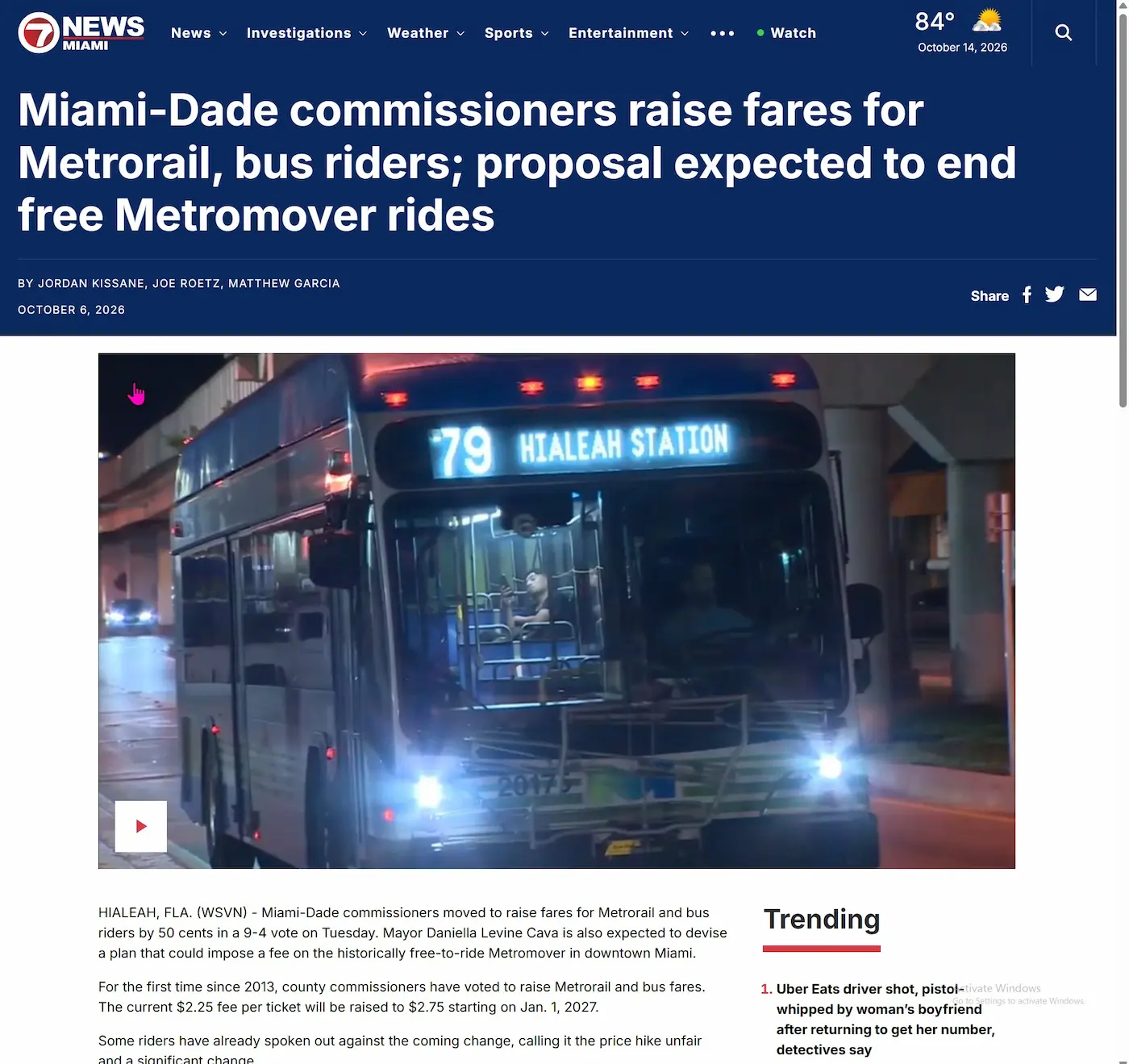
On October 6, 2026—three days before this same event in West Kendall— the Commission approved the first fare increase for Metrobus and Metrorail in 13 years, from $2.25 to $2.75 (a 22.2% increase, which will take effect in January 2027—still in the future at the time of this writing), and the county’s own official statement reads verbatim that “the additional funding will preserve service on 13 routes eliminated as part of the FY 2026–27 budget process”—in other words, those 13 routes had already been eliminated, and the fare increase restores them.
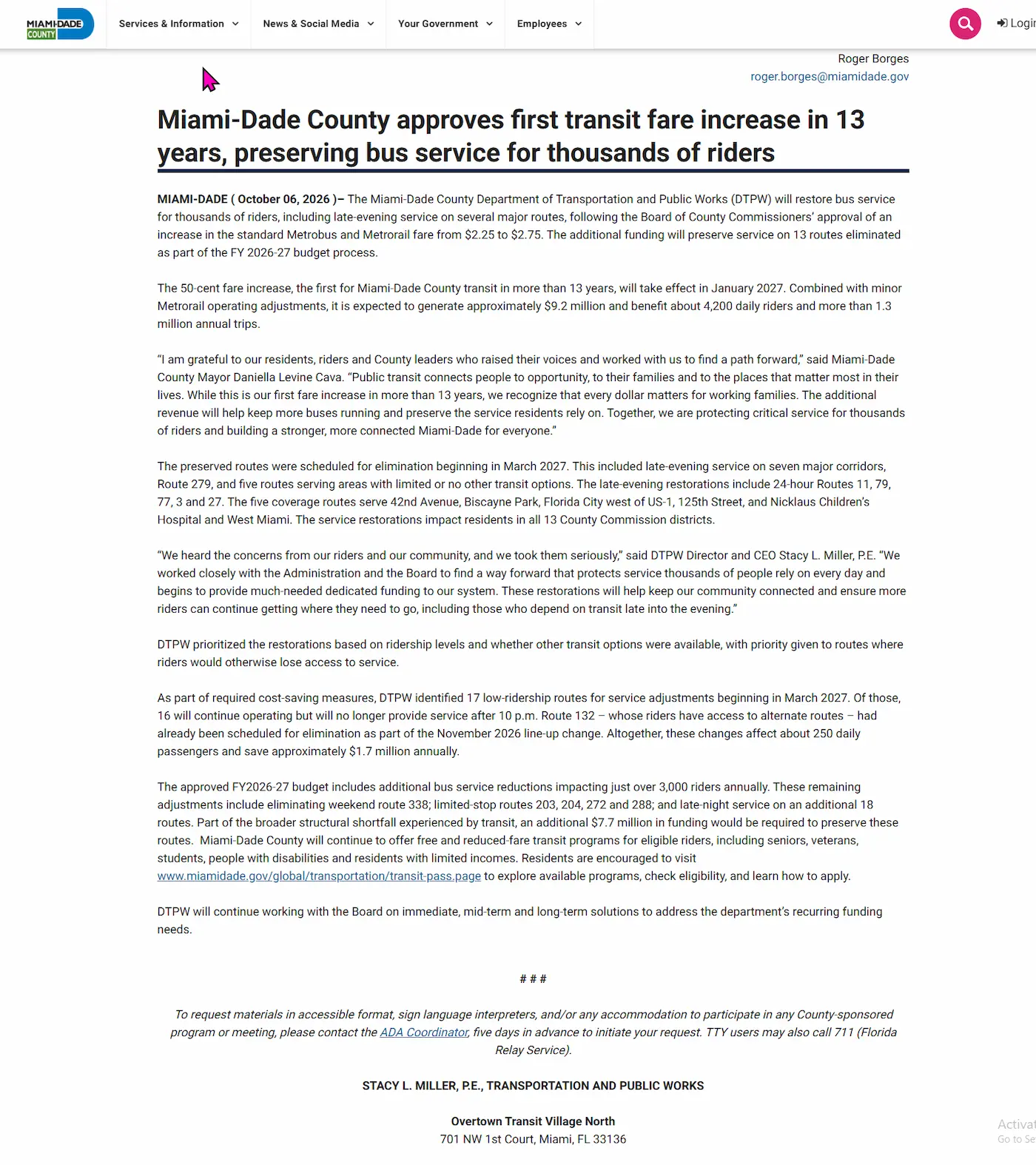
In addition to those 13, the same press release describes TWO more groups that the fare increase does NOT cover. First, 17 low-demand routes with schedule adjustments beginning in March 2027: 16 of them will continue to operate but will not run after 10:00 p.m., and Route 132—whose passengers have alternative routes, according to the press release—was already scheduled to be eliminated in the November 2026 schedule change; overall, the county estimates that these changes affect about 250 passengers per day and save $1.7 million per year.
Second, “additional bus service reductions affecting just over 3,000 riders annually”: the elimination of the weekend Route 338, the limited-stop routes 203, 204, 272, and 288, and night service on 18 additional routes—adjustments that, according to the press release, would require an additional $7.7 million to maintain, funds that the fare increase does not cover.
A woman attending that public meeting, identified by WSVN as “Gabriela,” estimated in her public comments that taking the Metrorail twice a day would cost her $240 a year—her own personal estimate, not a figure the county has published as a typical or universal cost (WSVN).
And this is not a new problem: it has remained unresolved for 24 years. In 2002, county voters approved a half-cent sales tax—the “People’s Transportation Plan”—with the explicit promise to extend the Metrorail to the southern part of the county, toward Homestead. In 2018, the administration of then-Mayor Carlos Giménez decided not to build that rail line: the county’s Transportation Planning Organization (TPO), in a 15-to-5 vote, approved a $243 million bus rapid transit (BRT) system instead.
According to CBS Miami, the Metrorail extension that was rejected had been estimated to cost about $1.3 billion—about four times more expensive than the BRT. Giménez himself defended the decision on cost grounds: “That was a good vote because now we can actually start doing something rather than promising people things that really can’t come to pass” (CBS Miami).
Neither WLRN nor CBS Miami—the archived sources on this decision—attribute to Giménez the argument that there is a lack of passenger demand in the southern part of the county; the argument that is cited in both is cost. The then-mayor of Cutler Bay, Peggy Bell, responded at the time: “Please don’t relegate us to the bus forever, because if you make that decision today, that’s what you are doing” (“por favor no nos releguen al autobús para siempre, porque si toman esa decisión hoy, that is what you are doing”), according to the same CBS Miami report cited above.
The stations on the “South Dade Transitway” (the BRT) opened in October 2025 (Miami Today does not specify the date).
Homestead Mayor Steven Losner called on the county to STOP the system, according to remarks reported in a Miami Today column published on May 27, 2026 (that is the publication date; the article does not specify the exact day Losner made the statement, and places the statement before the county’s own Transportation Planning Organization): according to that publication, he said that the BRT had created “traffic chaos in all of South Dade,” because the system disrupts traffic at 47 intersections along its 20-mile route, and that traffic light synchronization “is still being adjusted” (Miami Today, May 27, 2026).
This article does not claim that a Metrorail extension, had it been built, would have been free of other problems; nor does it claim that cost was the official rationale in every instance after 2018—only that it was the rationale for that particular decision. Nor does it claim that a dedicated rail line is necessarily free of traffic lights along its entire route—it depends on how far it is separated from traffic, and this article did not verify the design of the extension that would have been built.
It does, however, establish—with sources—that the 2002 promise remains unfulfilled 24 years later, and that the bus alternative built in its place is now facing—according to the mayor of the very city it was meant to serve—a documented complaint regarding traffic and traffic lights.
What Cava said, with the date and source
Cava called the amendment “deceptive” in an interview with WLRN on September 2: “It’s being presented as a simple tax cut, but it doesn’t eliminate the cost of providing the services that our communities depend on; it just changes who pays for them.”
A day later, on September 3, WFLX reported that Levine Cava said the county could lose “about 10% of its general fund revenue in the first year and 20% in the second.”
The “10%” figure matches, in magnitude, what had already been stated in the July 15 press release, when the budget was still a proposal; the “20%” figure is not supported by that press release, which for the second year provides only a dollar amount, not a percentage. Using the definition of the General Fund provided in the budget itself (Countywide + UMSA), this publication was unable to reproduce either of the two percentages using the available budget data, nor could it determine what methodology the administration used to arrive at them—see the analysis above. This September 3 statement also predates the budget’s final adoption on September 18.
Other figures with the same impact do not match. On September 2, WLRN directly attributes a different projection to Miami-Dade County: “Miami-Dade County projects a tax revenue loss of $359 million in just the first year” — $26.5 million less than the $385.5 million cited on page 26, which is attributed to the county as a whole, without specifying an official or document.
Ava Habif, of Friends of the Miami-Dade Public Library, told CBS Miami on October 1 that the amendment would account for “nearly 20%” of the library system’s budget (“a tsunami for the system”); Eight days earlier, on September 23, WLRN had reported that the Keep Libraries Funded coalition—founded by members of that same organization and coordinated by Habif, according to WLRN—estimated the loss at $20 million; WLRN itself estimated that this amounts to about 16% of the $124 million operating budget from the previous fiscal year (WLRN).
The 16% is, therefore, an arithmetic average based on the coalition’s figure, not a percentage provided by the organization; and it was not confirmed that Habif’s “nearly 20%” and that calculation refer to the same fiscal year or the same revenue category, so the difference is noted without calling it a contradiction.
The 19 fire stations: she herself reiterated this in West Kendall, subject to conditions, and without a specific plan in place
NMD recorded West Kendall’s entire presentation and confirms, with its own transcript, that Cava repeated this figure there. The presentation was in English; here is his exact, verbatim quote at the 23:33 mark: “So we don’t know exactly what would be cut, but we can estimate the kinds of impacts that it could have.”
And at 24:56–25:08: “So we’re looking at the possibility of as many as 19 fire stations closing, which of course could lead to delays in response times, and as many as 665 firefighters who might lose their jobs.” (Translation by NMD: “We don’t know exactly what would be cut, but we can estimate the kind of impacts it might have”; “We’re looking at the possibility of up to 19 fire stations closing, which of course could lead to delays in response times, and up to 665 firefighters who could lose their jobs.”)
This is the same figure reported by CBS Miami on September 28, which was repeated in conditional terms (“we’re looking at the possibility,” “might”) eleven days later, at an event that this article did document firsthand.
On September 28, CBS Miami (Manuel Bojorquez) reported that Levine Cava said: “I can say that for what we’re responsible for in Miami-Dade—Fire [services]—we could lose as many as 19 fire stations and over 600 firefighters. As for libraries, we could close 10 of our 51 libraries.” The same article attributes the figure of “nearly $390 million” in the first year to her office. CiberCuba includes the same quote in its October 10 coverage. There is an associated video from CBS Miami (2:22 min) that this article did not verify in terms of audio, only in the published text.
No budget document found—neither the Executive Summary nor the Fire Rescue budget—explains the calculation behind “19 stations.” The MDFR’s proposed FY2026-27 budget shows 73 fire stations and a total operating budget of $927.9 million; the specific impact of Amendment 3 on the Fire District—as shown above on page 26 of the Executive Summary—is $83.6 million in the first year.
This article does not break down those figures by the number of stations to “prove” or “disprove” the 19: an average cost per station does not equal the actual savings from closing a specific station, because it includes administrative and other services that likely would not disappear with a closure. The unanswered question is what model, what avoidable costs, and what staffing levels underpin the figure—not whether a simple arithmetic division reproduces it.
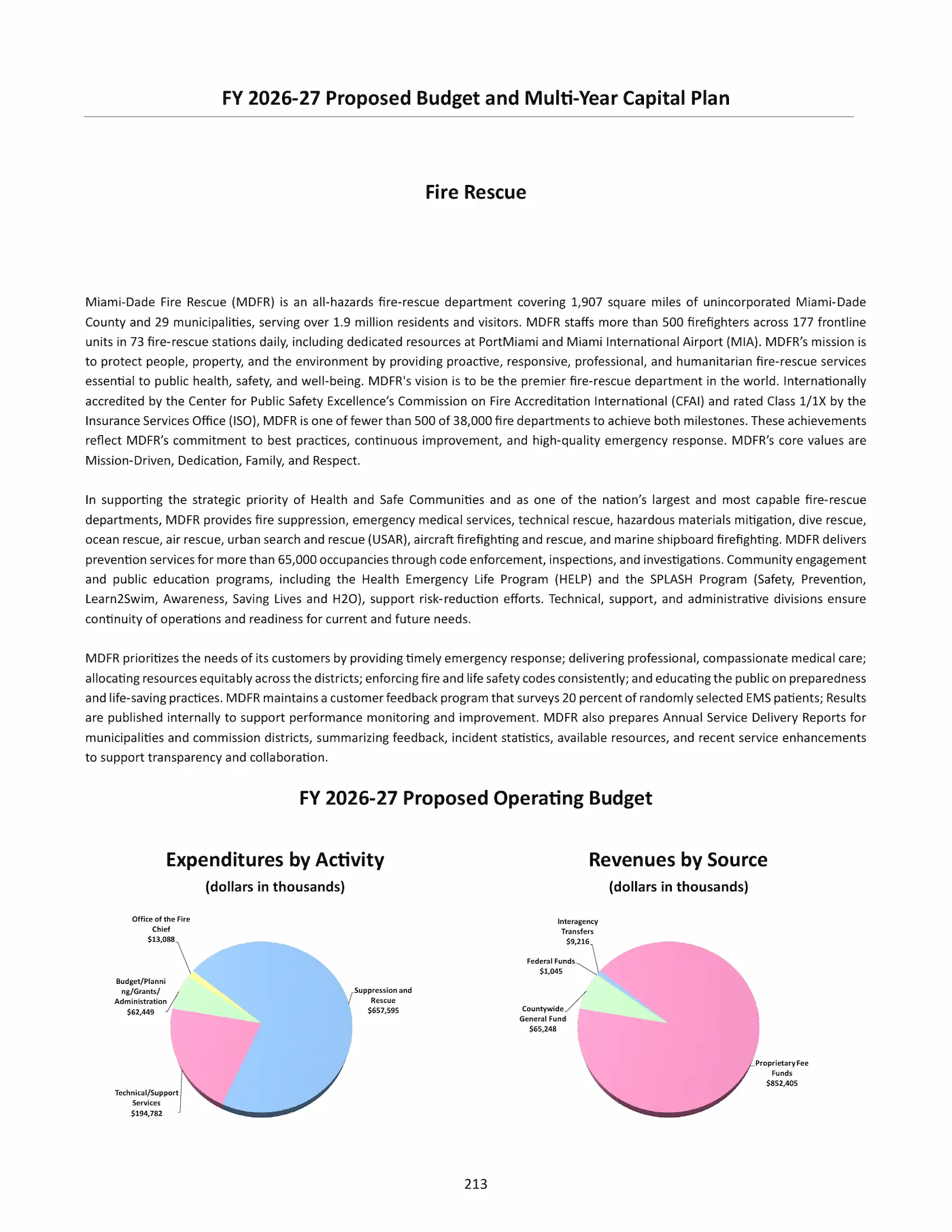
Page 213 of the Miami-Dade Fire Rescue proposed budget for FY2026-27, which lists 73 stations and more than 500 firefighters in 177 frontline units.
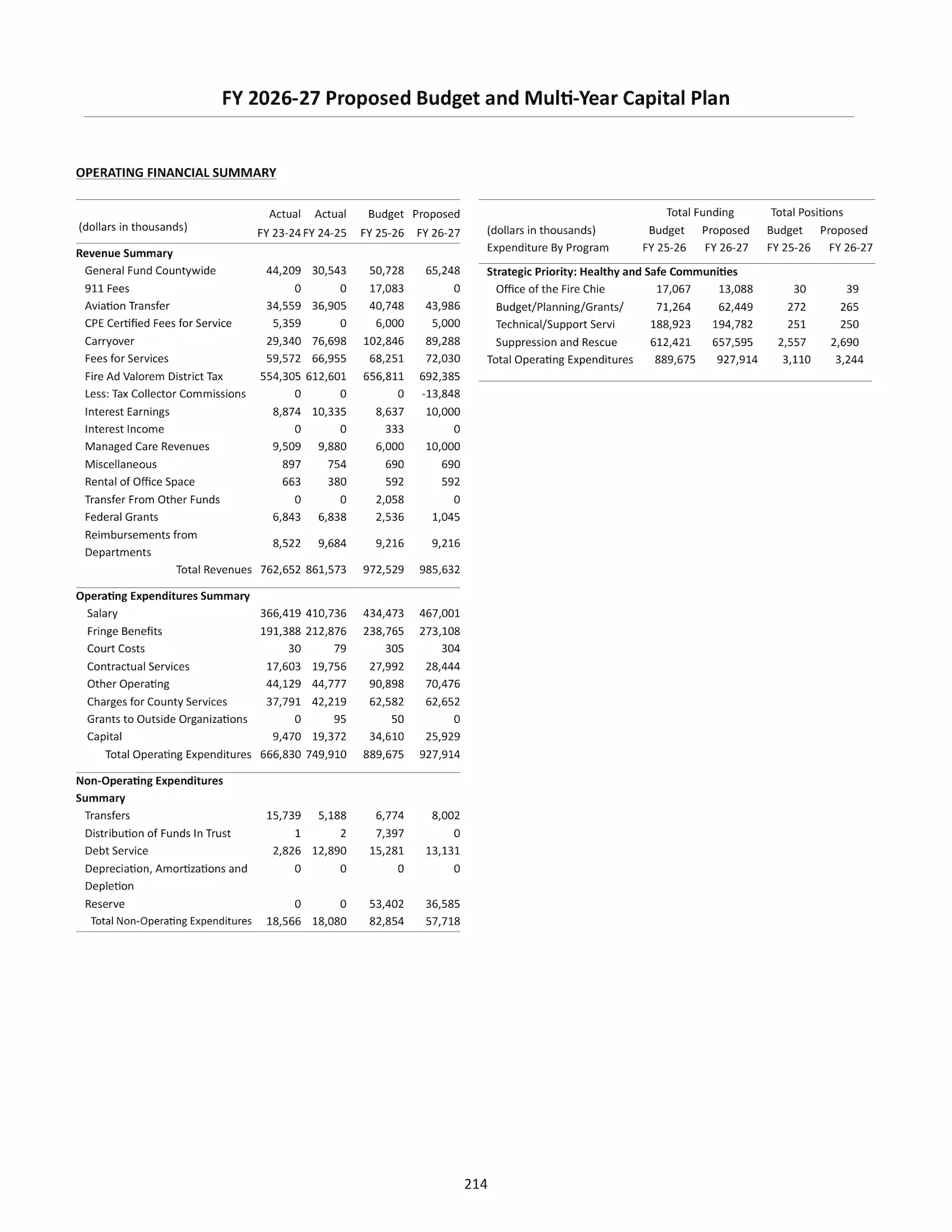
Page 214 of the same document, “Operating Financial Summary,” shows a total of $927,914 thousand ($927.9 million) in Total Operating Expenditures.
Separately, on September 28, three Miami-Dade elected officials—Property Appraiser Tomás Regalado, Supervisor of Elections Alina García, and Tax Collector Dariel Fernández—publicly endorsed Amendment 3, according to the same CBS Miami report; this report does not contain its own record confirming whether it was at the same event where Cava made his statement about the 19 stations.
García said, “It says public safety will always come first, so this will not affect public safety.” The text of the amendment does include public safety, fire protection, and emergency services among the authorized uses of the general property tax—the list of seven uses in Article VII, Section 9(a)(2), cited above, is not limited to “residual revenue”: it covers everything that counties and municipalities collect from that tax—but that provision does not establish a guaranteed minimum budget nor does it ensure the retention of a specific number of stations or employees—it is an authorized use within a list of permitted uses, not a protected figure or a mandatory allocation order.
A week later, on October 5, the Miami-Dade Democratic Party called for García to recuse herself from the canvassing board, citing a conflict of interest stemming from her oversight of a ballot that includes a measure she herself supports; García rejected the request, maintaining that she spoke “as a private citizen and a mother”—the same distinction this publication has already documented in a separate article about Alina García.
The response: “manageable,” “a complete falsehood,” “scare tactics”
Verbatim, minutes 6:24–6:42: “In a budget of 13,000 million dollars […] there’s a deficit of 300-something, 400 million. Let’s allocate 500 million so we don’t have to fight with them. That’s manageable.” Minute 7:16, regarding warnings about service cuts: “That narrative they’ve been pushing—that it will affect basic services […]—is a complete falsehood.” Regarding Governor Ron DeSantis: WFLX, in an article already archived by this publication, states in its own paraphrase that “he rejected warnings that the amendment would leave communities unable to provide basic services.”
Sheriff Rosie Cordero-Stutz posted her full statement on X on September 22, 2026 (6:12 p.m., 125.8K views), in English and Spanish, verified on October 13 directly against the original post: “Florida homeowners deserve meaningful relief from rising property taxes, and they have every right to consider Amendment 3 on its merits—not based on fear or speculation. Voters should not be led to believe that saving money on their property taxes must mean fewer deputies or weaker public safety. Tax relief and public safety are not competing priorities.”
“Every government agency, including the Sheriff’s Office, has a responsibility to carefully examine its spending, identify efficiencies, eliminate unnecessary costs, and ensure that taxpayer dollars are being used wisely. We can respect taxpayers while continuing to provide strong and effective law enforcement. As sheriff, I will always protect the resources necessary to keep Miami-Dade safe. Public safety will remain my priority, and it should not be used to scare voters away from Amendment 3’s property tax relief.”
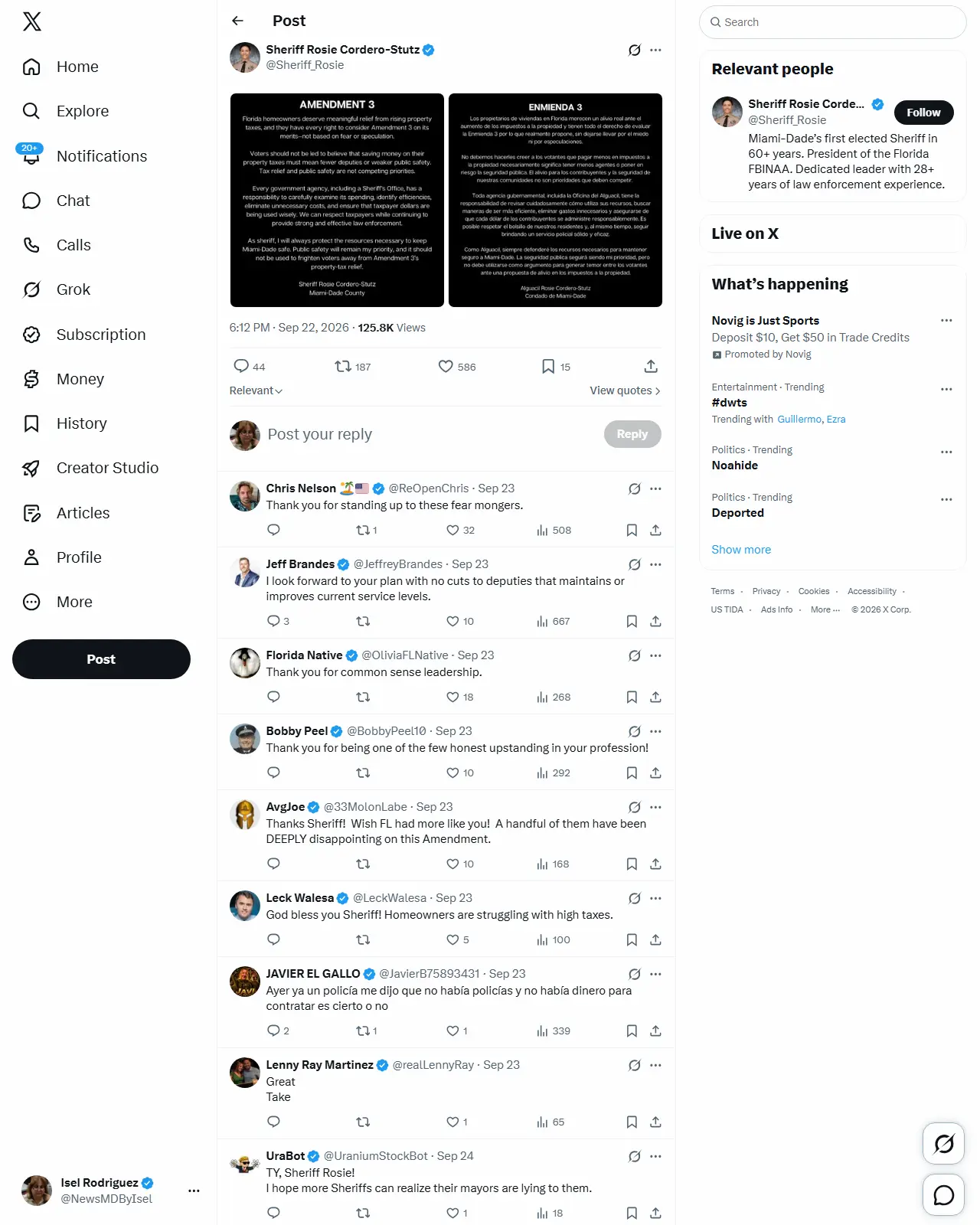
Screenshot of Sheriff Rosie Cordero-Stutz’s post on X (@Sheriff_Rosie), September 22, 2026, at 6:12 p.m., featuring the full statement in English and Spanish.
The two shortest sentences from that statement were already circulating before this fact-check, attributed to Cordero-Stutz on NBC6 (Hatzel Vela, September 23, 2026) and on Local10 (Andrea Torres, October 8, 2026); both general-interest media outlets confirmed the text, though without the original post. According to the Florida Politics headline, county Republicans described the warnings about weaker services as “fear tactics”—this outlet was unable to access the full text of that article (paywall), so nothing beyond the headline itself can be confirmed.
“Gifted,” in his own words: seventeen posts from the same official account, August–October 2026
Between August 5 and October 10, 2026, the official Instagram account of the Miami-Dade Property Appraiser’s Office posted at least seventeen videos about Amendment 3, almost all of which featured Regalado himself speaking on camera or in an interview. News Miami Dade downloaded and transcribed them on October 11, 2026; the complete archive with source information is available at 2-SOURCES/social-media/regalado-property-appraiser/. Verbatim transcripts of the passages, 100% accurate:
https://www.instagram.com/tomasregaladomdc
- Oct. 12, 2026 — During his interview with journalist Marian de la Fuente on UniVista TV, real estate appraiser Tomás Regalado shared his personal perspective on Amendment 3 and the financial pressure many homeowners are facing.
- Oct. 10, 2026, Big Five Club community event — he gives residents a savings figure: “If this amendment passes, you would be paying at least 30 or 40 percent less than what you currently pay in property taxes.” In this video, Regalado does not specify the home value or the base tax bill on which that calculation is based; without those assumptions, it is impossible to verify whether it applies to a specific homeowner or is merely a favorable example.
- Oct. 2, 2026 — During his interview with journalist Marian de la Fuente on UniVista TV, property appraiser Tomás Regalado shared his personal perspective on Amendment 3 and the financial pressure many homeowners are facing. Interview with Marian de la Fuente (UniVista TV) — he specifically rejects the firefighters’ sign campaign: “We’ve seen signs put up by firefighters on the streets that say ‘Save a life’ in big letters, ‘Vote no on Amendment 3.’ Are you going to tell me that the fire department is going to stop using its rescue equipment…? Of course not.”
- September 17, 2026, interview with Cao — he draws on his own experience as mayor of Miami during the 2009 mortgage crisis (a $100 million deficit) to argue that a government can cut spending rather than raise taxes to the maximum: “We had two options: raise taxes as high as possible, but we would have killed a city to save a government. What did we do? We cut spending.” Interview with Cao — explicit personal endorsement and explanation of the cap on non-homestead properties: “Amendment 3, when you vote ‘yes,’ states that, under state law, no property taxing authority may raise taxes by more than 5 percent.” Clarification: What the law limits to 5% is the annual growth in the ASSESSED VALUE of certain non-homestead properties, not a general cap on how much any homeowner’s tax bill can increase.
- Sept. 4, 2026 — In a Local 10 News report on Amendment 3, Property Appraiser Tomás Regalado shared his personal stance in support of the measure, which Florida voters will decide this November.
- September 1, 2026 — explicitly calls for a “yes” vote: “My recommendation is that you consider voting ‘yes’… My recommendation is that you say ‘yes,’ because the world isn’t going to end, but we—individually and as a community—will be paying less in taxes.” In the same video, he dismisses warnings of budget cuts: “You’re going to hear a lot of this; they’ll tell you that if you vote ‘yes,’ there won’t be any police or firefighters left, and parks will have to close. That’s not the case.”
- Aug. 10, 2026 — According to the caption of that post, it warns that organized opposition to Amendment 3 is expected in November.
- Aug. 9, 2026 — explains that the wording on the ballot should have been revised after it was challenged by a judge in León County.
- August 8, 2026, Miami-Dade County League of Cities Board of Directors meeting — quote from the caption, unconfirmed against the audio: “No matter what changes are made to the language, we will be voting on November 3 on Amendment Three.”
The same legal question, now applied to the side that supports the amendment
This article discusses below, in the section titled “The Legal Question,” whether Cava’s series of town halls falls under any of the exceptions in Statute 106.113 regarding the use of public resources for communication on a ballot issue. The same question applies, under the same statute, to these posts by Regalado—and here the text is more direct: while Cava’s invitation “does not mention Amendment 3 or ask for a specific vote” (see above), at least two of Regalado’s videos DO explicitly ask for a vote (“my recommendation… is that you vote yes”) from his office’s official account.
Subsection (2) of Section 106.113 prohibits the expenditure of public funds on communications regarding a ballot issue “irrespective of whether the communication… advocates for its passage or defeat,” with the same exceptions already cited (reporting on official actions, factual information on-site or in printed materials, public forums, and responses to direct inquiries). Subsection (3) allows an elected official to express a personal opinion, but—when read in its entirety, as explained below in the section “The Legal Question”—that permission is subject to the prohibitions in subsection (2) when it comes to public spending; it is not independent of them.
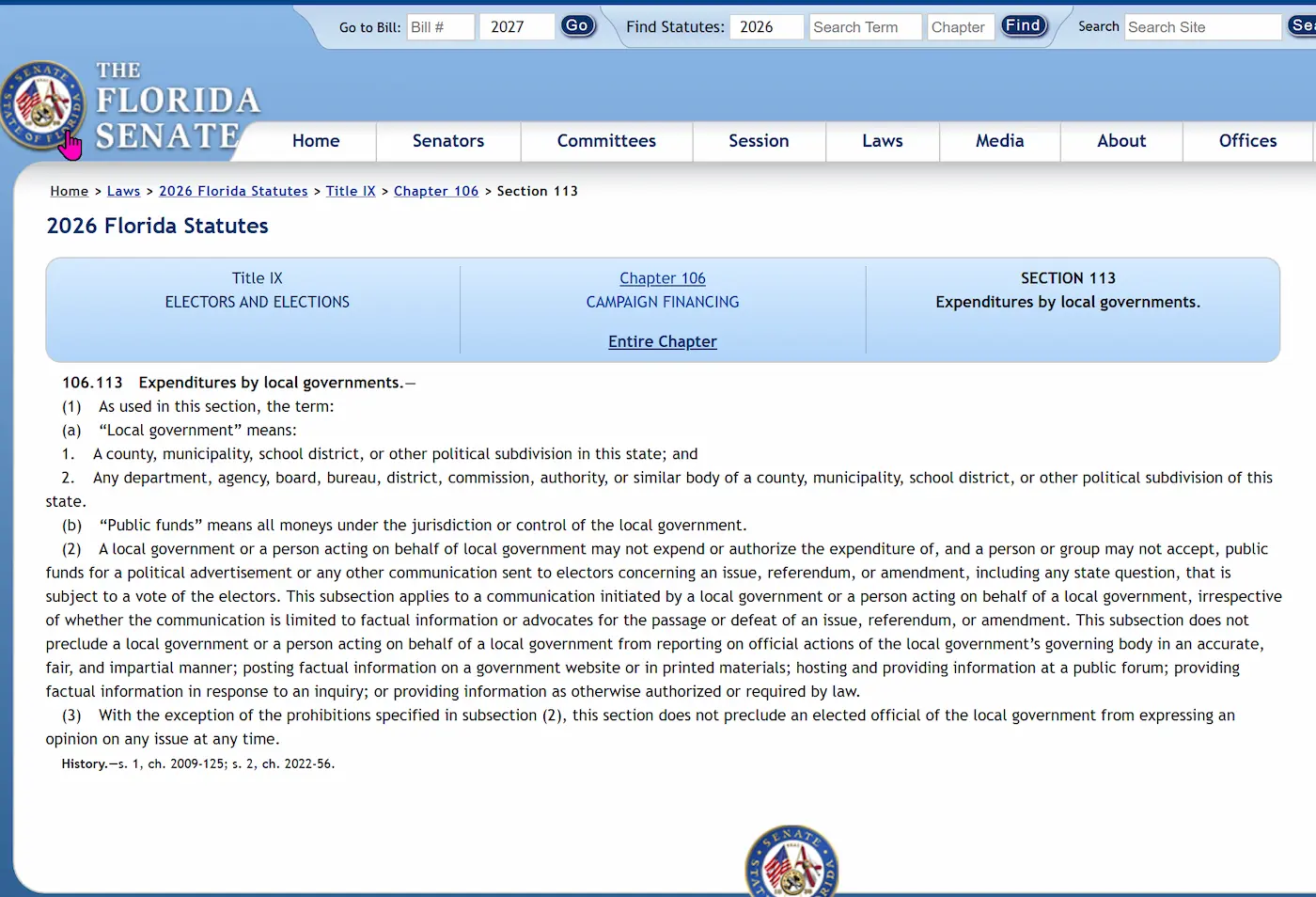
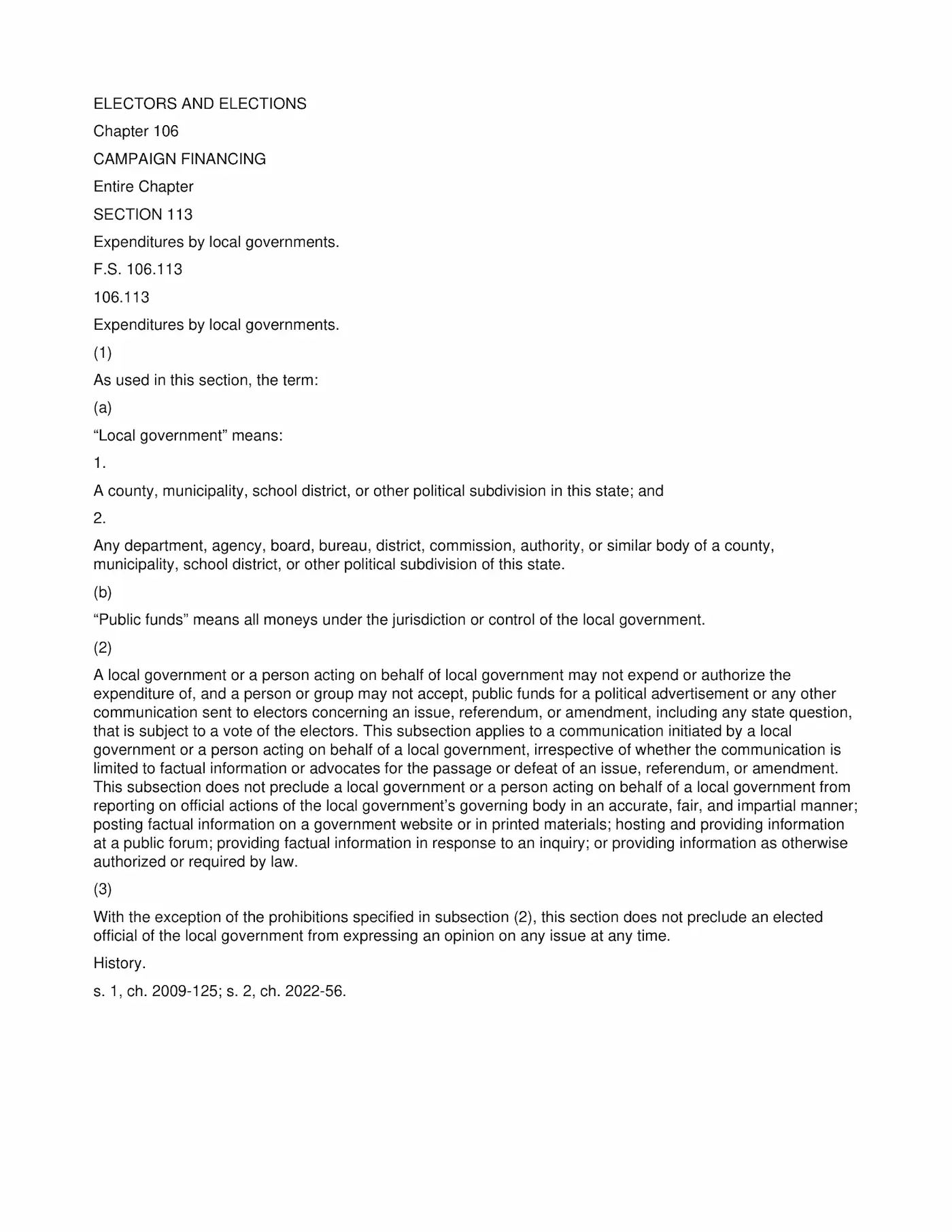
Florida Statute 106.113, 2026 edition, including subsection (2) (“irrespective of whether the communication is limited to factual information or advocates for the passage or defeat”) and subsection (3) (“With the exception of the prohibitions specified in subsection (2)…”).
It is not claimed here that these posts violate the law: it was not verified whether Instagram, as a platform, falls under any of the exceptions (it is clearly not an “official website or printed materials” in the literal sense of the text, but it is not ruled out either), nor was it investigated whether there are direct public expenditures associated with the production of these videos (equipment, staff, contracted social media services). It is established, though unresolved, that the same legal question this article previously raised regarding Cava’s town halls applies just as directly—and with more explicit language calling for a vote—to the official account of the Property Appraiser.
WFLX, updated on September 3, reports that DeSantis said: “You vote for it, you’ll pay less. End of story.” The article itself places that statement on “Monday,” without specifying the calendar date of that Monday—which is not necessarily September 3, the date the article was updated—; this piece did not confirm the exact date of that Monday.
The official “Vote Yes on 3” website—funded with $10 million from Florida Realtors, according to campaign finance records, as reported by WLRN on September 9, 2026 (WLRN; — explains the expansion of the exemption and clarifies that “school funding is protected”; it makes no mention of firefighters, libraries, or public safety.)

Screenshot of the “Vote Yes on 3” official page from Florida Realtors, under the “What Amendment 3 Does” section, featuring the phrase “School funding is protected” and making no mention of firefighters, libraries, or public safety.
In appearances on national television and on X, DeSantis offered a different technical argument. The full quote, VERIFIED on October 13 directly against the original post by @RonDeSantis (October 3, 2026, 12:31 p.m., 114,2K views, in response to an Orlando Sentinel op-ed by former Oviedo Mayor Dominic Persampiere—now a real estate agent—titled “Amendment 3 is a tax shift to non-homestead properties”): “Amendment 3 provides historic property relief for homestead properties. It does not impose or ‘shift’ any taxes. In fact, commercial properties (including apartment complexes) will see their property tax liability reduced from 10% annual valuation increases under current law to a maximum of 5% valuation increases under Amendment 3.”
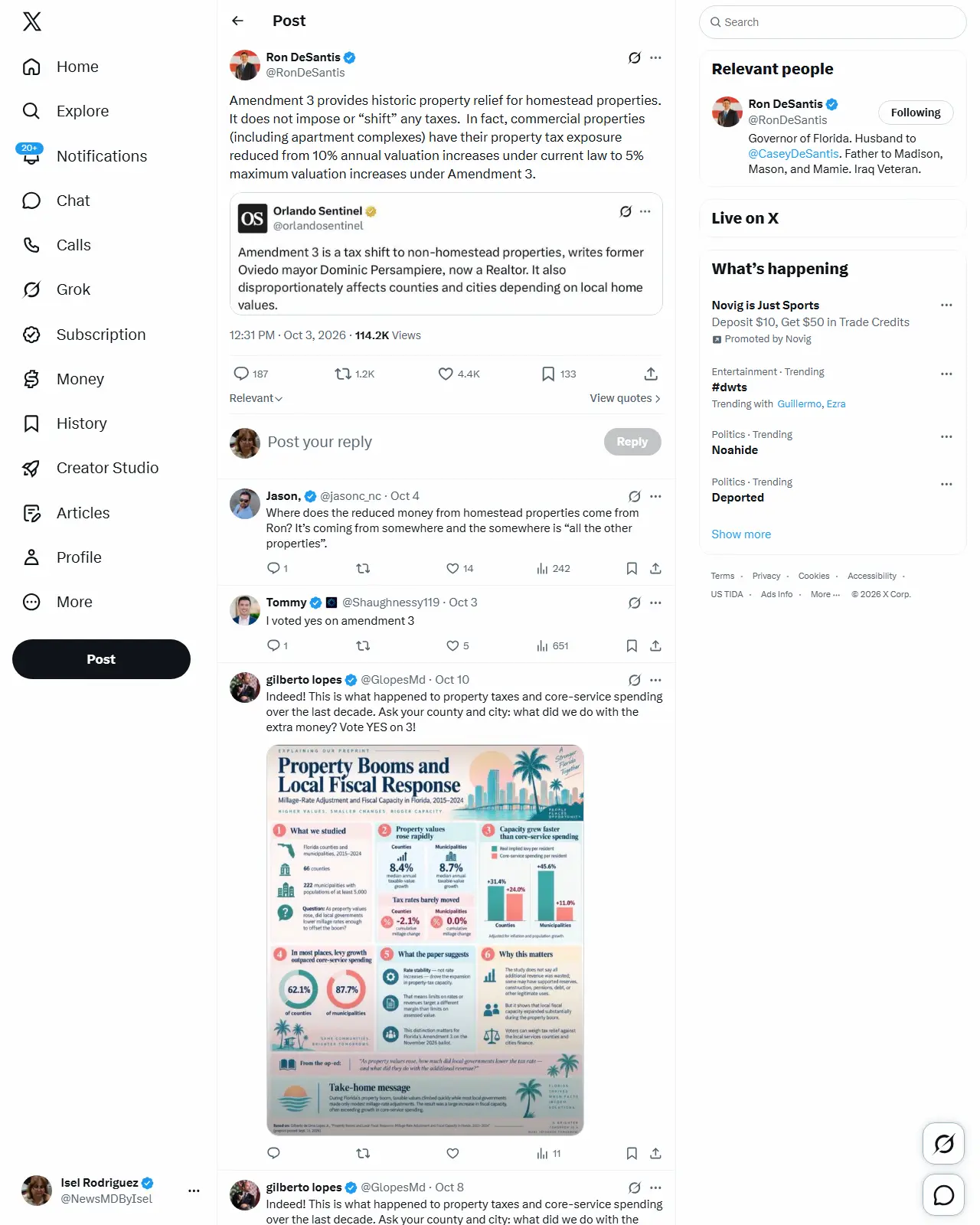
Screenshot of Ron DeSantis’s post on X (@RonDeSantis), October 3, 2026, at 12:31 p.m., responding to the Orlando Sentinel op-ed, with the full quote.
His argument is not that tax revenue will not decline, but rather that the amendment does not force anyone to pass on the cost—it reduces, for non-homestead properties, the cap on annual assessment growth from 10% to 5% (as stated in the text of the amendment itself, cited earlier in this article). A lower cap on assessment growth does not, in and of itself, guarantee a tenant’s final bill or ensure that rent will go down: it limits how much the tax base can rise, but it does not require the savings to be passed on.
On this point, DeSantis said that nothing in the amendment requires local governments to pass the cost on to tenants: “I don’t think they would admit to doing that, but I think it also is a fundamental misunderstanding of what it actually does.”
This second source was verified word for word in a general open-access source, Miami Times Online, which republished (labeled “Wire”) the same article from Florida Politics—October 7, 2026, by A.G. Gancarski—without the paywall that blocks access to the original Florida Politics article.
Video 1: Residents, elected officials, and public policy experts debate the pros and cons of Amendment 3 in Palm Beach County on October 7, 2026. Local file: sources/videos/2026-10-07_wflx_palm-beach-voters-pros-cons-amendment3.mp4 (1 min 55 s).
The legal question: Can the county use its own resources for this?
Florida Statute 106.113 prohibits a local government from spending public funds on communications to voters regarding a ballot measure—“irrespective of whether the communication is limited to factual information or advocates for the passage or defeat”— but it does not prohibit: reporting on official actions in an accurate, fair, and impartial manner; publishing factual information on an official website or in printed materials; organizing and providing information at a public forum; responding with factual information to a direct inquiry; and providing information in any other manner authorized or required by law.
Before 2022, the law contained a different general exception: it was sufficient for the communication to be “limited to factual information.” The Legislature eliminated this exception in 2022 and replaced it with these provisions—the “public forum” exception, unlike the “website or printed materials” exception, does not include the word “factual”—an interpretive issue that this analysis does not resolve; no ruling issued after 2022 was found that resolved that issue.
The absence of the words “Amendment 3” or an explicit call to vote in the invitation is not, in and of itself, sufficient to determine whether the series of town halls falls under this exception.
There is a similar precedent, predating the reform: in 2014, Miami City Attorney Victoria Méndez consulted the Miami-Dade Ethics and Public Trust Commission regarding an elected official who planned to visit “community centers, elderly centers, or other venues” to “educate and/or advocate to the public” on a ballot measure, bringing staff from his office. Méndez’s inquiry itself described these actions as “actions that elected officials and staff can do as part of their official duties”; the Commission’s verbatim response (Miriam S. Ramos) was: “That is correct” (INQ 14-178, predates the 2022 reform; it is not presented as definitive authorization for the 2026 actions).
[UPLOAD PLACEHOLDER — Image 26: Page 1 (of 2) of Opinion INQ 14-178 from the Miami-Dade Ethics and Public Trust Commission, 2014, with the response “That is correct” to the inquiry from City Attorney Victoria Méndez. Local file: sources/images/2026-10-14_miamidade-ethics_inq-14-178-pag1-that-is-correct.png. Required caption: “Local copy, Miami-Dade Commission on Ethics and Public Trust, INQ 14-178, page 1, ethics.miamidade.gov.” src=”[UPLOAD TO WORDPRESS — local path — replace with media URL]”]
Subsection (3) of the statute, read in its entirety, begins as follows: “With the exception of the prohibitions specified in subsection (2), this section does not preclude an elected official… from expressing an opinion.” In other words, an elected official’s right to express a personal opinion is subject to the prohibitions in subsection (2); it is not independent of them.
There is a second ruling (INQ 15-244, 2015) regarding the personal expenses of an elected official under that same subsection (3); its exact content COULD NOT BE VERIFIED because it could not be archived using a source that can be accessed, so it is not cited.
This media outlet found no evidence of spending on paid advertising, direct mail, or printed materials specifically for the town hall series, beyond the email sent to the official mailing list—and did not review the county’s spending records (OMB, purchase orders) for this series, which remains pending.
Neither of these has a direct connection to Amendment 3: they are part of the same broader contrast between warnings of budget cuts and how existing funds have been managed. (A third case, the one involving the Fisher Island fuel depot and the federal eminent domain lawsuit against the county, is covered separately in a standalone NMD piece on PortMiami, with its primary court record already on file, so as not to mix ongoing litigation with information in this case that has not yet been confirmed by an independent source.)
Animal Services: Protests have been documented at the very same shelter that Cava’s presentation identifies as a future solution. Cava said in West Kendall that a new 25,000-square-foot South Dade Adoption and Protection Center will replace the Medley overflow shelter, with an opening scheduled for the summer of 2027.
What his slide didn’t show: The lack of air conditioning at Medley is a long-standing complaint, documented by NBC6 in an investigative report on funds allocated to repair the facility (NBC6; local archive at documents/press-secondary-2026-10-12/nbcmiami_medley-shelter-no-ac-mayor-permanent-solution.pdf).
On July 27, 2025, WSVN reported on a protest following the death of a dog named Rocky at that facility: According to that report, the protesters as a group—not an identified individual—said that Rocky “died of heatstroke inside his cage” and accused the staff of taking the dogs out for walks “only 10 minutes a day”; among those present was a protester whom WSVN named, but the report does not attribute those two statements to her individually, so this article does not do so either and does not repeat her name.
County spokeswoman Gabriella Dominguez responded that Rocky was “seriously ill” and that “the compassionate decision was made to euthanize him humanely,” and the county said that the dogs have access to wading pools and are given ice daily in the summer (WSVN; local archive at documents/press-secondary-2026-10-12/2025-07-27_wsvn_protesters-rocky-death-medley-shelter.pdf).
This article did not independently verify the cause of Rocky’s death—nor did it confirm the medical records that the county claimed to have released, which this article was unable to locate on its own—: the claim of heatstroke comes from the protesters quoted by WSVN, not from this article’s own findings.
The county maintains that it upholds a high “no-kill” rate within its system—a general policy certification, not a guarantee that any individual animal will not be euthanized— and Cava herself has publicly promoted adoption, describing the county’s system as Florida’s largest no-kill, open-intake shelter. This article does not assert which version of Medley’s current circumstances is correct; both are documented, with their respective sources.
The dispute with the firefighters’ union over the helicopters occurred one budget cycle before this Amendment 3. In August 2025, during negotiations for the FY2025-26 budget (the cycle PRIOR to the one referenced in the rest of this article), the Cava administration proposed shifting the cost of the county’s four air rescue helicopters—a total of $28 million per year—from the countywide General Fund to the Fire District, which covers the 29 municipalities in the district.
William McAllister, president of Local 1403, warned that the measure would limit the ability to open new fire stations and threatened to file a lawsuit, with representation from the law firm Holland & Knight. Cava responded that service would not change and that the public would not be affected.
There is, in fact, a documented outcome—though not regarding the lawsuit: the memorandum from the Mayor’s Office to the Commission for the second budget hearing, dated September 12, 2025, states verbatim: “In response to discussions at the first hearing, we are also shifting the costs for Air Rescue from the Miami-Dade Fire Rescue budget to the General Fund, although I want to continue to stress, as we did at the hearing, that the original proposed budget had no impact on public safety or fire rescue services.”
[PLACEHOLDER FOR UPLOAD — Image 27: Page 2 (of 61) of the Mayor’s Office memorandum to the Commission for the second FY2025-26 budget hearing, September 12, 2025, containing the phrase “we are also shifting the costs for Air Rescue from the Miami-Dade Fire Rescue budget to the General Fund.” Local file: sources/images/2026-10-14_miamidade-gov_memorandum-2025-09-12-page2-air-rescue-general-fund.png. Required caption: “Local copy, memorandum from the Mayor’s Office to the Commission, September 12, 2025, page 2 of 61, miamidade.gov/govaction.” src=”[UPLOAD TO WORDPRESS — local path — replace with media URL]”]
In other words: the original proposal (to shift the cost to the Fire District) was reversed before the budget was finally adopted, and the cost of Air Rescue remained in the countywide General Fund, not in the District. This article has yet to find confirmation that the union filed the lawsuit it threatened (WLRN, CBS Miami), but the funding change that prompted the threat was indeed resolved, and in the manner requestedby the union (Mayor’s Office memorandum, Sept. 12, 2025). This is a direct precedent for budgetary friction with firefighters over how costs are allocated—relevant now that there is talk of a possible closure of up to 19 stations.
What this article does not claim
- He does not claim that Cava deliberately exaggerated the impact: his dollar figure ($385–386 million / $696.7 million) matches the Executive Summary. His “10%” is close to the July 15 press release from his own office; his “20%” is not backed by a percentage figure in that same press release, which for the second year provides only dollar amounts. This article failed to compare either of the two percentages against the definition of the General Fund used in the budget itself (7.75%, see analysis above) nor did it identify the administration’s methodology for arriving at them—this leaves the explanation unresolved; it does not prove that the percentages are incorrect.
- It does not claim that town hall meetings violate the law: the 2014 precedent and the current text are consistent with this series falling under the “public forum” exception, but this article did not verify any specific associated expenses nor did it find a ruling issued after 2022 that resolves the interpretive issue regarding the text.
- It neither confirms nor denies what Cava said on “Decode the Ballot” or at the town hall meetings in Orange (Oct. 8) and North Dade (Oct. 10): no coverage of those two events was found. The West Kendall event (Oct. 9) is documented firsthand, with NMD’s own recording.
- It does not state whether the figure of 19 stations is correct or incorrect: Cava repeated it in the conditional tense, in West Kendall, in the same way that CBS Miami reported it on September 28, without any budget document found to explain the model behind it, and without this article presenting any arithmetic breakdown as a rebuttal.
- It does not assert that the posts from the official Property Appraiser account violate Statute 106.113: the same legal question previously raised regarding Cava’s town halls remains unresolved—it was not verified whether Instagram falls under any exception to the statute, nor was any investigation conducted into public expenditures associated with the production of those videos.
Timeline
| Date | Fact | Who | Source / status |
|---|---|---|---|
| July 15, 2026 | Official statement from the Mayor’s Office upon presenting the proposed budget: “$385.8 million in General Fund revenue… more than 10% of the County’s General Fund.” | Mayor’s Office | Official Statement, miamidade.gov |
| July 2026 (proposed budget) | Executive Summary, p. 26: $385.5 million (FY27-28) and $696.7 million cumulatively (FY28-29) in total impact; $236 million and $433.4 million of that amount goes to the Countywide General Fund. | Document (quote) | Executive Summary of the Proposed FY2026-27 Budget, miamidade.gov, p. 26 |
| September 2, 2026 | Cava calls Amendment 3 “deceptive” in an interview with WLRN; the same WLRN report attributes a projection of $359 million for the first year to the county. | Mayor Levine Cava | WLRN, Sept. 2, 2026 |
| September 3, 2026 | Cava says the county could lose “about 10% of its general fund revenue in the first year and 20% in the second.” | Mayor Levine Cava | WFLX, Sept. 3, 2026 |
| September 22, 2026 | Sheriff Cordero-Stutz endorsed Amendment 3 in a post on X (Sept. 22): “Voters should not be led to believe that saving money on their property taxes must mean fewer deputies or weaker public safety” and “tax relief and public safety are not competing priorities.” | Sheriff Cordero-Stutz | Post by @Sheriff_Rosie on X, Sept. 22, 2026 — previously partially reported by NBC6 (Sept. 23) and Local10 (Oct. 8) |
| September 23, 2026 | WLRN reports that the Keep Libraries Funded coalition (founded by members of Friends of the Miami-Dade Public Library) estimates the loss at $20 million; WLRN calculates that this amounts to about 16% of a $124 million operating budget. | Keep Libraries Funded (figure) / WLRN (estimate) | WLRN, Sept. 23, 2026 |
| September 28, 2026 | CBS Miami (Bojorquez) reports: Regalado, García, and Fernández support Amendment 3; Cava, in a statement attributed to him in the same article, says the county could lose up to 19 fire stations, more than 600 firefighters, and close 10 of its 51 libraries, resulting in a loss of “nearly $390 million” in the first year. | Regalado, García, Fernández, and Cava | CBS Miami (Bojorquez), Sept. 28, 2026 CiberCuba, Oct. 10, 2026 |
| Oct. 1, 2026 | Friends of the Miami-Dade Public Library cites a different percentage—“nearly 20%”—eight days after WLRN calculated 16% based on the coalition’s figure. | Friends of the Miami-Dade Public Library | CBS Miami, Oct. 1, 2026 |
| Oct. 5, 2026 | The Miami-Dade Democratic Party asks Alina García to step down from the Canvassing Board; she rejects the request. | Democratic Party / Alina García | CiberCuba, Oct. 5, 2026 |
| Oct. 5, 2026 | The Mayor’s Office has announced the five “Conversations with Cava” town hall meetings via official mail. | Mayor’s Office | Official email from the Mayor’s Office (sender: [email protected]) |
| Oct. 7, 2026 | Cava has been announced as a participant in the League of Women Voters’ “Decode the Ballot” initiative. | Mayor’s Office | Official Email from the Mayor’s Office |
| Oct. 8, 9, 10, 2026 | Three official town hall meetings scheduled (Orange, West Kendall, and North Dade libraries). The one on October 9, in West Kendall, was recorded and transcribed firsthand by NMD. The other two have not yet been covered locally. | Mayor Cava (event) | West Kendall: NMD’s own recording — full event on YouTube |
| Oct. 16, 17, 2026 | Upcoming town hall meetings: Arcola Lakes Senior Center and Hialeah Gardens Library. | Mayor Cava (scheduled event) | As of the publication of this edition, none have occurred. |
| Nov. 3, 2026 | Florida is voting on Amendment 3; it needs 60% approval. | Florida Voters (Election Event) | The 60% threshold established by Article XI, Section 5 of the Florida Constitution for any constitutional amendment, as set forth in the House of Representatives’ Final Analysis, CS/HJR 1F, Initiative 10-110 fact sheet, Florida Department of State |
Sources consulted
Level 1 — Official and Primary Sources
- Miami-Dade County, official press release, “Miami-Dade Mayor Daniella Levine Cava Proposes Balanced FY2026-27 Budget, Keeping the County Tax Rate Flat for the Fourth Consecutive Year,” July 15, 2026. Local archive at
2-SOURCES/01-county/miami-dade/elections/conversation-with-cava-Amendment-3/documents/official-county-press-releases/2026-07-15_miamidade-gov_press-release-proposed-budget-proposed-fy2026-27.pdf. Read press release - Miami-Dade County, Proposed Budget for FY2026-27, Executive Summary, p. 26 (“Property Tax Reform”). Local file, verified word for word, in
2-SOURCES/01-county/miami-dade/budgets/FY2026-27/FY2026-27_proposed-county-budget-proposed_county_fy2026-27-proposed-vol-1.pdf, page 26 of 282. Read document - Miami-Dade County, Proposed Budget for FY2026-27, “Our Financial Structure,” pp. 39–45 (defines the General Fund as Countywide + UMSA, and Fire Department/Libraries as separate special revenue funds). Official excerpt from the section, 7 pages, downloaded on October 14, 2026, and cross-referenced with Volume 1 (same page 39), filed at
2-SOURCES/01-county/miami-dade/budgets/FY2026-27/2026-10-14_miamidade-gov_fy2026-27-proposed-financial-structure.pdf. Read document - Miami-Dade County, Proposed Budget for FY2026-27, Appendix C (“Countywide General Fund Revenue”), p. 134: $2,873.605 million. Same local file as the previous source, page 134 of 282 (total “2,873,605” in thousands of dollars, verified). Read document
- Miami-Dade County, Proposed Budget for FY2026-27, Appendix D (“Unincorporated Municipal Service Area General Fund Revenue”), p. 135: $748,189 million. Same local file, page 135 of 282 (total “748,189” in thousands of dollars, verified). Read document
- Miami-Dade County, Proposed Budget for FY2026-27, “Budget-in-Brief,” p. 18: “Operating Budget by Source” table showing the “Total Employees” row for the last five fiscal years (30,050 to 31,942). Same local file as sources 2, 4, and 5, page 18 of 282, verified number by number; image of the page archived in
2-SOURCES/01-county/miami-dade/elections/conversa con cava Amendment 3/images/2026-10-12_miamidade-gov_budget-fy2026-27-p18-total-employees.png. - Official email from Mayor Levine Cava’s Office, October 5, 2026, sent by
[email protected]. No public URL (email received). Full text at3-CASES/03-elections/cas-03-014-conversations-with-cava-amendment-3/sources/01-primaries/2026-10-05_official-email-mayor’s-office_conversations-with-cava-verbatim.md; screenshot in3-CASES/03-elections/cas-03-014-conversations-with-cava-amendment-3/sources/images/2026-10-07_county-email-invitation_conversations-with-cava-tax-dollars-at-work.png. - Florida Statutes 106.113, 2026 Edition, full text. Local file at
documents/secondary-press-2026-10-12/2026_flsenate_statute-106113-2026-edition.pdf. Read the statute - Miami-Dade Commission on Ethics and Public Trust, INQ 14-178 (2014). Local archive at
documents/secondary-press-2026-10-12/2014-07-23_miamidade-ethics_inq-14-178-mendez.pdf. Read the ruling - Florida Realtors, official website for the “Vote Yes on 3” campaign. Local archive at
documents/press-secondary-2026-10-12/florida-realtors_vote-yes-on-3-official-website.pdf. View page - Ron DeSantis, post on X, October 3, 2026, 12:31 p.m., 114.2K views; verified on October 13, 2026 against the original post via authenticated login; screenshot archived at
2-SOURCES/01-county/miami-dade/elections/discussion-on-Amendment 3/documents/x-posts-2026-10-13/2026-10-03_x_desantis-historic-property-relief.png. View post - Rosie Cordero-Stutz, Miami-Dade Sheriff, post on X (@Sheriff_Rosie), September 22, 2026, 6:12 p.m., 125.8K views, statement in English and Spanish across two images; verified on October 13, 2026, against the original post; screenshot archived at
2-SOURCES/01-county/miami-dade/elections/conversation-with-cava-Amendment-3/documents/x-posts-2026-10-13/2026-09-22_x_sheriff-cordero-stutz-amendment3-complete.png. View post - Miami-Dade County, Proposed Budget for FY2026-27, Volume 2, Fire Rescue section, pp. 213–214 (73 stations, 177 front-line units, more than 500 firefighters; Total Operating Expenditures $927,914 miles). Local file at
2-SOURCES/01-county/miami-dade/budgets/FY2026-27/2026-10-07_miamidade-gov_fy2026-27-proposed-fire-rescue.pdf(official excerpt from the section, downloaded on October 7, 2026, and re-downloaded on October 10 with the same MD5). Read document - Circuit Court of the Second Judicial Circuit, Leon County, Judge David Frank, Final Order Granting Summary Judgment, Consolidated Cases 2026 CA 1254, 1381, and 1405, Save Our Voters From Misleading Ballot Language, Inc. v. Byrd, August 4, 2026, 18 pages, read in full. Local file at
2-SOURCES/01-county/miami-dade/elections/conversa-con-cava-Amendment-3/documents/order-judge-frank-leon-county-2026-08-04/2026-08-04_leon-county-circuit-court_final-order-save-our-voters-v-byrd.pdf. Read order - Instagram, Miami-Dade Property Appraiser’s Office (confirmed uploader: “Property Appraiser of Miami-Dade County”), Sept. 1, 2026, video with an explicit recommendation to vote. reel/Dcv1Jdti64Z — 100% transcribed by NMD
- Instagram, idem, Sept. 17, 2026, interview with Cao about the 2009 crisis. reel/DdY_K9qjOP2 — 100% transcribed by NMD
- Instagram, idem, Sept. 23, 2026, interview with Cao about the non-homestead cap. reel/DdoRbKGi6yY — 100% transcribed by NMD
- Instagram, same as above, Oct. 5, 2026, interview with Marian de la Fuente (UniVista TV) about fire department signs. reel/DeIVrj3ChBO — 100% transcribed by NMD
- Instagram, same as above, Oct. 10, 2026, Big Five Club event, savings of 30–40%. reel/DeUbCXziZxT — 100% transcribed by NMD
- Instagram, idem, Aug. 8, 9, and 10, 2026 (League of Cities, ballot language, organized opposition) — cited only by their captions, not transcribed. reel/Dby7m5tCpd9, reel/Db1TLihi5Pp, reel/Db4G1ZUCgD2
- James Uthmeier, Florida Attorney General, letter to Secretary of State Cord Byrd containing the rewritten text of the title and summary of Amendment 3, August 13, 2026, in the case Save Our Voters From Misleading Ballot Language, Inc. v. Byrd. Local file with OCR at
2-SOURCES/03-state/elections/amendment-3-property-tax-2026/two-10-110_AG-letter-attorney-general-rewritten-text-OCR.md. View original PDF - Florida Department of State, file on Initiative 10-110 (HJR 1F), including the full text of the amendment. See file
- Miami-Dade County, official press release, “Miami-Dade Commission Approves FY2026-27 Budget,” September 18, 2026 (confirms verbatim the $121 million from Wise305 “since 2025” and the elimination of 400 vacant positions). Local archive at
2-SOURCES/01-county/miami-dade/elections/conversa con cava Amendment 3/documents/press-releases-official-county/2026-09-18_miamidade-gov_press-release-budget-adopted-fy2026-27.pdf. Read press release - Miami-Dade County, Proposed Budget for FY2026-27, “Message from the Mayor,” p. 7–8 (the $42 million from WISE305 in FY2025–26 and the $79 million in additional cuts in FY2026–27). Same local file as the previous sources, pages 7–8 of 282, verified; official excerpt from the section, 2 pages, downloaded on October 14, 2026, and cross-referenced with Volume 1, filed in
2-SOURCES/01-county/miami-dade/budgets/FY2026-27/2026-10-14_miamidade-gov_fy2026-27-proposed-message-from-mayor.pdf. Read document - Miami-Dade County, official statement, “Metrobus and Metrorail Fare Increase,” October 6, 2026 (13 routes previously eliminated in the adopted budget, reinstated due to the fare increase; 17 low-demand routes with schedule adjustments starting in March 2027, 16 of which will no longer operate after 10:00 p.m.; Route 338 and limited-stop routes 203/204/272/288 eliminated separately, not covered by the fare increase). Local file in
2-SOURCES/01-county/miami-dade/elections/conversation-with-Cava-Amendment-3/documents/official-county-press-releases/2026-10-06_miamidade-gov_press-release-increase-metrobus-metrorail-fare-increase.pdf. Read press release - Florida Association of Counties, “FAC County Revenue Impacts Readers Guide and Disclaimer,” June 3, 2026, including the impact table for HJR 1F across Florida’s 67 counties (Miami-Dade: $304.2M FY2027-28 / $542.06M FY2028-29). Local file located at
2-SOURCES/01-county/miami-dade/elections/conversa con cava Amendment 3/documents/state-fiscal-impact-2026/and at2-SOURCES/03-state/elections/amendment-3-property-tax-2026/fac-fiscal-impact-guide-2026-06-03.pdf(archived from September 18, 2026). Read document - Florida League of Cities, table showing the impact of the $250,000 exemption on the assessed value of residential property, city by city, for all 67 counties in Florida, including the 34 municipalities in Miami-Dade. Local archive at
2-SOURCES/01-county/miami-dade/elections/discussion-on-Amendment 3/documents/state-tax-impact-2026/.Read document - Florida House of Representatives, Final Bill Analysis, CS/HJR 1F (h0001z.SAC), June 16, 2026 (Official state impact figure from the Revenue Estimating Conference: -$4.95 billion FY2027-28, -$8.78 billion FY2028-29, -$11.86 billion recurring impact). Local archive, full text, at
2-SOURCES/03-state/elections/amendment-3-property-tax-2026/house-final-analysis-hjr1f-h0001z-SAC.pdf(archived from September 8, 2026). Read document - Mayor’s Office, memorandum to the Commission for the second budget hearing, September 12, 2025 (reversal of Air Rescue cost transfer to the countywide General Fund). Read memorandum
- Miami-Dade County, “Search Employee Salaries” (public salary search tool) and Transparency Portal. Salary Search Tool, Transparency Portal. Specific file used in this piece (23,718 rows, snapshot “ArcGIS MDC 2026-05-03”):
1-BASES/tables/salary-table/2026/mdc-county-2026.xlsx, with its own_SOURCE-mdc-county-2026.md. - Daniella Levine Cava (mayor) and Anthony Rodríguez (commission chair), “Written Notice of Board Action on the Miami-Dade Sheriff’s Office FY 2026–27 Budget,” October 7, 2026, official letter signed by both pursuant to Section 30.49(4) of the Florida Statutes (approved budget of $1,234,439,000 versus $1,048,109,115 certified by the Sheriff, a difference of $186,329,885). 5-page document, read in its entirety here. Local file at
documents/press-secondary-2026-10-12/2026-10-08_miamidade-sheriff-FY26-27-written-notice-board-action.pdf. Read document - Miami-Dade County, official statement from the Mayor’s Office regarding the approval of the MDSO FY2026-27 budget (“We approved the largest Sheriff’s Office budget in Miami-Dade history”), October 8, 2026. Local archive at
documents/secondary-press-2026-10-12/2026-10-08_miamidade-gov_press-release-sheriff-1-2b-record-budget.html. Read press release - Instagram, Miami-Dade Property Appraiser’s Office, Oct. 8, 2026, interview with Adriana Navarro (Mega TV): Regalado distinguishes between Amendment 3 (state) and Referendum 3 of the City of Miami. Local archive at
2-SOURCES/social-media/regalado-property-appraiser/2026-10-08_amendment3-vs-referendum3-megatv-navarro_DePBFTTiEZY.mp4, with its.transcription.txt file.reel/DePBFTTiEZY — 100% transcribed by NMD (entry added in V33: the timeline had already cited it since V31 without its own row in this list)
Level 2 — Media Coverage
- WLRN, “South Florida officials compare Amendment 3 property tax cut proposal to payday loan scam,” September 2, 2026. Local archive at
documents/secondary-press-2026-10-12/2026-09-02_wlrn_amendment3-property-tax-payday-loan-scam.pdf. Read article - WFLX, Forrest Saunders, “Gov. Ron DeSantis Says He’ll Help Promote Amendment 3 as Local Opposition Grows,” updated September 3, 2026. Local archive (excerpt) at
documents/secondary-press-2026-10-12/2026-09-03_wflx_desantis-helps-sell-amendment3-opposition-grows.pdf. Read article - CBS Miami, “Miami-Dade Library Supporters Warn That Florida’s Amendment 3 Could Cut Nearly 20% of the System’s Budget,” October 1, 2026. Local archive at
documents/secondary-press-2026-10-12/2026-10-01_cbsmiami_amendment3-library-budget-cut-nearly-20.pdf. Read article - NBC6/NBC Miami, Hatzel Vela, “Miami-Dade Sheriff Backs Florida Amendment 3,” September 23, 2026 (general media, quote verified word for word). Local archive at
documents/secondary-press-2026-10-12/2026-09-23_nbcmiami_sheriff-backs-amendment3.html. Read article - desantisdaily.com cites FL Voice News, September 24, 2026 (a political news site aligned with the governor, not a general-interest media outlet). Local archive (excerpt) at
documents/secondary-press-2026-10-12/2026-09-24_desantisdaily_sheriff-scare-tactics-cites-flvoicenews.pdf. Read article - WLRN, “Miami-Dade County Sheriff’s Office is requesting a $55 million budget increase,” July 17, 2025 (Cava’s proposed budget for the Sheriff’s Office: ~$38 million increase, compared to the ~$93 million requested). Local archive at
documents/secondary-press-2026-10-12/2025-07-17_wlrn_sheriff-budget-increase-request.pdf. Read article - Local10, “Sheriff’s budget among sticking points as Miami-Dade Commission approves final budget,” September 18, 2026 (quote from Cava regarding the additional $66 million and from Cordero-Stutz regarding appealing to the state Administration Commission). Local archive at
documents/secondary-press-2026-10-12/2026-09-18_local10_cava-sheriff-tallahassee-intervene.pdf. Read article - Florida Politics, “Miami-Dade Republicans defend Amendment 3, calling warnings of weaker services ‘fear tactics'” (behind a paywall; could not be verified against the full text). Link
- CBS Miami, Manuel Bojorquez, “3 Miami-Dade officials say they support Florida’s property tax cut amendment, while opponents warn of deep cuts,” September 28, 2026. Local archive at
documents/secondary-press-2026-10-12/2026-09-28_cbsmiami_bojorquez-officials-support-opponents-19-fire-stations.pdf. Read article, Watch video (2:22 min, audio not verified) - CiberCuba, “Democrats Ask Cuban-American Supervisor Alina García…,” October 5, 2026. Local archive at
documents/secondary-press-2026-10-12/2026-10-05_cibercuba_democrats-call-on-supervisor-alina-garcia.pdf. Read article - CiberCuba, “Amendment 3 Divides Miami-Dade Politicians…,” October 10, 2026. Local archive at
documents/secondary-press-2026-10-12/2026-10-10_cibercuba_amendment3-divides-miami-dade-politicians.pdf. Read article - WFLX, “Palm Beach County Voters Weigh the Pros and Cons of Amendment 3,” October 7, 2026 (video, archived by this outlet). Watch video
- Fox News, “Sunday Morning Futures,” May 31, 2026 (existence and description confirmed; video not directly sourced). Watch video
- Florida Politics, “Ron DeSantis Rebuts Argument That Homestead Exemption Hike Hurts Renters” (behind a paywall; could not be verified against the full text). Link
- WSVN, “Miami-Dade Commissioners Raise Fares for Metrorail and Bus Riders,” October 6, 2026 (quote from resident “Gabriela” during public comments). Local archive (excerpt) at
documents/secondary-press-2026-10-12/2026-10-06_wsvn_commissioners-raise-fares-metrorail-bus-gabriela.pdf. Read article - WLRN, “Miami-Dade Approves Rapid-Transit Bus Plan Over Metrorail Expansion in South Dade,” August 30, 2018. Local archive at
documents/secondary-press-2026-10-12/2018-08-30_wlrn_rapid-transit-bus-plan-over-metrorail-expansion-south-dade.pdf. Read article - CBS Miami, “Miami-Dade County Commissioners Meet to Solve Transportation Dilemma” (verbatim quote from Peggy Bell, then mayor of Cutler Bay). Local archive at
documents/secondary-press-2026-10-12/2018-08_cbsmiami_commissioners-meet-transportation-dilemma-peggy-bell.pdf. Read article - Miami Today, “County Struggles to Make Bus Rapid Transit Run as Promised,” May 27, 2026 (Homestead Mayor Steven Losner calls for a halt to the South Dade Transitway BRT). Local archive (excerpt) at
documents/secondary-press-2026-10-12/2026-05-27_miamitoday_county-struggles-bus-rapid-transit-losner.pdf. Read article - WLRN, “Firefighters’ Union Threatens to Sue Miami-Dade Over Proposed Budget,” August 7, 2025. Local archive at
documents/secondary-press-2026-10-12/2025-08-07_wlrn_firefighters-union-lawsuit-helicopters-budget.pdf. Read article - CBS Miami, “Fire union threatens to sue Miami-Dade County over budget cuts affecting Air Rescue helicopters,” August 2025. Local archive at
documents/secondary-press-2026-10-12/2025-08_cbsmiami_fire-union-threatens-to-sue-air-rescue-helicopters.pdf. Read article - NBC6, investigative report on the lack of air conditioning at the Medley Animal Services shelter. Local archive at
documents/press-secondary-2026-10-12/nbcmiami_medley-shelter-no-ac-mayor-permanent-solution.pdf. Read the report - WSVN, “Protesters Decry Multi-System Failure at Miami-Dade Animal Services After Dog Dies at Medley Shelter,” July 27, 2025. Local archive at
documents/secondary-press-2026-10-12/2025-07-27_wsvn_protesters-rocky-death-medley-shelter.pdf. Read article - Miami Times Online, A.G. Gancarski (Florida Politics, republished as “Wire”), “Ron DeSantis rebuts argument that homestead exemption hike hurts renters,” October 7, 2026 (general-interest media, no paywall; verified word for word). Local archive at
documents/secondary-press-2026-10-12/2026-10-07_miamitimesonline_desantis-rebuts-renters-argument.html. Read article - WLRN, Gray Rohrer/News Service of Florida, “Florida Realtors Group Spends $10 Million to Pass Florida’s Property Tax Cut Amendment,” September 9, 2026. Local archive at
documents/secondary-press-2026-10-12/2026-09-09_wlrn_florida-realtors-10-million-amendment3.pdf. Read article - Local10, Andrea Torres, “Miami-Dade Mayor to Sheriff: New Budget Includes ‘Historic’ $1.2B for MDSO,” October 8, 2026 (confirms the sending of the formal letter, the final amount, and that the sheriff had not responded publicly as of that date; general media source, verified word for word against the JSON-LD “articleBody” of the HTML itself, not against on-screen text). Local archive at
documents/secondary-press-2026-10-12/2026-10-08_local10_mayor-sheriff-historic-1-2b-mdso.html.Read article - Juan Manuel Cao Live (YouTube), “Cao Interviews Tomás Regalado on the Amendment to Lower Property Taxes,” September 12, 2026, 34:49, downloaded and transcribed by NMD on October 10, 2026 (ASR transcript with timestamps and edited by the editor). Local file at
2-SOURCES/social-media/cao-live-regalado-amendment3-2026-10-10/.View interview - WLRN, Zoey Thomas, “‘Fabric of the community’: Miami-Dade libraries warn against property tax cuts,” September 23, 2026, 6:53 a.m. (The figure of $20 million is attributed to the Keep Libraries Funded coalition; the 16% calculation based on $124 million was made by WLRN itself). Local archive at
2-SOURCES/01-county/miami-dade/elections/Amendment 3 discussion/documents/secondary-press-2026-10-12/2026-09-23_wlrn_miami-dade-libraries-warn-amendment3-cuts.html. Read article
Disclaimer
News Miami Dade presents the original sources from public hearings, Legistar documents, memos from the County Attorney’s Office, recommendations from staff at the Department of Regulatory and Economic Resources, Granicus archives, and records from the Florida Division of Elections and the Miami-Dade Commission on Ethics. This piece references government materials published by the relevant jurisdiction and direct quotes from public hearings streamed by Granicus. Every factual claim is anchored to its identifiable primary source. Statements of position are cited with the source and verbatim when available.
Specifically, this article was based on the county’s proposed FY2026-27 budget (full text, 282 pages), the mayor’s official statement, the full text of Statute 106.113 and Amendment CS/HJR 1-F, the Florida House of Representatives’ Final Analysis, guidelines from the Florida Association of Counties and the Florida League of Cities, Instagram posts from the Property Appraiser’s official account, and this media outlet’s own recording of the public event at the West Kendall Library.
Where this piece relies on news reports rather than primary sources—as several sections do—this is explicitly stated in the text itself, along with the level of verification: verified, found not to be true, or could not be verified.
Stay up to date with the latest news!
What the mayor says, what the budget presented by her administration says, and what the law says about using county resources for this discussion.
At News Miami-Dade, we’re tracking the entire case, figure by figure.
Don’t miss a single detail.
👉 Click here! #MiamiDade #Amendment3 #PropertyTax #LevineCava #Florida