

Florida’s Anti-DEI Law (SB1134): Miami-Dade Could Face a Lawsuit, and Its Officials Could Be Removed. Who Oversees This, and Who Pays?
A state law that takes effect on January 1, 2027, repeals local policies defined as DEI, prohibits spending on them, and allows any resident to sue a county or municipality that fails to comply. It classifies certain violations committed in an official capacity as misfeasance or malfeasance—categories that can trigger suspension proceedings and eventual removal; it does not provide for automatic removal. On July 21, 2026, the Miami-Dade commissioners were divided between challenging the law, exercising caution, and seeking a way to bring the law before a judge.

Underlying the debate is a bigger question: Who truly oversees local government?
On July 21, 2026, at its regular meeting, the Miami-Dade Board of County Commissioners opened a discussion on Florida Senate Bill 1134, the “official acts of local governments” law that prohibits the promotion and funding of diversity, equity, and inclusion initiatives. The agenda item, identified as 6B1, was introduced by Commissioner Vicki López.
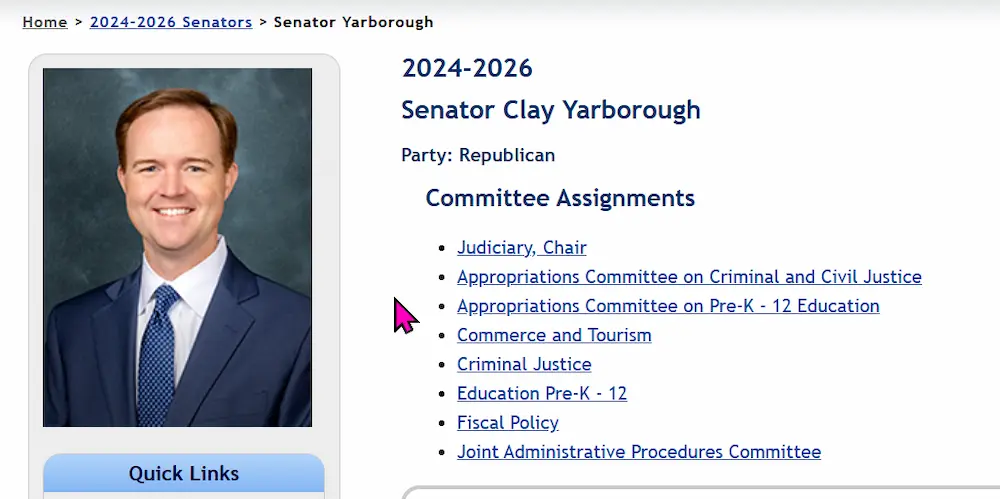
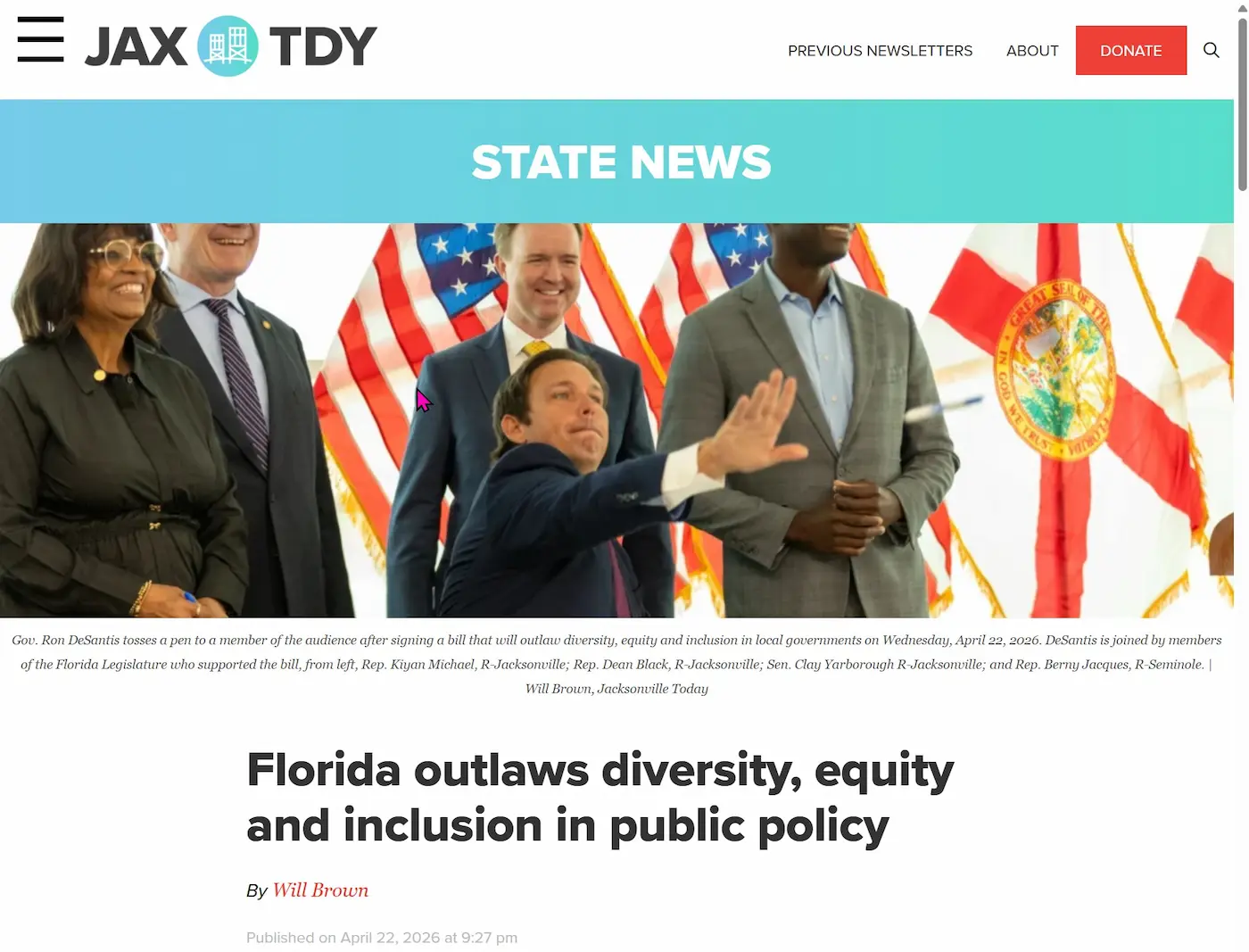
The law did not originate in Miami-Dade. It was introduced in the state Senate by Senator Clay Yarborough, a Republican from the Jacksonville area and chairman of the Senate Judiciary Committee, with a similar bill in the House—HB 1001— sponsored by Representative Dean Black. It was a measure supported by Governor Ron DeSantis as part of his agenda against diversity, equity, and inclusion policies.
In the Senate, it moved through three committees, each in a recorded public session:
- Community Affairs on February 3 (6 votes in favor, 2 against),
- Judiciary Committee on February 10 (8–3, where it became a committee substitute)
- and Rules on February 17 (19 to 5);
- Its official legislative analysis detailed the scope of the statute.
The Senate passed it 25–11 on March 4, and the House passed it 77–37 on March 10; the governor signed it into law on April 22, 2026. It was enacted as Chapter 2026-43 and takes effect on January 1, 2027, within the fiscal year for which the county will approve its budget in September.
In the Senate, it moved through three committees, each in a recorded public session: Community Affairs on February 3 (6 in favor, 2 against), Judiciary on February 10 (8 to 3, where it became a committee substitute), and Rules on February 17 (19 to 5); its official legislative analysis detailed the scope of the statute. The full Senate passed it 25 to 11 on March 4, and the House passed it 77 to 37 on March 10; the governor signed it into law on April 22, 2026. It was enacted as Chapter 2026-43 and takes effect on January 1, 2027, within the fiscal year for which the county will approve its budget in September.
What happened?
Commissioner Vicki López began by noting that the law is, in her words, “incredibly vague, ” and that the possibility of being accused of misfeasance or malfeasance leading to removal from office, or of being sued by any resident, caused her “lots of concern.” She moved that the County Attorney investigate the county’s ability to challenge the validity of SB 1134 or ask a court to clarify how it applies, and that the County Attorney report to each commissioner individually. The motion, expanded to explore “all options,” was approved by the full commission.

Source: Miami-Dade BCC, July 21, 2026, meeting, item 6B1 (Commissioner Vicki López, District 5, who introduced the item)
County Attorney Geri Bonzon-Keenan replied that her office had been studying the law for months, that the team met “at least three times a week, and on some days three times a day” due to the statute’s broad scope, and that she preferred to brief each commissioner before the September budget hearings. Regarding the idea of using the home rule charter to circumvent the law, she was unequivocal: “We do not believe that the charter is a vehicle for amending […] or preempting state law at this point in time.”

Source: Miami-Dade BCC, July 21, 2026, meeting, item 6B1 (County Attorney Geri Bonzon-Keenan)
Commissioner Oliver Gilbert proposed a procedural strategy to bring the law before a judge without the county suing itself.
Commissioner Oliver Gilbert said he agreed to challenge the law, but cautioned that the county would not have standing to sue on its own. His solution: create a funding application process for community organizations so that, if an application is denied under the new law, those affected could seek a declaratory judgment. “That’s how you get to court faster,” he said. “I’m not advocating that they sue us for money. I’m advocating that we need to actually get in front of a judge, and that’s probably the quickest way for a judge to tell us whether this law is binding or not.”

Source: Miami-Dade BCC, July 21, 2026, meeting, item 6B1 (Commissioner Oliver Gilbert).
The Board’s vice chair, Kionne McGhee, was the most outspoken. He quoted Martin Luther King (“an unjust law is no law at all”) and called the law “one of the most ridiculous pieces of legislation.” Then, speaking, as he put it , “as a private citizen, not as a commissioner,” he announced that he was willing to accept his removal.

Source: Miami-Dade BCC, July 21, 2026, meeting, item 6B1 (Vice Chair Kionne McGhee).
McGhee stated: “If removal is what it’s going to take to stop me from urging the people of Miami-Dade County—especially those in my district—who are going to be affected… then removal is going to have to happen. I intend to encourage my constituents and those I support to break this law. I intend, if possible, to fund organizations that work to uplift this community.” He concluded: “This is the moment when we plant the flag.”
The distinction that McGhee emphasized is legally significant: under the text of the law, which penalizes official actions taken in an official capacity and not the personal statements of a public official, his announcement—made, as he said, in a personal capacity—would not in and of itself constitute the official action that the statute penalizes. This is News Miami Dade’s interpretation of the text, subject to a court’s interpretation.
Board Chairman Anthony Rodríguez offered a counterpoint. He rejected the idea of encouraging people to sue the county, stating, “It is entirely negligent to encourage anyone to sue this county,” and clarified that this was not the Board’s policy. His stance was one of caution: “We need to be conservative because there are personal repercussions that the state can impose on this body,” and he mentioned removal from office as one such repercussion.

Source: Miami-Dade BCC, July 21, 2026, meeting, item 6B1 (Commissioner Anthony Rodríguez, District 10, Board Chair).
Commissioner Danielle Cohen Higgins proposed a third way. She said she wasn’t interested in discussing litigation because she wanted to reduce it, not increase it: “I want to quell and reduce it, not increase it.” She directed her question to the County Attorney: why couldn’t the county get around the law using its own tools—the powers granted by the home rule charter or the Board’s policy decisions— “the way that we have in so many other areas.” Faced with “a poorly worded statute,” she proposed amending the charter and noted that, as far as she knew, that day marked the deadline for placing an amendment on the November ballot.

Source: Miami-Dade BCC, July 21, 2026, meeting, item 6B1 (Commissioner Danielle Cohen Higgins).
Commissioner Raquel Regalado argued that the county is not the most appropriate entity to bring the matter before a judge: she said that there are many affected organizations that should seek clarification, whereas it would be much more difficult for the county to prove causation, harm, and standing, because its situation is very different from that of those organizations.

Source: Miami-Dade BCC, July 21, 2026, meeting, item 6B1 (Commissioner Raquel Regalado).
Commissioner Micky Steinberg, from District 4, seconded the motion and was the one who requested that it be expanded to explore all legal options. She noted that the law is worded so broadly that, in her view, it applies to all public officials, and she stated that she would take advantage of that ambiguity; she was also concerned that an adverse ruling handed down from a conservative perspective could harm other municipalities in the state.

Source: Miami-Dade BCC, July 21, 2026, meeting, item 6B1 (Commissioner Micky Steinberg, District 4).
Commissioner Juan Carlos Bermúdez, from District 12, cited a precedent: as he explained, around 2006, Miami-Dade sued the state over a state law that affected the county; it lost the case first in Tallahassee and then took the case to a local judge. His point is that the county has already taken Tallahassee to court before—a precedent that carries weight in the procedural path being discussed by Gilbert and the County Attorney.

Source: Miami-Dade BCC, July 21, 2026, meeting, item 6B1 (Commissioner Juan Carlos Bermudez, District 12). Excerpt from News Miami Dade, with no changes to the content. See the methodology for details.
What does the law actually say?
SB 1134 creates three sections of the Florida Statutes: Section 125.595 (counties), Section 166.04971 (municipalities), and Section 287.139 (certification required in contracts and grants).
The first two apply equally to the county government and the 34 municipalities, and personal liability rests not only with the commissioners but also with the county mayor, other county officials, and the mayors and city council members acting in an official capacity.
IN ESSENCE, IT PROHIBITS FUNDING, PROMOTE, OR TAKE ANY OFFICIAL ACTION RELATED TO DIVERSITY, EQUITY, AND INCLUSION, AND DECLARES EXISTING ORDINANCES, RESOLUTIONS, PROGRAMS, AND POLICIES ON THIS MATTER TO BE NULL AND VOID. IT PROHIBITS THE USE OF FUNDS, FROM ANY SOURCE, TO MAINTAIN AN OFFICE OR EMPLOY A DEI OFFICIAL, AND FURTHER PROHIBITS EMPLOYEES, CONTRACTORS, VOLUNTEERS, SUPPLIERS, OR AGENTS TO PROMOTE DEI INITIATIVES.
DEI stands for DIVERSITY, EQUITY, AND INCLUSION. In the public sector, it typically refers to policies that seek to expand the representation of historically underrepresented groups, ensure equitable treatment in hiring and service delivery, and create inclusive environments; in local government, this can take the form of equity offices, training programs, or diversity goals in hiring. Its advocates view it as a means of correcting inequalities; its critics see it as preferential treatment based on race or sex. SB 1134 establishes its own working definition, which is detailed below.
The legal definition of DEI is broad: it includes manipulating the composition of the workforce, promoting preferential treatment, or implementing training and activities designed with reference to race, color, sex, ethnicity, gender identity, or sexual orientation. It does not, however, cover equal opportunity materials that provide information on the prohibition against discrimination.

Source: Florida Senate Community Affairs Committee hearing, February 3, 2026, via The Florida Channel (Yarborough explains how it is determined what is permitted).
Embedded document. CS/CS/SB 1134 (2026), enrolled, Chapter 2026-43, full text. Official source: Florida Senate.
The enforcement mechanism has three components specified in the text of the law.
First, a personal consequence regarding continued service in office: a commissioner, the mayor, or another county official, or a mayor or city council member, who acts in an official capacity and violates the section “commits misfeasance or malfeasance in office”; in the case of county officials, Article IV, Section 7, of the Florida Constitution allows the governor to suspend them and leaves their removal to the Florida Senate.
Second, the cause of civil action is against the local government, not against the individual official: the statute allows a resident to bring an action in circuit court against the county (“an action in circuit court may be brought by a resident of the county against a county that violates this section”), with the possibility of a declaratory judgment, an injunction to stop the conduct, damages, and costs.
Third, contractor certification (the new Section 287.139): Any potential recipient of a contract or grant must certify that it will not use county or municipal funds to require its employees, contractors, volunteers, suppliers, or agents to adopt, study, or receive instruction using materials defined as DEI by law.
The law is not a blanket ban: it lists what is still permitted.
- A local government may recognize federal and state holidays, as well as patriotic and national observances;
- support nonprofit organizations that offer single-sexprograms for homeless individuals or for the education, counseling, and rehabilitation of at-risk youth;
- to honor the individuals and groups commemorated by monuments, memorials, and museums;
- and issue event permits in a neutral manner.
Nor can it be interpreted as conflicting with laws regarding restrooms and locker rooms, domestic violence shelters, school sports, or access to health care based on biological sex, nor with laws that guarantee health care based on race or ethnicity.

Source: Florida Senate Rules Committee hearing, February 17, 2026, via The Florida Channel (Yarborough describes the bill’s exemptions).
The law provides for a limited exception, as specified in the enacted text:
It does not cover the actions of a body composed of unelected volunteers, nor the basic administrative support provided to them, except when that support is provided by a county employee whose sole function is to provide it.
How did the government defend it, and what did the opposition object to?
At the Florida Senate hearings, the bill’s sponsor, Senator Clay Yarborough, defended the measure with the same argument: that the terms DIVERSITY, EQUITY, and INCLUSION are not the problem on their own, but rather what he described as their combination in a“DEI” effort.
To support his claim, he cited examples of spending that he attributed to local governments in Florida:
- stated that Broward County had spent nearly $900,000 on DEI training,
- that Gainesville paid its equity director about $189,000 a year
- and that St. Petersburg paid its chief equity officer about $219,000.
These are the figures that the sponsor presented at a public hearing.

Source: Florida Senate Community Affairs Committee hearing, February 3, 2026, via The Florida Channel (Yarborough lists examples of spending: Gainesville, St. Petersburg, Broward). Figures provided by the sponsor.

Source: Florida Senate Rules Committee hearing, February 17, 2026, via The Florida Channel (Yarborough explains what the bill seeks to eliminate).

Source: Florida Senate floor session, March 4, 2026, via The Florida Channel (Yarborough: “This promotes division, not equity”).
The opposition focused on the broad scope of the law. Several senators asked how a local government would know what is permitted and what is prohibited under such a broad definition, and what safeguards were in place against lawsuits filed by residents.
In the Judiciary Committee, among those who testified against the bill was the executive director of the Florida Coalition to Advance Racial Equity. The bill moved forward anyway through the three committees and the full chamber.

Source: Florida Senate Community Affairs Committee hearing, February 3, 2026, via The Florida Channel (a senator questions how to know what is still allowed).

Source: Florida Senate Community Affairs Committee hearing, February 3, 2026, via The Florida Channel (the question regarding safeguards against lawsuits filed by residents).

Source: Florida Senate Community Affairs Committee hearing, February 3, 2026, via The Florida Channel (the discussion on the frivolous lawsuit safeguard).

Source: Florida Senate floor session, March 4, 2026, via The Florida Channel (debate and vote on SB 1134, passed 25–11).
Why It Matters
Effective January 1, 2027, when the law takes effect, it will shift the personal risk of removal not only to the 13 county commissioners but also to the mayor, other county officials, and the mayors and city councils of the county’s 34 municipalities—for spending decisions that until now have been a matter of local discretion. In a county that defines itself as majority-minority, the practical impact falls on community organizations that rely on county funds.
Among the entities that could fall under the law’s interpretive scope, the ethnic and racial advisory councils operating under the county’s Community Advocacy Office hold a special place. The law appears to protect the actions of the volunteer councils themselves, but leaves open the status of county staff whose sole function is to provide support to them. That specific application has not yet been resolved by a court.
The following sections detail how much the county spends on these facilities, how that spending has changed, and who manages them. The July 21 discussion did not resolve anything: the Board approved a request for legal options and postponed the substantive decision until the September budget hearings.
What does the law prohibit, and what has the money been spent on?
Effective January 1, 2027, SB 1134 repeals local programs that fall under its definition of DEI and prohibits funding for them; any official who does so in an official capacity is subject to proceedings for misfeasance or malfeasance. The law does not specify which specific Miami-Dade programs are covered: this broad scope is what the County Attorney described as “expansive” and what Commissioner Vicki López called “incredibly vague.”
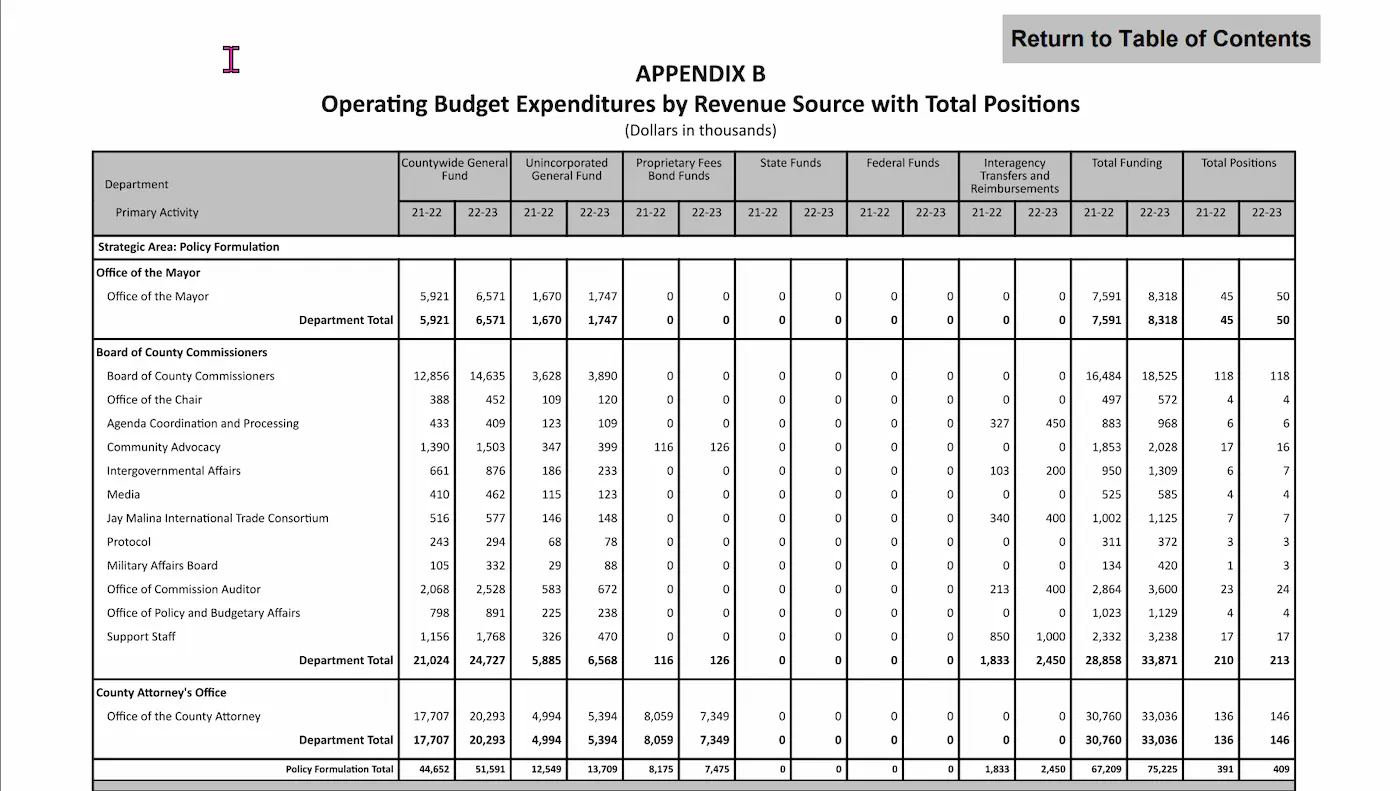
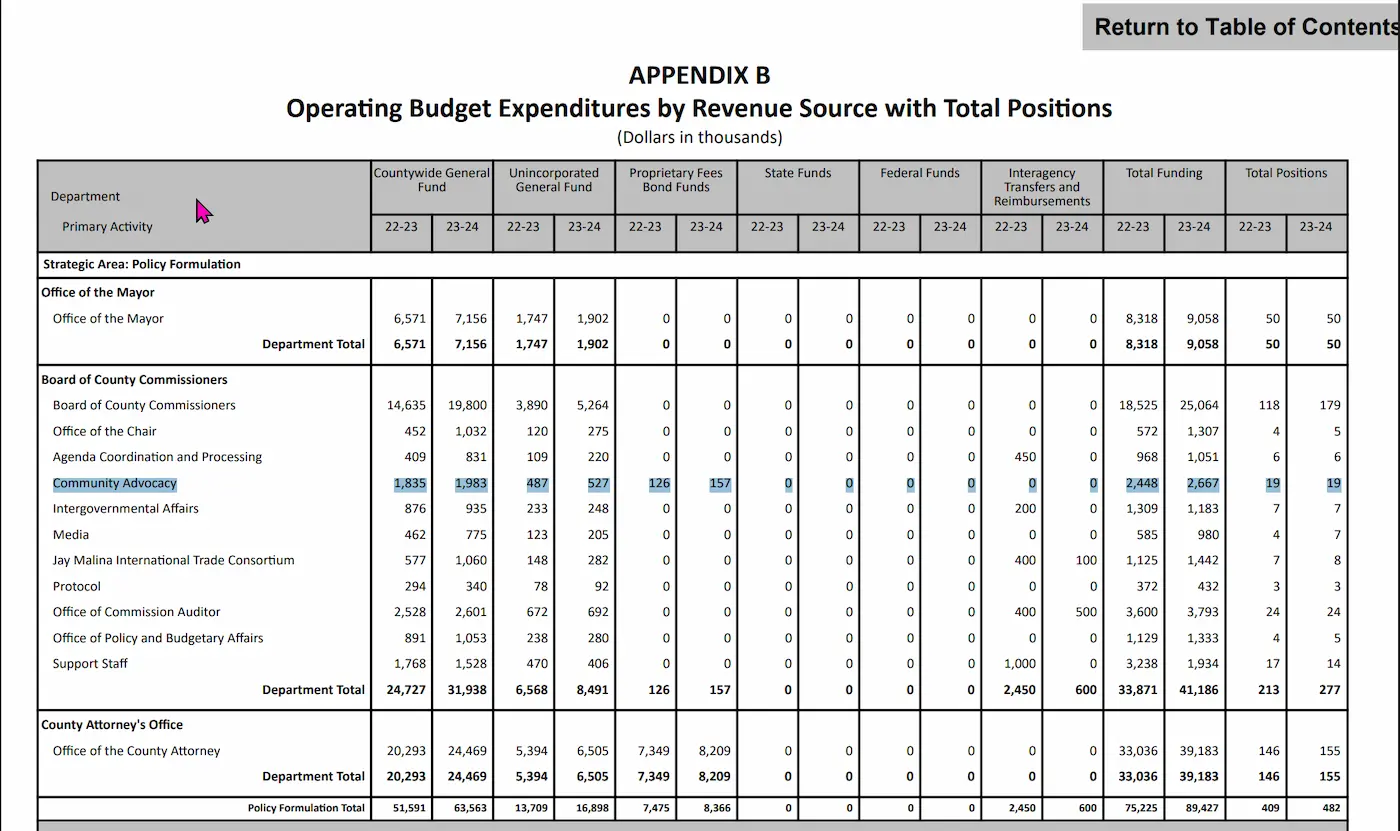
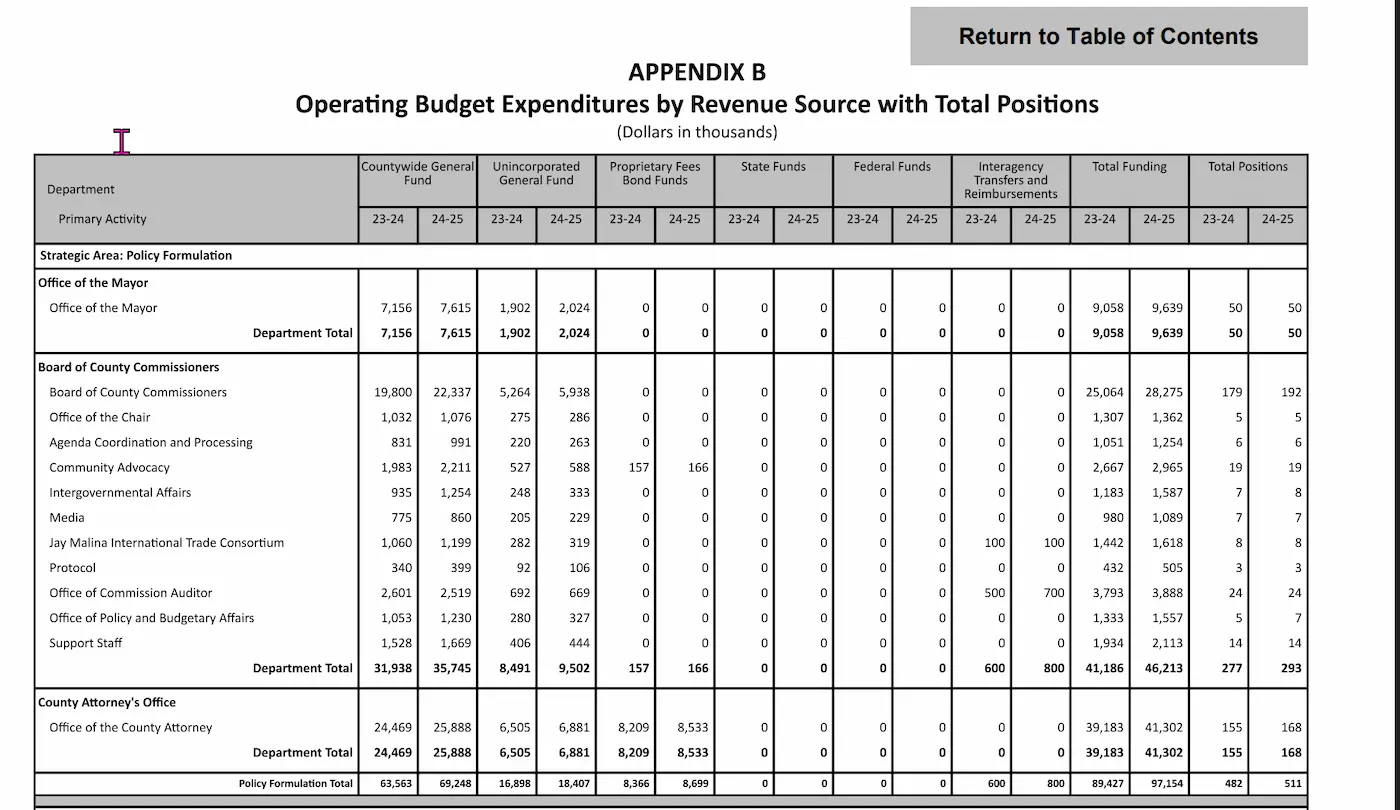
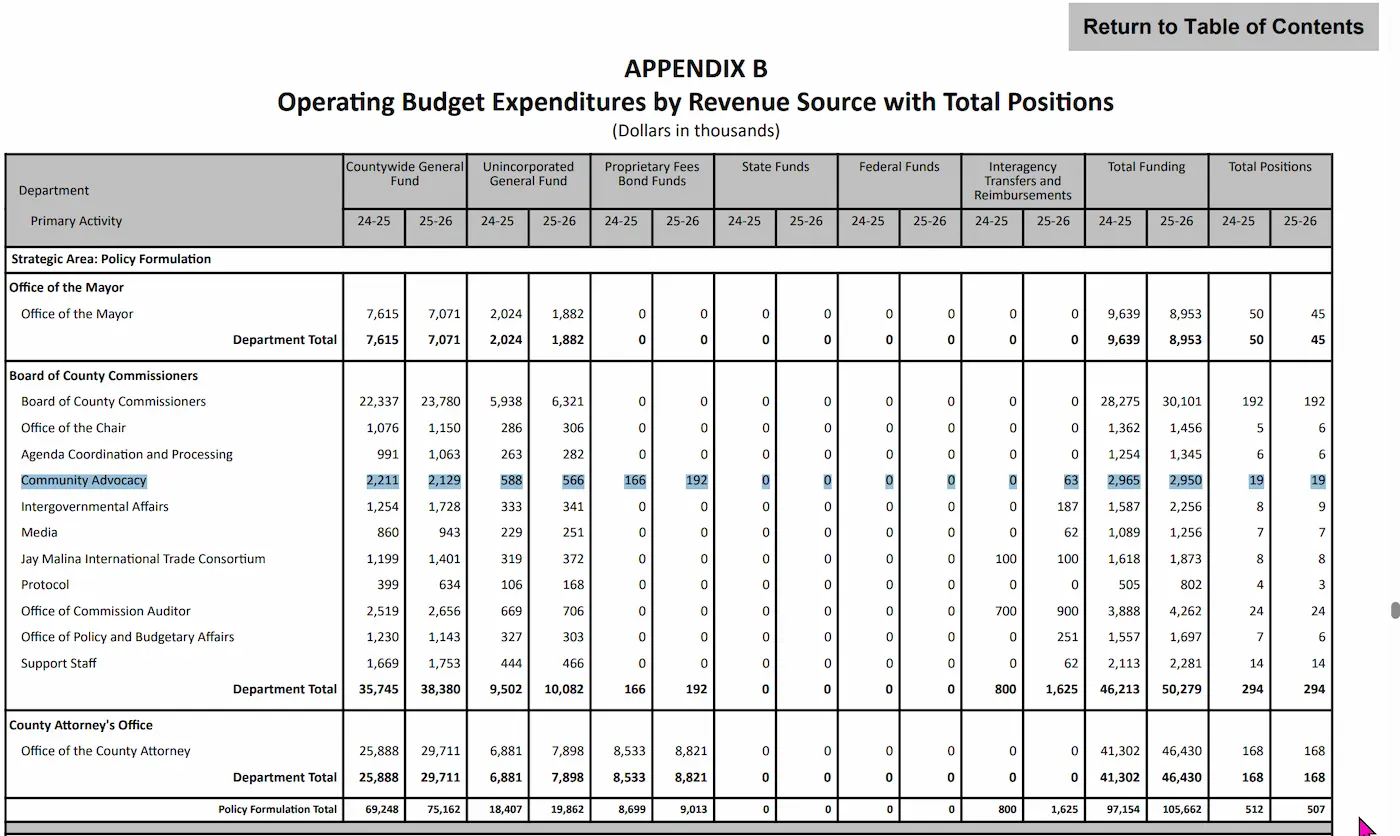
The county does not have a budget line item labeled “DEI.” What does exist are offices organized around categories of race, ethnicity, or gender, and those are the ones the law would cover. They are not listed here as an editorial judgment on their value, but because their structure places them under a law that specifically targets that way of organizing spending. This is what the county’s books show: with the complete series,
His series distinguishes between actual expenditures and budgeted amounts:
$1,354 million spent in FY2019-20 with 12 employees,
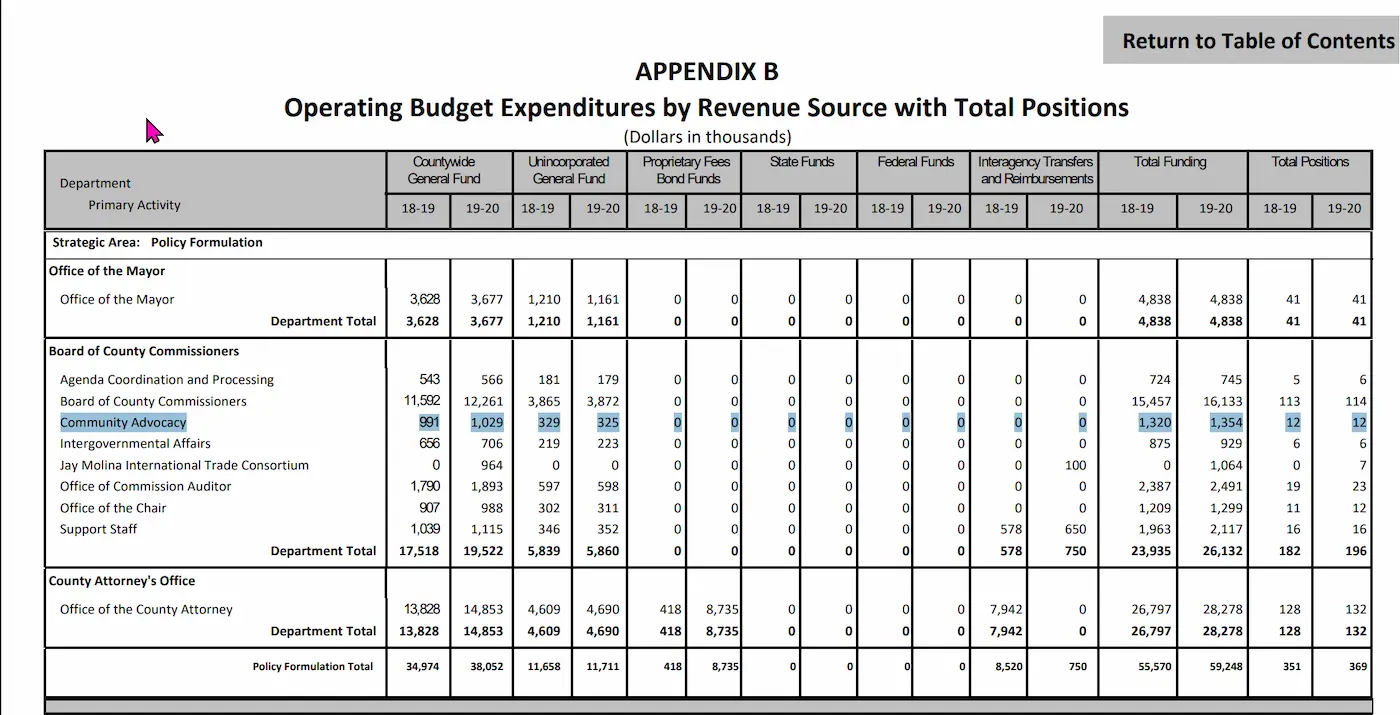
$1,614 million spent in FY2020-21, with 15 employees,
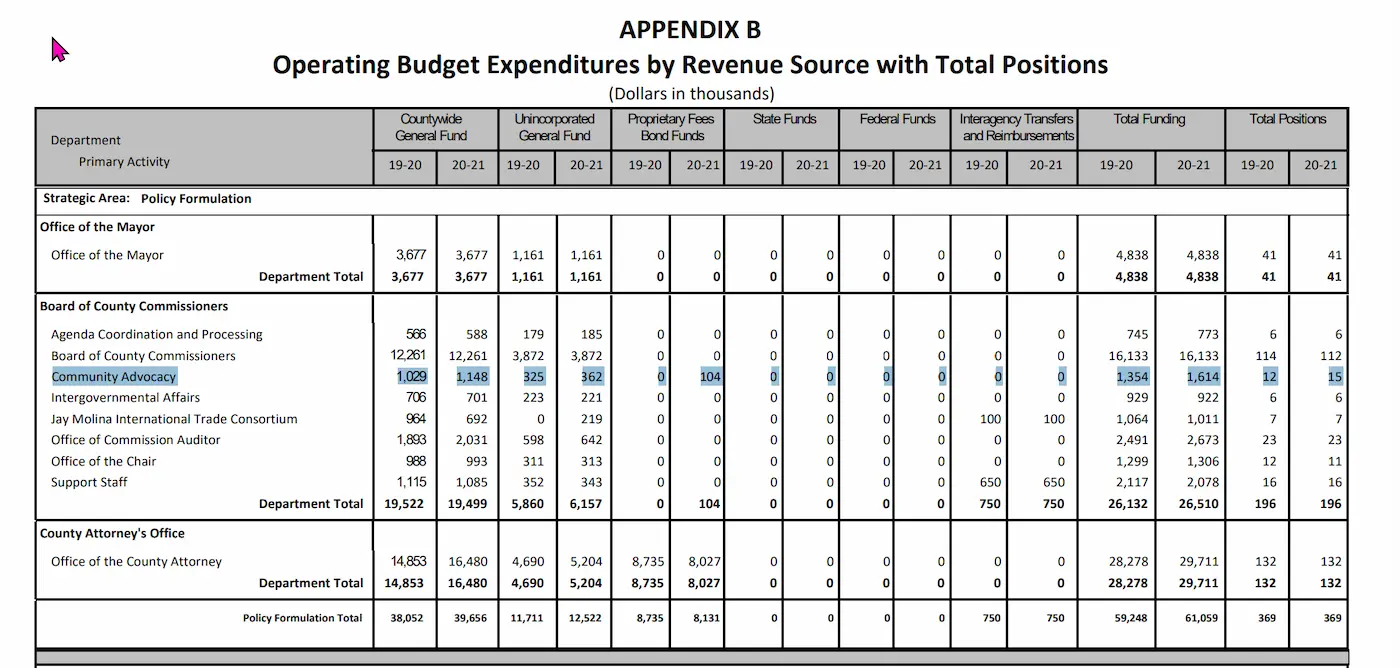
$1,853 million spent in FY2021-22 with 17 employees,
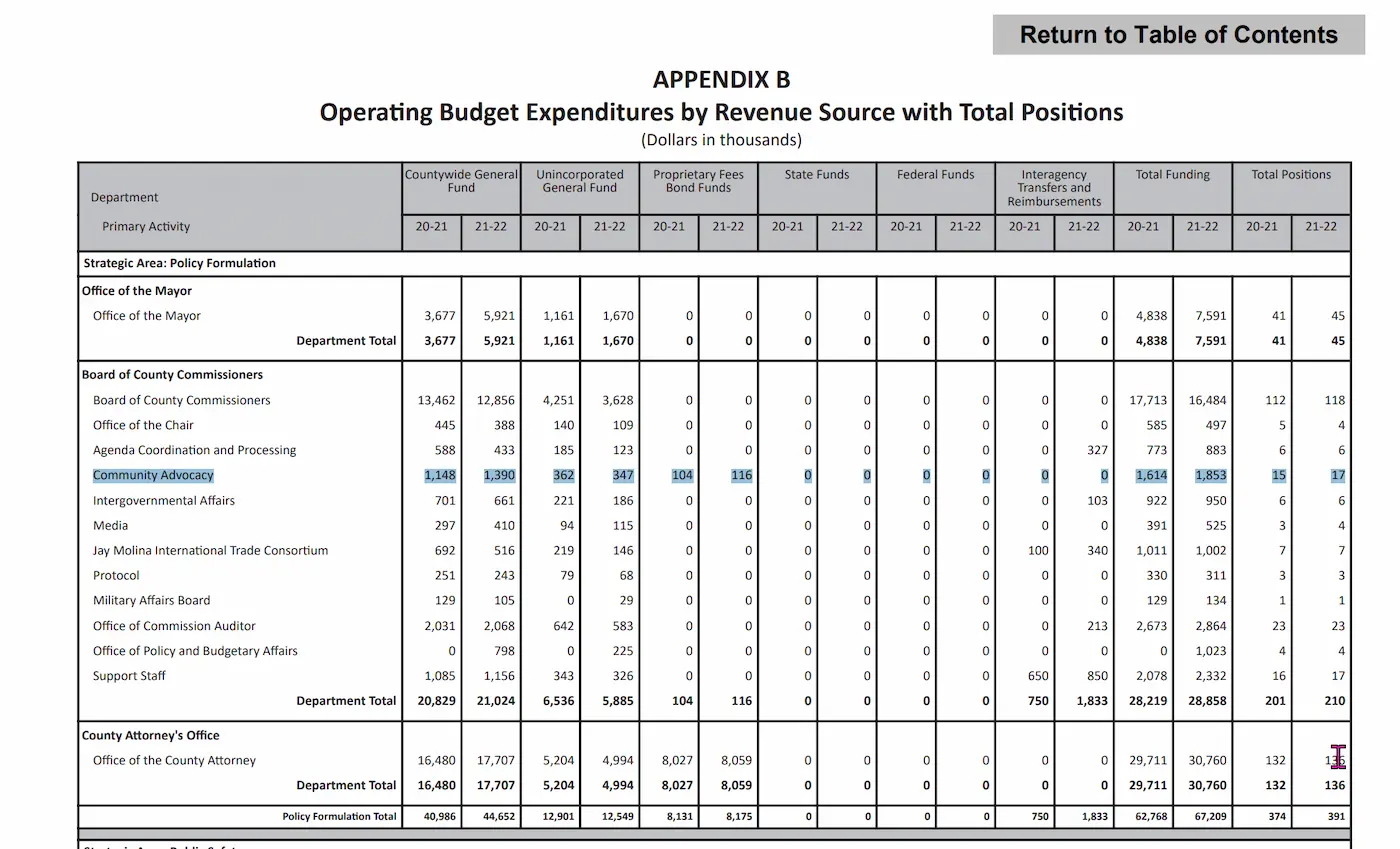
$2,028 million spent in FY2022-23 with 16 employees,
$2,667 million adopted for FY2023-24,
$2,965 million spent in FY2024-25,
$2,950 million adopted for FY2025-26
$2,739 million proposed for FY2026-27.
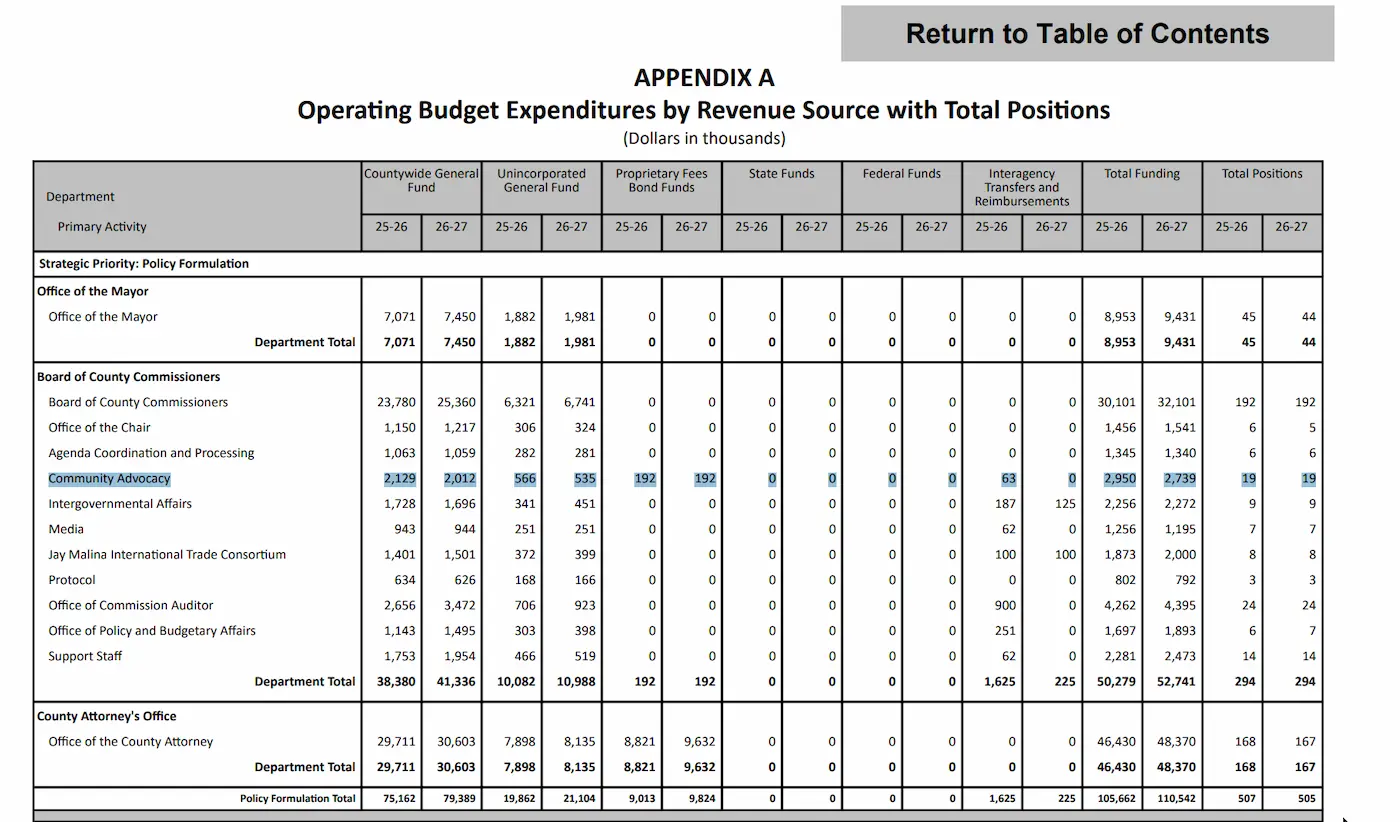
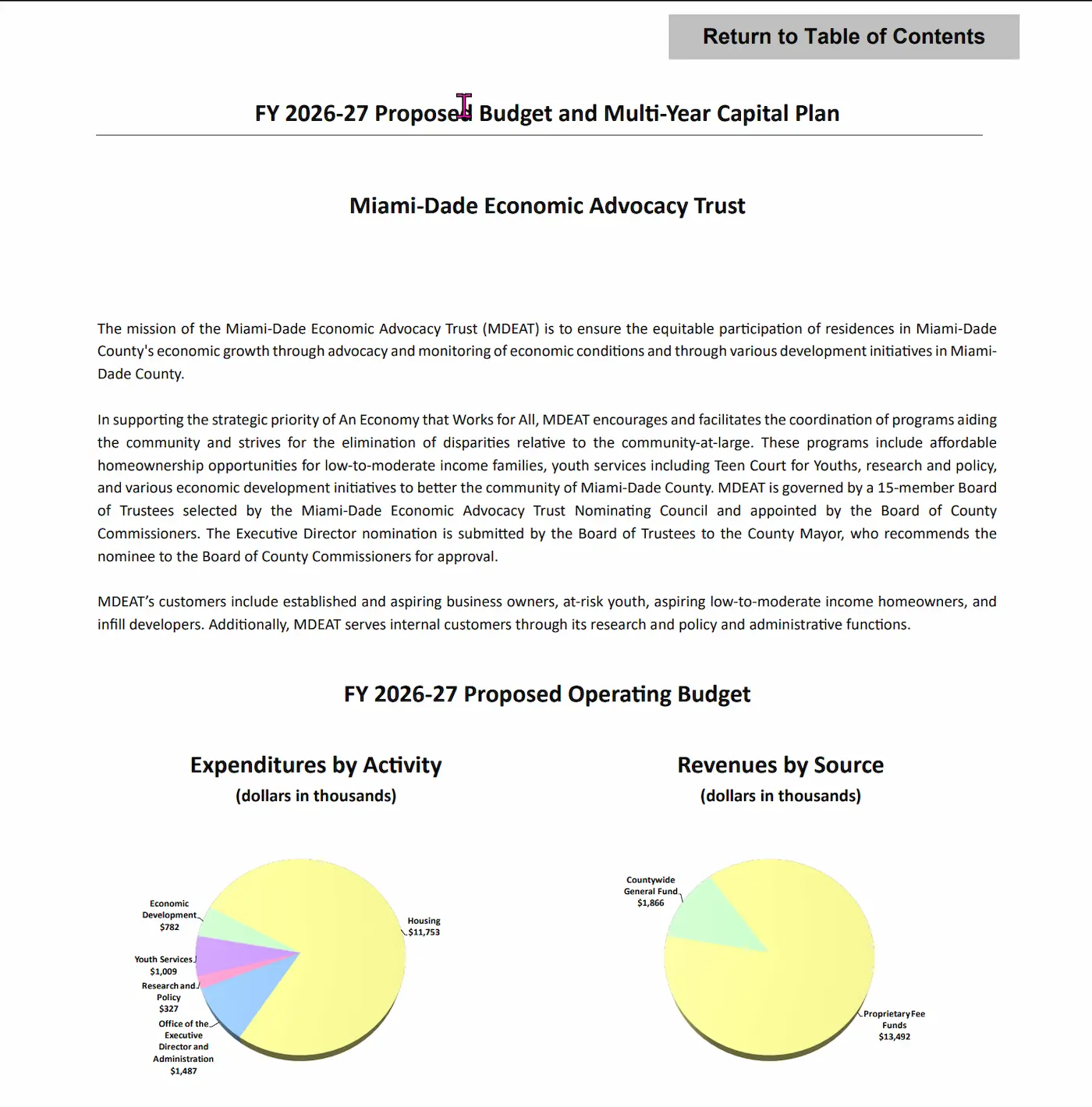
Other budget line items fall into a gray area. The Miami-Dade Economic Advocacy Trust (MDEAT), for example, manages $15,358 million in FY2026-27, but its mission is economic development, and it is not a program organized by identity; its spending uses “equity” language without being a council based on race or gender. Like MDEAT, there are about ten other budget lines—in Human Resources, Procurement, and urban planning—whose “equity and inclusion” language may or may not fall under such a broad law. That uncertainty—not to mention the law’s vague definition—is precisely what the commissioners are still unable to address.
MDEAT has also been under ethical scrutiny on another front. The Miami-Dade Commission on Ethics found probable cause against Edwin Miller, administrator of the trust’s housing program, in two cases (C 24-23-07 and C 24-36-10) decided by a 3-0 vote on January 14, 2026. The case was resolved the same day through a settlement: a letter of reprimand, a $1,500 fine, and referral to the Office of the Inspector General and the county’s Human Resources department. “Probable cause” is not a finding of guilt, but rather a determination by the Commission that there was sufficient basis to take action.
According to press reports —the details of which have yet to be verified against the Commission’s official memorandum— the alleged violations (abuse of office, conflict of interest, prohibited outside employment, and public records) stem from Miller’s having worked for the Black Business Investment Fund while on paid leave and subsequently favoring that entity in the procurement process for an MDEAT construction loan program. In a separate case, the Commission found no probable cause against the trust’s director, William Diggs, who was exonerated. This is a separate matter from SB 1134.
Why there are offices organized by identity—rather than just universal services—is the very debate that the law brings to the table. Those promoting the bill, such as Senator Clay Yarborough, maintain that local government decisions should be based on merit rather than identity categories. Its supporters argue that these programs address documented disparities in specific communities. Both positions are presented here; it is up to the reader to judge whether this spending is justified.
And here is a key finding: the proposed budget for FY2026-27—which the county approves in September and covers the period from October 2026 to September 2027—funds these programs at their full budget and staffing levels for the entire twelve months, and makes no mention of SB 1134, “DEI,” or January 1, 2027, at any point. The county is budgeting for the entire year for programs that, starting in January, the law prohibits it from funding, without stating in the budget how it will handle that mid-year disruption.
None of these programs are officially designated as “DEI” by the county; they are listed because their structure falls under the broad definition of the law, not because this article classifies them as such.
Who administers these programs, and who benefits from them?
Which offices, directors, and beneficiaries are behind those figures and are listed in the public record? The Office of Community Advocacy —created by Ordinance 21-34 and reporting to the Board of County Commissioners—is headed by Laura C. Morilla, who earns an annual salary of $200,105.92 according to the county’s payroll records.
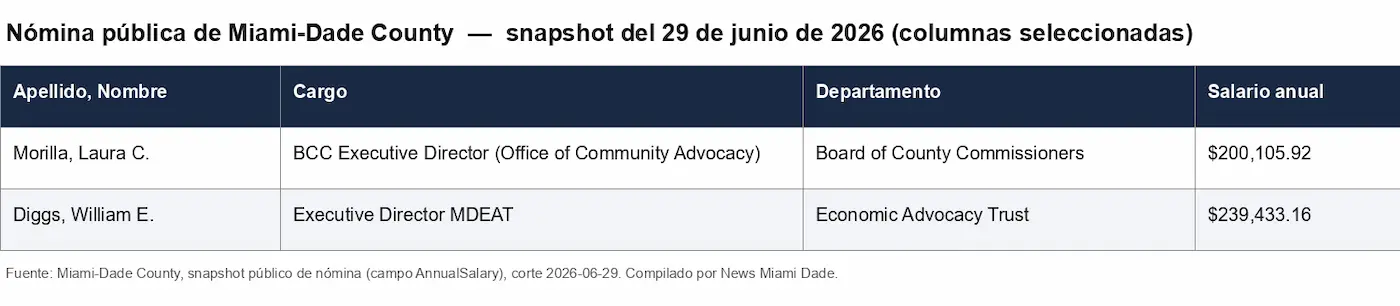
Its role is to provide administrative support to ten community advisory councils, several of which are organized by race, ethnicity, or gender (Black Affairs, Hispanic Affairs, Asian-American Affairs, Commission for Women, and LGBTQIA+ Advisory Board, among others), whose members are appointed by the commissioners:

And who pays for those councils’ events?
The answer is less clear than the organizational chart suggests. According to the Code of Ordinances(6/10), six of the ten councils have their own trust fund for private donations and sponsorships:
The Commission for Women, the LGBTQIA+ Advisory Board, the Interfaith Committee, and the Elder Affairs Committee; and, in a hybrid format, the Domestic Violence Oversight Board and the Military Affairs Committee.
The other four—including the three organized by race or ethnicity (Black Affairs, Hispanic Affairs, and Asian-American) and the Community Relations Board—do not have such a provision in the Code, and their funding comes from the Community Advocacy taxpayer budget.
But the minutes of those board meetings tell a different story. The Asian-American Advisory Board actually manages its own fund, with transactions totaling approximately $9,593.70 between 2024 and 2026 (including a $5,000 scholarship to Florida International University, a $1,000 allocation from the office of District 6 Commissioner Kevin Cabrera for the Asian Culture Festival, donations to temples, a Japan Immersion Day held twice, and minor sponsorships), even though that fund appears neither in the Code nor in the budget.
The Black Affairs Advisory Board received a private donation from the Miami Dolphins Foundation of $3,000 per year for three years. The Hispanic Affairs Advisory Board, on the other hand, does not publish any recent minutes, and the Community Relations Board does not maintain its own account. None of these funds publish their financial statements.
What is taxpayer money—and is not broken down—is the foundation: the 19 positions and the Community Advocacy budget that support the ten councils, plus the events that the book does itemize.
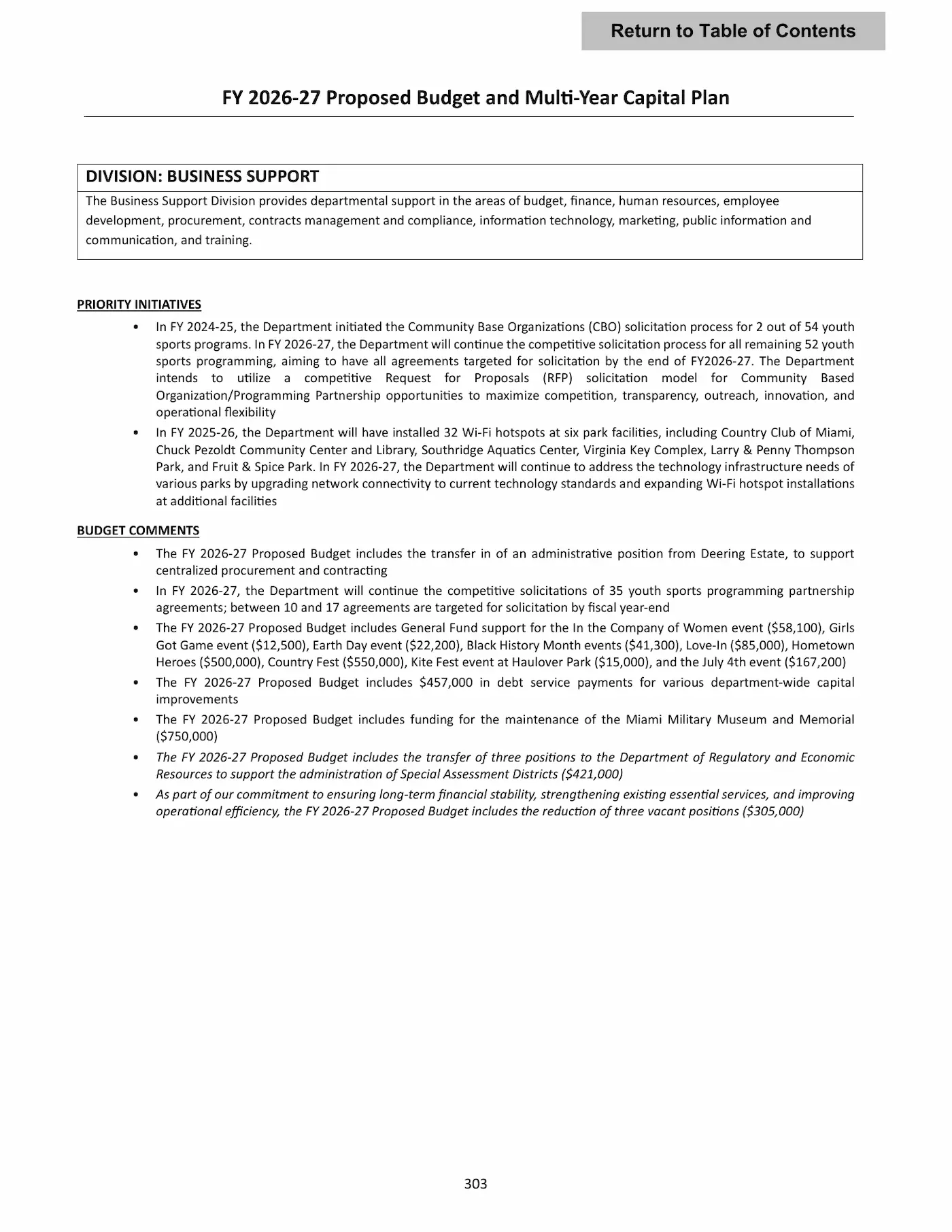
Parks is allocating $111,900 to three of them (Black History Month, $41,300; the “In the Company of Women” event, $58,100; and “Girls Got Game,” $12,500), while Cultural Affairs allocates another $40,000 to a youth film program. The county does not publish a quarterly spending report by department or by council: only performance dashboards without figures and the aggregated annual report. How much each gala costs, and what portion is publicly funded or privately funded, does not appear in any record.
Behind this lack of transparency lies a pattern set forth in the Code of Ordinances and in the councils’ public minutes: across the entire network of county advisory councils, only one fund is required by ordinance to submit periodic financial reports. The South Dade Black History Center, a sister council to the others mentioned, must receive a monthly financial report on its fund from the Office of Policy and Budgetary Affairs, and its expenditures are subject to a county audit (sections 2-433(c) and 2-435(g)).
The others, at most, are required to report on their activities, not their finances. Three of them—Interfaith, the Domestic Violence Oversight Board, and Military Affairs—have funds that the ordinance established without requiring any financial reporting.
The contrast is striking. The Commission for Women is the only board that publishes its financial statements voluntarily. The Domestic Violence Oversight Board, which oversees a portion of the food and beverage tax amounting to nearly $6.2 million annually, noted in its own minutes that it had gone months without receiving the actual expense reports for the fund it monitors. And the county does not publish any report that breaks down, board by board, how much is coming in and how much is being spent. That gap—more than any particular program—is what provides ammunition for bills like SB 1134.
This lack of accountability illustrates the broader mistrust that fuels measures such as SB 1134. Its proponents argue that local governments spend money on programs organized along identity lines without requiring merit or results, and that officials are employees of the voters—not the other way around. The existence of public funds for which no financial statements or audits are required—and for which almost no city council publishes financial records—is the kind of shortcoming that lends weight to that argument. Critics respond that the solution is not to ban such programs but to demand transparency, and that the law is so broad that it drags legitimate programs down along with the problem.
The Miami-Dade Economic Advocacy Trust (MDEAT) is a separate trust, led by William “Bill” Diggs, who earns an annual salary of $239,433.16, and has a board of fifteen trustees appointed by the Board. Unlike Community Advocacy, MDEAT does distribute funds: its official April 2024 statement documents $100,000 distributed among ten small businesses through a capitalization program. The trust’s own documentation mentions larger amounts—a $2.5 million land acquisition loan and $275,000 distributed among 54 businesses in FY2023-24— but those individual records are not listed in the county’s Legistar system, nor are their recipients listed online.
Residents can follow the same trail: expenditures are listed in the budget book; fees and salaries are listed in the public payroll; appointment rules are listed in the Miami-Dade Code; the members of each board are listed on the advisory boards page of miamidade.gov; and contracts and grants are available in the Legistar system.

The Big Picture: Who Oversees the County?
SB 1134 does not come out of nowhere. It is part of a broader debate over who oversees county spending. Externally, the Florida DOGE—the review body created by the governor’s executive order—examined the spending of local governments, including Miami-Dade,
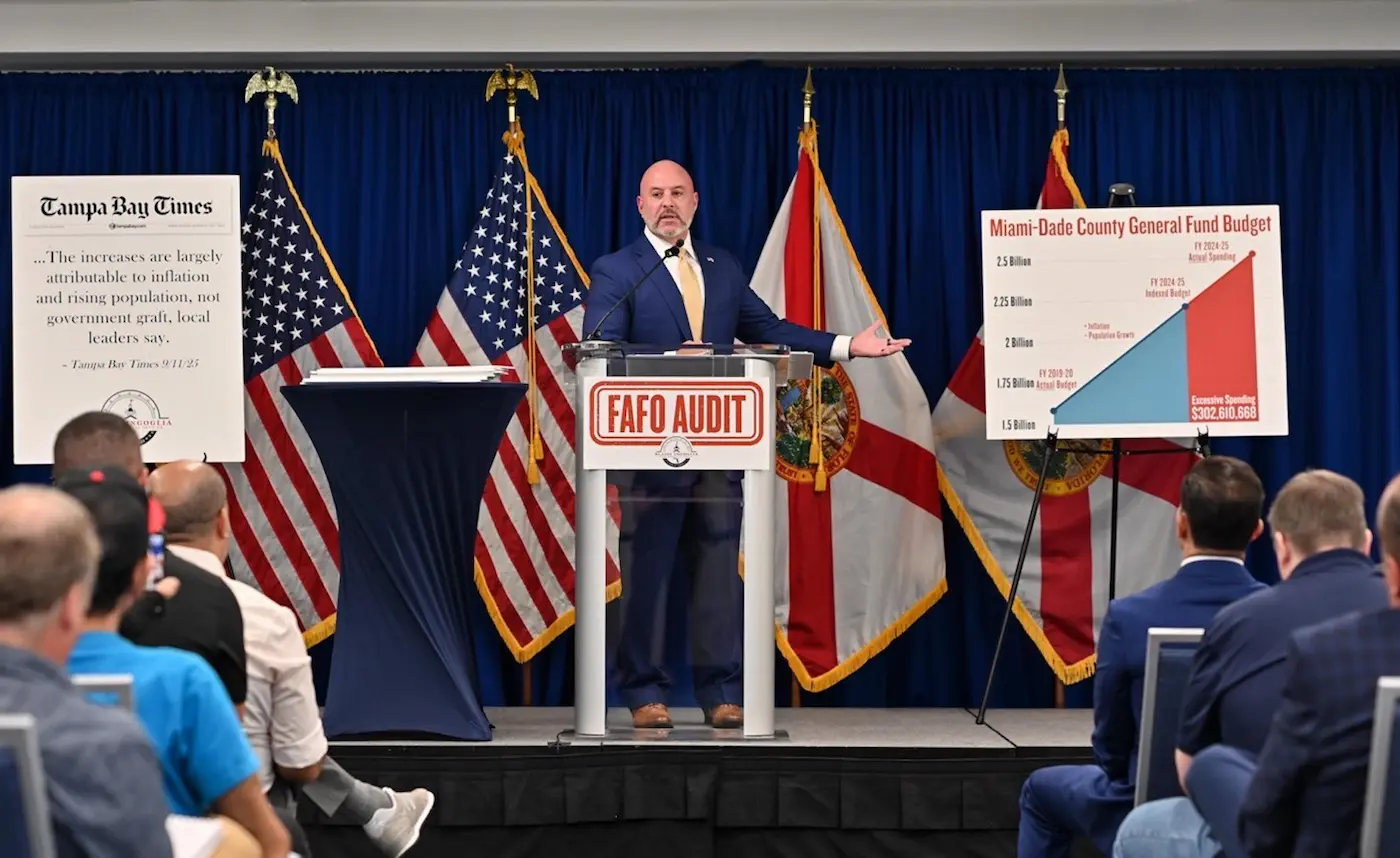
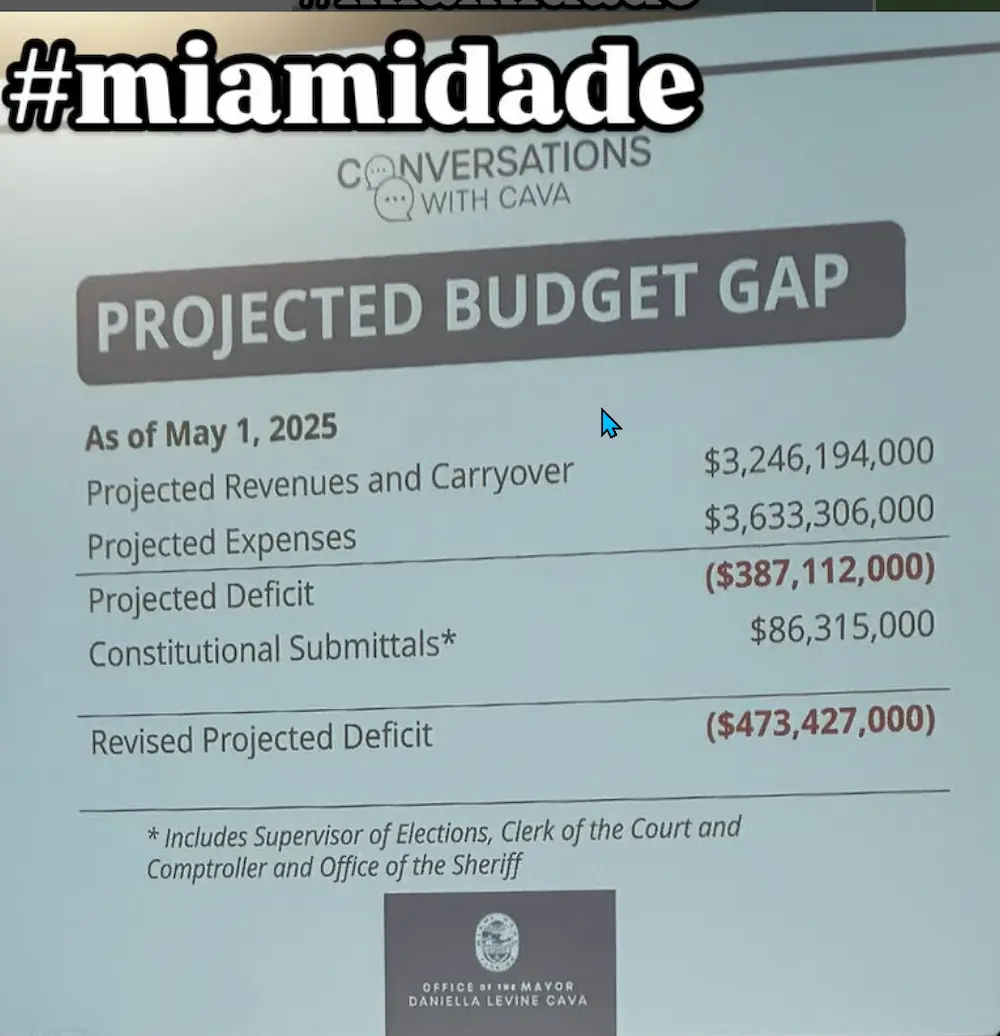
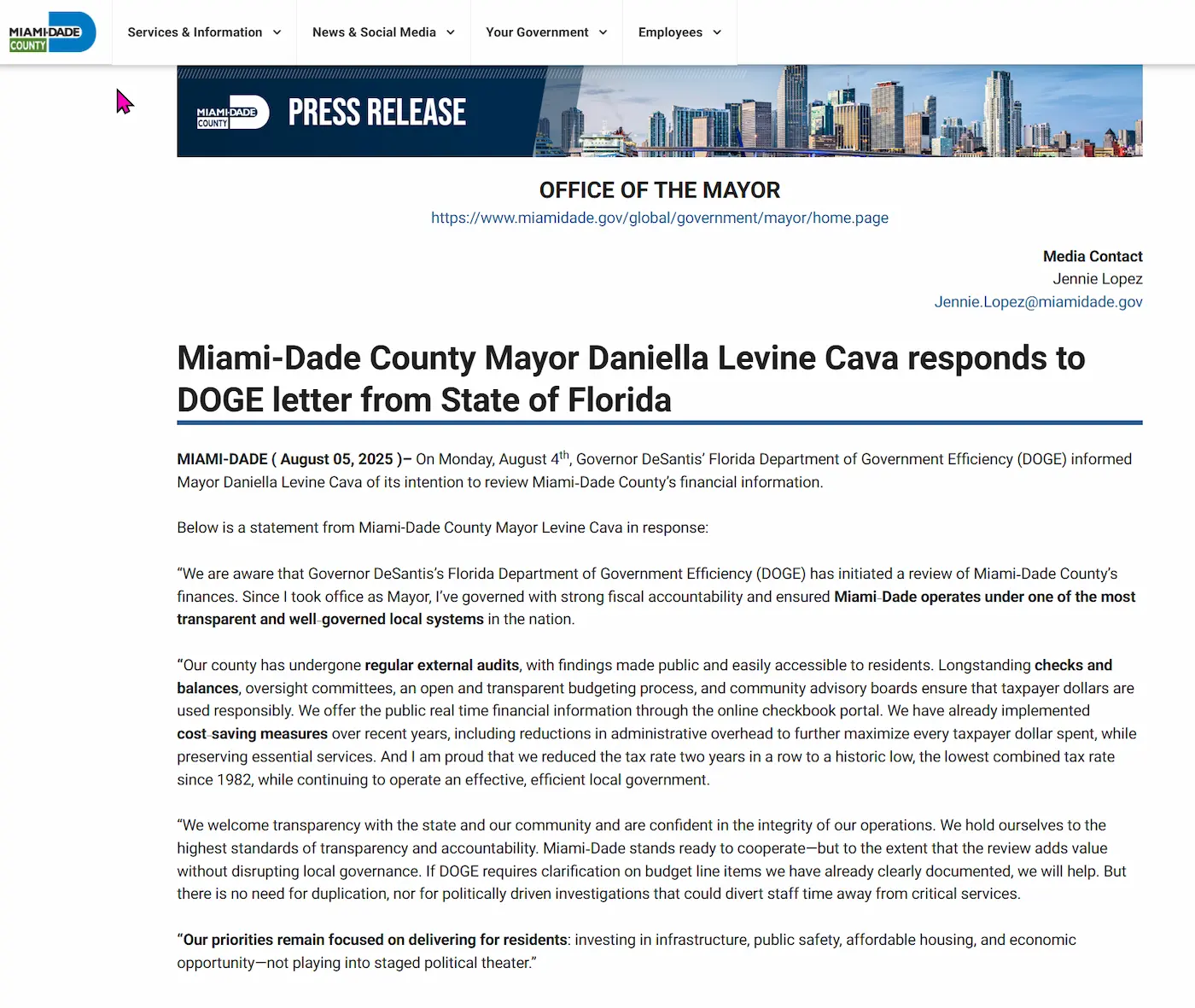
and published allegations; the county responded on August 5, 2025, noting that it operates under “one of the most transparent and well-governed local systems in the nation,” with “the lowest combined tax rate since 1982” —its historically low tax rate.
Internally, the county has its own oversight bodies—the Inspector General, the Commission on Ethics, and the Commission Auditor—which are funded by the county itself and, in the case of the Inspector General, enshrined in the Home Rule Charter by 73.72 percent of voters in 2020.
That debate—the independence of internal auditing versus external government oversight, and who pays for both—goes beyond the scope of SB 1134. What the law contributes to this conversation is straightforward: an official spending decision can be classified as misfeasance or malfeasance and trigger a proceeding that puts a commissioner’s position at risk, even if it does not result in automatic removal. The question, then, is no longer limited to DEI policies but shifts to who is accountable to the community and what safeguards exist to protect the independence of that oversight.
What questions remain unanswered?
This episode raises more questions than it answers. SB 1134 establishes a new rule for local government spending, and its practical application has not yet been defined. These are the questions the law has yet to answer, each rooted in its source.
- If, as Gilbert pointed out, the county does not itself have a specific dispute that would allow it to immediately obtain a court ruling, what avenue is available for a court to clarify the scope of the law without first exposing a community organization to the risk of losing funding?
- Kionne McGhee said, speaking in a personal capacity, that he would accept the removal. What is the position of each of the other 12 commissioners: to comply with the law, to seek clarification in court, or to challenge it?
- How many of the county’s 34 municipalities have active programs that are invalid under the law’s definition, and how many are already adjusting their policies to comply with it by January 1, 2027?
- How much would it cost taxpayers to challenge this law in court—whether through the process Gilbert proposed or any other—and how much would it cost, by contrast, to simply comply with it? No one presented that estimate during the session.
- If your community organization receives funding from the county or your city, does your program fall under the law’s definition or within its exceptions? Who in the local government will tell you this in writing, and when?
- If a court were to rule that any provision of the law is unenforceable, who would be held responsible for the time and funds that organizations have lost in the meantime?
- And here’s the reality check: if no commissioner is willing to have the county go to court directly, will the county’s response ultimately be compliance? And what, specifically, will change in the budget that is approved in September?
- The data compiled in this article—the text of SB 1134, verified quotes from the July 21 session, and figures from the county’s own budget book—allow readers to form their own judgment before September. Each factual claim is backed by its official source; the figures presented by the state are attributed to the state and are not independently verified.
Embedded materials and their original sources. The videos and images in this piece are taken from public records that readers can access at their original sources via the sources listed below. The remarks by the Board of County Commissioners (July 21, 2026, session, item 6B1) are included in the official Granicus recording (Source 1).
The Florida Senate sessions are available on The Florida Channel: Community Affairs from February 3 and Rules from February 17, plus the floor session from March 4 (Source 4). The embedded budget pages are taken from the Miami-Dade budget book—the proposed FY2026-27 budget and the adopted FY2023-24 and FY2025-26 budgets—with copies on file at News Miami-Dade (Source 5).
The payroll data comes from the county’s public salary snapshot, as of June 29, 2026 (Source 7). In addition, each image and video in this article includes a direct “View Original” link to that public source in its caption, so readers can verify the material on its source site without leaving the article.
Sources consulted
Level 1 (officers)
- 1. Miami-Dade Board of County Commissioners meeting, July 21, 2026, agenda item 6B1 “Discuss SB 1134 Official Actions of Local Governments” (primary sponsor: Commissioner Vicki López); official recording by Miami-Dade Granicus. Verbatim quotes taken from the audio recording of the public session and cross-checked against the transcript available on the official Granicus platform, with the exception of the quotes from Commissioner Cohen Higgins, which are noted in the methodology as pending verification.
- 2. CS/CS/SB 1134 (2026), “Official Actions of Local Governments,” Chapter 2026-43; sponsored by Senator Clay Yarborough (2026 profile and legislative record on his official Florida Senate webpage); companion bill HB 1001 by Representative Dean Black; creates sections 125.595, 166.04971, and 287.139 F.S.; effective January 1, 2027. The full text of the enacted bill (enrolled) is available in the official Florida Senate PDF.
- 3. Bill Analysis and Fiscal Impact Statement from the Florida Senate.
- 4. Official recordings of the Florida Senate hearings on SB 1134, via The Florida Channel (copies on file with News Miami Dade): Community Affairs, February 3, 2026 (approved 6-2); Judiciary, February 10, 2026 (committee substitute, 8-3); Rules, February 17, 2026 (19-5); and Senate floor session, March 4, 2026 (25-11). Material from the Senate hearings is paraphrased and attributed; the verbatim quotes in this article are from the BCC session on July 21.
- 5. Miami-Dade County Proposed Budget Book for FY2026-27 (Office of Management and Budget); the expenditure figures by program were cross-checked across all three volumes: the “Community Advocacy” line item appears in Volume 1, Appendix A, page 109 ($2,739,000 and 19 positions for 26-27), and the MDEAT breakdown is in Volume 2, page 93 (total $15,358,000). Both pages are reproduced as evidence in this article; a copy of the book is on file at News Miami-Dade.
- 6. Miami-Dade Code, sections 2-2427 through 2-2429 (Ordinance No. 21-34, adopted on April 20, 2021), which establishes and regulates the Office of Community Advocacy; A copy of the Code is on file with News Miami-Dade.
- 7. Miami-Dade County Public Payroll (May and June 2026 pay periods), entries for the Executive Director of Community Advocacy (Laura C. Morilla, $200,105.92) and the Executive Director of MDEAT (William Diggs, $239,433.16), confirmed in three monthly pay periods; copy on file with News Miami Dade.
- 8. Miami-Dade Black Affairs Advisory Board (composition rules in the Code and public roster), miamidade.gov.
- 9. Miami-Dade Economic Advocacy Trust, official press release dated April 1, 2024, regarding the Small Minority Black Business Capitalization Grant Program (10 businesses, $100,000); and MDEAT FY2025-26 budget document (Advocacy Trust); copy on file with News Miami Dade.
- 10. Miami-Dade Commission on Ethics and Public Trust: Case Files C 24-23-07 and C 24-36-10, determination dated January 14, 2026 (Commission’s public record).
- 11. Official statement from Miami-Dade County in response to the Florida DOGE’s review (August 5, 2025; copy on file with News Miami Dade).
- 12. Miami-Dade Office of the Inspector General: establishment of the office (1998), succession of officeholders (Mazzella, Jiménez), and its inclusion in the Home Rule Charter following the amendment approved by voters in 2020.
- 13. Miami-Dade Code, sections establishing the trust funds for six of the advisory boards: 2-269(f) Commission for Women, 2-2408 LGBTQIA+ Advisory Board, 2-227 Interfaith, 2-2384.1 Elder Affairs, 2-897 Domestic Violence Oversight Board, and 2-2104 Military Affairs; the Black Affairs (2-835), Hispanic Affairs (2-535), Asian-American (2-1090), and Community Relations (2-207) advisory boards do not have that provision. In addition to these is the South Dade Black History Center fund (2-436), the only one whose ordinance requires monthly financial reporting on the fund by the Office of Policy and Budgetary Affairs (2-433(c)) and a county audit of its expenditures (2-435(g)). (Municode; copy of the Code on file with News Miami-Dade).
- 14. Minutes of the Asian-American Advisory Board (meetings from 2024 to 2026) and the Black Affairs Advisory Board, available on the miamidade.gov advisory boards platform; a copy is on file with News Miami Dade. They document the Asian-American Advisory Board’s operating fund (transactions totaling approximately $9,593.70 between 2024 and 2026, including a $5,000 grant to Florida International University, a $1,000 allocation from Commissioner Kevin Cabrera’s office for the Asian Culture Festival, donations to temples, a Japan Immersion Day held over two years, and $193.70 for badges) and the donation from the Miami Dolphins Foundation to the Black Affairs Advisory Board ($3,000 annually for three years).
- 15. Official websites of the Miami-Dade advisory boards (miamidade.gov) and the proposed FY2026-27 budget book, volumes 1 and 2: the Parks Department’s identity-related event line items (Black History Month 41,300; In the Company of Women $58,100; Girls Got Game $12,500; totaling $111,900) and the Cultural Affairs youth film program ($40,000); the Hispanic Affairs Advisory Board’s webpage does not show any recently published minutes, and the Community Relations Board’s webpage does not report a dedicated fund; the county does not publish a quarterly spending report by department or by board, only performance dashboards and the aggregated annual report. The boards’ minutes (2024–2026) support the transparency overview: the Commission for Women reports its financial statements on a voluntary basis, and the Domestic Violence Oversight Board—which oversees the portion of the 1% tax on food and beverages allocated to shelters (projected by the county at approximately 6.223 million annually, according to the Homeless Trust’s Budget Director, Maria Abreu, at the board meeting on January 29, 2025, and the Appendix to the budget book), noted that it did not receive the actual expenditures from that fund; copies are on file with News Miami-Dade.
Level 2 (intermediate)
- 16. Florida Politics, “Governor-backed bill blocking local DEI initiatives moves forward in the Senate.”
- 17. Jacksonville Today, “Florida Bans Diversity, Equity, and Inclusion in Public Policy.”
- 18. Miami Times, “Probable cause found against MDEAT housing chief in Miami-Dade ethics investigation” (April 8, 2026, updated June 12, 2026).
Disclaimer: News Miami-Dade provides the original sources: the July 21, 2026, public meeting of the Miami-Dade Board of County Commissioners (agenda item 6B1) streamed by Granicus, the enacted text of Senate Bill 1134 of the Florida Legislature (Chapter 2026-43), the Bill Analysis, recordings of the Florida Senate hearings, and the county budget book. All citations and facts in this piece are drawn from the official record of public sessions and published government documents; each factual assertion is anchored to its identifiable primary source.
Statements are cited with their source and verbatim, when available. This document records positions expressed in public sessions and the text of a state law; it does not constitute a determination of criminal, ethical, or contractual misconduct.
Stay up to date with the latest news!
Would you like to receive more information and stay up to date on what’s happening in South Florida?
Visit our homepage to find out everything: local news, events, and much more.
Don’t miss a single detail. 👉 Click here!
#MiamiDade #News #Florida #SB1134 #DEI