
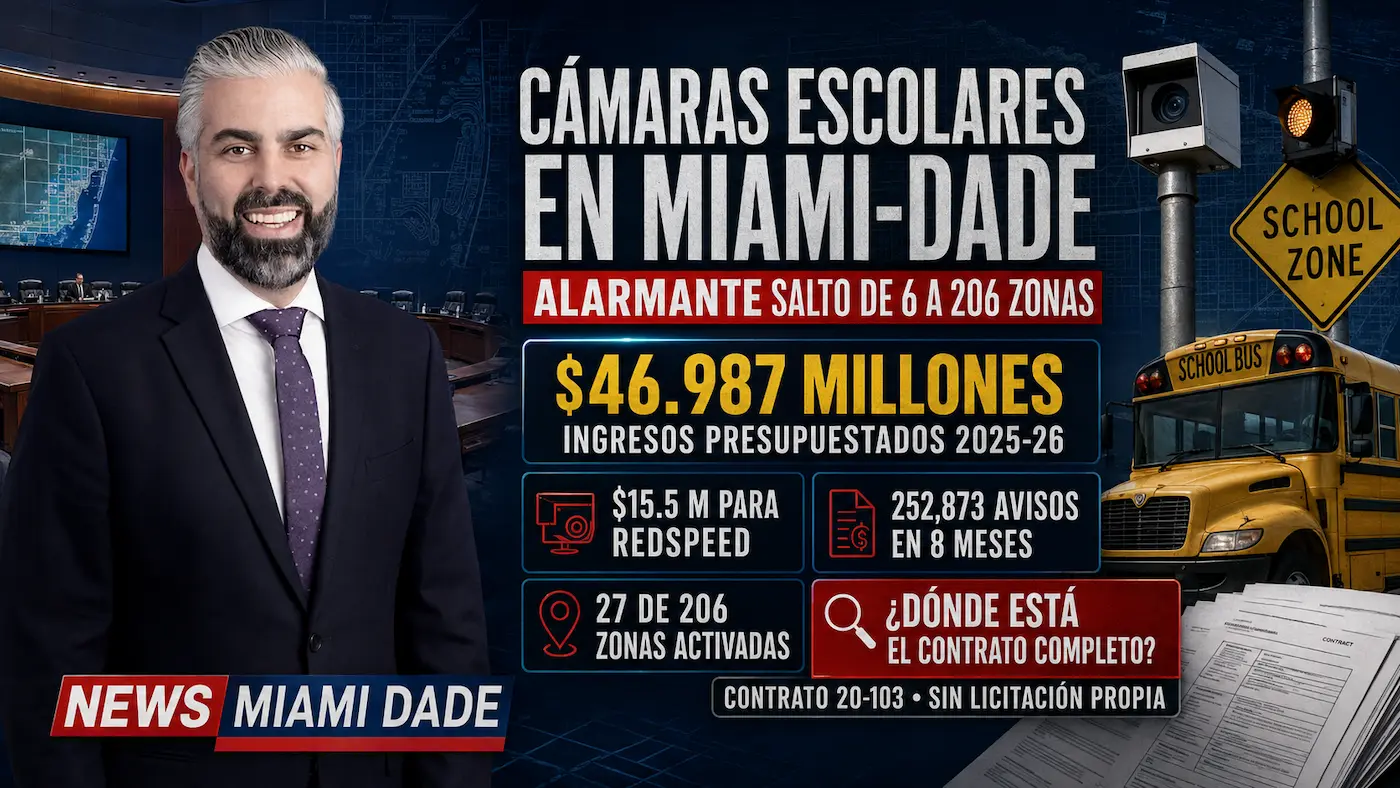
School Cameras in Miami-Dade: Alarming Expansion and a Projected $47 Million.A Contract Copied from 6 Zones to 206.
The document in which the administration asked the commissioners to approve speed cameras in school zones described the program, in writing, as a revenue generator. A year and a half later, the county’s adopted budget allocates nearly $47 million as county revenue from those fines and distributes two-thirds of the funds under two broad-purpose budget lines.


On January 17, 2024, the Miami-Dade Board of Commissioners approved the contract to install automated speed cameras in the 206 school zones already authorized by ordinance, without putting it out to bid, by adopting a contract that the city of Alpharetta, Georgia, had awarded in 2019 and that was implemented in six school zones. The budget adopted for fiscal year 2025–26 allocates $46,987,000 in revenue from these fines and sets aside $15,506,000 as payment to the company operating the system. By ordinance, the program operates only in the unincorporated area of the county.

What happened?
File No. 232491: Memorandum from the mayor regarding Item 8(P)(2) and Resolution R-901-23, including the roll call vote. Official document of Miami-Dade County, Source 4.
The matter did not begin in January 2024. It began on October 3, 2023, when the Board adopted Resolution R-901-23, sponsored by then-Vice Chair Anthony Rodríguez—now the Board’s Chair—which directed the mayor to negotiate a contract with RedSpeed Georgia LLC. The resolution did not call for a market analysis or a competitive bidding process—it specifically named the company. It was approved by a vote of ten in favor and two against—those of Commissioners Eileen Higgins and Raquel Regalado—with Commissioner René García absent.
File 231648: Ordinance 23-99, which identifies the 206 school zones, along with the Fiscal Impact Statement and the Social Equity Statement. Official document of Miami-Dade County, Source 3.
On November 7, 2023, the Board approved Ordinance 23-99, which creates Section 30-5.1 of the County Code and identifies the 206 school zones where the systems would be installed. Rodríguez himself sponsored the ordinance. Its Fiscal Impact Statement, signed by the county’s chief of public safety, stated that due to the number of variables, the impact could not be calculated, but that the program was expected to generate revenue.
State law requires more than simply passing the ordinance: it mandates that, at the public hearing, traffic data or other evidence supporting the installation of each proposed system be considered, and that it be determined that each school zone where the system is to be installed poses a high risk that justifies additional measures.
The ordinance states that it has considered traffic data or other evidence, and makes the determination in a single statement that covers all 206 zones at once: it states that in the unincorporated area, where surveillance is not supplemented by municipal police, there is a high risk. The evidence contained in the published record is the aggregate figure of nearly 2,500 citations issued in 2022. No data broken down by zone was found.
File No. 240293: Official copy from the Clerk of Resolution R-40-24 as adopted, with the roll call vote on page 12. Official document of Miami-Dade County, Source 5.
On January 17, 2024, the award decision was reached and approved as Resolution R-40-24. The mayor’s accompanying memorandum described the system as funded exclusively by the violator, at no cost to the county, and—to quote the document—revenue-positive, with projected revenues of $144 million for the county and $71 million for the company over six years.
It is important to understand what the figure of 215 million in the resolution’s title refers to, because it is not the amount the county pays to the provider. It is the sum of the two projections: 144 plus 71. And the memo itself notes that the county would not necessarily retain those 144 million, because for every fine of one hundred, it retains sixty and remits forty.
The original request for proposals was from 2019. Alpharetta issued it on June 6 of that year, requesting a system for nine school zones; it received three proposals—from RedSpeed, Verra Mobility, and Sensys America—and awarded the contract to RedSpeed, effective July 21, 2019, for five years plus five annual extensions. When Miami-Dade joined the contract in January 2024, there were six months remaining before the base term expired. The county’s memorandum includes a sentence worth noting: as of January 2024, there was no contract in effect.
The supplier profile included in the memorandum itself addresses a question frequently asked in Miami-Dade. RedSpeed Georgia, LLC has its principal place of business in Lombard, Illinois. In the “local address” field, the document lists “none.” Employees residing in Miami-Dade: four, or 4 percent of its workforce. And in the section on applicable ordinances, the memorandum indicates that the preference for small businesses and the local preference do not apply. These two preferences are provisions of the public bidding process, and there was no bidding process in this case: by adopting a contract from another jurisdiction, the memorandum itself designates them as inapplicable.
During the session, Commissioner René García, a former state senator, asked how much the vendor expected to earn without Miami-Dade having conducted its own bidding process. The administration’s response was that the figures were projections based on how the Alpharetta contract was structured: they took what that city collected in one year across six zones and extrapolated it to Miami-Dade’s 206 zones. When asked afterward if the terms were identical, as required by the “adhesion” provision, the administration responded that the percentage was the same but that the key difference was the six zones versus the 206.
Case No. 250658: Resolution R-363-25 and the text of Implementing Order 3-38, the order governing adherence to contracts from other jurisdictions. Official document of Miami-Dade County, Source 8.
When asked whether it is customary to enter into contracts of a comparable size, she replied that, in general, yes, but that in this case it was recommended because there was a prior directive from the Board itself.
During the debate, Commissioner Eileen Higgins asked a county attorney to confirm that the fine would be a civil penalty with no effect on a driver’s license, as the commission had been told. Assistant County Attorney Anita Viciana responded that these are notices of violation under Chapter 316 and that, if left unpaid, they can become uniform traffic fines which, if not addressed or paid in accordance with legal procedure, can lead to driver’s license suspension. Higgins requested that it be noted in the minutes that the previous information was incorrect and announced that she would vote against the motion on procedural grounds, not on the merits.
Commissioner Raquel Regalado pointed out that the school district should be participating but was not, that there are schools in the county without crosswalk monitors due to a lack of funding, and that there was no evidence that the program was necessary. That statement was captured on video.
Toward the end of the debate, Regalado pointed out that the county has its own data on where traffic accidents actually occur, as part of its road safety program, and that this data was not included in the case file. This statement was confirmed on video by the editor at the 03:34:07 mark of the session recording.

Commissioner Raquel Regalado questions the administration and objects that no evidence has been presented to show that the program is necessary. Session of January 17, 2024. Official recording, Fuente 12.
Anthony Rodríguez, then vice president and now president of the Board, who sponsored the ordinance and the resolution and authored the amendment, argued that adherence to the agreement is a legal and standard procedure that avoids having to wait years for a new bid. And he said, verbatim, that the intention is not to generate revenue: that the idea is to generate zero dollars, because zero would mean that all drivers have stopped.
The documents he himself sponsored said otherwise. The Fiscal Impact Statement for his ordinance predicted that the program would generate revenue. The memorandum responding to his resolution described it as revenue-positive and projected 144 million for the county.
The police official who answered questions about fair enforcement , privacy, and errors acknowledged that there were no such cameras in the county’s unincorporated jurisdiction and that his officers had no experience with them. He explained that the company would first screen the citations and would only forward to the officers those it deemed to be legitimate violations.
The motion was approved with an amendment proposed by Rodríguez himself that transferred the administration of the police contract to the Department of Transportation and Public Works. The change can be tracked on paper without the need for a recording.
The official agenda for that January 17—which News Miami Dade downloaded and has on file—sets the starting point. The matter was listed as item 8(P)(2) under the Strategic Procurement Department section, and its wording stated, verbatim, that authorization was granted for contract number 20-103, a speed detection camera system for school zones with RedSpeed Georgia, LLC, for the Miami-Dade Police Department, for a total estimated amount of $215 million over six years. That same document notes that the item had come from the January 8 committee meeting with a favorable recommendation by a vote of three to one.
Official agenda for the Board of Commissioners meeting on January 17, 2024, Meeting No. 5034. Item 8(P)(2) appears on page 36 and concerns the RedSpeed contract awarded to the Miami-Dade Police Department. Official Miami-Dade County document, Source 10.
The outcome of the session bore a different name. The meeting minutes themselves show that the resolution was adopted with an amendment on January 17, and its legislative history indicates that the amendment concerned the department responsible for administering the contract, which was transferred from the Miami-Dade Police Department to the Department of Transportation and Public Works, with the police and the Department of Technology coordinating efforts.
The title of the resolution, as adopted, already refers to Transportation and Public Works. The legislative history of the bill also includes the motion read into the record by an assistant county attorney: to transfer the department responsible for administering the police contract to the Department of Transportation and Public Works, and to replace all references to the police in the mayor’s memorandum.

An assistant county attorney reads aloud the amendment transferring the police contract to the Department of Transportation and Public Works, citing the contract by its number. Session of January 17, 2024. Official recording, Source 12.
The vote was ten to three. Voting against were Commissioner René García—who had been absent in October—and Commissioners Eileen Higgins and Raquel Regalado. The roll call is recorded in the Clerk’s official copy, although the vote was cast aloud in the chamber.
How It All Began
The timeline fits into a table. Each row is taken from an official document or the recording of the session.
| Date | What happened? | What proves it? |
|---|---|---|
| May 31, 2023 | The governor’s office approves CS/CS/HB 657, which allows counties to issue speeding tickets in school zones using cameras. | Official project history. Enacted on June 1, Chapter 2023-174, effective July 1. |
| Oct. 3, 2023 | The City Council directs the mayor to negotiate with RedSpeed Georgia LLC in accordance with the Alpharetta contract. The resolution specifically names the company; it does not require a competitive bidding process or a market analysis. It gives the mayor 30 days to finalize the contract award. | Resolution R-901-23, paragraph 11(A)(17). Sponsor: Anthony Rodríguez, then vice president and now chairman of the Board. Approved 10 to 2, with Eileen Higgins and Raquel Regalado voting against and René García absent. |
| Nov. 7, 2023 | Second reading of the ordinance that establishes Section 30-5.1 and identifies the 206 school zones, all of which are located in the unincorporated area. | Ordinance 23-99, Section 7(E). Its Fiscal Impact Statement states that the impact cannot be calculated but is expected to generate revenue. |
| Jan. 8, 2024 | The matter is being reviewed by a committee. A resident points out in a public comment that the contract is not included in the documentation. No one responds. | Item 3C. Recommendation approved by a vote of 3 to 1, according to the official agenda of the plenary session. |
| Jan. 17, 2024 | Approval is granted for contract 20-103, with an estimated value of 215 million over six years. Rodríguez proposes an amendment to transfer police administration to the Department of Transportation. He states in the chamber that the goal is to generate zero dollars. | Resolution R-40-24, Section 8(P)(2), as amended. Approved 10 to 3, with René García, Eileen Higgins, and Raquel Regalado voting against. |
| Nov. 4, 2024 | The first cameras are activated. | County Notice. Previously, there was a 30-day grace period without a fine. |
| September 4, 2025 | At the budget hearing, Commissioner Eileen Higgins explains that the revenue is divided into thirteen portions, one for each district, and that it does not go back into the general fund. She introduces an amendment to direct her district’s portion to the general fund. | Recording of the session. The figure for your district—$17,388—is listed in the text of the ordinance adopting the measure. |
| Fiscal Year 2025–26 | The cameras have their own budget, the G3109. It allocates 46,987,000 for county revenue and 6,500,000 for the surplus, and distributes the 53,487,000 across five budget lines | Adopted Budget, Volume 1, page 166. The largest line item, 20,739,000, appears in Appendix G of that same volume as RedSpeed projects by commission district. |
| Jan. 21, 2026 | The Board receives the program’s first annual report. From December 1, 2024, to July 31, 2025: 252,873 notices issued, 170,404 paid, and 75,468 issued as standard traffic fines. Seventy systems in 27 zones. | Case No. 252478, item 14(B)(1). It was not included in the consent agenda—which is prohibited by law—but rather in the section of the agenda subject to the four-day rule. |
| June 2, 2026 | The Board ratifies the closing of the 2024–25 fiscal year. Included in this is the cameras’ fund, with 10,500,000 in revenue that was not budgeted: 4,000,000 for expenses and 6,500,000 for reserves, which is the same 6,500,000 that the following fiscal year records as a surplus. | Ordinance 26-38, Section 5(G), sponsored by President Rodríguez. The minutes state that he opened the public hearing and closed it with no speakers. |
Why It Matters
Florida Statutes, Section 316.1896: Speed detection systems in school zones; the four grounds for citation; penalties; allocation of funds; and reports. Official text of the Florida Legislature, Source 1.
The law authorizing the program specifies how each $100 fine is allocated. Sixty dollars goes to the county or municipality to administer the system and fund other public safety initiatives. Twenty dollars goes to the state’s general fund. Twelve dollars goes to the school district, earmarked for school safety, student transportation, or pedestrian safety. Five dollars go to the county or municipality for the crosswalk monitor program. And three dollars go to a state police training fund.
In other words: for every $100 a driver pays after being ticketed near a school, $12 goes to the school system and $65 stays with the jurisdiction that installed the camera.
What is done with the $60 allocation—identified by name and number—in the Adopted Budget for fiscal year 2025–26? The $5 from crossing guards has a separate legal purpose and is not included here. The cameras have their own fund, G3109, within Transportation and Public Works. The budget records $46,987,000 in revenue from fines and a surplus of $6,500,000, and allocates the resulting $53,487,000 across five line items: $15,506,000 for payment to the contractor; $2,037,000 for violation reviews and hearing officer expenses; $705,000 for department administration; $14,500,000 transferred to the Sheriff’s Office for public safety initiatives; and $20,739,000 under the heading of other legally eligible project costs.
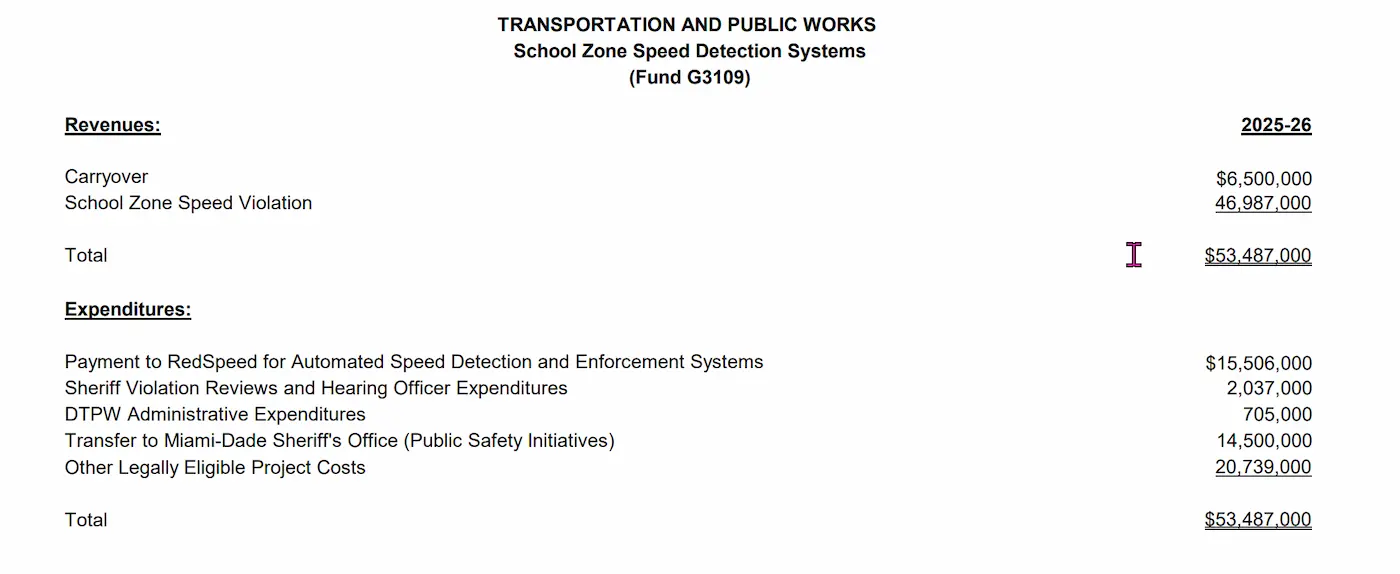
Source: Miami-Dade County, Adopted Budget for Fiscal Year 2025-26, Volume 1, page 166. Screenshot from News Miami-Dade. Unmodified. Source 9.
These are budgeted figures, not verified revenue. However, they support three calculations presented in the book itself, as well as those made by News Miami-Dade based on figures from the same document.
The first identifies what that revenue line item is. The 15,506,000 from the supplier matches, to the nearest whole number, 33 percent of the 46,987,000 allocated. And 33 percent is, according to the county itself, the portion the company charges out of the sixty dollars the county withholds. There is a second verification that points to the same conclusion, and that is what the fund is missing.
The law requires the county to remit twenty dollars to the state, twelve to the school district, and three to a police training fund. If the reported revenue were gross, the expenditure side would have to include those remittances—more than sixteen million. There are five line items, and none of them is a remittance. In other words, those nearly 47 million are not the gross revenue from the fines: they are the county’s share. The gross revenue they represent—at $100 per fine—would be around 78 million, which would mean some 783,000 fines paid in a single fiscal year.
Second: County-level oversight and administration cost 2,742,000, or 5.1 percent of the fund. When the payment to the company is added, the identifiable operating cost rises to 18,248,000, or about 34 percent.
Third: the two line items with the broadest scope—the transfer to the sheriff’s office and other legally eligible costs—total 35,239,000, which is two-thirds of the fund’s total.
And there is an earlier figure that had not been disclosed until now. The 2024–25 fiscal year—the first with cameras rolling—closed with funds that were not budgeted. In June 2026, the administration submitted the closing adjustment ordinance for that fiscal year to the Board, and Annex A includes a line item for fund G3109 with a single revenue category, literally titled “revenue from RedSpeed cameras”: $10,500,000. Of this amount, $4,000,000 was allocated to program expenses and $6,500,000 to the reserve.
You can see two things there.
First: All the other funds on that same page include a line item for already-approved revenue, but the one for the cameras does not.. Its only revenue line item is for fines. That money was allocated in its entirety through the year-end budget adjustment, and the memorandum itself states this: the supplement is financed by new revenue from fines under the program.
Second: the 6,500,000 transferred to the reserve fund is exactly the same amount that the budget for the following fiscal year allocates as the balance remaining in that same fund.
File 260553: Ordinance 26-38, year-end adjustments for fiscal year 2024-25, with fund G3109 listed in Annex A. Official document of Miami-Dade County, Source 7.
The Board approved it on June 2, 2026, as Ordinance 26-38, sponsored by President Anthony Rodríguez. In other words, it ratified 10.5 million in revenue from cameras for a fiscal year that had ended in September 2025. The minutes state that the president opened the public hearing and, since no one came forward to speak, closed it.
That money does not go into a general fund. At the budget hearing on September 4, 2025, Commissioner Eileen Higgins explained this in a public session: the revenue from the cameras is divided into thirteen parts—one per district—and does not go back into the general fund. She herself introduced a formal amendment to direct her district’s share to the general fund and allocate it to community organizations. The text of the ordinance adopting the budget specifies the exact amount: $17,388.

Commissioner René García estimates that the program allocates approximately twenty million dollars to the commission. Budget hearing on September 4, 2025. Official recording, Source 12.

The exchange in which it is recorded in the minutes that the county does not pay for the technology, along with a breakdown of the legal distribution of each fine. January 17, 2024, session. Official recording, Source 12.
That elastic band has another name twelve pages further on, in the same book. Appendix G, which lists non-departmental expenditures for the unincorporated area, lists the same figure—20,739,000—under a heading that leaves no room for doubt: RedSpeed projects by commission district. This is documentary confirmation of what Commissioner Higgins had said during the session: that this money is divided among the districts. What remains unpublished is how much goes to each one.
What the First Annual Report Says
File 252478: the program’s first annual report, including the seven required figures, the tiered payment scale, and the allocation of funds. Official document from Miami-Dade County, Source 6.
On January 21, 2026, the Board received the program’s first annual report, which is required by state law and Section 30-5.1(7) of the County Code. It was addressed as a separate item, and the administration read the figures aloud, noting that certain details must be recorded in the minutes.
From December 1, 2024, to July 31, 2025, 252,873 violation notices were issued. A total of 2,129 were contested. Of these, 1,598 were upheld and 531 were dismissed. A total of 170,404 were paid. And 75,468 were issued as standard traffic fines: thirty out of every hundred.
It is worth comparing that first figure with the one the county itself used to justify the program. Throughout 2022, with officers on duty, the police issued nearly 2,500 tickets for speeding in school zones in the unincorporated area. In eight months, with cameras operational in 27 of the 206 zones, 252,873 citations were issued. That’s 100 times more with only one-tenth of the planned deployment. The comparison allows for two interpretations, both of which are legitimate: either there was widespread violations that no one was enforcing, or the system detects violations on a scale that officer-led enforcement never could.
That last figure brings us full circle to the January 2024 hearing. It is exactly the process that the county attorney described when she corrected the Board: the conversion to a traffic fine, which is the path through which, if left unaddressed, it could ultimately result in the loss of one’s driver’s license.
The allocated funds for the period: 3,408,080 to the state general fund; 511,212 to the police training fund; 2,044,848 to the school district; 852,020 to the crosswalk monitor program; 6,645,756 to the county for administration and public safety initiatives; and 3,578,484 to the company. Total: $17,040,400.
What Happened When the Board Received That Report
The report was not accepted without objection. Commissioner Raquel Regalado removed it from the agenda to discuss it, and her remarks highlight precisely what this article has had to reconstruct by hand: that the report details revenue collected but does not reconcile it with the budget. She explained that she had to consult the budget ledger herself to reconcile the figures, and requested that, going forward, the report include projections and their budgetary alignment. The Director of Transportation and Public Works, Stacey Miller, agreed to do so, and the chair ordered that this be recorded in the minutes.

Commissioner Raquel Regalado removes the annual report from the list and requests that it be cross-referenced with the budget going forward. Session of January 21, 2026. Official recording, Source 12.
It was Director Miller herself who read aloud, one by one, the figures that the law requires her to read aloud.

Stacey Miller, Director of Transportation and Public Works, reads aloud the figures that she is required by law to read. Session of January 21, 2026. Official recording, Source 12.
Commissioner Keon Hardemon then spoke, and that’s when something came up that isn’t in any of the program documents. He said that during the budget cycle, the Board had issued instructions on how to allocate that money, and that each affected district was expected to receive a portion to invest in its community. He added that he was surprised to discover that the total amount collected goes first to the sheriff’s office before the districts can access any of it. His fundamental objection was this: it is one thing for a neighborhood to be flooded with fines, but quite another for that neighborhood to be able to reinvest what it pays.

Commissioner Keon Hardemon states that the Sheriff’s Office collects payment first, and Commissioner Regalado responds. Session of January 21, 2026. Official recording, Source 12.
To respond , Ray Baker, director of the Office of Management and Budget, took the stand and described the mechanism with a clarity that the record lacks. First, the amount allocated to the Sheriff’s Office is included—or projected to be included. Once the amount corresponding to the budget for that purpose has been received, the remaining portion becomes available to the thirteen districts, distributed according to the allocations of the neighborhood improvement program and set forth in what he called the second budget memorandum. And he openly acknowledged the question this raises: whether there will be enough money for that portion. He proposed providing periodic updates on actual revenue collected, so that everyone would know when spending could begin.
Commissioner Oliver G. Gilbert III summed it up in one sentence: they don’t get paid until everyone else has been paid.

Ray Baker, Director of the Office of Management and Budget, explains the allocation order and the second budget memorandum, and Commissioner Oliver G. Gilbert III summarizes it. Session of January 21, 2026. Official recording, Source 12.
As the meeting drew to a close, Raquel Regalado proposed that instead of reviewing this matter once a year, it be reviewed every three or four months, precisely because part of that money goes toward funding the Sheriff’s Office. The report was accepted by a voice vote, without a roll call.
All of the above are statements made during a public hearing, not proven facts about how the program works. They are included here for what they are: what was said, with the recording provided so that anyone can verify it.
The figure in the report that doesn’t add up with the report itself
33 percent is not a figure that first appeared in 2026. The mayor’s memo already stated this twice in January 2024: that the company receives 33 percent of each fine under the city contract, and that it would be entitled to 33 percent of the $60 retained by the county.
And it wasn’t just a single figure: the memo lists the full scale. The company charges 33 percent of that $60 for the first 100 systems installed, 32 percent for systems 101 through 200, 31 percent for systems 201 through 300, and 30 percent for 301 and up. The more devices, the lower the percentage. The memo sums it up with a promise: that the vendor will charge the same or less in penalties than in the city’s contract.
The annual report states the same range: that the company receives 33 percent of $60 when there are up to 100 systems installed, and states that there were 70. 33 percent of 60 is 19.80 per fine, which, over 170,404 fines paid, would amount to $3,373,999.
The report lists 3,578,484, which is 204,485 more. That amount amounts to exactly $21.00 per fine paid, which is 35 percent of sixty, not 33 percent as stated in the document itself.
News Miami-Dade arrives at that figure based on the three numbers in the report itself. The precision of the result—exactly twenty-one dollars—suggests a fixed fee per fine rather than a percentage. It’s also worth noting what the figure does not contradict: $21 is still less than the $24.75 the company charges in Alpharetta, where 33 percent is applied to a $75 fine. The promise to charge the same or less per fine still stands. What doesn’t add up is the percentage.
There is nothing to suggest any irregularity: it could be a contractual provision different from the one summarized in the report, or a drafting error. The signed contract and its price schedule would resolve this. And there is a detail in the case file that points in that direction: Alpharetta’s original bid specifications expressly allowed the supplier to charge in one of two ways—either a percentage of each fine paid or a fixed amount per fine paid.
That contract has not been made public. The Board approved, via Resolution R-40-24, access to RedSpeed’s Contract 20-103, with an estimated value of $215 million over six years. However, neither the signed contract, nor the letter of agreement with the county, nor the annexes regarding pricing and revenue sharing are included in the legislative record, which is limited to the recommendation package and the Clerk’s official copy.
The resolution itself states this in the paragraph preceding the vote: the contract documents are on file and available upon request at the Strategic Procurement Department. News Miami-Dade opened the two legislative files for this item and verified that they are not there: the only attachment listed in both is the previous resolution, R-901-23. “Filed and available upon request” is not the same as “published.”
The same report includes a detail that highlights the issue: under the agreement, the company itself is responsible for billing, collecting, and distributing the fines, as well as submitting quarterly reports to the state on behalf of the county.
What the county wrote and what it said
The contrast is evident in three documents and one sentence. The Fiscal Impact Statement for the ordinance stated that it was expected to generate revenue. The mayor’s memorandum described it as having a positive revenue impact and projected 144 million for the county. The adopted budget allocates nearly 47 million in revenue from fines in a single fiscal year. And during the session in which it was approved, it was defended by stating that the intention was to generate zero dollars.
The Social Equity Statement in the case file itself provides the baseline: the Miami-Dade Police Department issued nearly 2,500 tickets for speeding in school zones throughout 2022 in the unincorporated area. And it explains why the change was sought: it states that enforcing the law with officers alone is difficult, because while one officer stops and tickets a driver, others commit the violation and get away.
It’s worth reading the projection while looking at the calendar. The memo states, verbatim, that the projected revenue is 144 million for the county and 71 million for the provider over a six-year period, and those two figures were calculated for the 206 school districts.
To compare them with the budget, you have to put both sides on the same basis, and News Miami-Dade does it this way. The 144 million is the amount remaining to the county after the vendor’s share has been set aside; the 46,987,000 line item in the budget, on the other hand, represents the fund’s revenue before paying the company, because that payment comes from the same fund. Comparing like-to-like figures using either method yields the same result.
Adding the two projections together, 215 million over six years amounts to about 35.8 million annually, compared to the 46,987,000 allocated. And after deducting the supplier’s payment on both sides, the projected amount is 24 million compared to 31,481,000. In both cases, this is about one-third more than anticipated.
What gives that one-third its significance is the scale on which it occurs. The first annual report places the program that generated those figures at 70 systems spread across 27 school districts—just over one in ten of the 206 on which the projection was based.
Two clarifications to ensure a fair comparison. The budget reflects projected revenue, not actual revenue collected. And the 252,873 fines listed in the annual report correspond to eight months, not a full fiscal year. Even with these two caveats, no document in the file explains the discrepancy between the projections and the budgeted figures.
What the County Says Today
The county’s official website states that the speed camera system is funded entirely by the fines paid and that a violation occurs when a driver exceeds the speed limit by more than ten miles per hour.
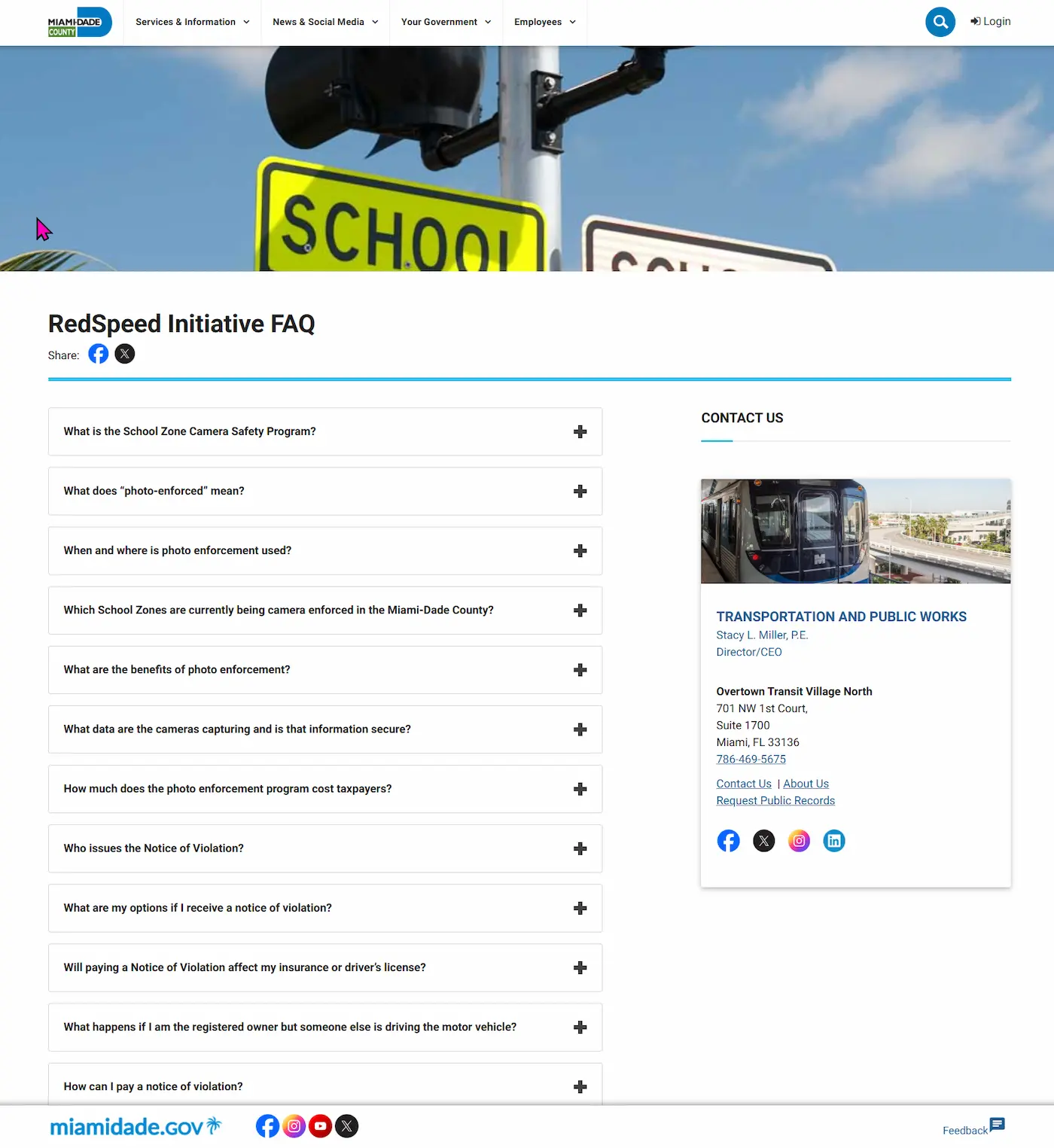
That statement is true, but it falls short because it doesn’t specify which of the two limits or at what point. The law authorizing the program does not provide for just one scenario for a fine: it provides for four, and they don’t all work the same way.
Three of them are based on the reduced speed limit in the school zone and apply only during short time windows: the thirty minutes before and after the start of the breakfast program, the same thirty minutes around the start of classes, and another thirty minutes around dismissal. The fourth is different in every way. It invokes a different section—the one regarding general speeding; it enforces the normal speed limit on the road, not the school zone limit; and it does not operate during a half-hour window but, in the words of the statute itself, for the entire duration of the school day.
In other words: mid-morning, when the reduced speed limit in the school zone is not in effect, the camera continues to operate. What it measures then is whether the driver exceeds the normal speed limit on that road by more than ten miles.
That ties in with what the law requires to be posted. The permanent sign must indicate the boundary of the school zone and the hours during which it is in effect, or a flashing beacon in lieu of the hours. It is not mandatory to place the standard road boundary marker within the zone. And the provision that the zone is in effect throughout the school day is determined, according to the legal text, by the boundary marker that is in place.
The first annual report does not indicate the weight of each case: it lists the 252,873 notices issued and the other figures required by law, but does not break them down by the section of the law cited in each summons. Such a breakdown must exist, because each summons is issued under one section or another.
And the annual report itself clarifies the actual scale: between December 1, 2024, and July 31, 2025, there were 70 systems installed in 27 school zones, out of the 206 authorized by Ordinance 23-99. The program that produced these figures is therefore operating in just over one out of every ten approved school districts.
Open Questions
- How many zones have been added since July 2025, and when will all 206 be completed?
- Does the company charge a percentage or a fixed amount per fine, and under what clause?
- What has the school district done with its share?
- What exactly do the 20,739,000 in other legally eligible costs consist of, district by district?
- And did the program slow down?
The annual report required by law was submitted on January 21, 2026, and contains the seven mandatory figures, but none of them measure whether people are slowing down. No assessment of speed reduction was found in either the annual report or the records reviewed.
Florida Statutes, Section 316.1895: Establishment of School Zones, Requirements for Permanent Signs, Double-Penalty Signs, Maintenance, and Periodic Inspection. Official Text of the Florida Legislature, Source 1b.
There is another issue that stems from the signage itself. The law governing school zones requires that the permanent sign display the reduced speed limit and, written on it, the hours during which that limit is in effect, or an intermittent beacon as an alternative to the hours. It does not require the standard speed limit to be posted within the zone. And it defines the violation based on what is posted. With police officers, that mattered little; with a system that issues fines based on time slots, it matters.
Do the 206 zones display the specific hours or the flashing beacon? Since 2008, the same law has also required a “double fines” sign within any newly established school zone or one where the signage has been replaced.
And the law itself specifies who is responsible for answering that question. School zones maintained by the county—which are those in the unincorporated area where these cameras operate—must be inspected periodically by the sheriff’s office or another qualified officer to determine whether they are being properly maintained, and “maintained” expressly includes the signs.
This requirement is part of general law and applies to any school district maintained by a county in Florida: it did not originate with this program nor does it depend on it. That office also fulfills two other functions documented in the program: it reviews violations and receives a transfer of $14,500,000 from the fund for public safety initiatives. This article does not claim that one function is contingent upon the other. What the records can answer is this: Do these inspections take place, how often, and what did they find?
And one more thing, which the law addresses on its own. The statute mandates two requirements regarding the annual report: that it not be included on the consent agenda and that public comment on it be allowed. The first requirement was met, as evidenced by the agenda for the January 21, 2026, session, which News Miami-Dade downloaded and retains. That document includes a section on consent items, number three, and the report is not listed there: it appears in section fourteen, which covers items subject to the four-day rule, as item 14(B)(1), file number 252478, titled “Annual Report on Speed Detection Systems in School Zones.”
Official agenda for the Board of Commissioners meeting on January 21, 2026, Session 5452. The annual report appears on page 50 as item 14(B)(1), within the section on matters subject to the four-day rule. Official document of Miami-Dade County, Source 10.
The second point is more difficult to determine whether it has been fulfilled or not. News Miami-Dade listened to the complete recording of that session on January 21, 2026.
The public comment period opened and closed 47 minutes into the session—about five minutes before the Commission reached that agenda item—and none of the residents who spoke mentioned the camera program. When the agenda item was reached, no specific public comment period was opened: the session moved directly from Commissioner Regalado’s request to the reading of the figures and then to the discussion among commissioners. Whether that general comment period—which closed before the matter was addressed—meets the legal requirements for this specific report is a question the county has not answered.
All of these questions have a single place to begin finding answers. The resolution approving the program states, in the paragraph preceding the vote, that the contract documents are on file and available upon request at the county’s Strategic Procurement Department. “On file and available upon request” is not the same as “published.”
Embedded materials and their original sources
The nine video clips in this piece are taken from the official recordings of the Miami-Dade Board of Commissioners’ public meetings, as documented in Source 12. News Miami-Dade hosts them on its YouTube channel, with Spanish subtitles, and they are embedded in this article from there; the complete original recording remains in the county’s public archive.
Along with the nine clips, the complete, uncut version of Agenda Item 8(P)(2) from January 17, 2024—sixty-five minutes long—is also published here so that anyone can verify for themselves the context of what is cited here. Four are from the January 17, 2024, session, during which the contract was approved; two are from the September 4, 2025, session; and four are from the January 21, 2026, session, during which the first annual report was presented. News Miami Dade downloaded the full recordings, transcribed them, edited the clips, and verified one by one the on-screen captions identifying each speaker. Neither the audio nor the video has been altered; only the cited segment has been extracted.
The screenshot of Table G3109 is taken from the Adopted Budget for fiscal year 2025-26, Volume 1, page 166, as cited in Source 9. It is an unmodified screenshot.
The two agendas shown—the one dated January 17, 2024, and the one dated January 21, 2026—are the official documents published by the County Agenda Coordinator’s Office, as cited in Source 10. News Miami Dade downloaded them and is publishing them in their entirety, without modification.
The program’s official website, Source 11, was accessed and saved as a local copy on August 23, 2026. It is cited via a link, without an embedded screenshot.
Sources consulted
Level 1, official sources
- 1. Florida Statutes, Section 316.1896, Speed Detection Systems in School Zones, Penalties, Allocation of Funds, and Reports. Official Text of the Florida Legislature.
- 1b. Florida Statutes, Section 316.1895, Establishment of School Zone Speed Limits, Signage, Maintenance, and Inspection. Source of the requirements for permanent signage, double-fine signage, the allocation of maintenance responsibilities, and periodic inspections by the Sheriff’s Office. Official text from the Florida Legislature, downloaded and archived by News Miami-Dade on August 24, 2026.
- 2. Florida Statutes, Section 316.0776(3), placement and installation, and the requirement to include the annual report on the agenda without addressing it under the consent agenda and allowing for public comment. Official text.
- 3. Miami-Dade County, File No. 231648, an ordinance establishing Section 30-5.1 of the Code, identifies the 206 school zones and contains the Fiscal Impact Statement and the Social Equity Statement. Second reading, November 7, 2023, item 7(E). Case file.
- 4. Miami-Dade County, Case No. 232491, the mayor’s memorandum regarding Item 8(P)(2), and Resolution R-901-23 with its roll call vote. Case file.
- 5. Miami-Dade County, File No. 240293, official copy from the Clerk of Resolution R-40-24 as adopted, with the roll call vote on page 12. File.
- 6. Miami-Dade County, File No. 252478, first annual program report, item 14(B)(1) of the January 21, 2026, session, including the seven figures required by law, the tiered payment scale, and the allocation of funds. Case file.
- 7. Miami-Dade County, File No. 260553, Ordinance 26-38, supplemental year-end adjustments for fiscal year 2024-25, with Fund G3109 listed in Annex A, page 30. File.
- 8. Miami-Dade County, Case No. 250658, Resolution R-363-25, and the text of Implementing Order 3-38, the order governing adherence to contracts from other jurisdictions. Case file.
- 9. Miami-Dade County, Adopted Budget for Fiscal Year 2025-26, Volume 1: Fund G3109 on page 166 and Appendix G on page 285. Office of Management and Budget.
- 10. Miami-Dade County, Office of the County Agenda Coordinator. Official agendas for the Board meetings of January 17, 2024, identified as meeting 5034 and printed on January 16, 2024, and from January 21, 2026, identified as meeting 5452 and printed on January 20, 2026. News Miami Dade downloaded and retains both. The county does not publish each agenda at a separate URL; they can be retrieved by date from its official agenda database. The minutes of those same sessions can be retrieved in the same way from the minutes database.
- 11. Miami-Dade County, Department of Transportation and Public Works, official program website and FAQs. Red Speed Initiative.
- 12. Miami-Dade County. Official recordings of the sessions held on January 17, 2024, September 4, 2025, and January 21, 2026, available in the county’s public broadcast archive. News Miami Dade downloaded the full recordings, transcribed them, translated them into Spanish, and edited the clips featured in this piece.
Level 2, intermediate
13. Media coverage of 2026 court rulings in other Florida counties. Consulted as a reference and expressly NOT used as the basis for any claim in this article.
Disclaimer
News Miami Dade provides access to the original sources from the public hearings, Legistar documents, memos from the County Attorney’s Office, recommendations from the staff of the Department of Regulatory and Economic Resources, Granicus files, and records from the Florida Division of Elections and the Miami-Dade Commission on Ethics.
This article references government materials published by the relevant jurisdiction and includes direct quotes from public hearings broadcast by Granicus. Each factual statement is backed by an identifiable primary source. Statements of position are cited with the source and quoted verbatim when available.
This article does not allege that any irregularities have been committed. The discrepancy between the 33 percent cited in the county documents and the $21.00 per fine resulting from the figures in the annual report is presented for what it is: an arithmetic inconsistency between official documents, with two possible explanations noted in the text itself. The document that would resolve this discrepancy is the signed contract with its fee schedule, which is not listed among the attachments to the legislative records.
The calculations attributed to News Miami-Dade are arithmetic operations performed on figures contained in official documents, and they are identified as such wherever they appear.
Stay up to date with the latest news!
The county copied a contract designed for six school zones and stretched it to cover 206, and today its budget includes nearly $47 million that comes out of the pockets of anyone driving past a school. The question no one has answered isn’t how much is collected, but whether anyone is putting the brakes on it. At News Miami-Dade, we’ve read the entire file and are tracking your public money dollar by dollar. Don’t miss a single detail.
#MiamiDade #News #Florida #SchoolCameras #PublicFunds