

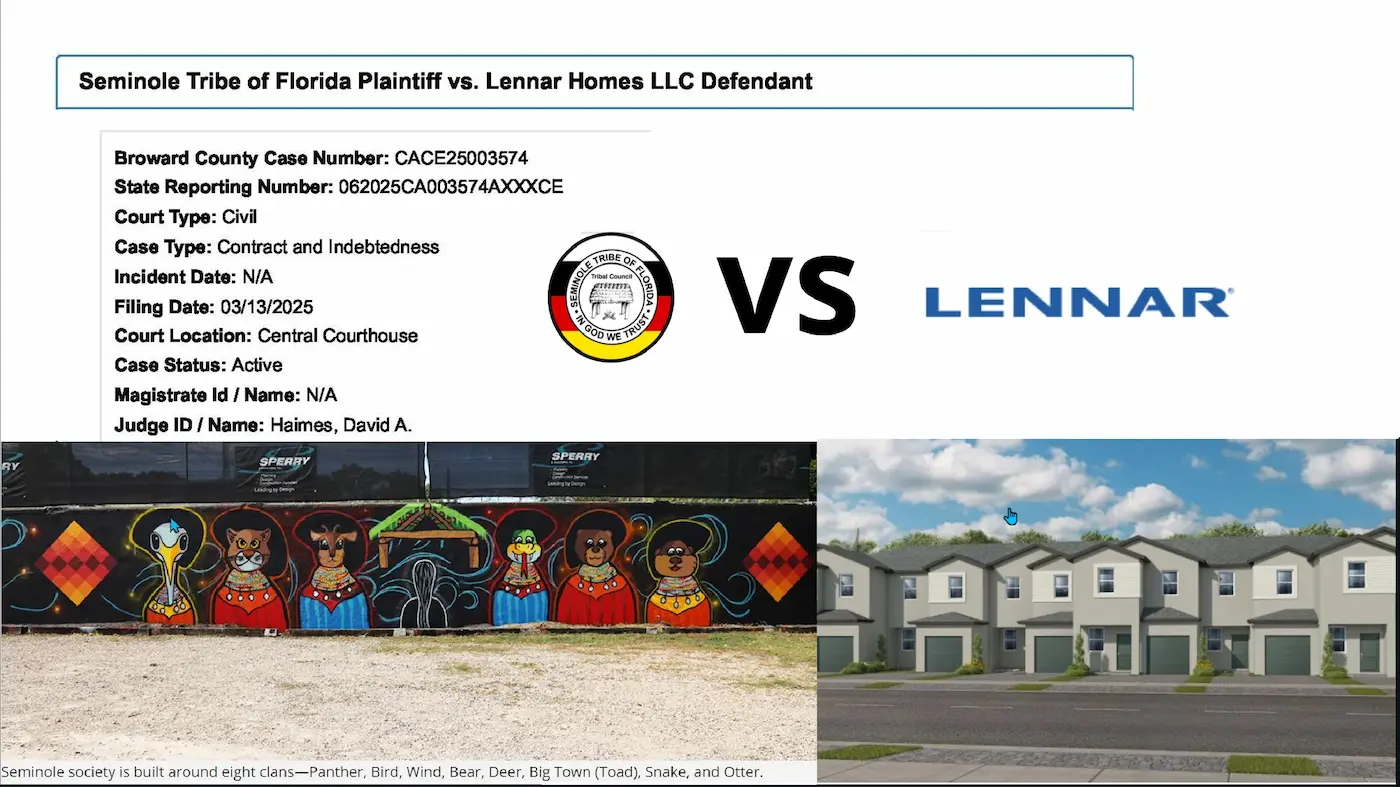
Florida judge halts Lennar arbitration: the shocking case of over 340 (uninhabitable) Seminole Tribe homes. 466 Homes and Hundreds of Millions at Stake
A Broward Circuit judge dealt a serious blow to Lennar, one of the largest homebuilders in the United States, by denying it the ability to remove from the court system most of the claims filed by the Seminole Tribe of Florida for hundreds of allegedly defective homes built on tribal land.
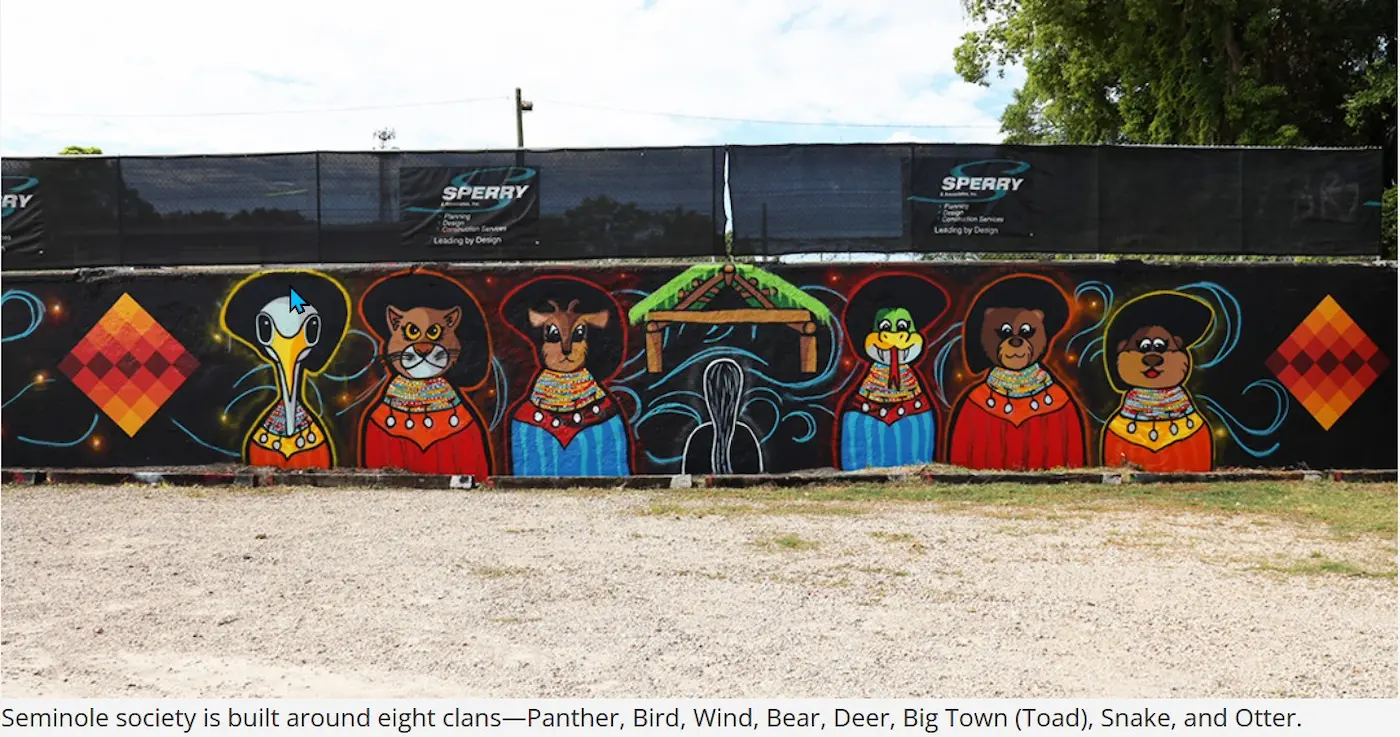
The ruling allows the Tribe’s main lawsuit to continue in state court for more than 340 homes, while only a smaller part of the case – 123 homes sold to individual tribal members – may go to private arbitration.
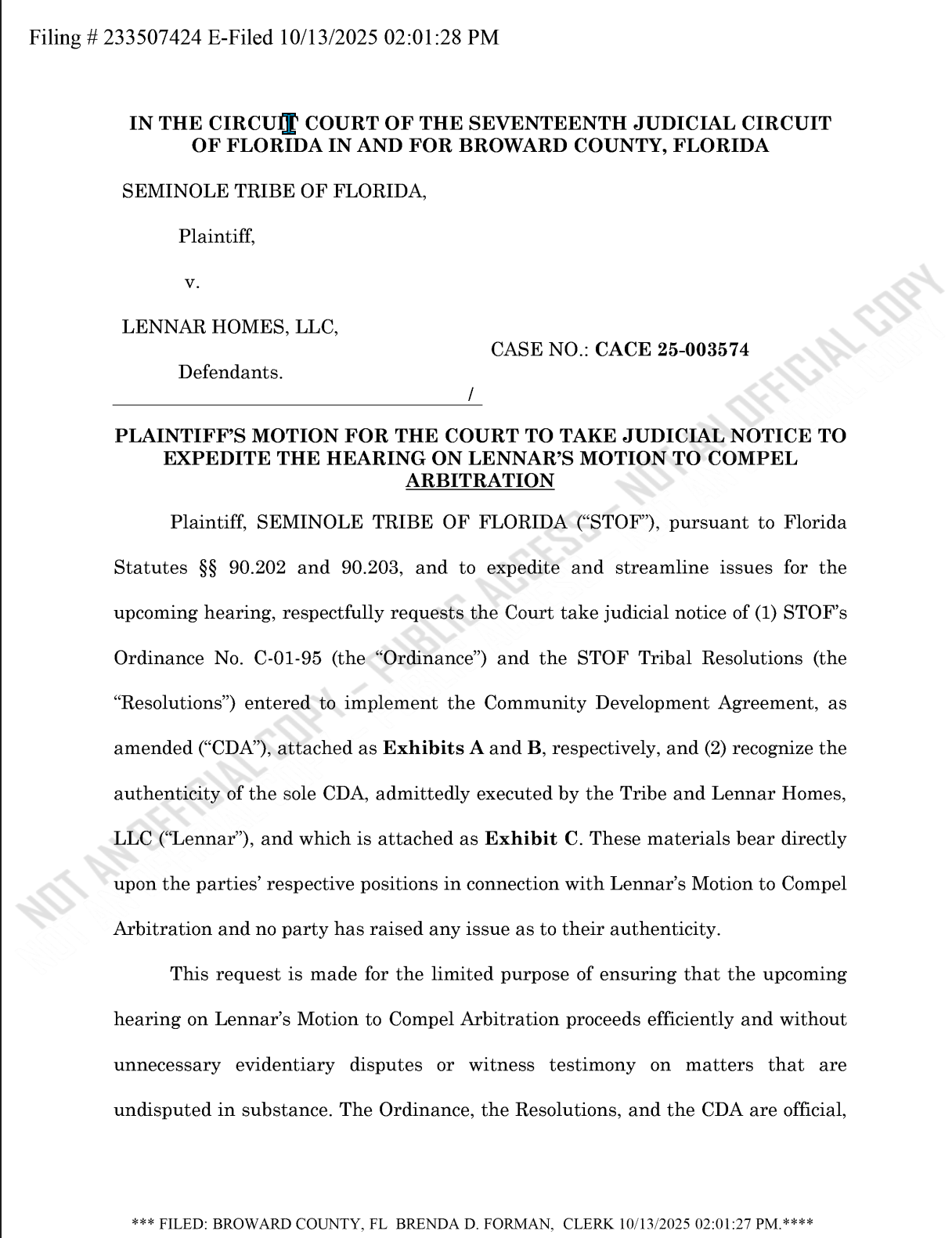
What Judge Haimes decided
Judge David A. Haimes of the 17th Judicial Circuit in Broward ruled this week that:
- It is not appropriate to compel arbitration of claims related to 343 Seminole Tribe-owned homes built by Lennar on tribal lands.
- Arbitration is maintained with respect to 123 homes sold to individuals of the tribe, where arbitration clauses included in the sales and warranty contracts are directly applicable.
In practice, this means that three-quarters of the litigation – the core of the case – will be heard in state court, in public, with access to records and hearings, rather than being buried in a confidential arbitration process.
The tribe’s attorney, William Scherer of Conrad & Scherer (Fort Lauderdale), hailed the ruling as “a major victory,” stressing that they can now “move forward quickly with discovery and depositions to hold Lennar accountable for the defective homes.”
Who is who in the case; The lawsuit case no; cace 25-003574
By the Seminole Tribe of Florida (Plaintiff)
- William R. Scherer – Lead Counsel Bar Number: 169454 Conrad & Scherer, LLP Tribe’s star litigator; same firm that obtained the $800+ million judgment against Wells Fargo.
- Howard M. Bushman Bar Number: 364230 Harke & Clasby LLP Specialist in complex civil and commercial litigation.
- Jason Kellogg Levine, Bar Number: 578401 Kellogg, Lehman, Schneider & Grossman LLP Firm with strong track record in construction litigation and high value disputes.
- Jack B. Tuter Jr, Bar Number: 363405 Retired Chief Judge Jack Tuter joins Conrad & Scherer as a senior partner.
By Lennar Homes LLC (Defendant)
- Crystal Boni Carswell – Bar Number: 108882 Lead defense counsel. Responsible for leading Lennar’s strategy for defective housing claims.

How the conflict was born: 466 houses and hundreds of millions at stake
The dispute goes back a long way. According to the lawsuit and the tribe’s own attorney’s statements, the facts are summarized as follows:
- The Seminole Tribe of Florida contracted Miami-based Lennar to build 466 homes on several of its reservations.
- The tribe claims to have invested about $300 million in that housing program before deciding to stop the project and sue for massive construction defects.
- In total, there is talk of more than 550 homes affected (those owned by the tribe plus others sold to individual members), but the central claim that now remains in state court focuses on those 343 homes in the hands of the tribe itself.
Lawsuit case no; cace 25-003574 claims hundreds of millions of dollars in damages, a figure that some reports put at around $200 million for just the portion now being heard in Broward, not counting possible additional claims.
- WGCU’s (PBS/NPR) own coverage makes it clear that some of the affected homes are in the Immokalee area, specifically, “A number of homes built on Snake Clan Road in the Immokalee area are among those in reservations across the state alleged to have shoddy construction…” WGCU PBS & NPR for Southwest Florida
- That same release explains that the “defective” homes are spread across six tribal reservations, including those located in Glades and Hendry counties. WGCU PBS & NPR for Southwest Florida
The six official reservations of the Seminole Tribe (where, according to the lawsuit, these houses were built) are: Wikipedia
- Big Cypress Reservation – rural area south of Lake Okeechobee (Hendry County).
- Brighton Reservation – in the Glades County area.
- Immokalee Reservation – in Immokalee, Collier County (here is Snake Clan Road).
- Hollywood Reservation – in Hollywood, Broward County (tribal headquarters).
- Fort Pierce Reservation – in St. Lucie County.
- Tampa Reservation – in Hillsborough County.
Lennar’s version… and the questions it leaves open
Lennar, for his part, issued a statement in which he assures:
“At Lennar, we stand firmly behind the homes we build, guided by our core values of quality, value and integrity. We take these concerns very seriously and seek to collaborate with the Seminole Tribe to address them.
In that spirit, we have shared a comprehensive plan that contemplates the necessary repairs and improvements, and we have expressed our willingness to move forward.
Our goal is to ensure lasting satisfaction and confidence in the homes we build, and we are fully prepared to begin this work immediately.”
– Lennar
But in the face of that polished statement, uncomfortable questions arise that Lennar has yet to answer clearly:
- How does one of the country’s largest builders manage to deliver hundreds of houses with “systemic “defects – water intrusion, mold, structural and electrical problems – without raising any internal alarm bells?
- Where did the quality controls fail?
– In the design?
– In the supervision of subcontractors?
– In final inspections before handing over the keys? - If they are now talking about a “comprehensive repair plan,” why wasn’t that plan implemented earlier, when the tribe started complaining about leaks and mold and, according to the lawsuit, families had to leave their homes?
- And the bottom line question: if this happens in a 500+ home project for a tribal nation, what real assurance do individual buyers have in other Lennar developments in Florida?
The company is asking for trust. But when a construction giant admits it needs a “comprehensive plan” to correct what a customer describes as uninhabitable homes, it’s no longer just a contract that’s at stake: it’s the credibility of its entire quality chain.
What Seminoles say: “systemic” defects and uninhabitable houses
The documents submitted by the Tribe and the law firm Conrad & Scherer paint a devastating picture:
Alleged defects:
- Failures in the building envelope (seals, exterior walls, insulation).
- Roof and structural problems.
- Defects in ventilation and air conditioning ducts.
- Problems in windows, ceilings, lighting fixtures and waterproofing systems.
Consequences:
- Water intrusion at significant levels.
- Mold formation to the point of making some homes “absolutely uninhabitable,” in Scherer’s own words.
- Reports of electrical failures and recurring air conditioning problems mentioned in associated local media coverage.
Scherer has described the problems as “systemic”, not isolated errors of one or two houses.
The lawsuit even includes the concept of “constructive eviction”: Seminole families who, although they are the formal owners of the houses, have been forced to abandon them due to safety and sanitary conditions.
Lennar’s response
Lennar, for his part, argues that:
- It “stands behind its homes” and that it is “committed to correcting any problems that do not meet its standards without delay.”
- It claims to have presented a “comprehensive” plan for repairs and says its priority is to “resolve the owners’ concerns – not prolong the process.”
On the legal side, the company tried to take everything to arbitration based on the warranty clauses and sales contracts, arguing that all the tribe’s claims should be channeled through arbitration.
Judge Haimes, however, put the brakes on that strategy for most of the homes, drawing a clear line between homes owned by the Tribe as a sovereign entity and those purchased directly by individuals, where arbitration agreements do remain in effect.
Who’s behind the lawsuit: the law firm that has already brought down Wells Fargo
Another key element of the case is who represents the Seminole Tribe: the law firm of Conrad & Scherer.
- This firm was the same one that secured a record judgment of more than $800 million against Wells Fargo Bank in 2023 for alleged mismanagement of a trust fund for tribal children.
This background places Conrad & Scherer in a particular position:
- They have already demonstrated that they can win big lawsuits against financial giants on behalf of the tribe.
- The case against Lennar is now presented as a new battle against a large corporation, this time in the construction sector.
Why does it matter that there is no arbitration?
Beyond the pointed clash between Lennar and the Seminole Tribe, the Haimes ruling opens up several angles of public interest:
- Transparency and scrutiny
- As it remains in state court, the bulk of the case will unfold in plain view: filings, motions, expert testimony, hearings and, eventually, a trial.
- If everything had gone to arbitration, much of this information would remain in the shadows, in a private forum and not very accessible to the public.
- Tribal negotiating strength
- The threat of an open court case, with possible significant damages, gives the tribe much more leverage to negotiate a serious settlement.
- The message to Lennar is clear: he will not be able to simply “close” the case in an arbitration room away from the spotlight.
- Precedent for work on tribal lands
- Other housing or infrastructure projects in indigenous territories will watch this case closely.
- The underlying legal question is to what extent a developer can shield itself in arbitration when dealing with a sovereign tribal nation, and when state courts say “so much for that.”
- Lennar’s reputation in Florida market
- Florida is experiencing a construction rush, but also growing concerns about quality, homeowner’s insurance and hurricane resistance.
- Being at the center of a lawsuit that speaks of “uninhabitable” homes for an entire tribe does not help the builder’s image, either with private buyers or local governments.
What’s next
With arbitration ruled out for three-quarters of the homes, the case enters a key phase:
- Discovery:
- Production of documents by Lennar: drawings, mailings, internal quality reports, inspection reports, communications with subcontractors.
- Expertise on construction, moisture, mold, electrical and mechanical systems.
- Depositions:
- Sworn statements from engineers, Lennar management, inspectors and tribal officials.
- Agreement scenario:
- The pressure of the process can lead to a settlement of millions of dollars before trial, especially if the expert reports confirm that the defects are widespread.
Meanwhile, for the Seminole Tribe, the case is more than just a contract dispute: it is a test of how far it can command respect from corporations operating on its land, and a signal to the rest of the country that it is not willing to swallow, in silence, shoddy projects paid for with hundreds of millions of dollars.
News Miami-Dade is a truly independent media: no hidden owners or sponsors, just the voice of the people and the truth, plain and simple.
Connect with us:
📧 Email: [email protected], [email protected]
📱 WhatsApp: +1 (786) 748-2386
🌐 Website: https://newsmiamidade.com/
🎧 Follow us on social media to stay up to date with the latest news.
If you have a story to tell, a complaint or want to make your voice heard, contact us. Miami-Dade deserves a media that works for its people, not for the powerful.