
Does Anthony Rodriguez Want to Appoint Vicki Lopez in District 5? Analysis of Rumors and Evidence: Miami-Dade Appointment Attempt? Analysis of the District 5 Vacancy and the Legal Process.
The resignation of Eileen Higgins from Miami-Dade Board of Commissioners District 5 on November 6, 2025 has sparked speculation about her replacement. Rumors are circulating about possible favoritism, including one suggesting that Chairman Anthony Rodriguez may push for the appointment of Vicki Lopez. This could fuel perceptions of political jockeying, but remains speculative.

Let’s focus on the facts:
the legal process, Rodriguez’s role as chairman and Lopez’s profile. miamitimesonline.com
Anthony Rodriguez’s Role as Chairman
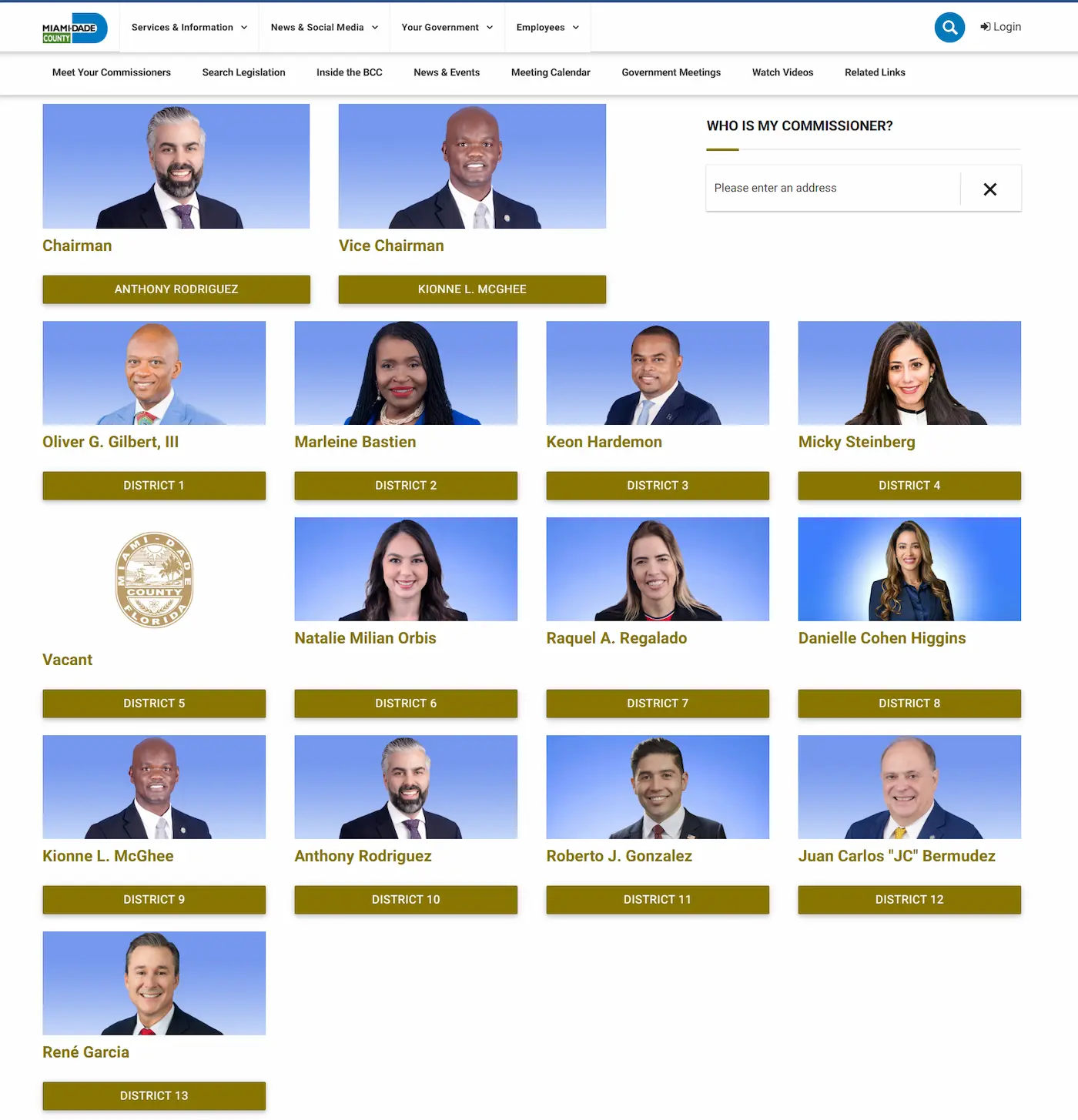
Anthony Rodriguez, elected Chairman of the Board in November 2024 for a 2-year term, presides over meetings and influences agendas, but does not make appointments unilaterally – he requires a majority of the 13 commissioners.
Details on the Election Process to Fill the Vacancy in District 5 of the Miami-Dade Board of CommissionersThe vacancy in District 5, left by the resignation of Eileen Higgins on November 6, 2025, is governed primarily by Section 1.07 of the Miami-Dade County Home Rule Charter.
The Board of Commissioners has the flexibility to choose between appointment or special election.
Options for Filling the Vacancy
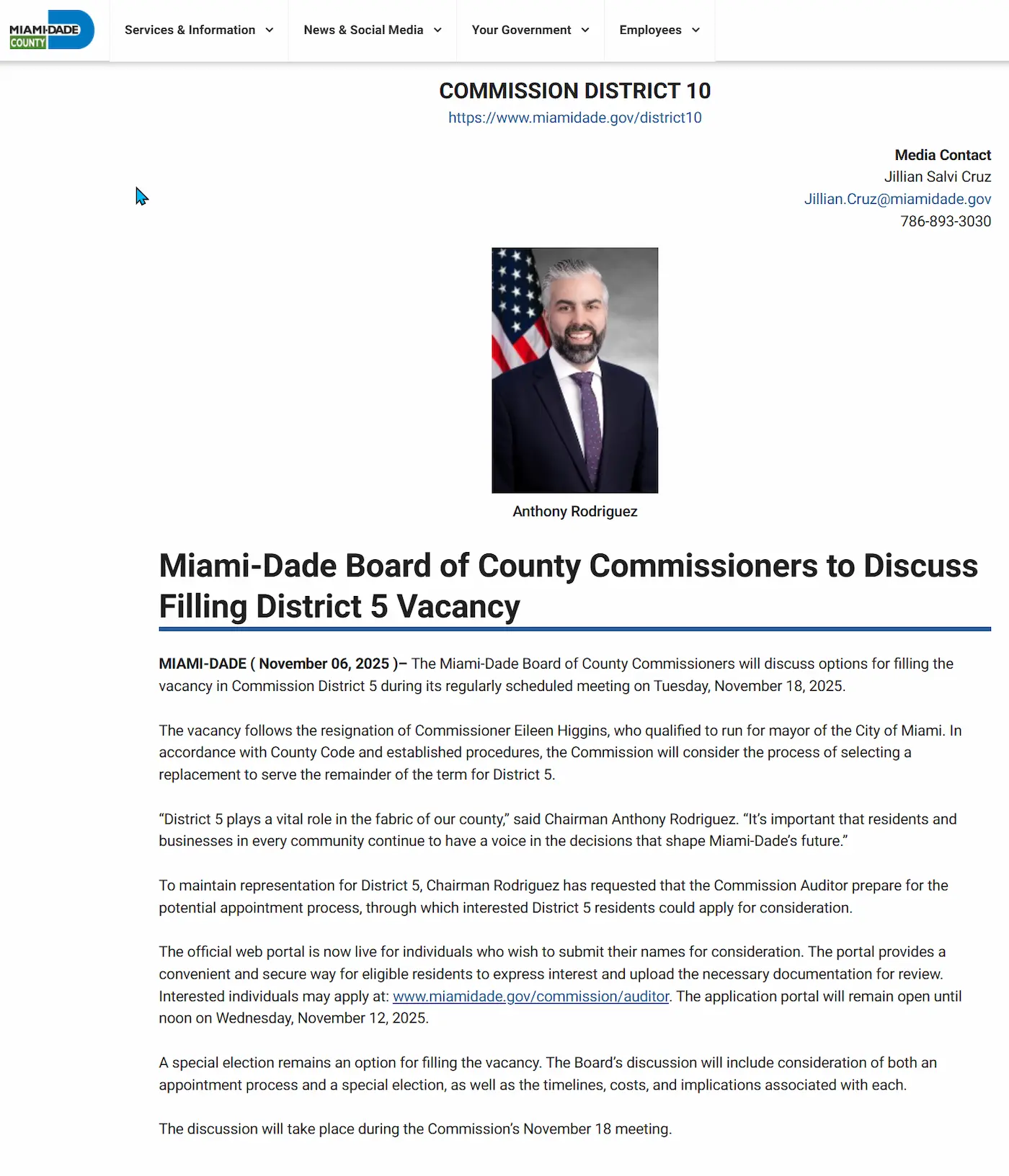
The Board may choose to:
Appointment:
The Board appoints an interim replacement by majority vote of the remaining members (currently 12 commissioners) within 30 days of the vacancy (i.e., until December 6, 2025).
The appointee must meet the residency requirements: be a qualified elector, reside in District 5 at the time of appointment, have lived in Miami-Dade for at least 3 years and in the district for at least 6 months.
The interim serves only until the next county-wide election, which would be in November 2026. At that election, someone would be elected to fill out the remainder of the term until 2028.
Advantages: Faster and more economical (avoids special election costs).
Disadvantages: Can be seen as “cronyism” or favoritism, since it does not directly involve voters.
Current Process: Chairman Anthony Rodriguez opened an application portal for candidates interested in the appointment, managed by the Office of the Commission Auditor. Applications close at noon on November 12, 2025. Applicants will be evaluated by the Board.
Special Election:
If the Board fails to appoint within 30 days, it must call a special election to be held no more than 90 days after the vacancy (until approximately February 2026).
Qualification period: The first 10 days after the call for the election.
If a second round (runoff, if no candidate obtains more than 50%) is required: It is held within 30 days after the certification of the initial results.
The winner serves the remainder of the unexpired term (through November 2028).
Advantages: Allows voters in District 5 to decide directly, promoting democracy.
Disadvantages: Additional costs for taxpayers and electoral logistics.
Qualifications for candidates: Be a qualified elector of the district, pay a qualifying fee of $360 (or collect equivalent signatures), and meet the above residencies.
Legal Basis
- Miami-Dade Charter, Section 1.07: Specifically sets forth the options for appointment or special election, with no 28-month threshold (unlike the general state law in Florida Statutes §114, which applies to non-charter counties and where the Governor appoints if less than 28 months remain, or until the next election if more). Since Miami-Dade is a charter county, its Charter takes precedence.
- Other Provisions: If a majority of the Board becomes composed of appointees (not elected), it must call an election within 90 days to replace them. There are also public hearings and transparency requirements at Board meetings.
- Next meeting: The Board will discuss the issue on November 18, 2025, including both options, at a meeting open to the public.
Ways of Forcing an Election (if Appointment is Opted for)
Although the Board decides initially, there are mechanisms to pressure or force an election:
- Citizen Petition: Residents can collect signatures (approximately 10% of registered voters in District 5, about 15,000-20,000 signatures, based on similar precedents) to demand a special election. This is not explicitly in the vacancy charter, but is derived from general citizen participation provisions and has been used in past cases.
- Lawsuit: If a Charter violation is alleged (lack of transparency or favoritism), a court may order an election. Precedents in Florida show that lawsuits have forced elections in similar vacancies (e.g., in counties such as Broward or appeals in Miami City).
- Pressure on Governor Ron DeSantis: Under state law, if the Board fails to act by the deadline, the Governor could step in and temporarily appoint, but this is rare in charter counties. Emilio Gonzalez (candidate for Miami mayor) has publicly criticized the potential appointment, calling it a “backroom deal” and advocating for an election to “trust the voters.”
- Public and Political Pressure: Residents can attend hearings, contact commissioners or use social media to demand an election. Gonzalez has highlighted how lawsuits and pressure forced elections in previous attempts to cancel votes in Miami City.
Potential Candidates and Rumors
Several names have surfaced in press reports and political rumors:
| Vicki Lopez: | Republican State Representative (113th District). Mentioned as a possible Rodriguez favorite; has appeared on candidate lists since October 2025. Her experience includes work in criminal justice and post-Surfside legislation. |
| Bruno Barreiro: | Former Miami-Dade Commissioner. |
| Anna Hochkammer: | Former Pinecrest councilman. |
| David Richardson: | Former Miami Beach Commissioner. |
| Joe Sanchez: | Former Miami City Commissioner; already filed paperwork anticipating a special election and prefers that option, but would run for appointment if elected. |
Recommendations for Residents
- Monitor the November 18 meeting via the Board’s website (miamidade.gov/commission).
- To apply for the appointment: Visit the Auditor’s website before November 12 (http://www.miamidade.gov/commission/auditor).
- Contact the Board or Rodriguez for clarity: [email protected] or via the official website.
- If irregularities are perceived, consider joining petitions or consulting lawyers for lawsuits.
This process seeks to balance efficiency and democracy, but the final decision rests with the Board. If you need more specific details (such as forms or precedents), I can dig deeper. floridapolitics.com miamidade.elaws.us leg.state.fl.us
Emilio Gonzalez’s Perspective: Criticizing Higgins and Calling for an Election
Miami mayoral candidate Emilio Gonzalez has criticized his opponent Eileen Higgins for her silence on the possibility of the Miami-Dade Board of Commissioners appointing a replacement for her vacant District 5 seat, rather than calling an election for voters to decide.
“Higgins was re-elected just a year ago, then immediately turned her back on the voters to pursue another office and left her seat vacant,” Gonzalez said in a statement.
“He waited until the last possible moment to resign, blocking District 5 residents from electing their own representative on Election Day. That deliberate timing undermined the democratic process and handed the county commissioners the power to fill his seat. Now they must decide whether to install another insider or let the people vote for themselves.”
Gonzalez was instrumental in Miami having a mayoral election in the first place, as city leaders, including Mayor Francis Suarez, tried several times to cancel the election and move it to November 2026 without voter approval. Originally, Miami commissioners voted 3-2 to cancel the city’s election, which set off a firestorm by Gonzalez to keep it.
A Florida appeals court rejected the City’s final attempt to cancel the election and move it to next year in July. “Higgins is silent, just as he was when the Miami City Commission tried to cancel this year’s election,” Gonzalez added.
“It would be abominable for the county commissioners to cancel an election and appoint a replacement instead of trusting the voters of District 5. The people deserve an election, not another closed-door deal designed to protect an insider.”
Both Higgins and Gonzalez will face off again on December 9 in a runoff for mayor, after finishing first and second. Neither candidate received enough votes to clear the 50% threshold and win outright in last week’s mayoral election.
Higgins has been endorsed by Miami-Dade County Mayor Daniella Levine Cava, while Gonzalez has several endorsements, including from Governor Ron DeSantis.
Background on Vacancies on the Miami-Dade Board of Commissioners
The Miami-Dade Board of Commissioners has handled several vacancies in its districts over the years, guided by Section 1.07 of the county’s Home Rule Charter. This section states that vacancies must be filled by a majority vote of the remaining members within 30 days (appointment), or the Board may call a special election within 90 days.
The decision between appointment or special election depends on factors such as cost (a special election can cost between $500,000 and $1 million, according to Department of Elections estimates), time remaining in the term, and political considerations, such as avoiding leaving the seat empty for months or allowing voters to decide directly.
Historically, the Board has often opted for appointments to save resources and maintain continuity, although this has generated criticism for possible perceptions of cronyism. However, in some cases special elections have been held, either by Board decision or pressured by lawsuits or citizen petitions.
Below, I detail key examples based on historical reports and official documents. Note: Many recent precedents show that appointees often retain their seats in subsequent elections, with a 100% success rate in the last five cases.
Examples of Appointments
Most recent vacancies have been filled by appointment, especially when the remaining term is short or the cost of an election is high.
- District 6 (2025: Resignation of Kevin Marino Cabrera): Cabrera resigned in April 2025 to become ambassador to Panama, leaving approximately 18 months left in his term (until November 2026). The Board opted for appointment rather than special election, citing costs of up to $1 million and the need for immediate representation.
- Chairman Anthony Rodriguez recommended the appointment in an April 14 memo, and an application portal was opened. Only two candidates applied: Maria Eugenia Puente Mitchell (former Mayor of Miami Springs) and Natalie Milian Orbis (Vice Mayor of West Miami).
- On May 6, 2025, the board voted 9-3 to appoint Orbis, a Republican with county experience. Commissioners such as Eileen Higgins, Rene Garcia and Micky Steinberg voted against, arguing that the voters should decide. Orbis served out the remainder of the term and retained the seat in the 2026 election. miamiherald.com +2
- District 8 (2020: Daniella Levine Cava Resignation): Levine Cava resigned in November 2020 to take over as county mayor, leaving a partial term. The Board considered a resolution to call a special election (File Number: 202285, introduced in November 2020), but this failed after being adopted with amendments.
- In her place, on Dec. 7, 2020, they appointed Danielle Cohen Higgins in a quick vote (it lasted about 10 minutes). Higgins, with county experience, served the remainder of the term and won re-election in 2022 and 2024.
- This case illustrates how the Board prioritizes appointments to avoid delays, despite initial election proposals. youtube.com +2
- Other Notable Appointments:
- Rebeca Sosa (District 6, circa 2001): Appointed after a vacancy, served multiple terms and retained the seat in subsequent elections.
- Audrey Edmonson (District 3, 2005): Appointed and reappointed several times until her retirement in 2020.
- Roberto Gonzalez (details not specified in sources, but mentioned as appointed and re-elected).
- These examples highlight a pattern: Of the last five appointees (including Orbis, Gonzalez, Cohen Higgins, Sosa and Edmonson), all retained their seats in the subsequent election, benefiting from incumbency advantage. floridapolitics.com +1
Examples of Special Elections
Although less common in the county, special elections have been called when the Board decides to do so or because of external pressure, such as lawsuits alleging Charter violations or lack of transparency.
- District 5 (2018: Bruno Barreiro resignation): Barreiro resigned in March 2018 to run for Congress, leaving a partial term. The Board called a special election in June 2018 (with possible runoff). Eileen Higgins won in a runoff against Zoraida Barreiro (wife of the former commissioner), with a focus on issues such as transportation and housing.
- This case is a direct precedent for the current vacancy in District 5, showing that special elections allow for direct voter input, albeit at additional costs. mcimaps.com
- Other Cases with Pressure for Elections:
- In the county, cases like District 8 in 2020 show election proposals failing, but the possibility of citizen petitions (10% of district voters, ~15,000-20,000 signatures) or lawsuits can force them if irregularity is perceived. miamitimesonline.com +1
Trends and Lessons
- Preference for Appointments: Over the past 20 years, the Board has favored appointments to vacancies with short terms (less than 2 years), citing efficiency and cost. This has led to criticism, as in 2025 with Orbis, where opponents argued for direct democracy.
- Role of Lawsuits and Public Pressure: Precedent shows that lawsuits can force elections if Charter violations (e.g., lack of transparency) are alleged. In nearby state cases, such as legislative vacancies in Florida in 2025, Governor DeSantis called elections after lawsuits.
- Impact on Subsequent Elections: The appointees have an advantage, with 100% retention in recent cases.
- Current Context (District 5, 2025): Similar to 2018, but the Board will discuss on November 18 whether to appoint (portal open until November 12) or call an election. Candidates such as Vicki Lopez, Joe Sanchez and others are under consideration, with critics such as Emilio Gonzalez advocating for election to avoid “backroom deals.”
For more details, consult the official Miami-Dade website (miamidade.gov/commission) or reports in the Miami Herald and Miami Times. If favoritism is perceived, residents may file petitions or lawsuits, as in past precedents. miamitimesonline.com +1
Rumors may be, but necessary vigilance is always needed.
Without concrete evidence, the rumor of a favored appointment seems like speculation. However, the process must be transparent to avoid perceptions of cronyism. Residents can monitor the Board and use petitions or lawsuits to force elections if irregularities are perceived. Miami-Dade deserves merit-based appointments, not connections.
Contact Rodriguez or the Board for clarity.
📰 Stay informed with the latest news!
Would you like to receive more information like this right on your screen? 🌟 Visit our homepage and find out what’s happening in South Florida: local news, events, politics and much more.
👉 Click here! newsmiamidade.com/en
Don’t miss a single detail. #MiamiDade #News #Florida