


Heavy Backpacks Urge Solutions in Miami-Dade: 9 Powerful and Urgent Strategies for 2025. Reduce school weight with safe, healthy and digital solutions.
In 2025, the Miami-Dade County Public School system, I believe, has not adequately addressed a persistent reality: heavy backpacks remain a daily problem for thousands of students. Although classrooms now have digital whiteboards and online educational platforms, many children still carry backpacks that exceed 10-15% of their body weight, the maximum limit recommended by pediatricians and physical therapists.
This excessive load not only causes momentary discomfort; it also generates back pain, muscle injuries and poor posture that can persist into adulthood. In this guide we present 9 powerful and urgent strategies to alleviate the school load, combining health, technology and organization.

Hidden weight that threatens school health
Heavy backpacks are a silent risk. A 30 kg child carrying 5 kg is carrying the equivalent of a 70 kg adult carrying about 12 kg every day. Most parents and teachers underestimate this repeated strain.
Alarming data on the weight of backpacks
- In primary and secondary school, many backpacks weigh more than (5 – 10) kg.
- Textbooks usually provide most of the weight (between 1 and 3 kg each).
- Only 20% of schools carry out periodic checks of the weight of backpacks.
Physical and emotional risks of heavy backpacks
Pain, posture and stress at school age
Exceeding the recommended weight generates low back pain, dorsalgia and poor posture. The back muscles, still developing, are forced to compensate for imbalances, and this can lead to functional scoliosis or postural kyphosis.
In addition, carrying an excessive backpack causes physical and mental stress: the student becomes fatigued earlier, reduces concentration and may even associate the school routine with discomfort or pain.
Causes of excess weight in backpacks
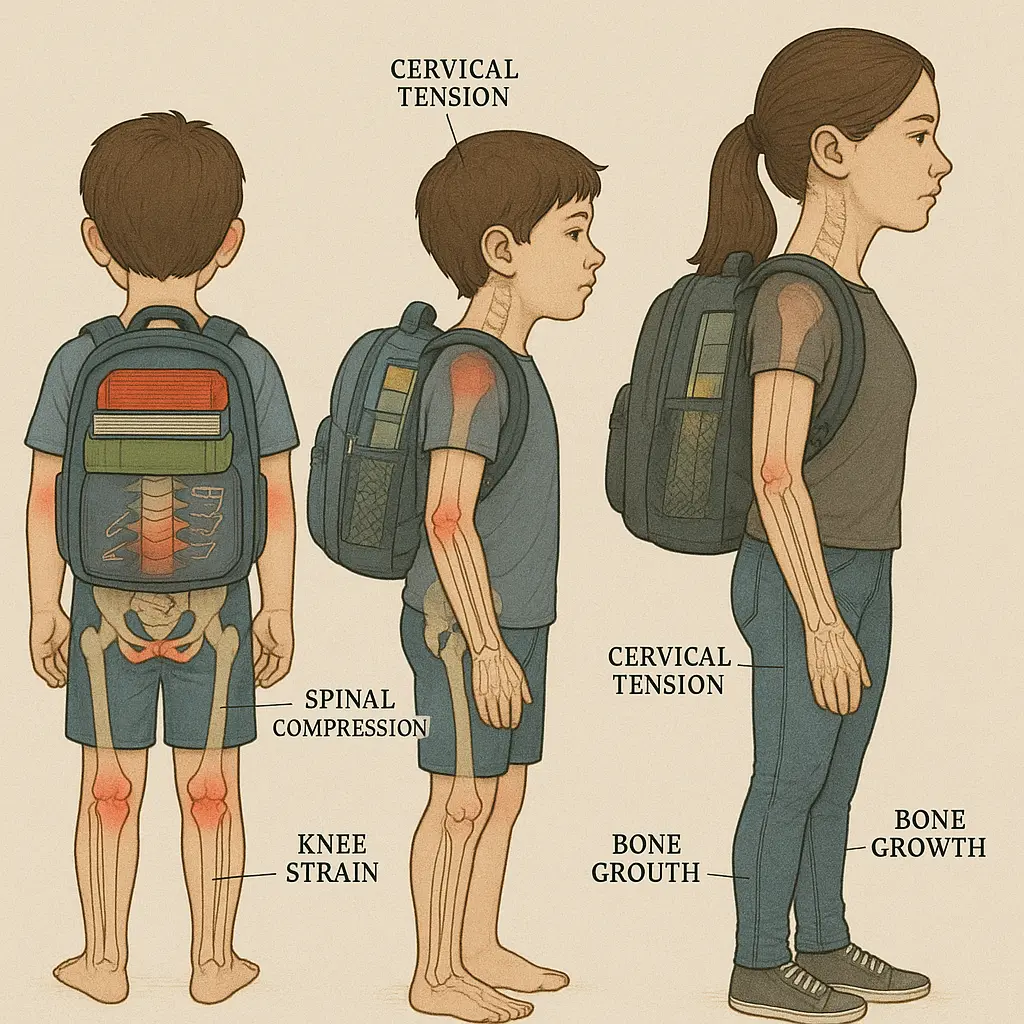
Printed books, lack of organization and resistance to the digital shift
The main culprit is not the notebooks, but the physical textbooks. Despite the existence of digital versions, many schools still require printed volumes due to tradition or publishing contracts.
Lack of lockers, poor planning of daily material and resistance to using digital resources for fear of distraction also play a role.
9 powerful and urgent strategies for reducing school weight
1. Establish a 10 % body weight limit.
Each week, teachers or tutors can weigh backpacks to ensure that they do not exceed 10% of the student’s weight. This promotes awareness and prevents long-term injuries.
2. Leave stationary books at home or in the classroom.
Texts should not travel on a daily basis. One copy can be kept in class and another at home, or used in PDF or ebook format.
3. Use digital platforms with offline access
LMSs allow access to assignments, readings and assessments without the need for constant connection. A single lightweight device can replace several kilos of books.
4. Plan materials according to the daily schedule
Avoid the classic “carry everything just in case” with clear calendars of subjects and materials for each day.
5. Incorporate lockers or shelves in schools.
Starting in the fifth grade, lockers should be standard. They are economical, safe and reduce the average load by up to 40%.
6. Promote lightweight notebooks and eliminate duplicates.
Soft cover or recycled notebooks weigh less without sacrificing quality. Repeated materials (such as duplicate folders) should also be eliminated.
7. Train teachers and families in digital resources.
Digital training is key to overcoming technological resistance. When teachers trust the tools, they use them more and paper is reduced.
8. Audit the weight of backpacks annually
Each school year should begin with a formal backpack check by the student health or welfare department.
9. Promote awareness and ergonomics campaigns.
Brief talks on posture, backpack carrying and strap adjustment help prevent spinal problems.
Benefits of implementing these strategies in 2025
Adopting these measures reduces muscle pain, improves posture, increases comfort and reinforces a positive relationship with the school. It also promotes a modern educational environment, consistent with the digital age.
The future of the school backpack: digital, lightweight and healthy
Modernization is not about filling classrooms with screens, but about using technology intelligently to alleviate the physical burden. The backpacks of the future will be hybrids: lightweight, made from recycled materials and connected to digital content.
Conclusion: a healthy back starts with a light backpack.
In 2025, carrying heavy backpacks is unnecessary and harmful. Technology offers affordable solutions, and student health must be a priority.
Adopting these 9 powerful and urgent strategies does not require large investments, just commitment and organization.
Light backpack, free mind and healthy back: modern education starts by lightening the weight.
What is the ideal weight of a school backpack?
The backpack should not exceed 10-15% of the student’ s body weight. For example, a 30 kg child should not carry more than 3-4.5 kg. This limit helps prevent long-term pain and injury.
Why are heavy backpacks a health risk?
Heavy backpacks put stress on the back, shoulders and neck. If used daily, they can cause low back pain, poor posture, functional scoliosis and muscle fatigue. They also affect school performance by increasing fatigue.
What is the main cause of excess weight in backpacks?
The excess weight is mainly due to the use of printed textbooks that travel every day. Notebooks weigh little, but books can add up to 5-10 kg. The most practical solution is to use digital versions or leave the books fixed at home or in the classroom.
How to reduce the weight of the backpack without affecting learning?
You can keep a light backpack using a mixed model:
Stationary books at home or at school.
Downloadable digital content.
Calendar of materials per day.
Lightweight notebooks and no duplicates.
This ensures complete learning without physical overload.
What measures can schools implement immediately?
Schools can implement simple actions:
Monitor the weight of backpacks on a weekly basis.
Set a limit of 10% of body weight.
Enable lockers or shelves.
Use a single digital platform.
Train teachers and families in educational technology.
What type of backpack is most recommended for students?
The best option is a backpack with two wide straps, lumbar support and waist adjustment. It should fit over both shoulders and adjust to lower back height. Avoid shoulder bags or one-shoulder backpacks.
Do ebooks and digital platforms really help?
Yes, ebooks and LMS (Learning Management Systems) platforms significantly reduce weight, as a single device can contain hundreds of books. In addition, they allow offline access for offline study.
How can families and teachers get involved in keeping backpacks light?
Parents and teachers should coordinate to check the contents of backpacks, respect the schedule of materials and teach organizational and ergonomic habits. With small daily routines, excess weight is avoided.
What if a student is still carrying a heavy backpack?
Chronic overweight bearing can lead to recurrent pain, postural alterations and loss of flexibility. In the long term, persistent low back pain may develop, affecting quality of life in adulthood.
What changes could be implemented by schools for school backpacks in 2025?
In 2025, modern schools may adopt hybrid models: lightweight backpacks, digital materials and organization by timetables. The goal is to achieve a healthier, more practical and sustainable education.
How do teachers adapt assignments to decide whether to leave books at school or at home, and when to use digital materials?
Teachers play a key role in reducing the weight of heavy backpacks.
They generally organize assignments according to three criteria:
1️⃣ Location of books:
(a) If the subject is mainly worked on in class, digital books can be viewed from the laptop and on the digital whiteboard.
b) If review or reading at home is required, the texts can remain fixed at home.
2️⃣ Use of digital materials: when content is available on educational platforms or in PDF format, teachers opt to use digital versions, thus reducing physical weight and promoting interactive learning.
3️⃣ Planned rotation: a weekly calendar is drawn up where each day the necessary materials are defined, avoiding the “take everything just in case”.
In this way, teachers balance the physical and digital load, ensuring that students learn with less weight and more efficiency.
How do you manage the weight of backpacks when students rotate classrooms in middle and high school?
When there is subject rotation, the school should minimize the transport of books. The ideal is to have fixed sets of books per classroom or leave the books at home and use digital versions at school. With this, heavy backpacks are reduced to light notebooks and a device.
Is it better to always leave books in the classroom or always at home?
This mixed model works well: fixed books at home (for study and reading) and digital materials at school (for class and activities). This way there is no “carry and bring” and heavy backpacks are avoided even when students rotate classrooms.
What if there are not enough devices or the Wi-Fi is spotty?
Offline mode: pre-download chapters/resources in the LMS.
Shared carts: tablets or laptops per student for class time.
Local caches/school USB: preloaded material without relying on the Internet.
These actions lower the weight without slowing down learning.
Miami-Dade School Board Facts

Practical summary (for parents) of how to contact and participate before the Miami-Dade School Board:
Where and when
- Location: School Board Administration Building (SBAB), Auditorium, 1450 NE 2nd Ave, Miami, FL 33132.
- Regular meetings: once a month, usually on Wednesdays.
- 11:00 a.m.: Resolutions/Proclamations.
- 1:00 p.m.: Regular meeting.
- ≈6:30 p.m.: Public hearing (may begin at the end of the agenda).
- Live broadcast: WLRN-TV Channel 17 and WLRN-FM 91.3.
- Simulcast and minutes/agendas: (Published Agendas, Web Simulcast, archives and minutes).
How to communicate / sign up to speak
- Citizen Information Center, Room 102 ( 305-995-1128 ).
- Address for correspondence/requests:
Superintendent of Schools
1450 NE 2nd Ave, Room 102, Miami, FL 33132 - E-mail for requesting speaking time (agenda/public hearing): [email protected]
- Deadline: until 4:30 p.m. on the published deadline for each meeting.
- Speaker / public participation form and guidelines: available on the Board’s website ( Citizen Involvement / Board Speaker Form section).
Accessibility (ADA)
- Accommodation requests (5 days in advance): 305-995-7104.
- TDD (hearing impaired): 305-995-2400.
- Contact ADA by email: [email protected].
Agenda, dates and files
- Agenda for each meeting: available from 11:00 a.m. on the date of publication indicated.
- Annual calendar, meeting archives and historical minutes: in the Board portal ( Meeting Schedule, Meeting Archives, Minutes sections).
Key notes
- To appeal decisions, each person is responsible for obtaining a verbatim record of the hearing.
- In extraordinary cases, a Board member may participate and vote for communications technology.
- Prior to 11:00 a.m., public invocation may be held in accordance with Policy 0165.
📰 Stay informed with the latest news!
Would you like to receive more information like this right on your screen? 🌟 Visit our homepage and find out everything that’s happening in South Florida: local news, events, weather, sports and much more.
👉 Click here! newsmiamidade.com/