
Oliver Gilbert and Rule 6.06: How to Silence the Public with Rule 1 or Reasonable Opportunity.“Thank you means your two minutes are up”.
Current Standards on Reasonable Opportunity for the Public to be Heard and Why Respect Them
In Miami-Dade, there is a clear, written and enforced rule that many residents are not aware of… and that some commissioners seem to prefer to ignore.

It’s called “Reasonable Opportunity for the Public to be Heard on Non-Public Hearing Propositions, Rule 6.06.”
And it’s not a favor. It’s a right.
THE LAW EXISTS, BUT NO ONE UNDERSTANDS IT: How Rule 6.06 has become the perfect tool to silence the public in Miami-Dade
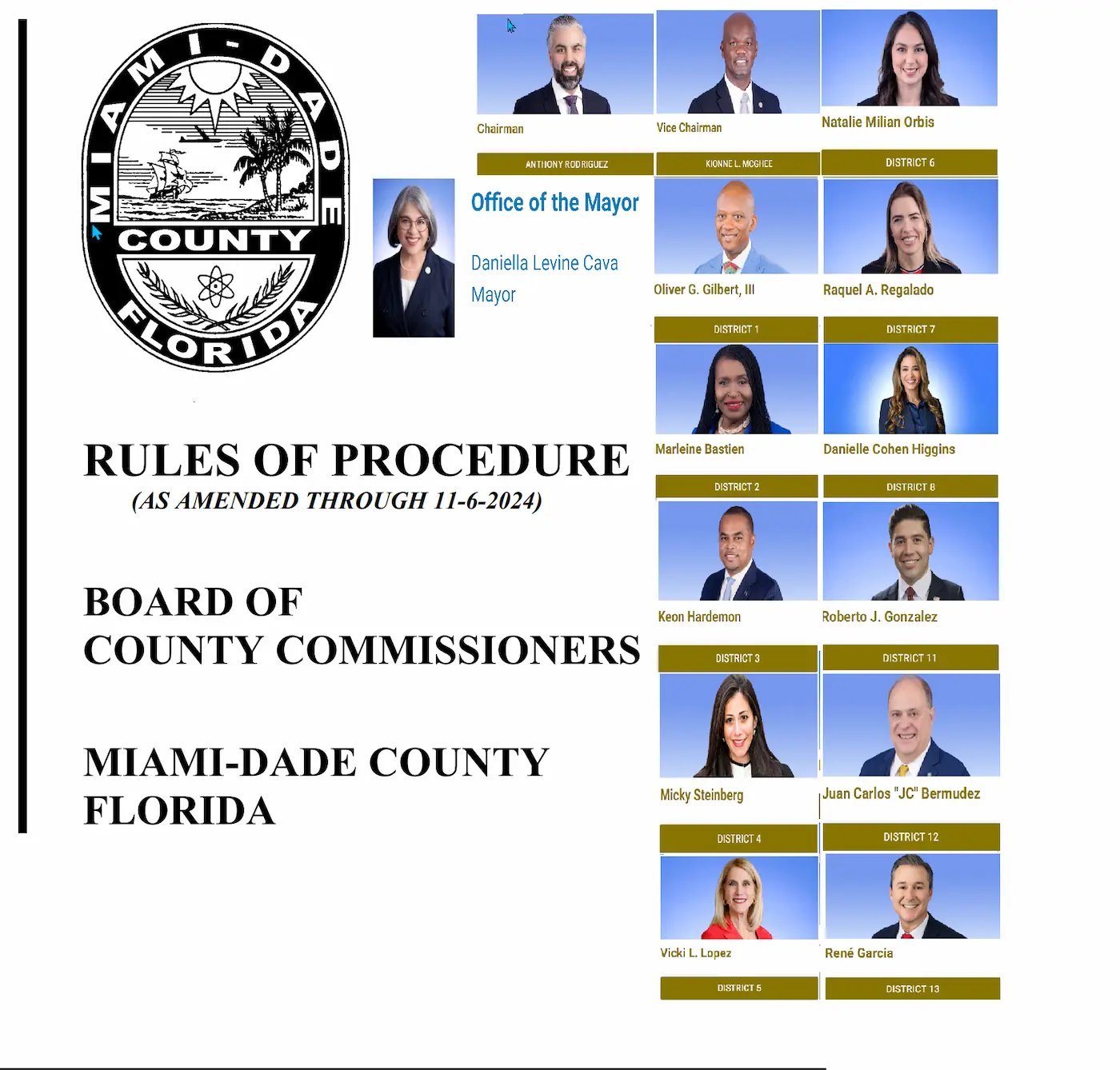
Although some commissioners, such as Oliver G. Gilbert III, Keon Hardemon, and Chairman Anthony Rodriguez himself seem to have doubts or strict interpretations about its application – evidenced by interruptions and thematic restrictions during sessions such as the one on October 9, 2025 – the “Reasonable Opportunity for the Public to be Heard as Provided in Rule 6.06” is a clear and mandatory rule.
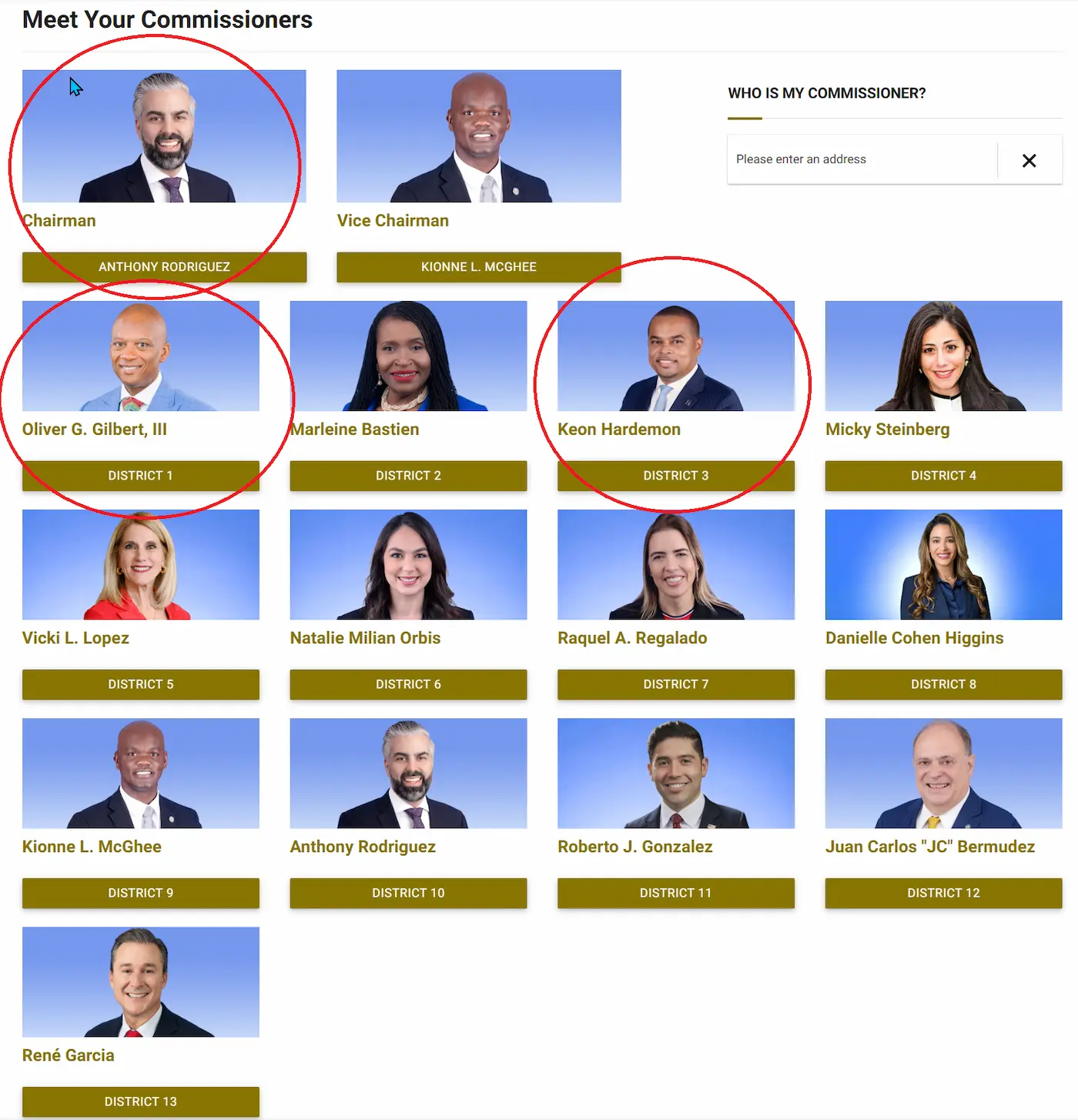
This rule, established in the Rules of Procedure of the Miami-Dade County Board of County Commissioners, guarantees the citizen’s right to participate in the decision-making process. Below, we explain in simple words what it means, what the current rules are, why to abide by them and the consequences of not doing so, based on state and local law.
What does “Reasonable Opportunity for the Public to be Heard as Provided in Rule 6.06” mean?
In simple terms:
The local government (the Miami-Dade Board of Commissioners) must give the public a reasonable opportunity to speak on any proposal or “proposition” that does not require a formal public hearing, before a decision is made. This obligation comes from Florida state law(Statute 286.0114, known as part of the Sunshine Law) and is detailed in the county’s internal Rule 6.06. leg.state.fl.us miamidade.gov
This is not an optional courtesy, but a legal requirement to promote transparency and citizen participation. The “proposition” refers to general substantive policy issues, not to procedural motions or minor details.Current Standards under Rule 6.06Rule 6.06 establishes specific procedures to ensure this opportunity: General Requirement: There must be a time for public comment at regular meetings where a proposition not subject to public hearing is discussed. This occurs before the committee (if applicable) or directly before the full commission.
Registration and Procedure:
- Individuals must register with the Agenda Coordination Office at least by the start time of the meeting (in person or virtually during emergencies).
- A card is completed indicating name, address, the proposition and whether speaking for, against or for information.
- Speakers go to the podium, give their information and have up to 2 minutes per person (no more than 5 minutes total per agenda).
- Total limits: Maximum 10 minutes for proponents and 10 minutes for opponents. If there are more than 5 per side, one representative is elected (up to 4 minutes).
- Waiver option: Without speaking, you can express support or opposition by standing up or going to the podium briefly. miamidade.gov
Decorum and Restrictions:
- Comments should be addressed to the commission as a body, not to individuals.
- Vulgar, obscene, harassing language or personal attacks are prohibited (Rule 6.05). The chairman may interrupt or remove the speaker.
- No interruptions, applause, signs or distracting use of cell phones are allowed. miamidade.gov
When Yes Applies: Prior to the motion to set the agenda or at the discretion of the chair, on propositions such as appropriations (e.g., items 3A7 and 3A9 in the October 9, 2025 session).
Exceptions to the Obligation
The law allows not opening comments in certain cases, in order to avoid unnecessary delays:
Emergencies: If it affects the public health, safety or welfare and requires immediate action.
Ministerial or Routine Actions: Such as approving minutes, ceremonial proclamations, recesses or adjourns.
Sunshine Law Exempt Meetings: Or those with confidentiality (e.g., litigation, personnel).
Quasi-Judicial Proceedings: Such as zoning or permits, if a formal hearing has already been held.
Second Readings of Ordinances: If there was a prior opportunity at the first reading or committee.
Prior or Future Opportunity Propositions: Not repeated if the public has already been heard.
These exceptions do not justify arbitrary restrictions, such as those applied by Gilbert in limiting issues to “the item says what it says,” when the comments touched on agenda-related funding and neglect.
Why Respect These Rules. Respecting Rule 6.06 is essential for several reasons:
- Transparency and Democracy: Florida’s Sunshine Law seeks to make government open, avoiding closed-door decisions. Silencing the public breaks trust and can be perceived as a “power play,” as Theophilus Williams denounced. leg.state.fl.us
- Avoid Legal Challenges: If violated, decisions may be challenged, invalidated, or used in due process claims. For example, Statute 286.0114 allows recovery of attorney’s fees if violation is proven. leg.state.fl.us +1
- Equity: Ensures that voices from marginalized neighborhoods, such as District 2, are heard on critical issues (infrastructure, violence prevention funding). Double standard – unlimited time for industry vs. restrictions for residents – exacerbates inequities.
- Public Benefit: Promotes real solutions, such as CRA audits or transportation for seniors, by incorporating community perspectives.
Some commissioners seem to doubt its scope, interpreting it strictly to avoid criticism(e.g., “it is not of the item” or “they are confused”). However, the rule prevails over other provisions and cannot be suspended, emphasizing its unwavering importance.
Ignoring it not only violates the law, but undermines the principle of “government of the people, by the people and for the people”.
Other Occasions in which Gilbert has Applied Subject Restrictions and the Two-Minute Limit
Throughout his tenure as chairman of the Miami-Dade County Commission, Commissioner Oliver G. Gilbert III has repeatedly invoked rules of procedure to narrow the topics of discussion during public comments, ensuring that speakers stick strictly to the agenda item and avoid personal mentions of elected officials.
These restrictions, which include time limits of one or two minutes per speaker (depending on the type of audience), have been criticized for limiting free speech and silencing critical voices in the community.
One notable example occurred on September 7, 2023, during a budget hearing at the Stephen P. Clark Center. When activist Sharon Shaw criticized Mayor Daniella Levine Cava’s animal shelter policies, Gilbert quickly stepped in to remind her of the county’s rule: comments should be directed at the commission as a whole, not at specific individuals. “We act as a county.
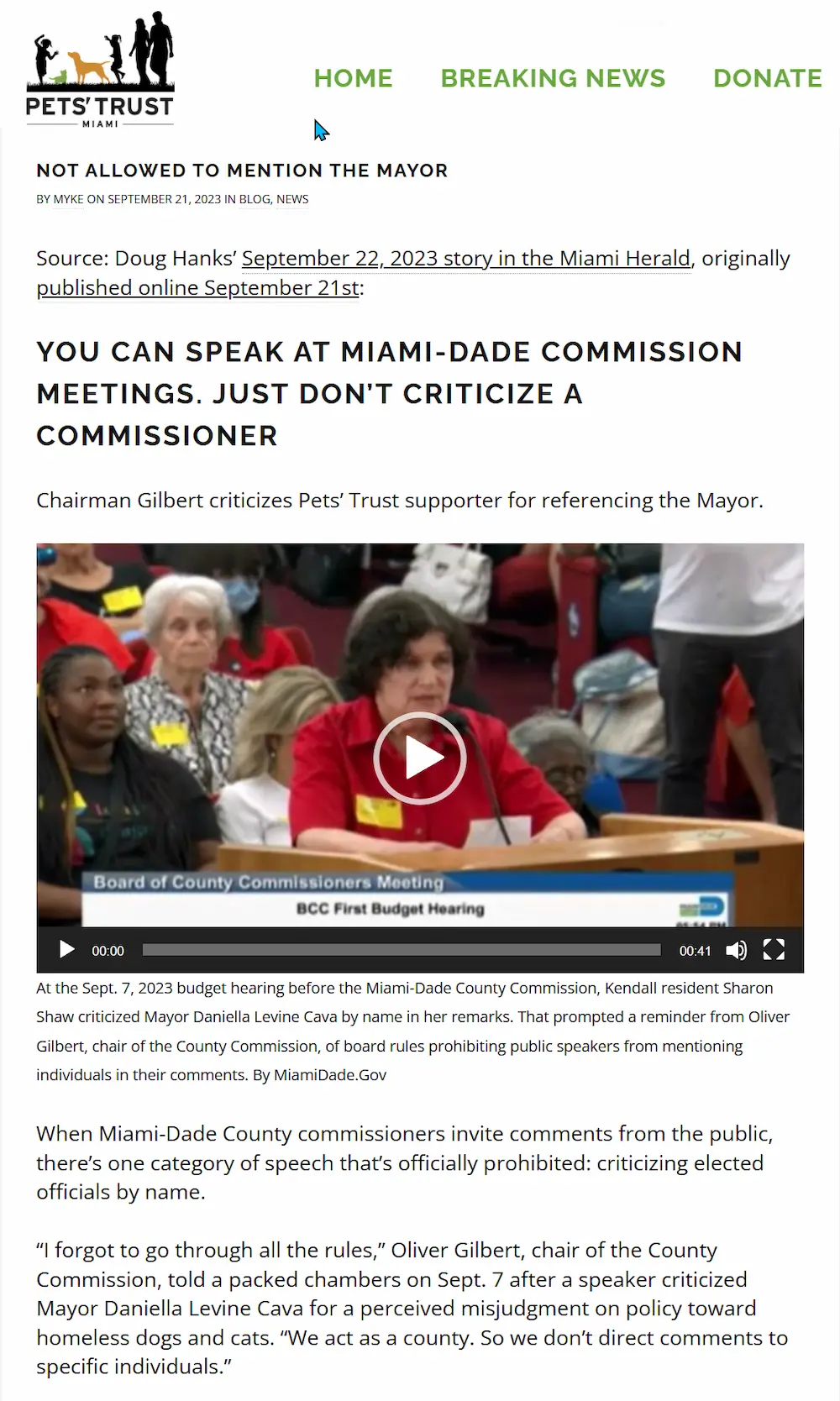
Therefore, we do not direct comments to specific individuals,” Gilbert stated, emphasizing that the rule seeks to maintain order and avoid personal attacks. Shaw, limited to just 60 seconds, described the rule as “undemocratic,” but was not interrupted during her allotted time.
In a subsequent interview, Gilbert defended the restrictions: “It’s not just about criticism…. It’s a matter of decorum.
In previous committees and hearings, Gilbert has applied similar barriers. For instance, in committee meetings prior to 2025, there have been documented instances where speakers were warned or silenced for straying from the topic, such as in debates over bridges in Palmetto Bay in 2022, where then-chairman Jose “Pepe” Diaz (Gilbert’s predecessor) set precedents that Gilbert has continued.
In addition, in committee sessions, the two-minute limit (or less, such as one minute in crowded hearings) has been strictly enforced for residents, while lobbyists and industries such as the port have received extended time without interruption, highlighting an apparent double standard.
These practices are not isolated; they are part of a county decorum policy that prohibits applause, signs and direct mentions of commissioners, in order to “maintain order.” However, critics argue that such rules prioritize efficiency over citizen participation, especially on sensitive issues such as violence, infrastructure and public funds.
As in the case of October 9, 2025, these precedents show a pattern where Gilbert’s“procedural wall” leaves out the reality of the neighborhood, prioritizing technicalities over genuine dialogue.
In Miami-Dade, where infrastructure, innovation and technology discussions should be open spaces for citizens to air concerns about critical issues such as transportation electrification, the reality is often different. Monday, December 8, 2025, at the Infrastructure, Innovation and Technology Committee (IIITC) meeting, chaired by Oliver G. Gilbert, III (District 1), saw a clear example of how the public’s voice is limited.
Gilbert, as chair of the committee that oversees “sustainable growth, responsible service delivery, environmental protection, and innovation and technology initiatives,” abruptly cut off a speaker after her two minutes, even denying her to read “one or two more lines,” even though there were no other speakers waiting.
This practice, common under commissioners Gilbert and Keon Hardemon (District 3), raises questions: is it a rigid rule or a strategy to avoid uncomfortable concerns?
The session, with members Micky Steinberg (District 4), Raquel A. Regalado (District 7) and Danielle Cohen Higgins (District 8) – and a vacant vice chair – addressed items such as zoning amendments, oral reports and additions to the agenda (e.g., 3L, 3M on transportation safety plans).
But the key moment came from Miami-Dade resident Maria Magdalena, who criticized the county’s fleet electrification program. She thanked commissioners such as Roberto J. Gonzalez (District 11) and Natalie Milian Orbis (District 6) for highlighting the issue, and denounced the spending on EVs as a waste of taxpayer money on “climate change programs.” He cited facts such as the propensity of EVs to catch fire, gridlock in hurricanes and a February 2025 Miami Herald article on South Florida’s electric bus fleet. miamiherald.com

According to the report, Miami-Dade and Broward spent $126 million on 117 electric buses and charging stations, but most broke down in less than a year, a national problem exacerbated by the bankruptcy of Proterra, the supplier. reddit.com
Magdalena also cited the U.S. Energy Information Administration’s (EIA) long-term forecast to 2050, stating that EVs “will increase air pollution compared to internal combustion vehicles. However, the EIA’s Annual Energy Outlook 2025 projects the opposite: EVs contribute to reduced CO2 emissions in the transportation sector, although factors such as electricity generation (e.g., if it relies on coal) may influence the overall footprint. There are no direct quotes in AEO 2025 that support a net increase in pollution; on the contrary, it emphasizes transitions to clean energy to maximize environmental benefits. This discrepancy highlights the need to verify claims at public hearings, something that was truncated here.
Gilbert interrupted with “Thank you means your two minutes are up,” and denied extensions, suggesting submitting in writing, “Why don’t you turn it into them and we’ll have it in writing. I’ll read it.” Despite Magdalena’s insistence to “put it into record,” the chair closed the reasonable opportunity to be heard. This occurred without other speakers, violating the spirit of Rule 6.06, which allows “reasonable opportunity” – not a strict limit if there is no time competition. As in past sessions, Gilbert and Hardemon have been criticized for using the “one-minute rule” to silence dissenters, especially on controversial issues such as EVs and budgets.1)
The “Minute Rule”: Strategy or Unnecessary Rigidity?
Gilbert justified the cut with time, but is it logical when there is no queue? The speaker was only asking for “one more sentence” to complete her EIA quote. This custom, representative of Gilbert (who chairs IIITC focused on innovation, but limits discussions on technologies such as EVs), goes against democracy: representatives should listen, not censor.
In July 2025, Magdalena sent a detailed email to Mayor Daniella Levine Cava and the board denouncing these programs; cutting her off now prevents a full dialogue.
The EVs Issue: Facts vs. Myths in the Truncated Debate
The criticism of the electric fleet is valid: the Herald documented massive failures, with inoperative buses and costs in the millions. pressreader.com
Proterra’s bankruptcy exacerbated problems, and similar reports in other cities question reliability. conexionflorida.com
About hurricanes:
EVs can shut down without electricity, and there are risks of flood fires (e.g., lithium batteries). However, the claim of increased pollution ignores EIA projections that see EVs reducing emissions in the long term with cleaner grids. Cutting off debate prevents clarification of these points.
Subsequent Proceedings: Uninterrupted Agendas and Amendments
After closing the public, the committee added items such as 3M (transportation safety plan) and deferrals (e.g., 3J to February 2026).
Discussed amendments, as in 2B for property analysis instead of written reports, prioritizing individual briefings to avoid “public records” of non-owned assets. Moved items to the next BCC, showing internal efficiency but contrasting with rigidity to the public.
This meeting exposes failures in transparency: while the committee advances agendas, it silences citizen voices. Gilbert, with his background in community development, should be fostering dialogues, not cutting them off.
Uncomfortable questions to the County
- Why deny a short extension when there are no other speakers? Is the “one minute rule” flexible in practice, or a barrier to controversial topics such as EVs?
- On the electric fleet: What is the current status of the $126M in buses? How many are operating, and what are the plans for hurricanes or failures?
- For EIA claims: Can management provide the exact quote from AEO 2025 on EVs and contamination, to verify publicly?
We demand more time for the people. Let’s continue to monitor via Granicus and Gilbert’s networks(@OliverGilbert3 on X, no recent posts about this meeting). True innovation includes listening to the public. #MiamiDade #TransparenciaYa.
News Miami Dade
Join us at News Miami Dade and stay on top of everything that’s happening in our county! Find out how politics is moving in Miami-Dade and its cities, the businesses that are in the news, the vibrant cultural world, must-see events, demonstrations against injustices, and much more. We are always at your service to inform you with fresh news, in-depth analysis and exclusive content.
Visit us at:Website: newsmiamidade.com.
Instagram: @miamidadetoday and @newsmiamidade
Facebook: NewsMiamiDade
TikTok: @newsmiamidade305
X (Twitter): @NewsMiamiDade
Send us your ideas or questions to [email protected], [email protected] or via WhatsApp: 7867482386. Subscribe, follow and share! Together, we explore what makes Miami-Dade tick.