


Shocking Reveal 2025: Miami-Dade and its Municipalities Shut Down Transparency with Administrative Burdens and Digital Labyrinths. When the Light of Transparency is Dimmed
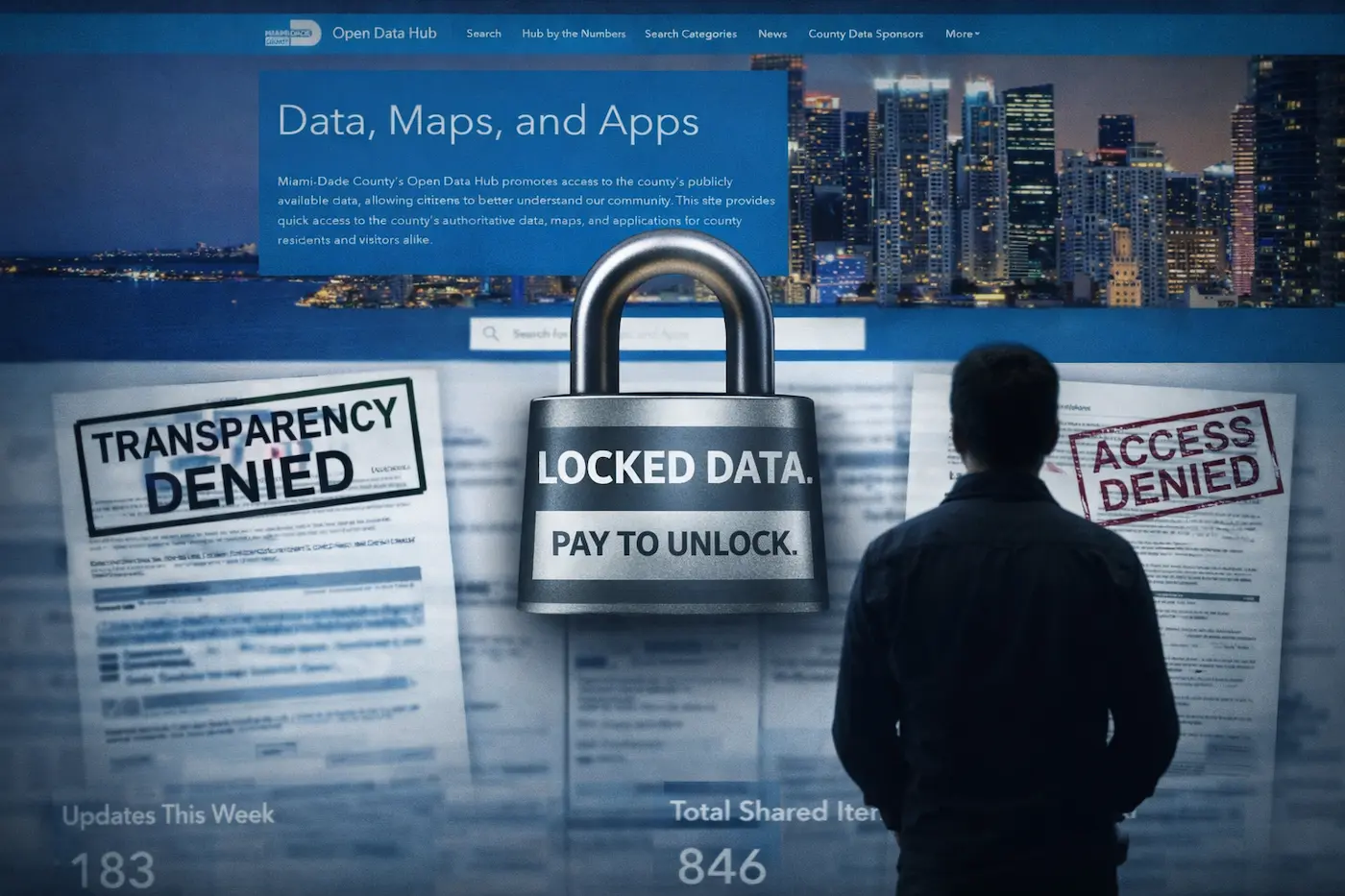
At a time when public information should be accessible at the click of a button, Miami-Dade County and its municipalities seem to have moved away from the transparency that once characterized it. Until a few years ago, citizens could view the salaries of public employees – from gardeners to top officials – on open official portals. But in 2025, that access has morphed into a digital maze where every query has a price tag.
This new reality not only limits access to essential information, but also undermines public trust in a county with more than 38,000 employees and a budget in excess of $12.9 billion. What was once a practice of accountability is now perceived as a privilege reserved for those who can pay for transparency.

From Open Portals to Digital Labyrinths
The Golden Era of Transparency (2015-2019)
During the second half of the last decade, Miami-Dade County’s salary portal represented a national example of open government. Citizens could view annual salaries, bonuses and overtime immediately. The average salary in 2019 hovered around $70,000, a figure that was transparent and verifiable online.
This public access was protected by Florida’s Sunshine Law, one of the most robust public records laws. Its purpose was clear: to ensure that citizens could “inspect and copy” any official document without unnecessary barriers.
The Post-Amendment 10 Decline and the New Constitutional Departments
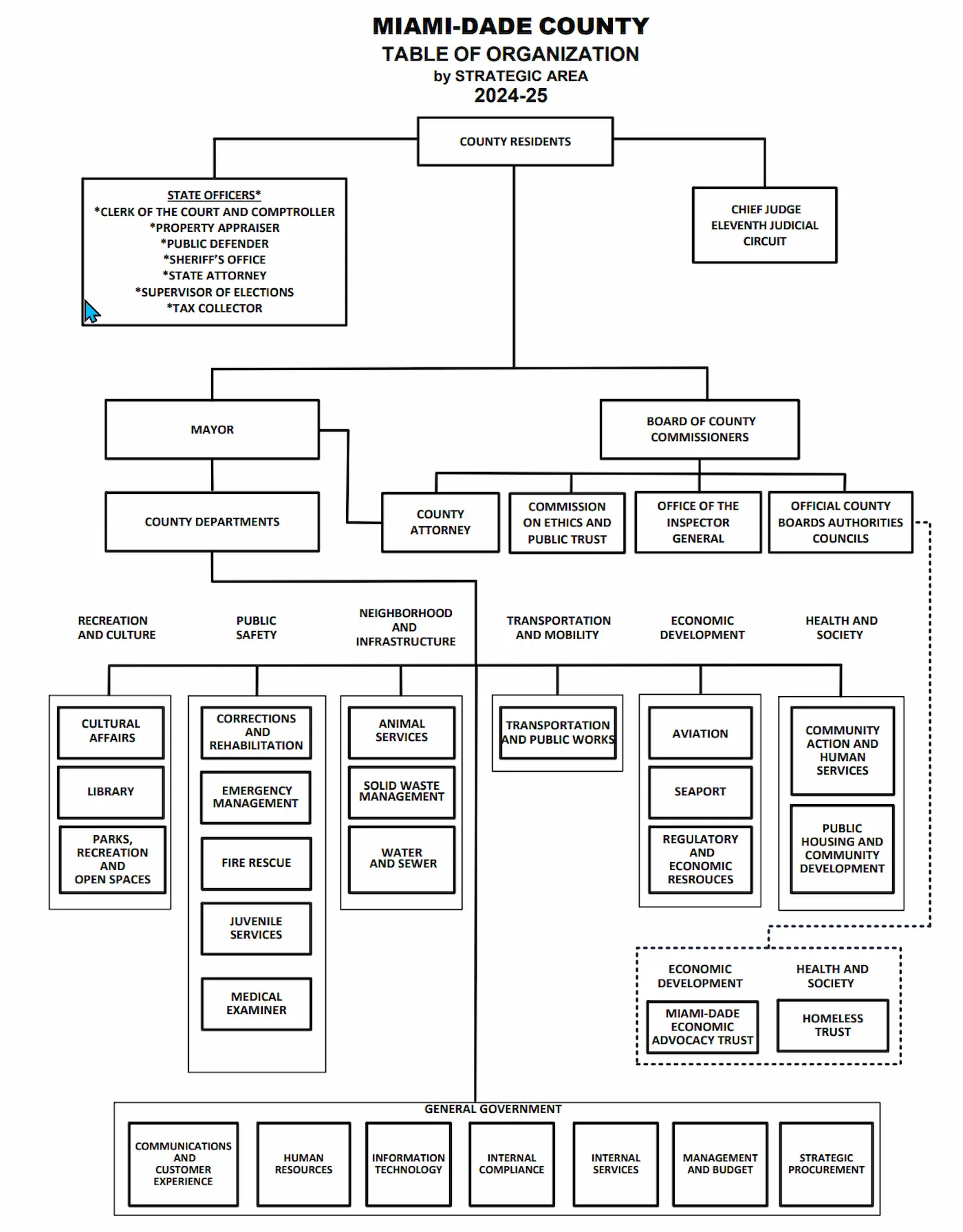
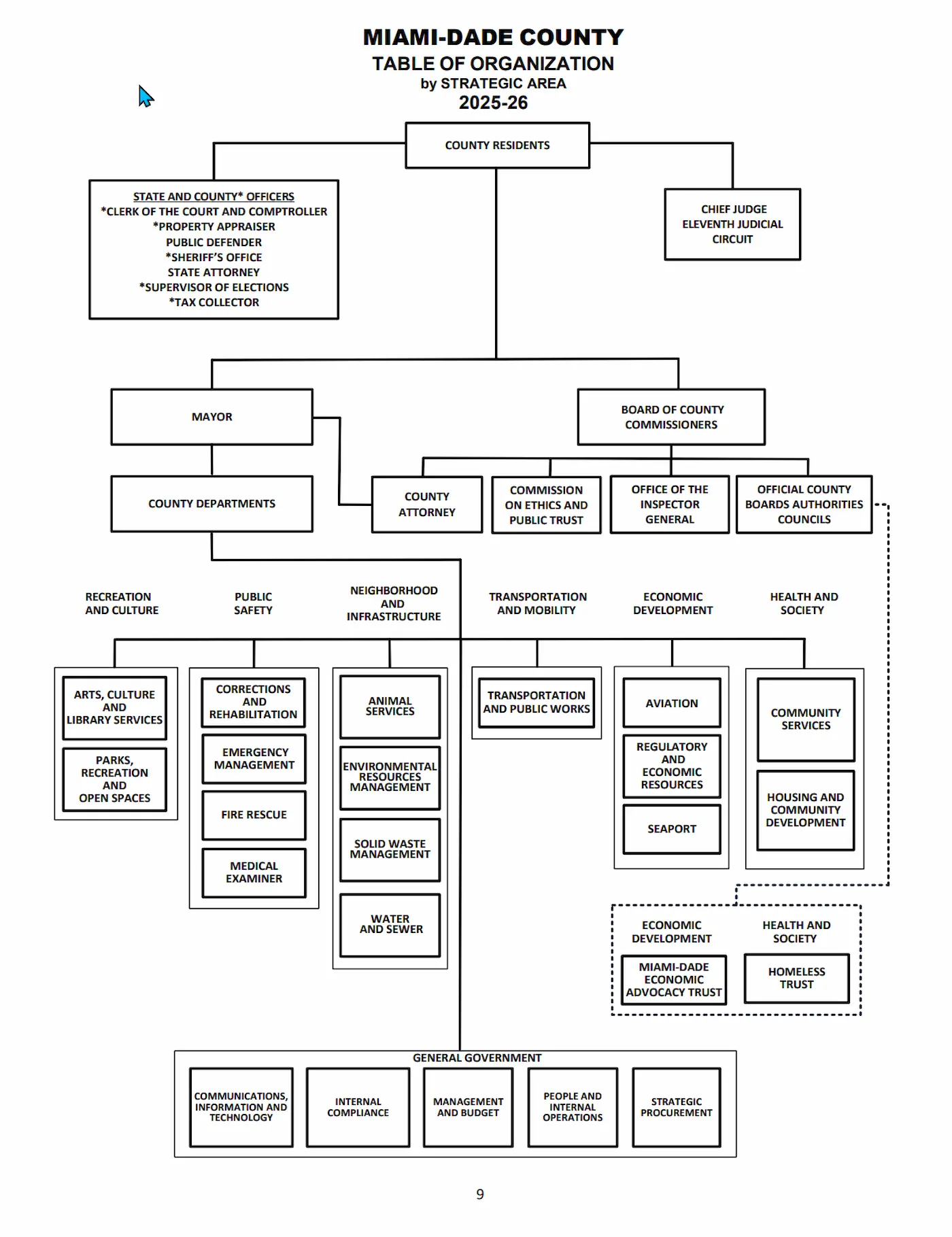
With Amendment 10 of 2018, several county departments – such as Police, Elections or the Sheriff – were transformed into independent constitutional entities. Although the intention was to give them autonomy, the result was the opposite: data dispersion and fragmentation of public access.
Today, requesting salaries from these departments involves separate paperwork, bureaucratic justifications and, in many cases, fees based on “reasonable costs” that are rarely reasonable.
Public Solicitation: The New Business of Fees
In theory, Florida’s public records law (Chapter 119) allows charging for copies or processing time, but in practice, the costs have become a deterrent.
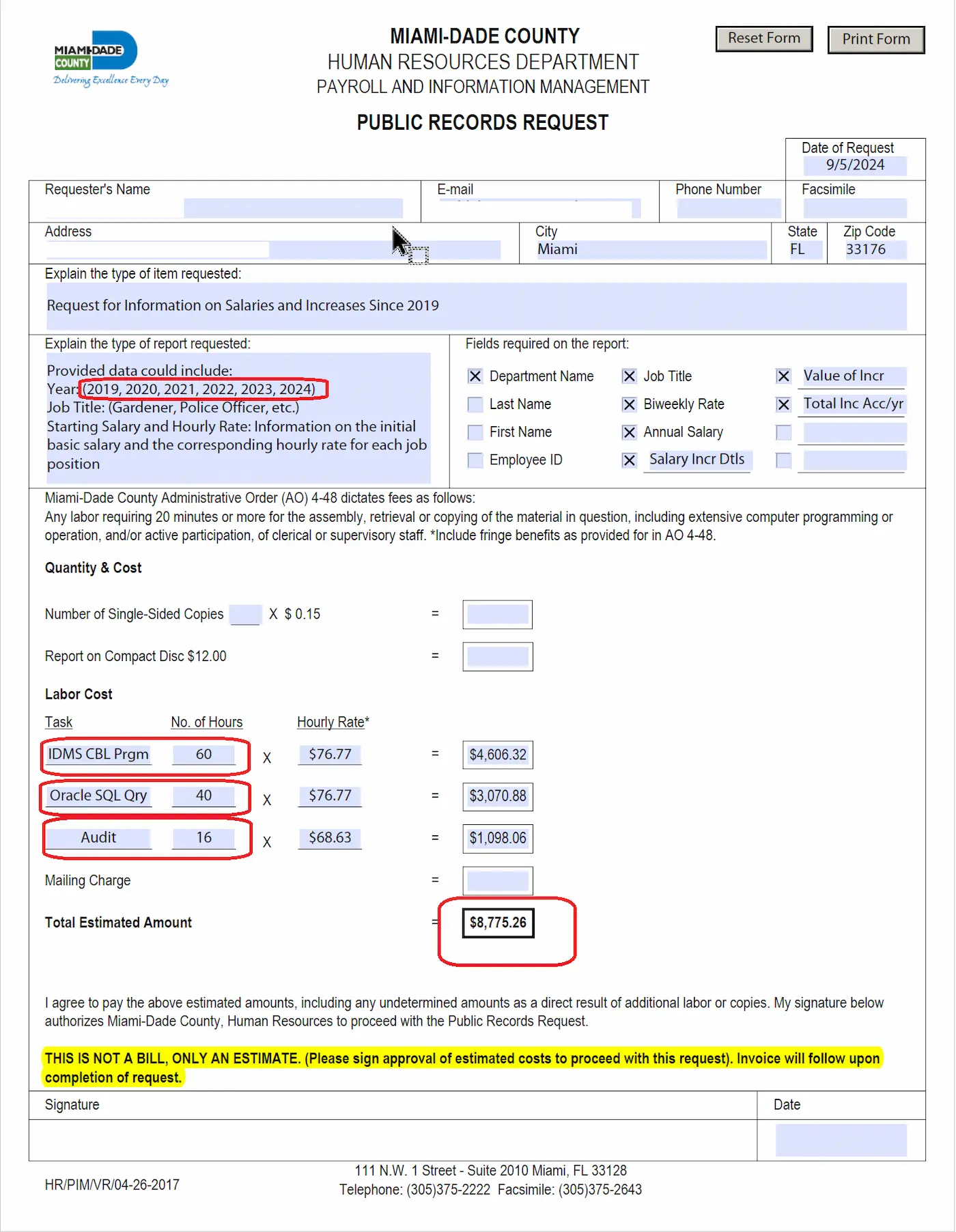
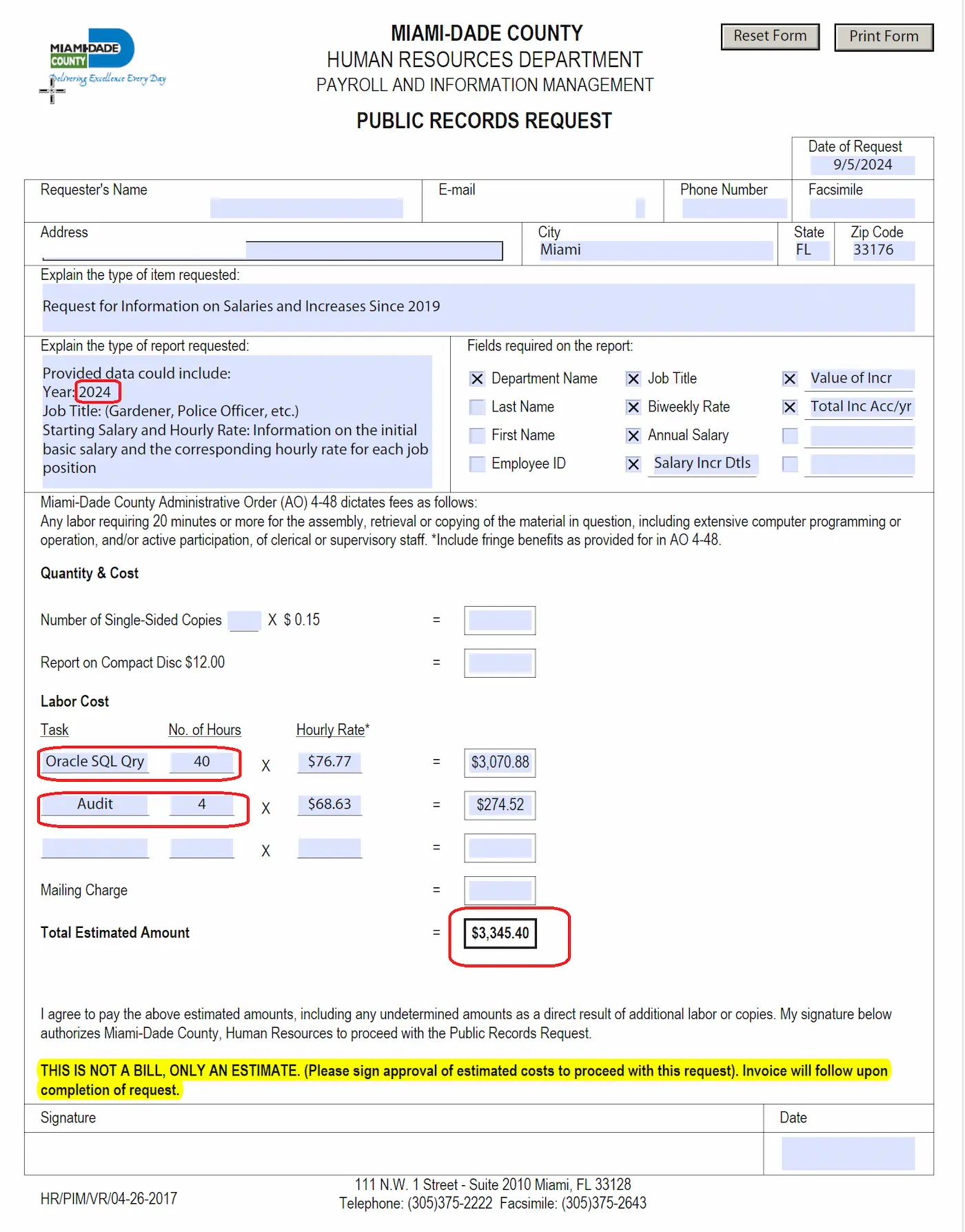
Case in point: a request to access salary data between 2019 and 2024 generated an estimated bill of $8,775.26, reduced to $3,345.40 just by limiting the search to one year.
According to database experts, that same query – a simple SQL statement – should take no more than 10 minutes.
The Price of Knowing: Exorbitant Fees and Dubious Legality
Chapter 119: What the Law Says vs. What Miami-Dade Does
Chapter 119, Florida Statutes authorizes charges for physical copies and extensive staff work, but cautions that these must be “reasonable” and cannot serve as a barrier to access.
However, Miami-Dade appears to have made that exception the rule. Estimates for “extensive labor” include inflated hours of programming or audit review, adding up to thousands of dollars for data that is already public and digital.
(Source: Florida Bar Association)
A Real Case: $8,775 for Public Payroll Data
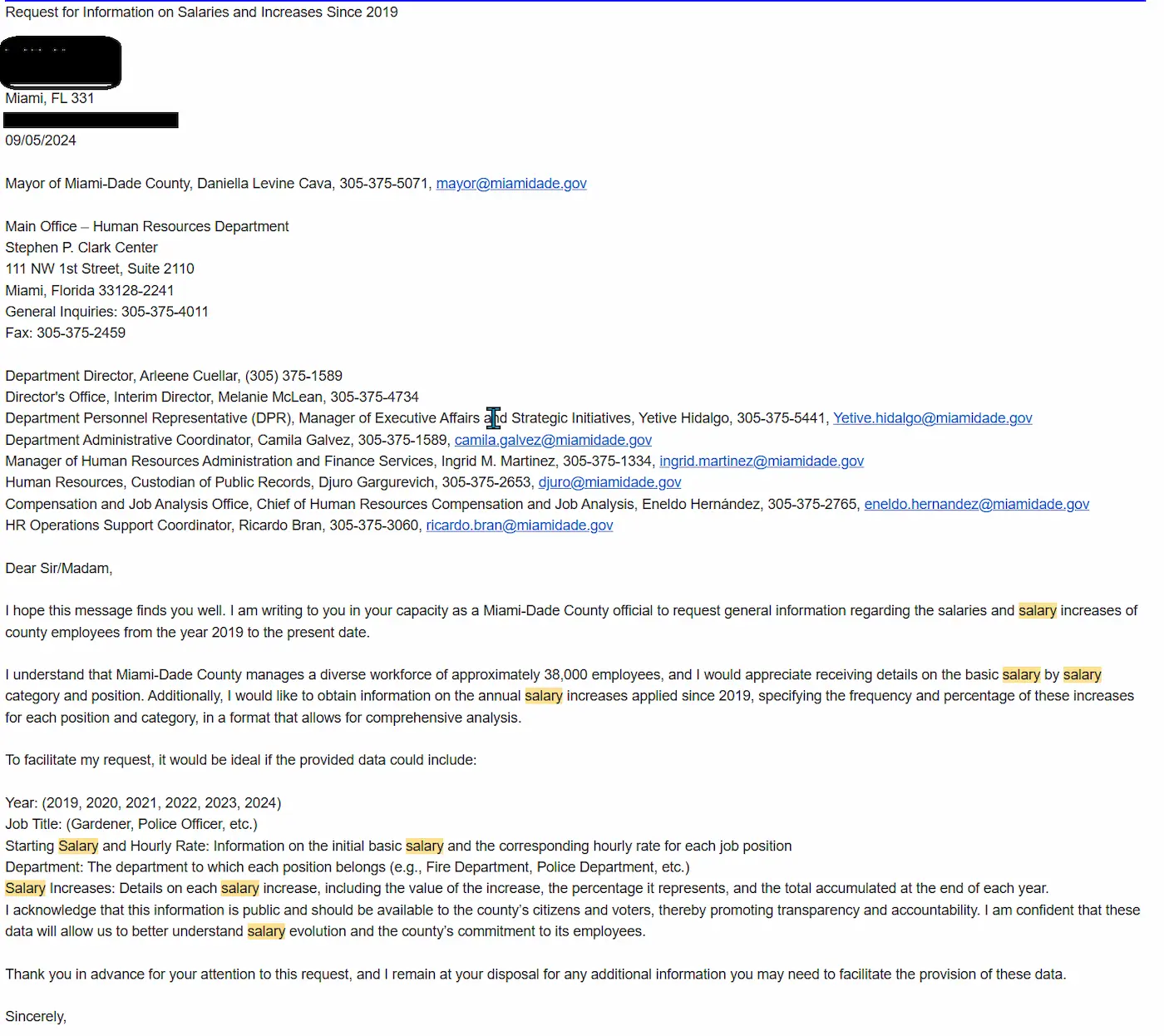
In September 2024, a data analyst requested employee salary records between 2019 and 2024. The response from the Human Resources Department was a preliminary invoice for 100 hours of technical work, with a total cost of $8,775.
Reducing the request to only 2024 lowered the cost, but the figure was still disproportionate.
This not only contradicts the spirit of the Sunshine Law, but represents a modern form of economic censorship.
Objective of the Study: Evaluate Possible Salary Incentives in Electoral Periods.
This study was initiated with the purpose of verifying in an objective and documented manner whether, during the periods prior to and coinciding with re-election processes at the county level, salary increases, extraordinary adjustments or modifications in compensation scales for Miami-Dade County employees occurred that could temporarily coincide with political or electoral interests.
The analysis is not based on an accusation, but on a legitimate question of public interest:
whether salary increases, bonuses, classification adjustments or changes in hourly rates responded exclusively to technical, contractual or inflationary criteria, or whether there was an atypical concentration of salary improvements at politically sensitive times, such as re-election cycles.
Given that Miami-Dade County manages a workforce of approximately 38,000 employees, any across-the-board wage variation has significant fiscal impact and, at the same time, can influence the labor and electoral climate, especially when those employees are also county residents and voters.
Therefore, the detailed collection of salary data from 2019 to date is essential to:
- Identify temporal patterns in increases.
- Determine whether the increases were uniform, staggered or selective.
- Verify if the adjustments were aligned with collective bargaining agreements, inflation or performance evaluations, or if they were concentrated in periods prior to elections.
- Ensure that budgetary decisions were made under responsible management criteria, and not as indirect tools of political influence.
This approach is fully in line with the citizen’s right to oversight, Florida’s Sunshine Law, and the basic principles of transparency and accountability that should govern all public administration.
Shadow Municipalities: Opacity in Miami-Dade County Cities
The “Privacy” Argument as a Political Shield
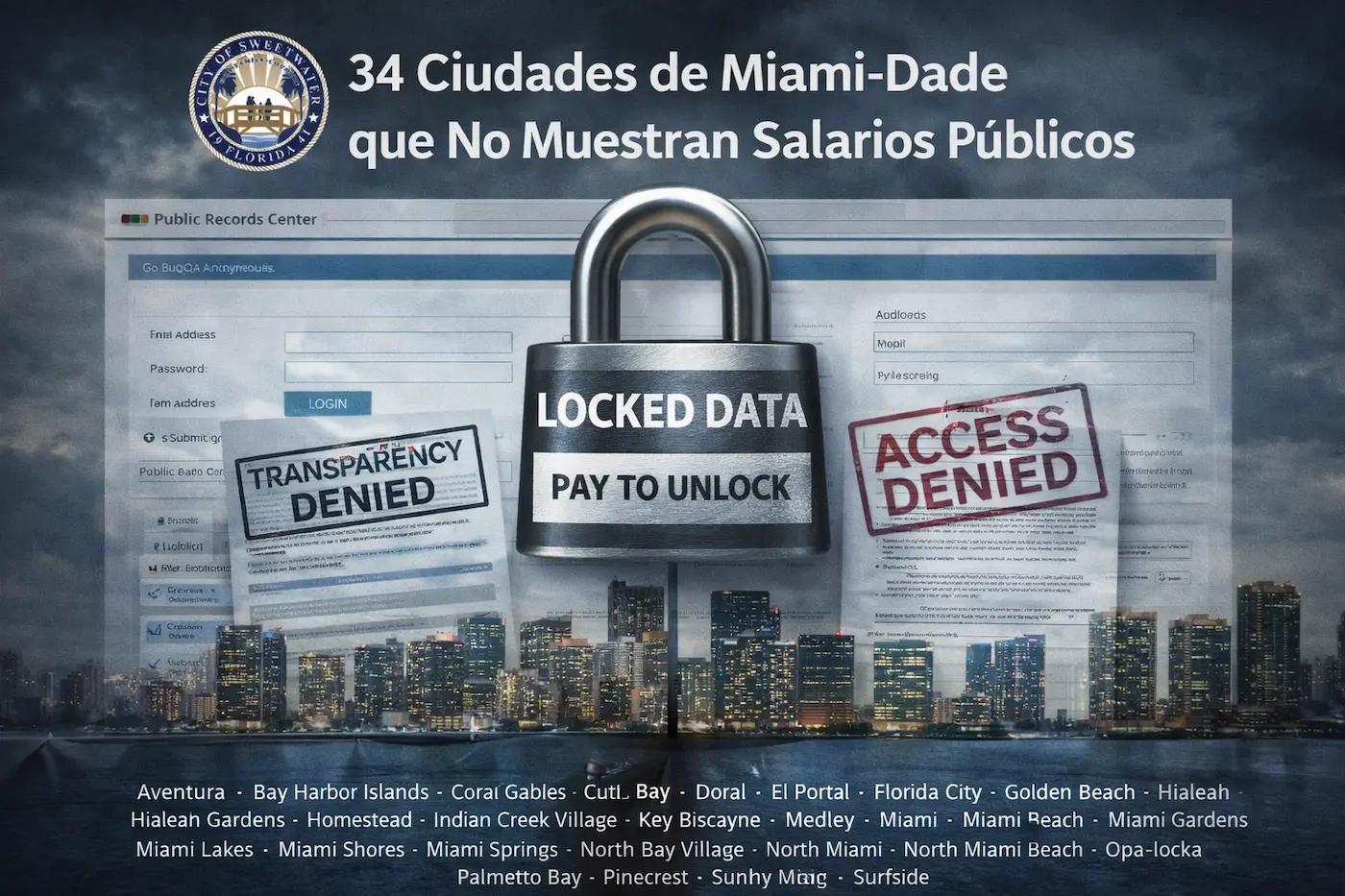
In cities like Miami or Sweetwater, transparency is even more limited. Local administrations argue “privacy protection” to deny requests or charge hundreds of dollars for access to basic data.
Under new job security provisions, public officials can now hide salaries in “sensitive” areas, opening the door to arbitrariness.
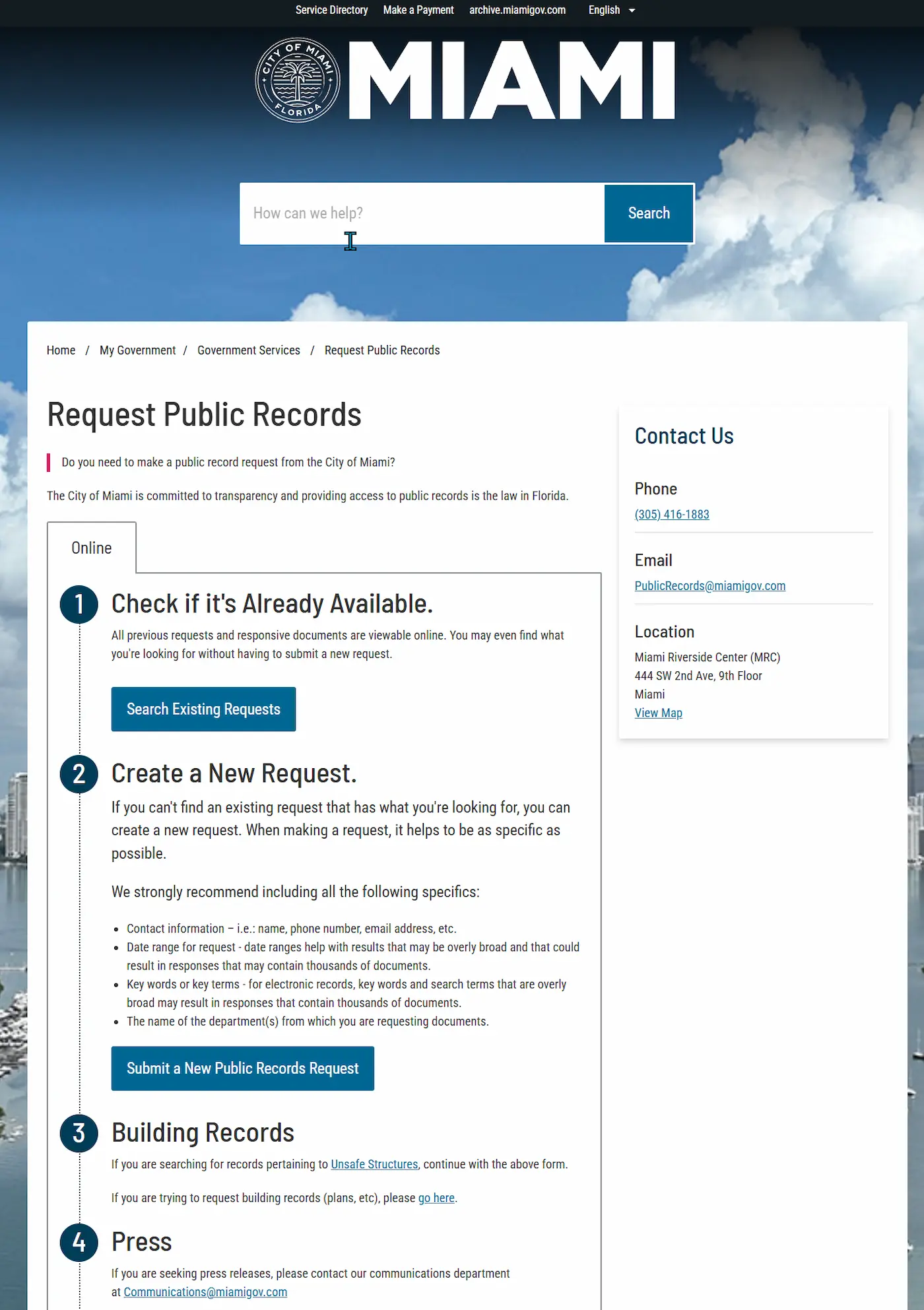
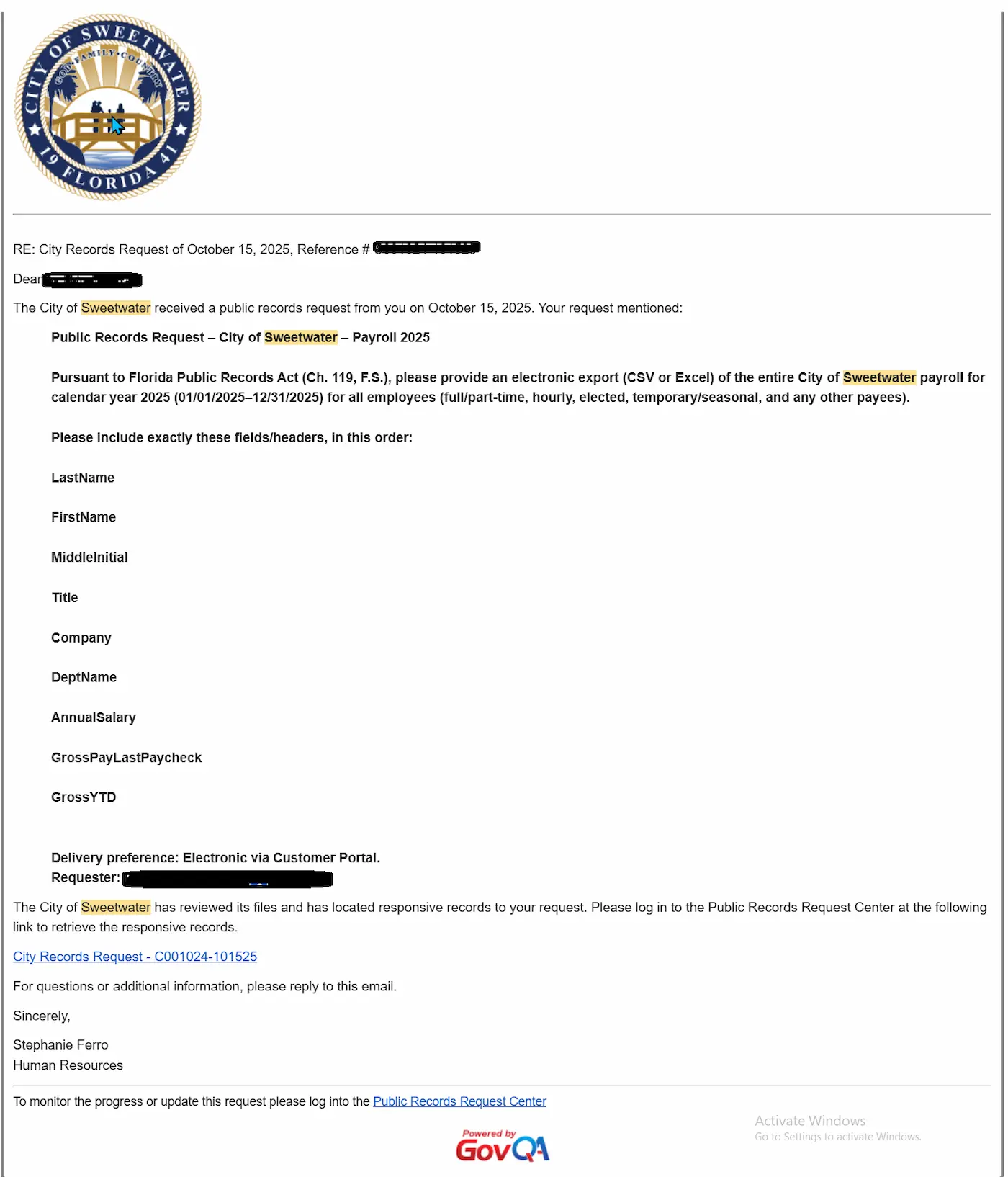
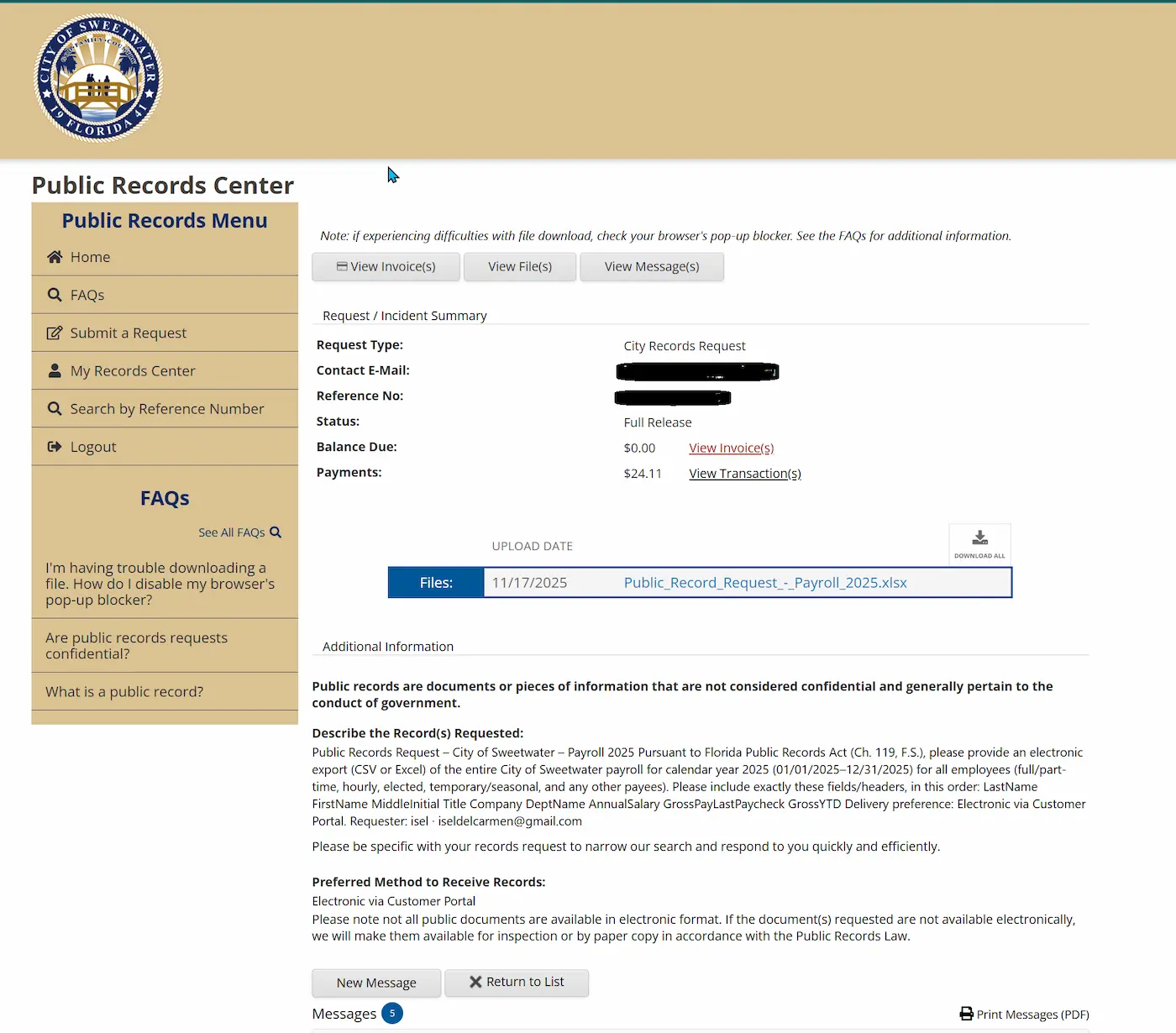
Transparency does not depend on technology, but on political will.
Comparison with New York: Wage Transparency as a Public Interest Standard
While Miami-Dade has fragmented and made access to salary information more expensive, New York City takes a diametrically opposed approach, based explicitly on public interest and accountability.
In New York, municipal salary data is published in an open, free and structured manner, under the principle that citizens have the right to know how the public budget is spent on salaries and overtime of all municipal employees.
What New York publishes openly
The city collects and disseminates data directly from its Personnel Management System (PMS), which is fed by each municipal agency. Each individual record includes, among others, the following fields:
- Agency
- Employee’s first and last name
- Agency start date
- Work location (borough)
- Job Description
- License status at fiscal year-end (June 30)
- Base salary
- Basis of payment (hourly, annual, etc.)
- Regular paid hours
- Regular gross payment
- Overtime worked
- Total paid overtime
- Other compensation (retroactive payments, lump sums, etc.)
This level of detail allows any citizen, journalist or analyst to make an accurate assessment:
- how financial resources are distributed,
- how much of the budget is allocated to overtime,
- which agencies have the highest concentration of labor costs,
- and how wages evolve over time.
Technical transparency and clear warnings
New York not only publishes the data, but explains its limitations in a transparent manner. For example:
- It clarifies that interim salary increases are not reflected; only the final salary at the close of the fiscal year.
- Warns about possible exceptional duplicities due to reissuance of checks.
- Publicly document methodological changes, such as the adjustment applied from fiscal year 2023 to avoid double counting of overtime, especially in uniformed services.
This level of methodological warning demonstrates institutional will for clarity, not concealment.
Exceptions justified and delimited by law
Even in cases where redactions apply, New York does so in a manner:
- specific,
- limited,
- and legally grounded.
For reasons of security and protection of criminal investigations, certain NYPD and District Attorney’s Office data are partially withheld, in accordance with clear provisions of the Access to Information Act. These redactions are identified (e.g., with “XXX”) and are not used as an excuse to block the rest of the system.
The contrast with Miami-Dade
The comparison is inevitable:
- New York publishes as much as possible, explains what it cannot publish and why.
- Miami-Dade, on the other hand, disperses information, eliminates historical portals, and refers the citizen to paid requests, even for data that already exists in digital format.
The result is a model where, in New York, transparency is the rule and exceptions are justified; while in Miami-Dade, access has become an administrative maze that discourages citizen oversight.
The Veil of Corruption: What the Numbers Don’t Show
While the lack of salary transparency is troubling, experts point out that the real corruption in Miami-Dade is not in the visible paychecks, but in the invisible kickbacks that circulate among politicians, contractors and real estate developers. In a county where the construction boom dominates the economy, the line between public power and private interest has become dangerously blurred.
Bribes, Favors and the “Developer Power” Culture
In recent years, there have been multiple documented cases of inspectors and officials accepting bribes to expedite building permits or approve projects with zoning violations. According to reports by CBS News and Miami New Times, this “culture of favor” is sustained by covert political donations and lack of public scrutiny.
Developers – major campaign donors – finance local candidates in exchange for influence in rezoning or public contracts. Meanwhile, the average citizen pays the price in the form of collapsed infrastructure, uncontrollable traffic and increased inequality.
The Promise of Sheriff Rosie Cordero-Stutz
In 2025, newly elected Sheriff Rosie Cordero-Stutz promised to root out institutional corruption and strengthen oversight over public contracts. However, without access to salaries and compensation records, conflicts of interest remain hidden.
The problem lies not only in the officials who steal, but in a system that hides what should be visible, weakening public confidence and facilitating impunity.
Towards Real Transparency: Proposals and Solutions 2025
Unified Portals and Citizen Audits
A viable solution would be the creation of a single, centralized portal that integrates data from all county constitutional departments. This system would allow for open searches, free downloads and automatic updates, following successful models such as openpayrolls.com or New York’s data portal.
In addition, citizens could participate in collaborative audits, reviewing expenditures, salaries and contracts in real time. Participatory transparency not only prevents corruption, but also empowers the voter.
Clear Legal Limits to Access Fees
Florida Chapter 119 needs an update that sets strict limits on administrative costs. No county should be able to charge thousands of dollars for existing digital records.
An exemplary model would be California, where “reasonable costs” are defined by law and audited annually by civilian agencies.
Another measure proposed by transparency organizations is the obligation to publish quarterly reports of all access requests received, detailing costs, response times and reasons for denial. This would hold the departments themselves accountable for their level of openness.
Public Accessibility and “Hidden” or Limited Data
- Public and Open: The entire portal is free and accessible without registration. The data is “as is” with disclaimer of accuracy (e.g., approximate areas), but there are no paywalls or restrictions on use (open license for reuse). This complies with the county’s open data policy, which excludes legally protected data (e.g. sensitive personal information under HIPAA for health or FERPA for education). gis-mdc.opendata.arcgis.com +2
- Hidden or Limited Data: Although public, the portal “hides” relevant information through aggregation or exclusion for privacy.
- Examples:
- Privacy: Health data (e.g. “Mental Health”) is aggregated by zone to avoid individual identification, hiding granular details that could be useful for residents in specific areas. merlcenter.org +2
- Limited Update: Some datasets (e.g. 2000 demographics) are outdated, hiding recent trends. Forum critics point out that sensitive data such as detailed building permits require additional requests, not always on the portal. facebook.com +1
- Partial Transparency: In audits (e.g. 2022 permits), it is noted that raw data is protected, limiting in-depth analysis. Generally, open data portals like this one face criticism for not including everything (e.g. detailed financial data), forcing paid requests under Sunshine Law.
- Potential Hiding: In contexts like SDGs (Sustainable Development Goals), these portals limit data by aggregation, hiding local inequalities (e.g. pollution by specific neighborhood vs. general county). escholarship.org For residents, this means that critical data like detailed environmental violations could require manual crosswalks or extra requests.
In summary, the portal is a valuable and public resource with 650+ datasets in 17 categories, but its limitations in detail and updating “hide” relevant insights, promoting partial rather than full transparency. For more granular data, consider direct requests to the county.
High percentage of outdated data: Analysis of the GIS-MDC Open Data portal.
GIS-MDC Open Data is Miami-Dade’s official open data showcase, built on ArcGIS Hub. It is public and free, allows downloading in CSV, KML, GeoJSON and shapefile, and does not require registration, aligning with the county’s transparency policy. However, its practical value for citizens is limited by the age of many datasets, excessive aggregation and lack of synchronization with operational sources (permits, inspections, etc.). gis-mdc.opendata.arcgis.com
What it does bring today:
Free access to hundreds of layers and tables (search by topics such as Property, Transportation, Public Safety, Environment). The county’s own gallery and services pages lead to this hub. gis-mdc.opendata.arcgis.com
- Query applications (e.g. Employee Salary Search) and viewers such as Land Information Viewer, integrated with the county’s GIS ecosystem. gis-mdc.opendata.arcgis.com
Where it fails for accountability:
- Vintage data (thematic outdatedness): demographic sets from 1990, 2000 and 2010 abound. Although some pages show “updated” recently (due to metadata maintenance), the content is still decades old, obscuring key recent trends for planning and equity. Examples: Tract Pop 2000, Block Group Pop 2010, Block 2000, and even TIGER 1990 layers. gis-mdc.opendata.arcgis.com.
- Aggregation/privacy that dilutes analysis: in sensitive topics (health, safety), layers are often published aggregated or as “document links”, reducing spatial detail and forcing citizens to make additional requests to view raw data. Miami-Dade County
- Uneven coverage and synchronization: while layers such as Parcel/Property and Channel are kept visible, not all operational flow (e.g., permits with detailed attributes) is available in downloadable and up-to-date form for citizen audits. gis-mdc.opendata.arcgis.com
Why it matters for transparency 2025:
If the portal publishes mostly old or aggregated series, citizen monitoring on current impacts (gentrification, rezoning, pollution by neighborhood, road safety, 311 effectiveness) becomes incomplete. Although 311 service and property datasets exist, temporal desynchronization prevents detecting recent patterns (e.g., hotspots of violations or correlation with rezonings). gis-mdc.opendata.arcgis.com
Specific recommendations:
- Update schedule per dataset (target frequency and last actual ingestion) visible on each tab. gis-mdc.opendata.arcgis.com
- Clear labeling of “vintage” (data reference year vs. portal update date) and alerts when the vintage exceeds X years. gis-mdc.opendata.arcgis.com
- Publication of operational statements (permits, inspections, penalties) with a minimum retention of 24-48 hours between source system and portal, except for legal exceptions. Miami-Dade County
- Openness KPIs: percentage of datasets with “vintage ≤ 2 years”, average latency rate and number of layers with raw download enabled. Publish these KPIs on the Transparency & Open Data page. Miami-Dade County
Operational conclusion:
GIS-MDC Open Data is a good starting point (free and without registration), but the age of much content and aggregation limit its power for public scrutiny in 2025. The solution requires not more technology, but data governance: freshness goals, greater granularity where the law allows, and public metrics of portal performance. gis-mdc.opendata.arcgis.com
Frequently Asked Questions (FAQs)
1. What is the Florida Sunshine Law?
It is a state law that guarantees public access to government records and meetings. Its purpose is to prevent corruption through absolute transparency in public management.
2. Why is it now so difficult to access public salaries in Miami-Dade?
Since 2024, several departments became constitutionally independent, fragmenting the data system. In addition, local governments started charging “extensive labor” fees that are not always justifiable.
3. Is it legal to charge thousands of dollars for digital records?
Only if the cost reflects actual technical work. However, many experts argue that the current charges violate the spirit of the Sunshine Law, as they act as barriers to entry.
4. What can a citizen do if he/she receives an excessive budget for a public request?
You may appeal to the Florida Public Records Ombudsman or file a formal complaint in court. There are precedents where judges have ordered to reduce or eliminate fees considered abusive.
5. How does this lack of transparency affect local corruption?
Without accessible public data, it is more difficult to detect irregularities, favoritism or conflicts of interest. Administrative obscurity becomes fertile ground for abuse of power.
6. What proposals are being discussed to improve transparency in 2025?
Among the ideas are the creation of a unified portal, the free digitization of public records, and the imposition of legal caps on administrative costs. All seek to restore the basic principle: public information should be free and accessible.
Recovering the Light in the County of Shadows
Miami-Dade is at a critical juncture. Transparency, once a symbol of civic pride, has become an expensive transaction, reserved for those who can afford it. However, the solution does not require technological miracles, but political will, clear regulation and citizen oversight.
Access to public information is not a luxury: it is a democratic right. If the county aspires to fight corruption, rebuild trust and protect the integrity of its institutions, it must reopen its data, without fees or obstacles.
Only when the light once again shines on payrolls, contracts and decisions will Miami-Dade be able to say that it truly serves the public and not the powers that be.
🔗 Recommended external sources:
- Florida Sunshine Law – Chapter 119
- The Florida Bar – Public Records Guidelines
- WLRN News – Miami-Dade Transparency Reports
- OpenPayrolls – Public Salary Data
- Miami New Times – Investigations into local corruption
Want more news like this?
Visit our homepage to stay up to date on the latest happenings in South Florida and beyond:
Stay informed with the latest news!